Inspiration
The alarm always starts the same way. A cell you've been quietly draining for energy — some beautiful, impossible thing turning behind reinforced glass — finds a neighbour exactly like itself. Two fields touch. They resonate. And the breach you set in motion three calm decisions ago tears down half your Site.
I kept circling one question that most management games never ask. They ask can you hold it? I wanted to ask something harder: where do you put it?
I grew up on the SCP Foundation — that vast, collaborative universe of catalogued anomalies and clinical "containment procedures" — and on the management games that quietly turned dead time into spreadsheets I loved: Fallout Shelter, Lobotomy Corporation, Clash of Clans. Each proved a piece. None had been fused into something mobile-first, social, and spatial. When Meta announced Horizon's pivot to synchronous social games on mobile, the missing piece clicked into place: a containment game where your layout is a living puzzle you build alone — and then share with, and weaponise against, the entire world.
What it does
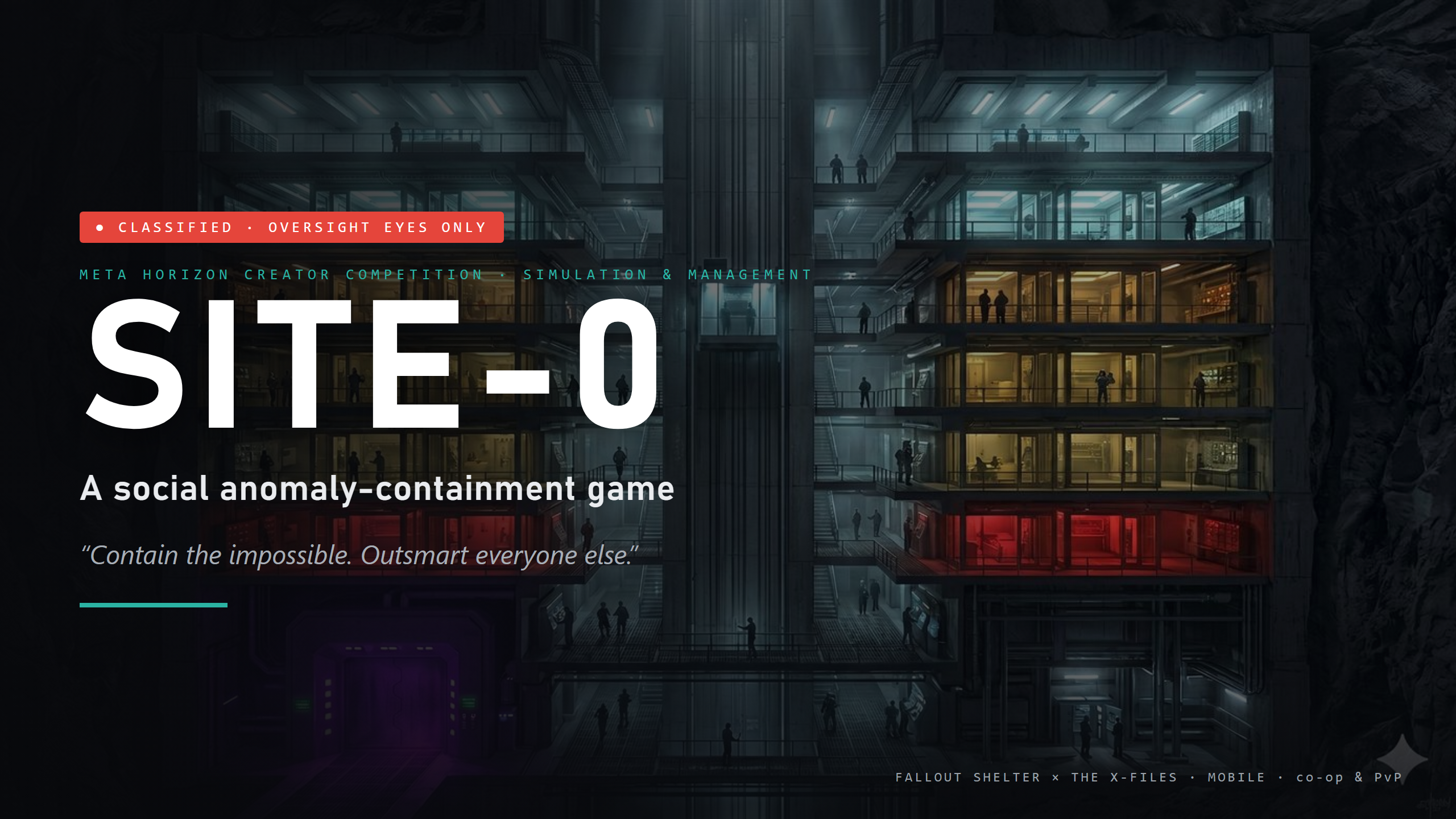
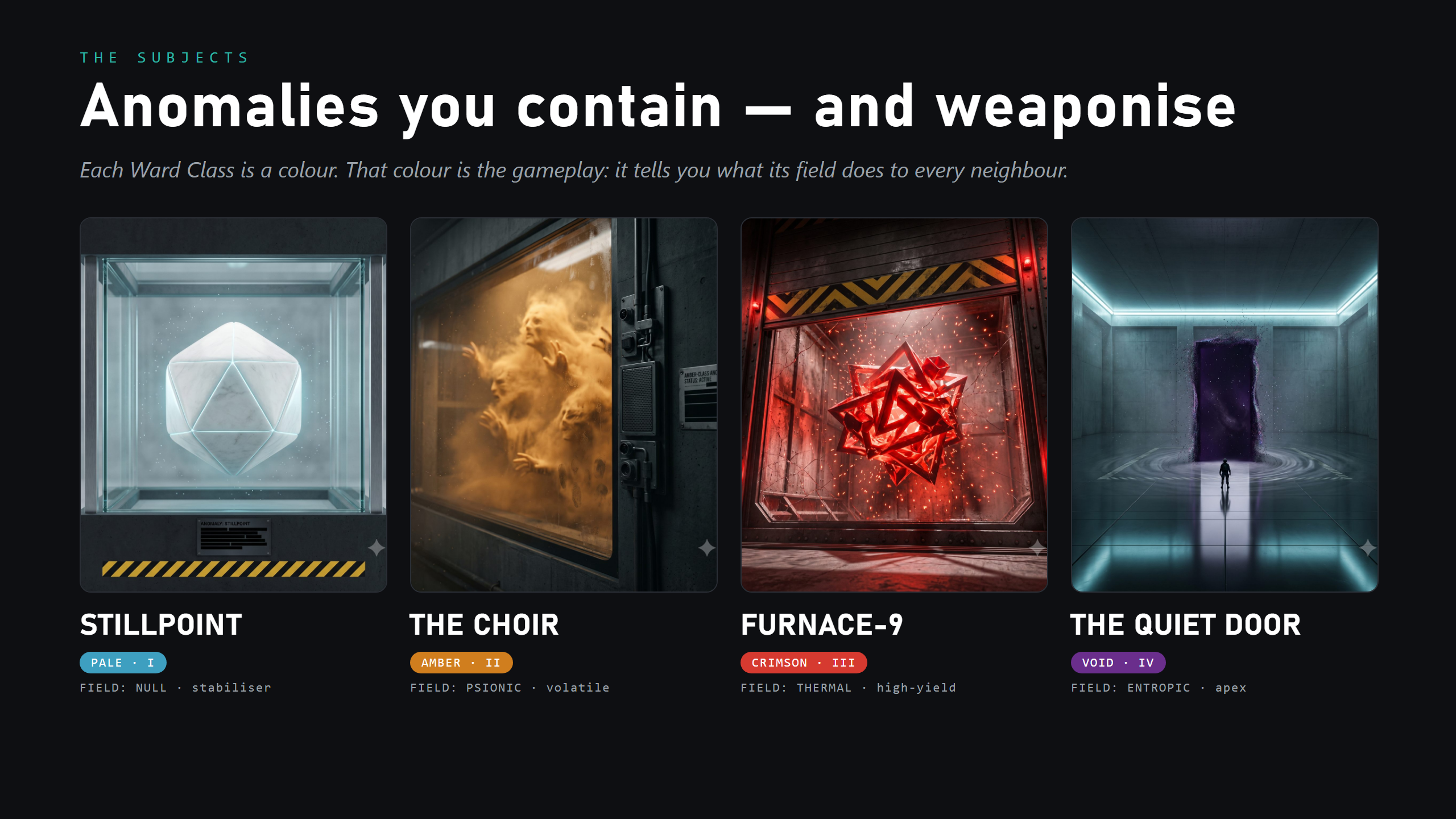
SITE-0 is a social anomaly-containment management game. You are the Director of a secret underground Site, and your job is to capture reality-bending anomalies — "Subjects" — and hold them on a grid that is anything but static.
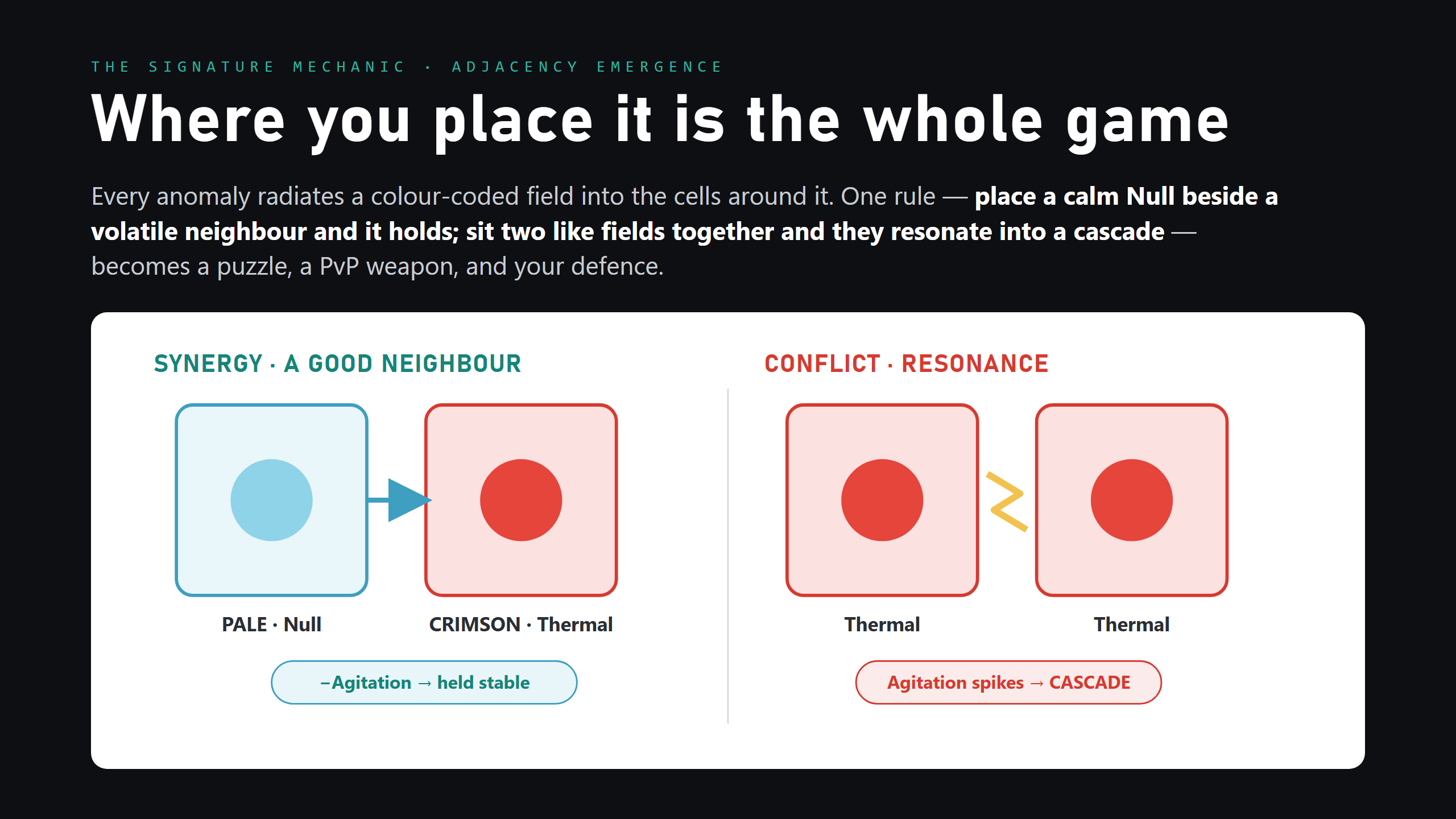
The living grid is the whole game. Every contained Subject radiates a colour-coded field into the cells around it. A calm Pale / Null field soothes a volatile neighbour and holds it stable; place two volatile Crimson / Thermal Subjects side by side and their fields resonate into a cascading breach. Colour isn't decoration — colour is the rules.
You grow by exploiting what you contain, and that is the central tension of the entire economy:
Exploit ↑ → Energy / Data ↑ — but Agitation ↑ → Containment Integrity ↓ → Breach risk ↑.
Smart adjacency (a Null neighbour, a dampener pylon) is how you push that throttle harder than anyone else dares. Researchers, Wardens and Operatives staff the Site; an Oversight authority sets quotas; and each cycle you file a Redacted Report, choosing what to disclose (for funding) versus bury (for autonomy — at the cost of rising Suspicion that paints a target on your back).
And you are not alone. SITE-0 is one of many agencies — real players — across a shared world:
- Convergence (co-op): a world anomaly erupts and players join in real time to contain a massive shared breach, pooling staff and fields.
- Incursions (PvP): scout a rival's grid, spot an adjacency weakness, and provoke their breach yourself — siphoning resources or poaching a Subject. Structured like Clash of Clans (leagues, shields, partial losses) so it's competitive fun, not griefing.
The result is one mechanic that plays as three games: your adjacency mastery is a puzzle (your own layout), a weapon (reading an enemy's grid), and a defence (building a sabotage-proof Site).
How I built it
This is a pre-production package, so I worked document-first. I started by locking a single source-of-truth concept, then derived all four deliverables from it — which is how the Game Design Document, Player Journey Map, Visual Concept Package and Production Plan stay perfectly coherent in language, systems and art direction.
- Design partner: Claude (Opus 4.8) — concept generation, systems design, rubric-aligned critique, and the entire documentation/typesetting system.
- Visual concept art: an AI image generator, used with curated, art-directed prompts (a fixed palette and a "clinical-wonder" style spine) rather than freeform generation, so the anomalies, staff and environments share one identity.
- The dossier pipeline: a dependency-free HTML/CSS/SVG → PDF toolchain (rendered with headless Edge) that turns Markdown into a branded "redacted dossier." The UI wireframes, palette and system diagrams are hand-built SVG so the art literally serves the gameplay.
- Target platform: Meta Horizon Worlds (Horizon Studio + TypeScript), whose native multiplayer makes the co-op and PvP layers an engine feature rather than a bolt-on.
Challenges I ran into
- Honouring SCP without infringing it. The fix: build an original universe (own org, own anomalies, own lore) that openly credits SCP as its primary inspiration — shippable, legally clean, and still true to the genre its fans love.
- Making "colour = rules" instantly readable on a small phone screen — solved by binding every Ward Class to one hue that drives its cell, its field glow and its UI, with icons + values for colour-blind play.
- A PvP that's competitive but not toxic. "Provoke a rival's breach" is a thrilling idea that can turn into griefing; the answer was the Clash-of-Clans-proven toolkit — leagues, shields, cooldowns, and losses that are always recoverable.
- Innovation and validation. I wanted a genuinely new core on top of loops that are already proven at scale, so feasibility never reads as a gamble.
Accomplishments that I'm proud of
- One mechanic, three games. Adjacency Emergence works as puzzle, weapon and defence — depth that compounds across every mode.
- A theme that justifies its own social layer. Containment is the rare fantasy where co-op and PvP both make total sense.
- A single, coherent visual identity — the "classified dossier" — running through all four artifacts, from the cover to the wireframes.
- A package built for Meta's actual strategy: mobile-first, synchronous-social, broad and shareable.
What I learned
- The strongest innovation lives in the system, not the set-dressing. "Where you place it" is a deeper idea than any single piece of art.
- Coherence is something you engineer. A single source of truth made four documents feel like one game.
- Design for the platform's direction, not just the genre. Aligning with Horizon's social-mobile pivot turned a solid sim into a strategic fit.
What's next for SITE-0
- P0 — Prototype (greybox): build the adjacency rules engine with no art and answer the only question that matters first — is placement an interesting decision?
- P1 — Vertical Slice: the first 15 minutes, instrumented against the Journey Map ("aha" under 10 minutes, D1 return > 40%).
- P2 — Solo Alpha → P3 — Async Social → P4 — Sync Social + Soft Launch: layer the world on a complete solo game, then prove co-op and PvP, then scale.
- Longer term: clans, seasonal world-events, and a UGC Anomaly Designer so players create and share their own Subjects — the ultimate content engine for a UGC platform.
Built With
- claude
- css
- gemini
- html
- meta-horizon-worlds
- node.js
- svg
- typescript


Log in or sign up for Devpost to join the conversation.