Team Members:
- Jennifer Mendoza
- Ben Slater
- Julian Kwan
- John Barberiz
The Idea:
- To create an office chair that will promote a healthy lifestyle in your work environment by promoting movement
Purpose (the Why):
Why: Sitting at your desk in the same position for too long can cause strain in your body. It’s also common for people to become distracted and/or stressed while at work
What makes this different: Although other products are similar that can be used to raise you to a different height or pivot your chair, the difference with the Sitand is that is connected to you through different channels. This connection allows for you to become more mindful of your work environment and self.
- This connection can be achieved through different tools like a Muse (to track your brain waves – EEG, Alpha), FitBit (to track your heart rate for instances when you get too stressed), or a desktop app that measures your productivity to the chair)
What will the chair do: Based on the signals transmitted from your smart device (eg/Muse, Fitbit, even your phone) and a set time of 45 minutes the chair will move to remind you to move out of your chair and to stand up or sit down. However, if the chair recognizes that you are "in the zone" the movement functionalities can be turned off to avoid distractions.
X Axis: Pivot the Seat of the Chair Purpose: when a person is standing with the chair the person can use the seat as a leaning mechanism to redistribute the weight/force away from your body to reduce the strain
Y Axis: Raise the chair from a sitting position to a standing position Purpose: Promoting a change of position
Technology Implemented:
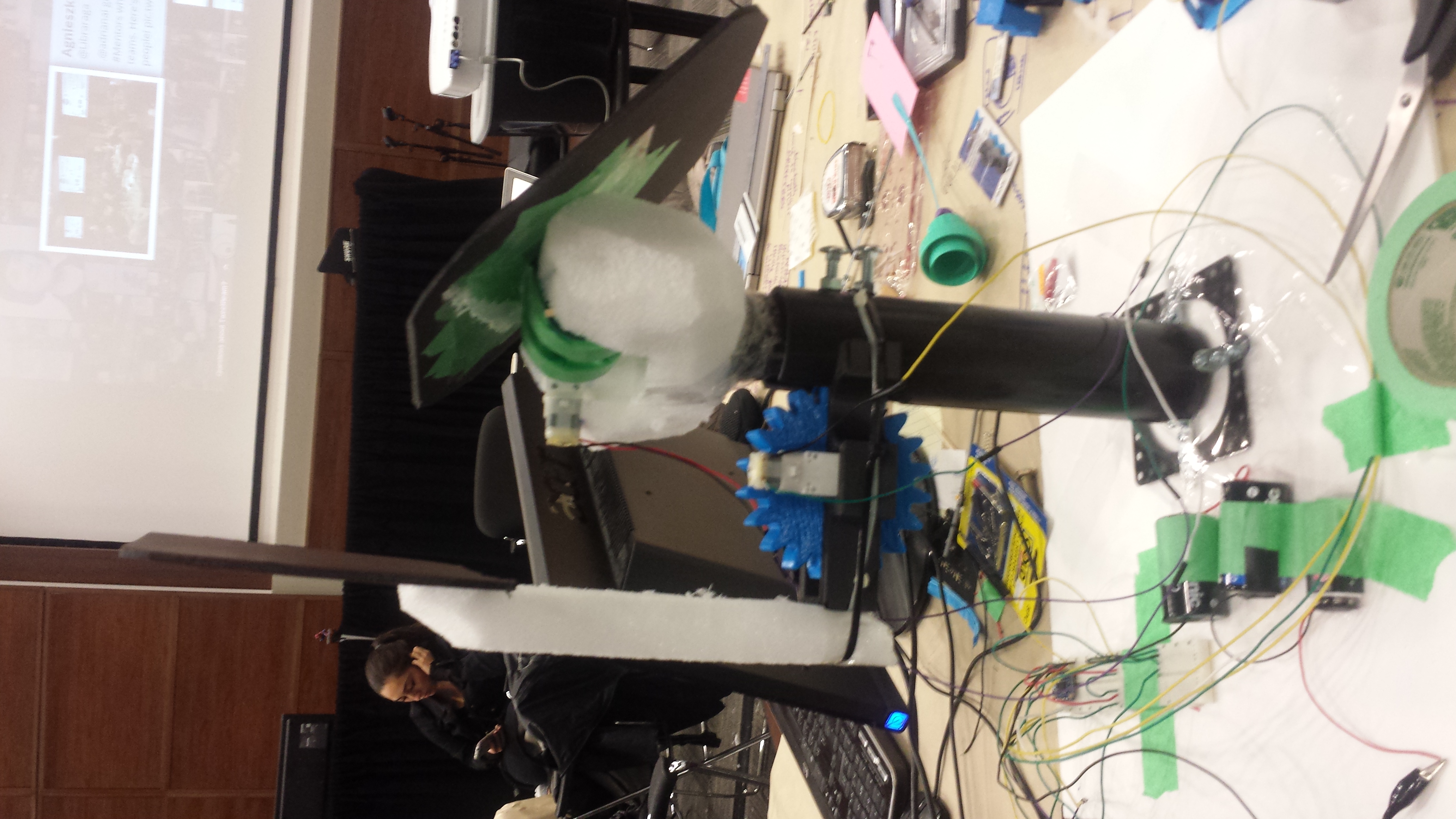
3D Printer: Created: Rack and Pinion, Cog, Gear and Applicable Housing Purpose: raise and lower the chair
Sensors to detect movement along two axes X and Y (X pivot, Y raise)
Raspberry Pi
- Host programming for motor drivers
- Create wireless connections between the smart device and chair
Muse (mindful movement tool):
- To extract brain waves primarily the Alpha, Beta, Delta waves.
- Connecting the Muse to MuseLabs (a tool to read brainwaves data). MuseLabs was to identify moments when an individual is distracted from work and stressed in those situations the chair will send the appropriate signals
Challenges:
Mechanical
- Scaling of 3D printed parts made building final design difficult
- We had many mechanical components which made getting everything working seamlessly together tough
Technical
- Bluetooth and Wifi Connections to the RaspberrPi
- Muse: connectivity issues between Muse and Mac’s Bluetooth and issues converting a recordings (.muse) to readable (.csv) file to analyse the data as Terminal wouldn’t directly register Muse files in the terminal
Logistical
- Troubleshooting the size of the 3D Printing
- Scaling the size of our initial mode

Log in or sign up for Devpost to join the conversation.