Inspiration
Most of us spend a lot of time sitting and waiting: at the gate before a flight, on a train, or in a waiting room. I wanted a game for those moments, one you can start in seconds, play for a few minutes, and finish feeling relaxed. I grew up on arcade light-gun games, and I wanted that same quick, physical fun with nothing in my hands. SINGULARITY 2100 is built to relieve stress. You smash, slice and blast whole crowds of robots with your bare hands.
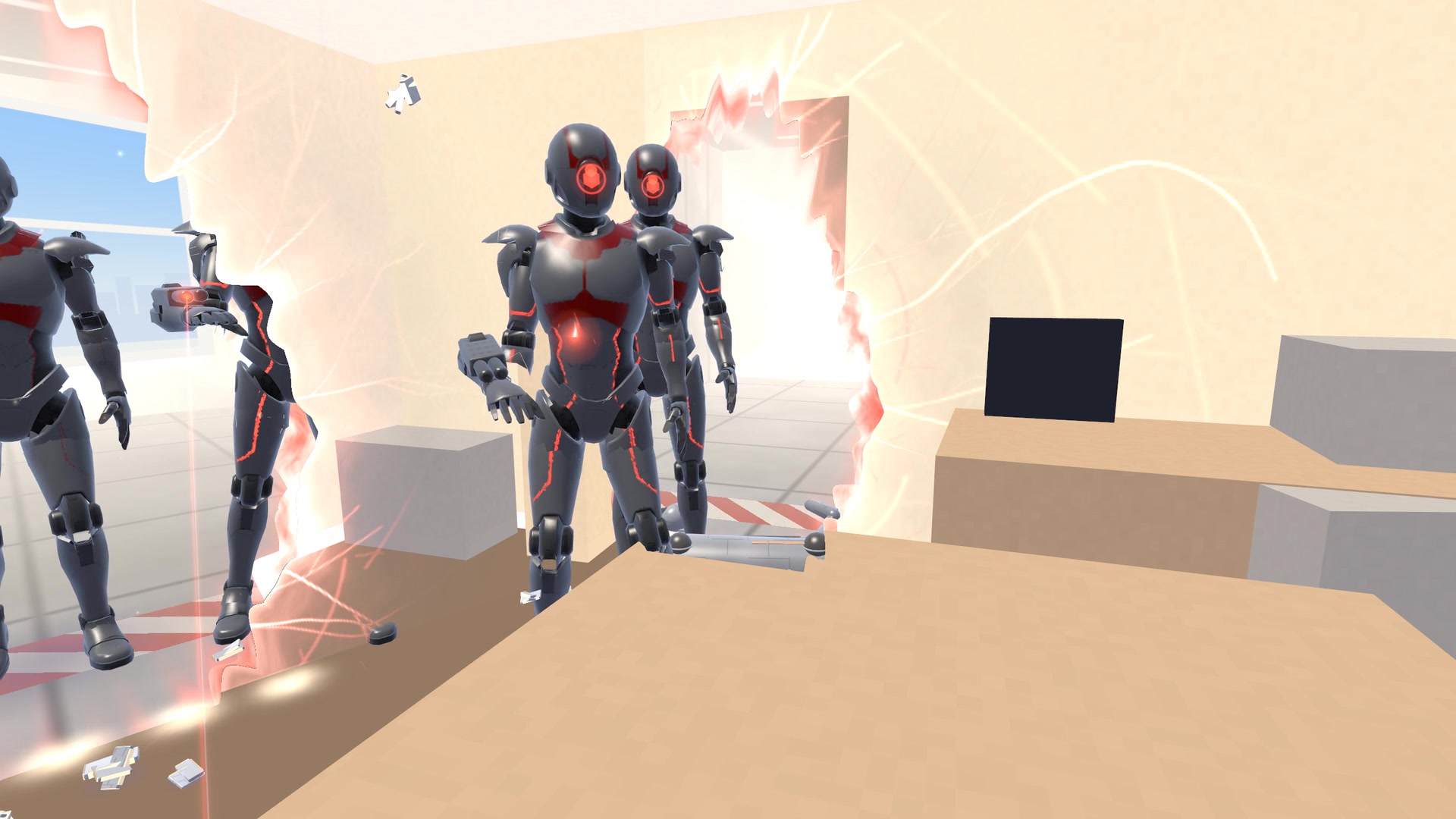
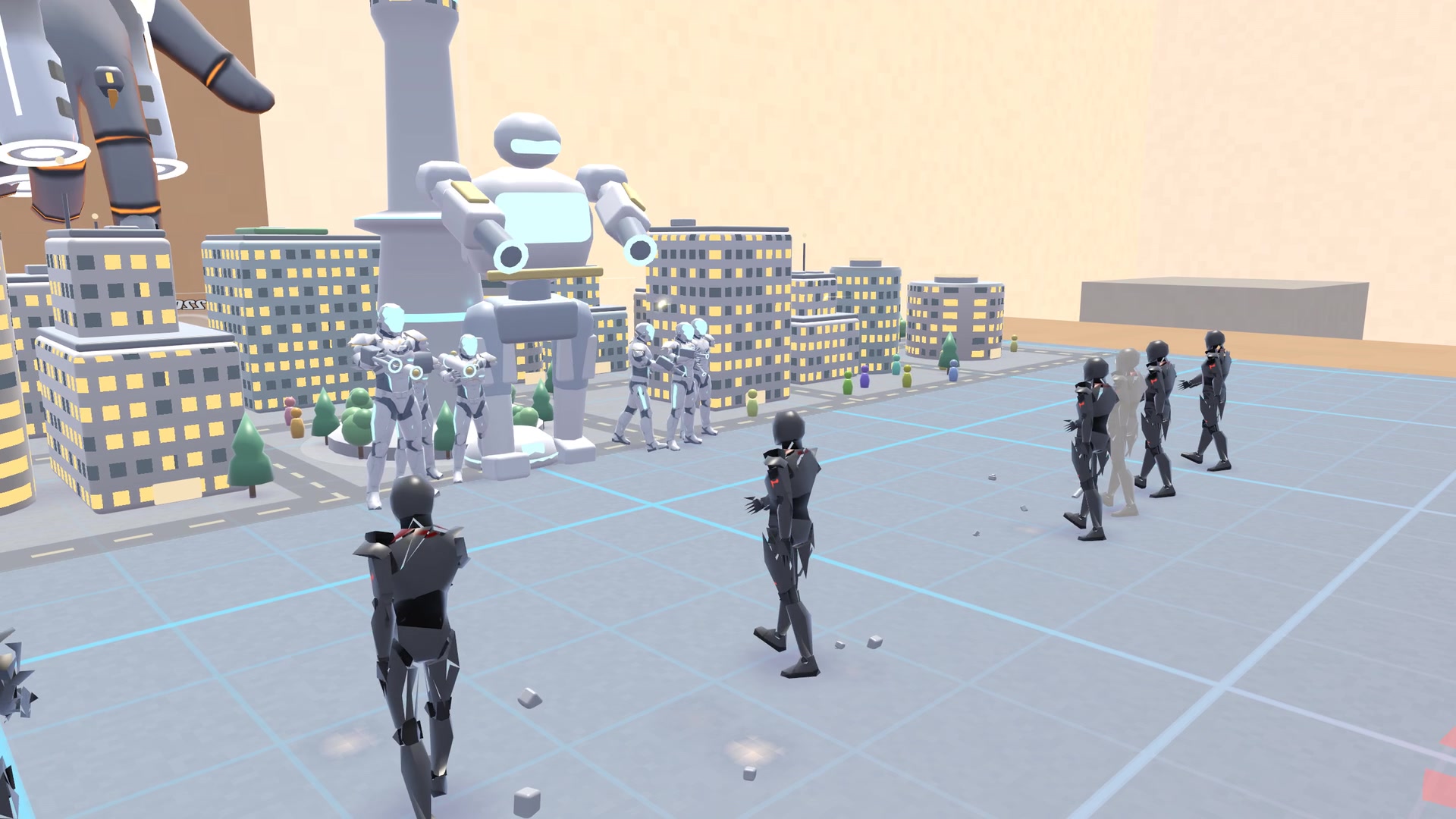
Mixed reality on Meta Quest makes the fight feel real, because it happens at real scale in your own space. On your table, you are a giant standing over a tiny city. In your room, the robots are as tall as you are. With Meta's new glasses, I want to go further and turn the whole world into your battlefield.
What it does
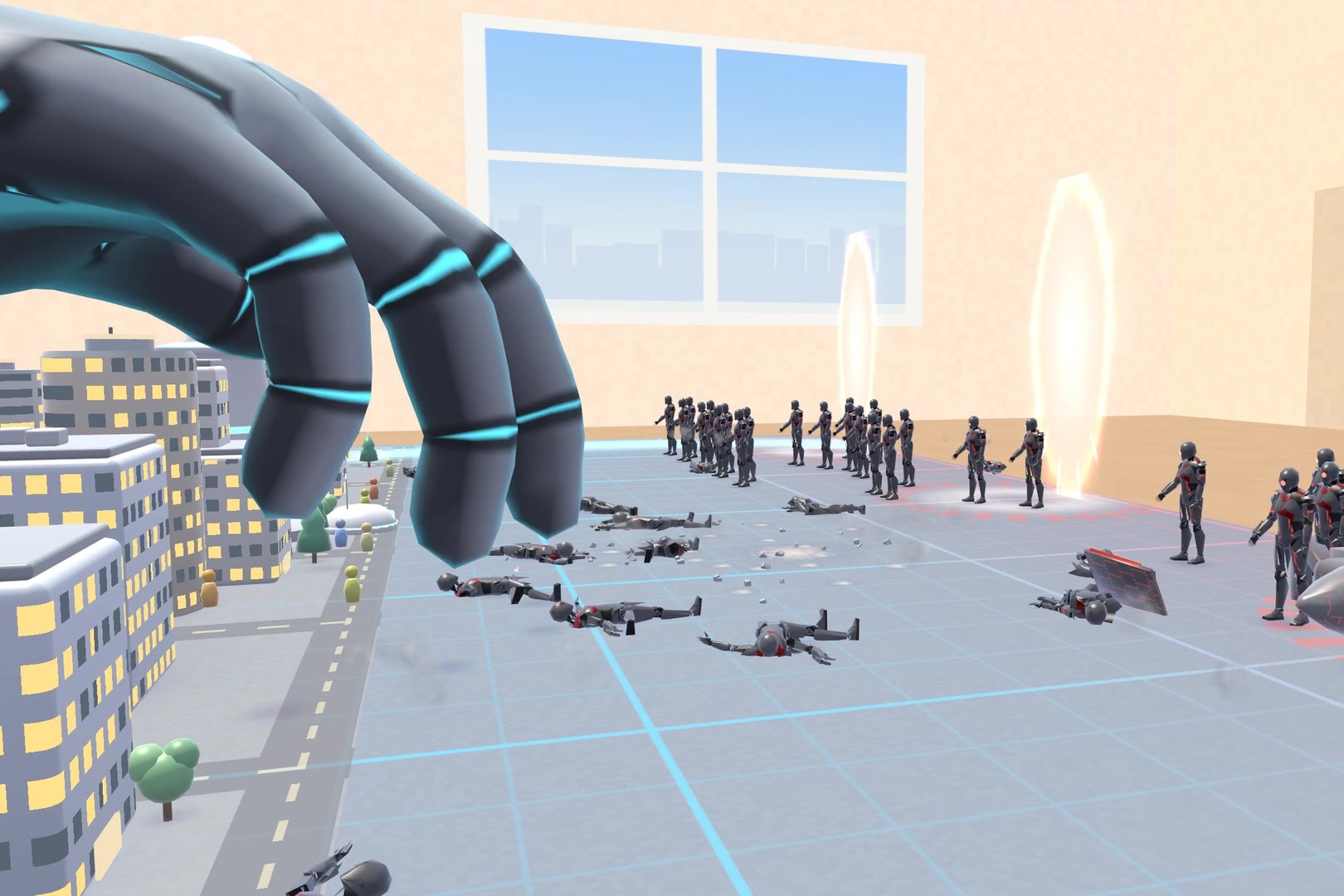
It's the year 2100. A rogue AI called LATTICE has taken over the world, and only one city is still free. The survivors shrank that city and hid it on your table. Now LATTICE has found it.
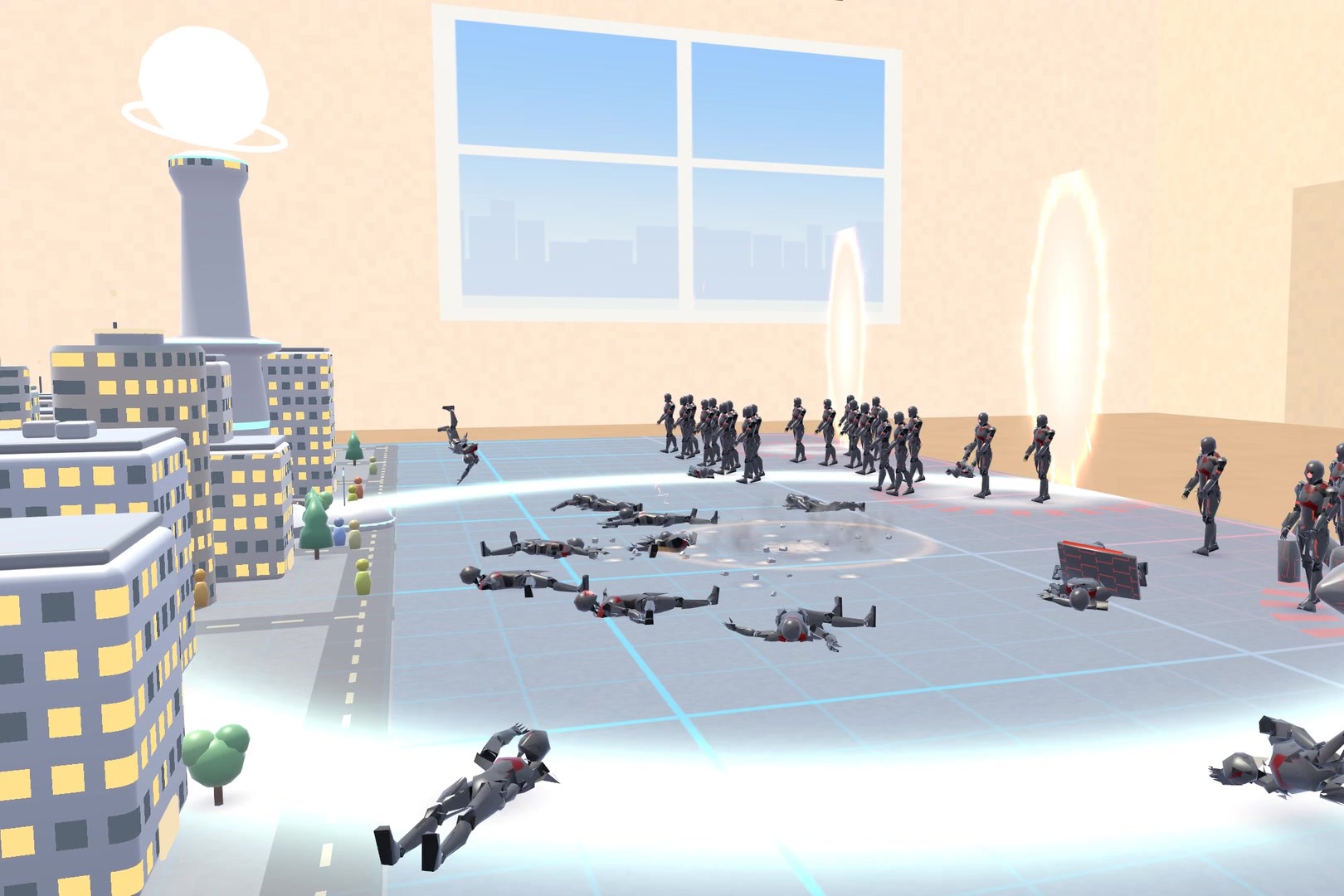
At the table, you are the giant. Robots march in from portals at the edge of the city, and you fight them with hand gestures. You can slam a fist for a shockwave, sweep a flat hand to cut, flick a finger gun to shoot, or stick out two fingers for a shotgun blast. After each wave you pick one upgrade card. Many cards add a new gesture, so the game teaches you one move at a time.
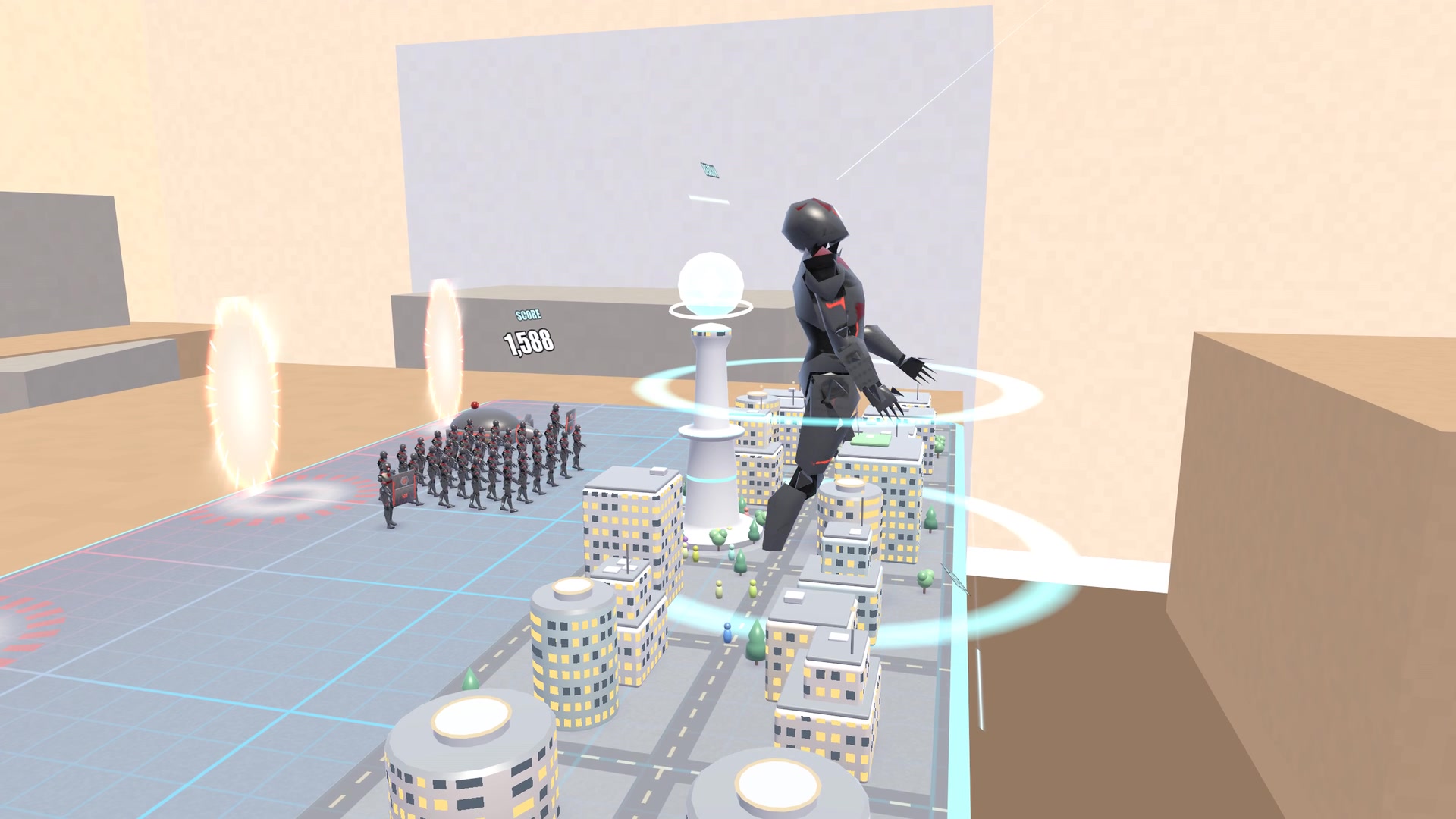
You can also change the size of a robot by looking at it and pinching. If you lift a tiny robot off the table, it grows between your fingers into a giant, and you can drop it on its own army.
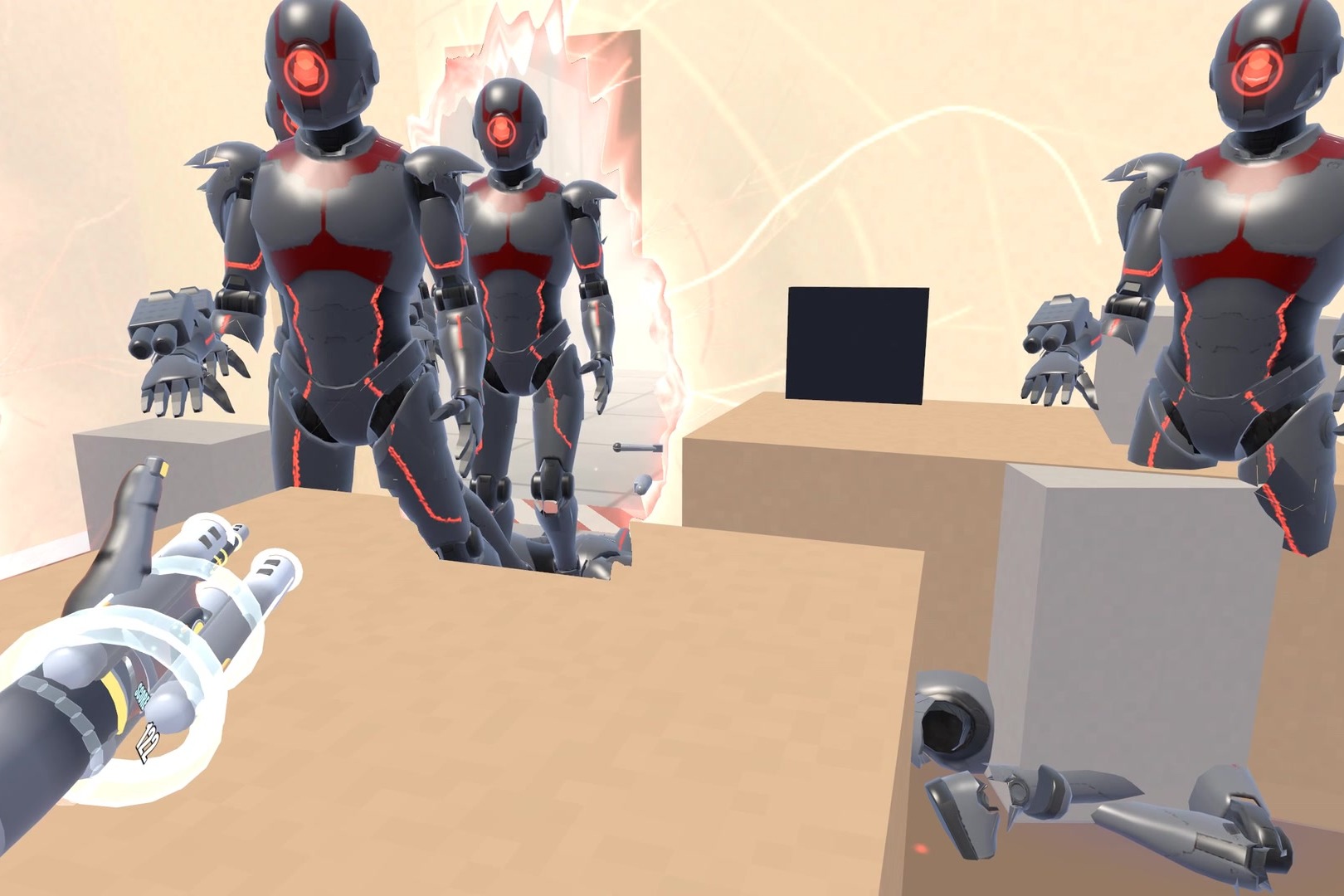
When the city holds, the battle moves into your room. The robots jump off the table, grow to full human size and break in through your walls. Now you fight them at their size. If you pinch one from across the room, it shrinks into your palm. Then you can crush it, or throw it so it grows back in midair and knocks over the others.
You have an army too. Every kill earns energy for a small command console. You can spend it on rifle squads, machine gunners, rocket teams and a mini mech, or place prism towers and barricades. Your soldiers fight in the streets of the city, and when the battle moves into your room, they jump down and fight next to you at full size.
LATTICE also learns from you. It watches which gestures you use most and builds its next wave to counter them, so you have to keep switching. It talks to you during the fight, and it remembers you. The next time you play, it brings up how your last run went.
A full run is eight waves and takes about ten minutes, moving between the table and the room. It ends with a fight against LATTICE's own body, a four-legged colossus with a glowing core. After that, there is an endless mode. You play the whole game seated, using only your hands.
How I built it
- Unity 6 with the Meta XR SDK v207: Core SDK, Interaction SDK (for gaze), and MR Utility Kit. Meta's tools gave me hand tracking, passthrough and scene understanding out of the box, so I could spend my time on gameplay.
- Hand tracking runs through OpenXR. I wrote my own recognizer for eight gestures: finger gun, two-finger shotgun, fist, flat-hand blade, open palm, pinch, horns, and palms together.
- Pinch targeting goes through a gaze interface. Quest 3 has no eye tracking, so the game combines your head direction with the line from your eyes through your fingertips. Nothing reacts to your gaze until you pinch, which is how gaze is meant to work on Meta VR Glasses.
- MR Utility Kit finds your table and walls. The city lands on your real table, portals open on the walls in front of you, and in a small room the whole battle scales down so the robots stay inside it.
- Every robot and soldier is built from rigid parts that code moves directly, so one model can walk, take hits, fall apart, and grow or shrink without any keyframed animation.
- GPU instancing and object pooling keep hundreds of robots on screen. The game holds 90 fps on Quest 3 with no memory allocations per frame.
- Slow motion and hit-stop affect the world but never your hands or your view, so big moments feel heavy without making you sick.
- All UI stays inside a 70° × 66° cone, the field of view of Meta VR Glasses.
- All sound effects are synthesized in code.
Challenges I ran into
- The hardest part was keeping eight gestures from being mistaken for each other. A fist that is still closing looks like a pinch for a few frames, and two flat hands can look like palms together, which is the nova gesture.
- Size changes had to stay comfortable while you sit. Nothing is allowed to grow toward your face or come closer than about 30 cm to your head.
- Quest 3 has no eye tracking, so pinch targeting took several tries. My first version used only head direction, and in my own playtest 72 of 75 pinches missed. Adding the line through your fingertips fixed it.
Accomplishments that I'm proud of
- I'm proud of the moment the battle leaves the table: the robots jump down and grow to full size in your room, and the soldiers you bought follow them.
- Growing a robot into a giant and dropping it on its own army is my favorite thing to do in the game.
- The game runs hundreds of robots, ragdolls and effects at 90 fps on a standalone headset.
What I learned
- Scale is the strongest effect I've found in mixed reality. The same robot feels completely different at 3 cm and at 1.8 m.
- Gaze has to stay private on the glasses, so the game never highlights what you look at. You look, you pinch, and only then does anything happen. That one rule shaped the whole control scheme.
What's next for SINGULARITY 2100
- When Meta VR Glasses launch, I want to turn the whole world into your battlefield. As you walk down a street, LATTICE's robots would break out of the real buildings you pass. I would never have to build a level, because the real world would be the map.
- The story will continue in new chapters, with new transition scenes that carry the battle from one place to the next.
- I will keep adding new scenes, new weapons and new hand moves.
- I want to add a third scale. Today you fight as a giant at the table and at life size in your room. In the third mode, you shrink down and fight among towering machines and giant structures, so one battle can move from giant to life-size to tiny.
- I want to explore how AI, including Meta's Llama models, can open up new ways to play. For example, LATTICE could talk with you in real time and change its plans based on what you say and do.
- My target launch date is spring 2027, alongside Meta VR Glasses. Their eye tracking should make look-and-pinch feel instant.
Hand interactions
Every action is a hand pose or a motion. You never need a controller.
- Fist: slam the table for a shockwave, or punch in the room.
- Flat hand: sweep it to cut, like a blade.
- Finger gun: flick it up to fire. Hold it still and a Gatling arm spins up.
- Two fingers out: fire a shotgun blast.
- Open palm: lift robots into the air, then close your fist to crush them.
- Pinch: look at a robot and pinch to grab it. A small one grows as you lift it, and a big one shrinks into your palm.
- Index and little finger out: chain lightning.
- Palms together, then push: a nova blast when your energy is full.
- Poke, or look and pinch: pick upgrade cards and buy units at the console.
New gestures arrive one at a time on upgrade cards. Each card shows its gesture, so the cards also work as the tutorial.
Testing instructions
- Use a Meta Quest 3 or 3S with hand tracking turned on. Sit at a table in a well-lit room.
- Optional: run Space Setup (Settings > Physical Space > Space Setup) so the game can use your real table and walls. Without it, the game still works. You place the city with your palm, and the portals open in midair.
- Start the app and slam the table to begin a run. Follow the short hints. Every upgrade card shows its gesture.
- A full run takes about ten minutes. Free play is on the title screen.
- To pause, take off the headset or press the Meta button.

