-
-
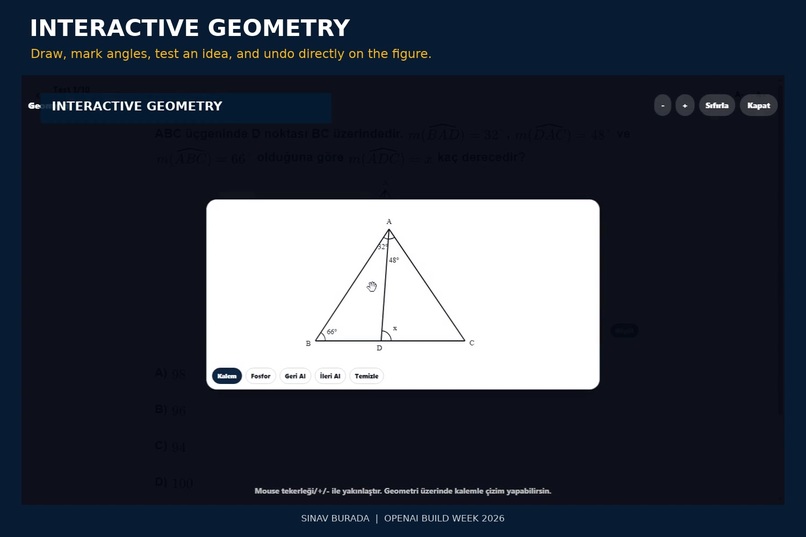
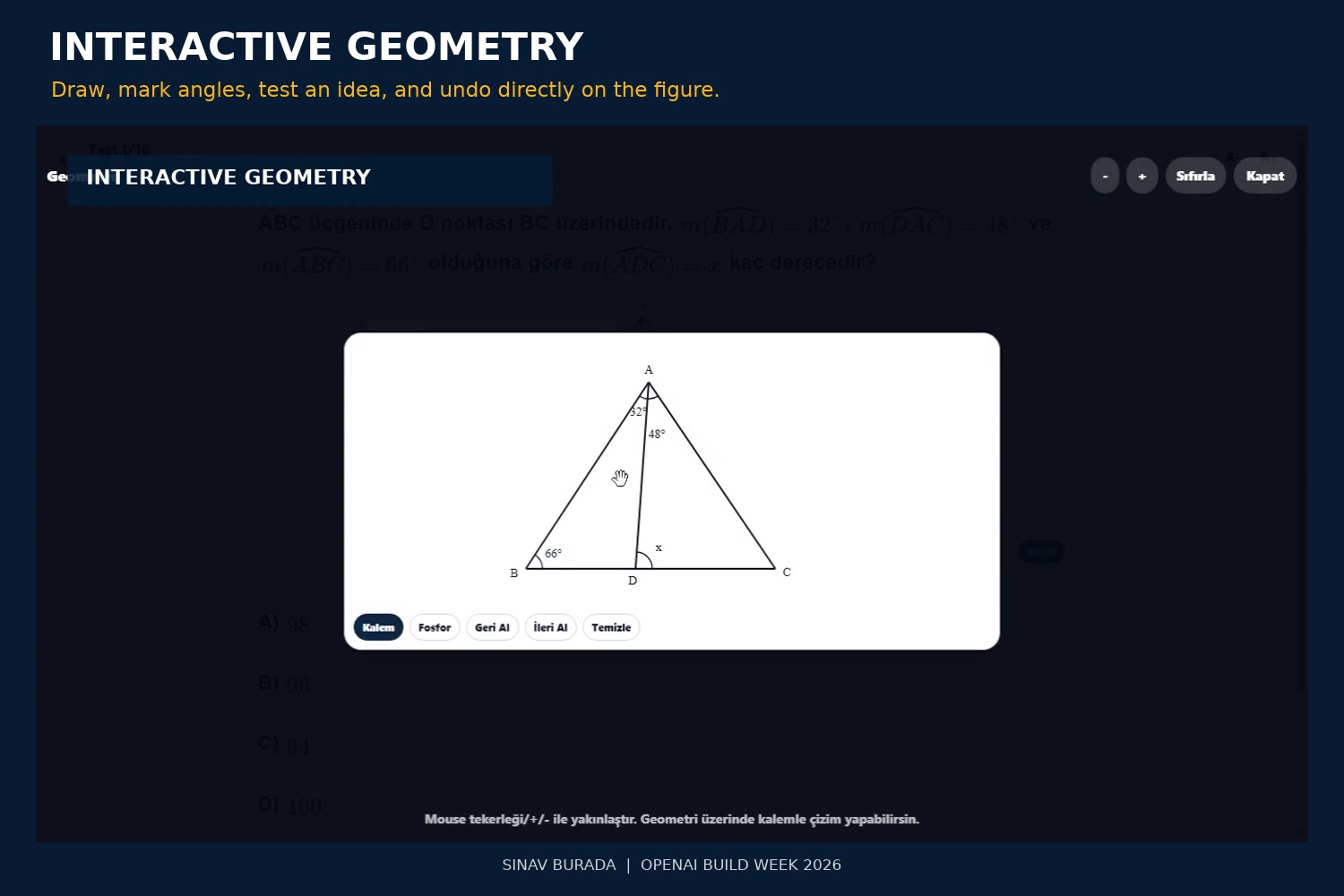
Interactive geometry lets students draw, mark angles, test ideas, and undo their work.
-
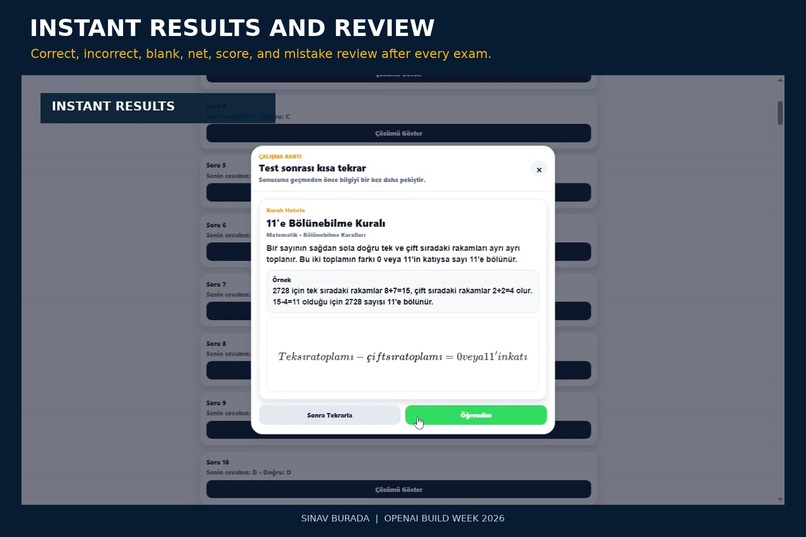
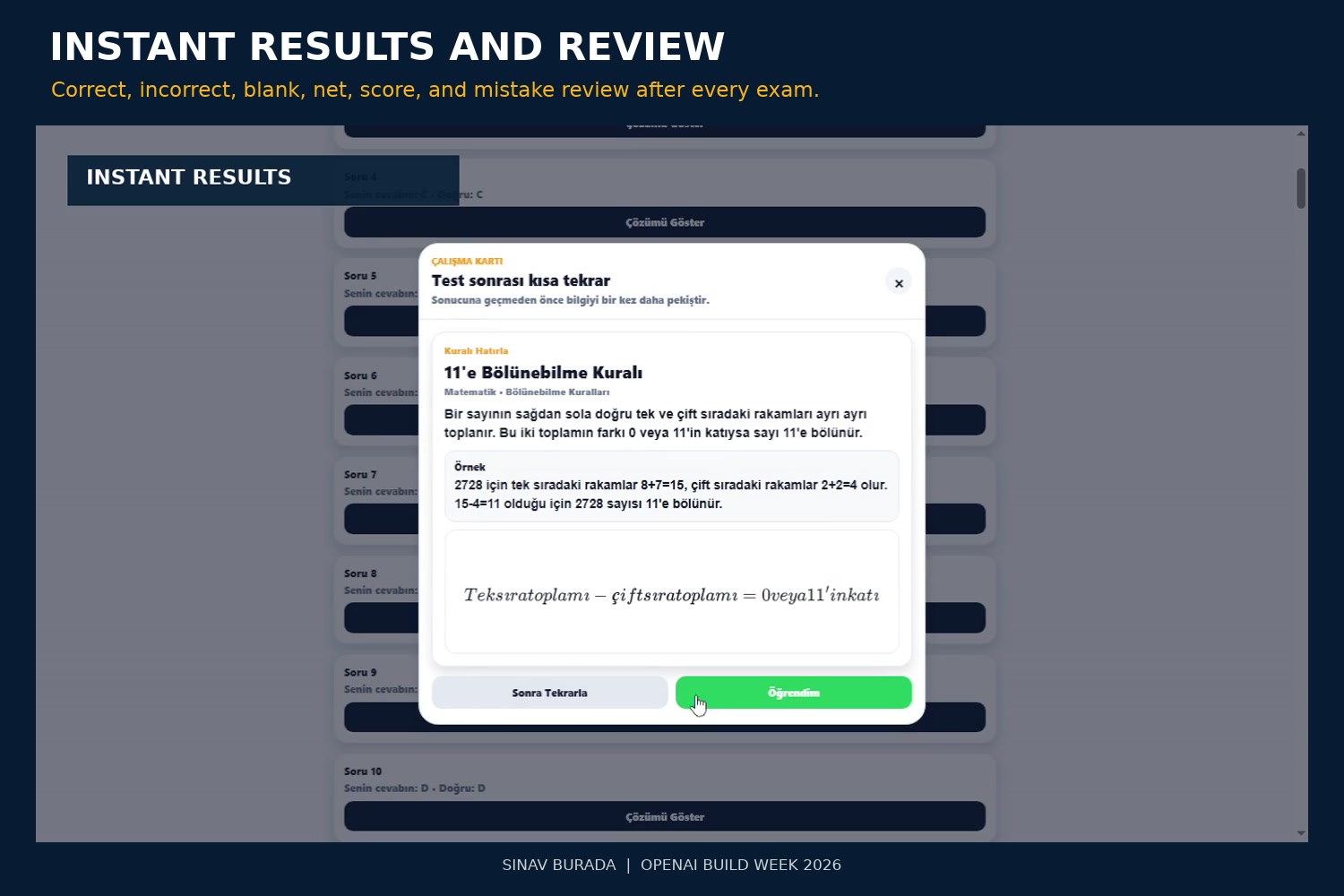
Study cards reinforce key concepts with concise explanations and targeted revision content.
-
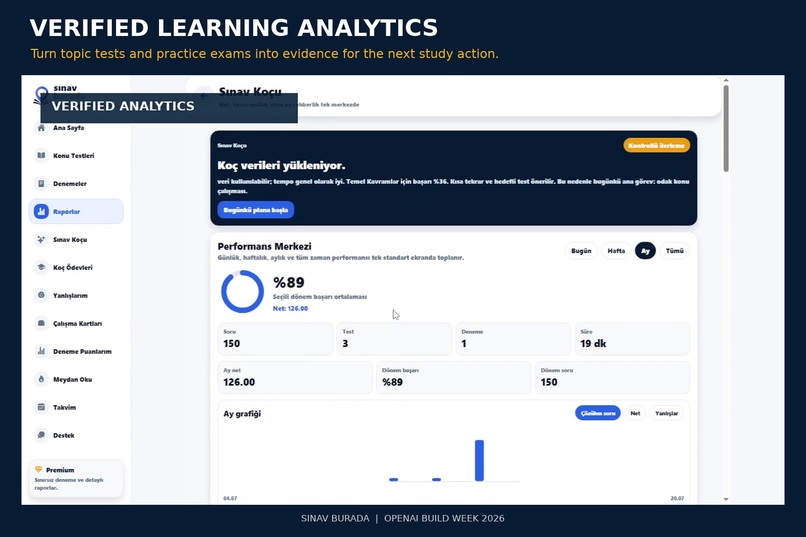
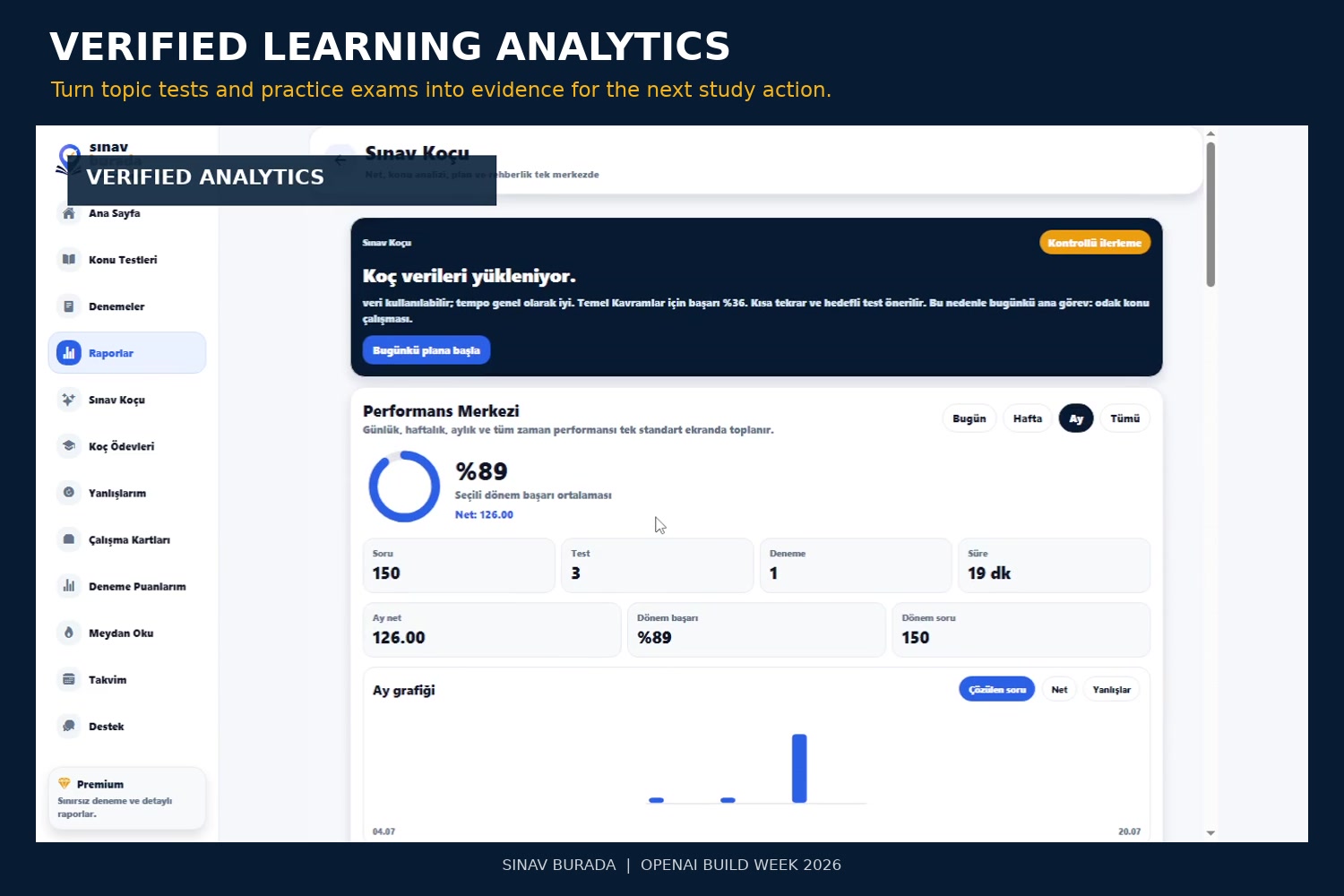
Verified test and exam data reveal weak topics, performance trends, and the next study priority.
-
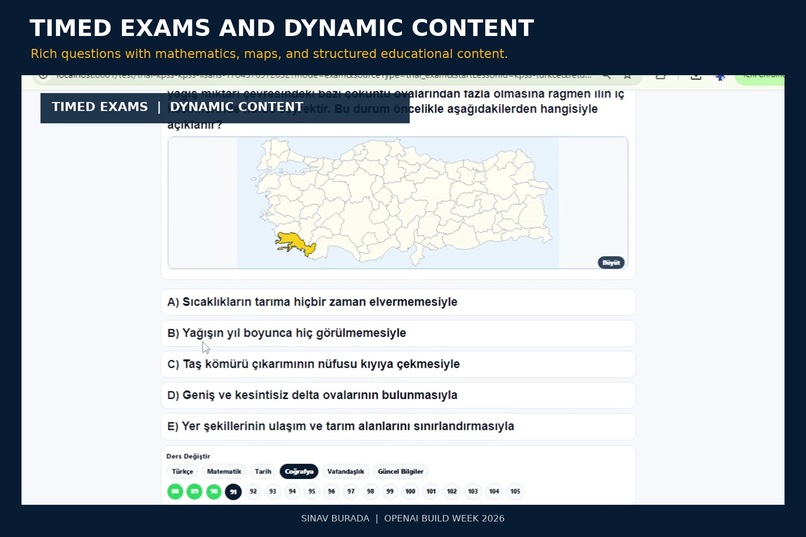
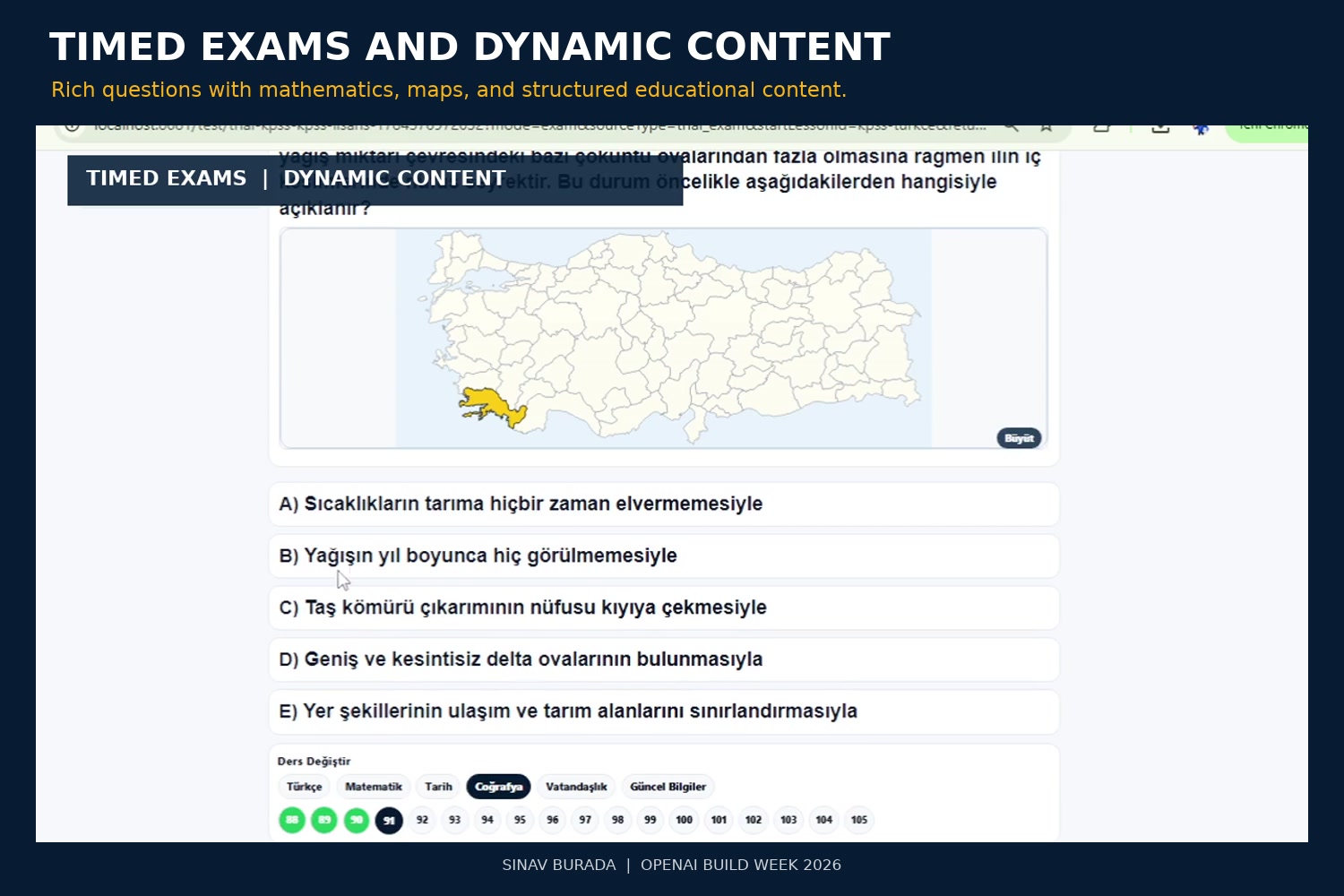
Timed exams support rich text, mathematics, maps, charts, and structured educational content.
-
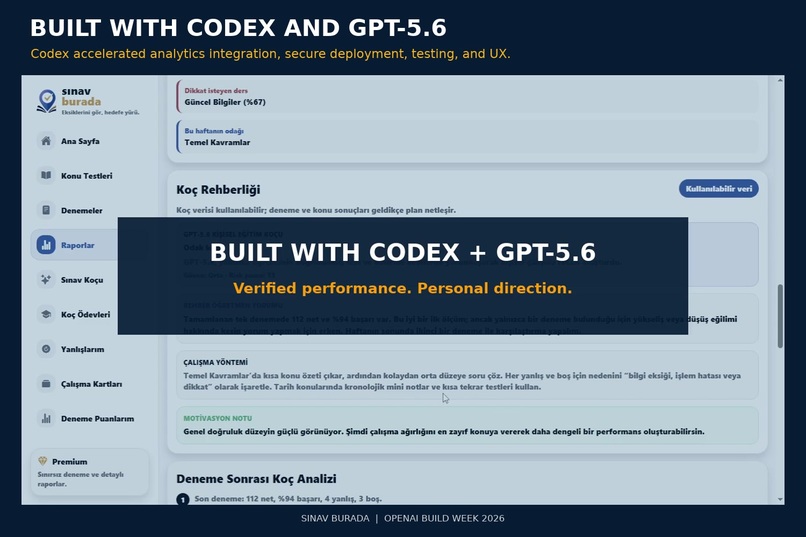
Codex accelerated analytics integration, secure AI deployment, fallback testing, and interface refinement.
-
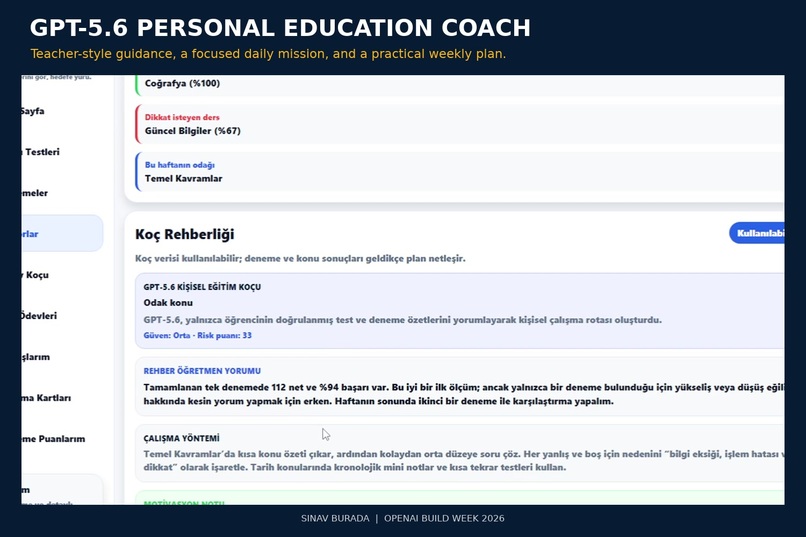
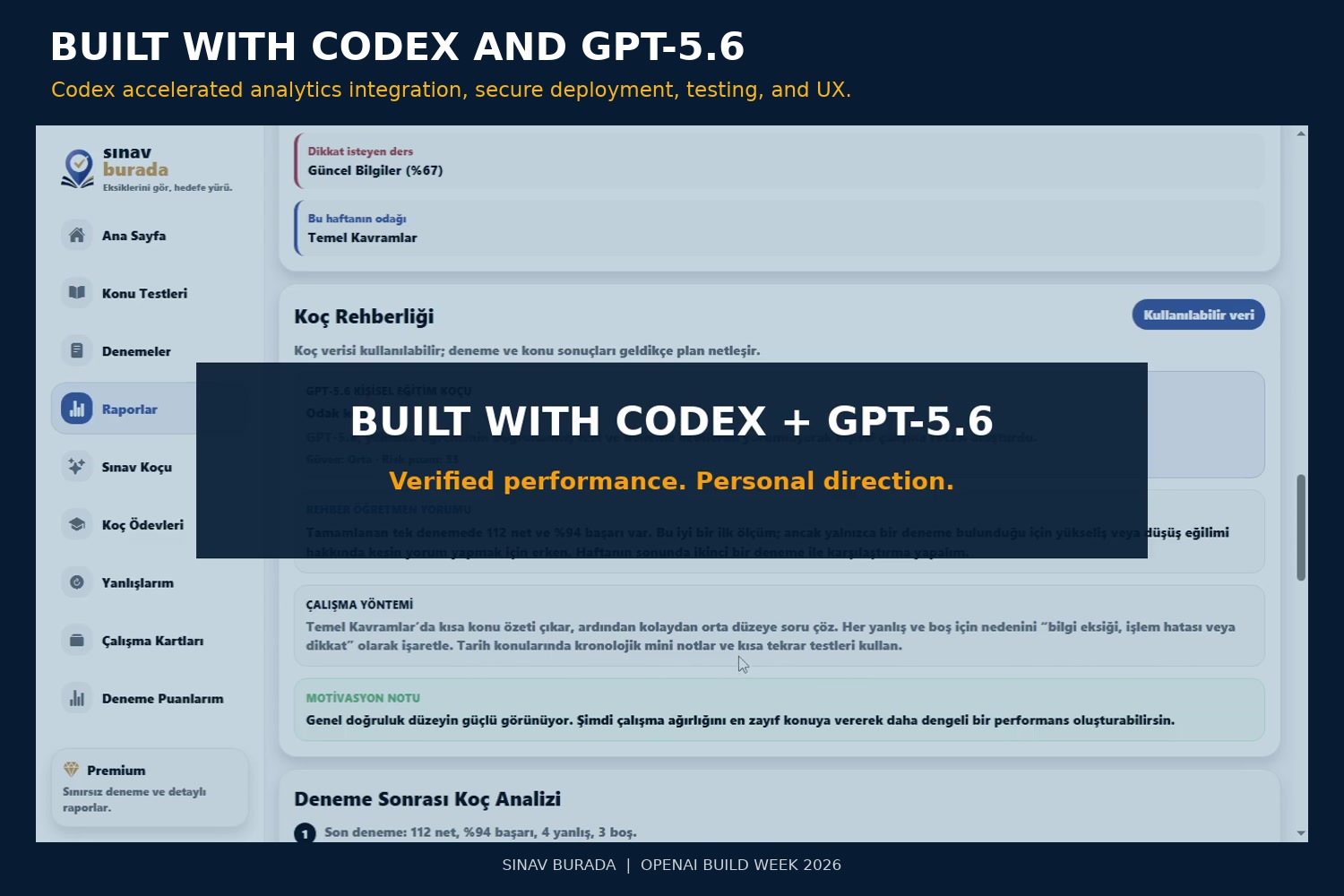
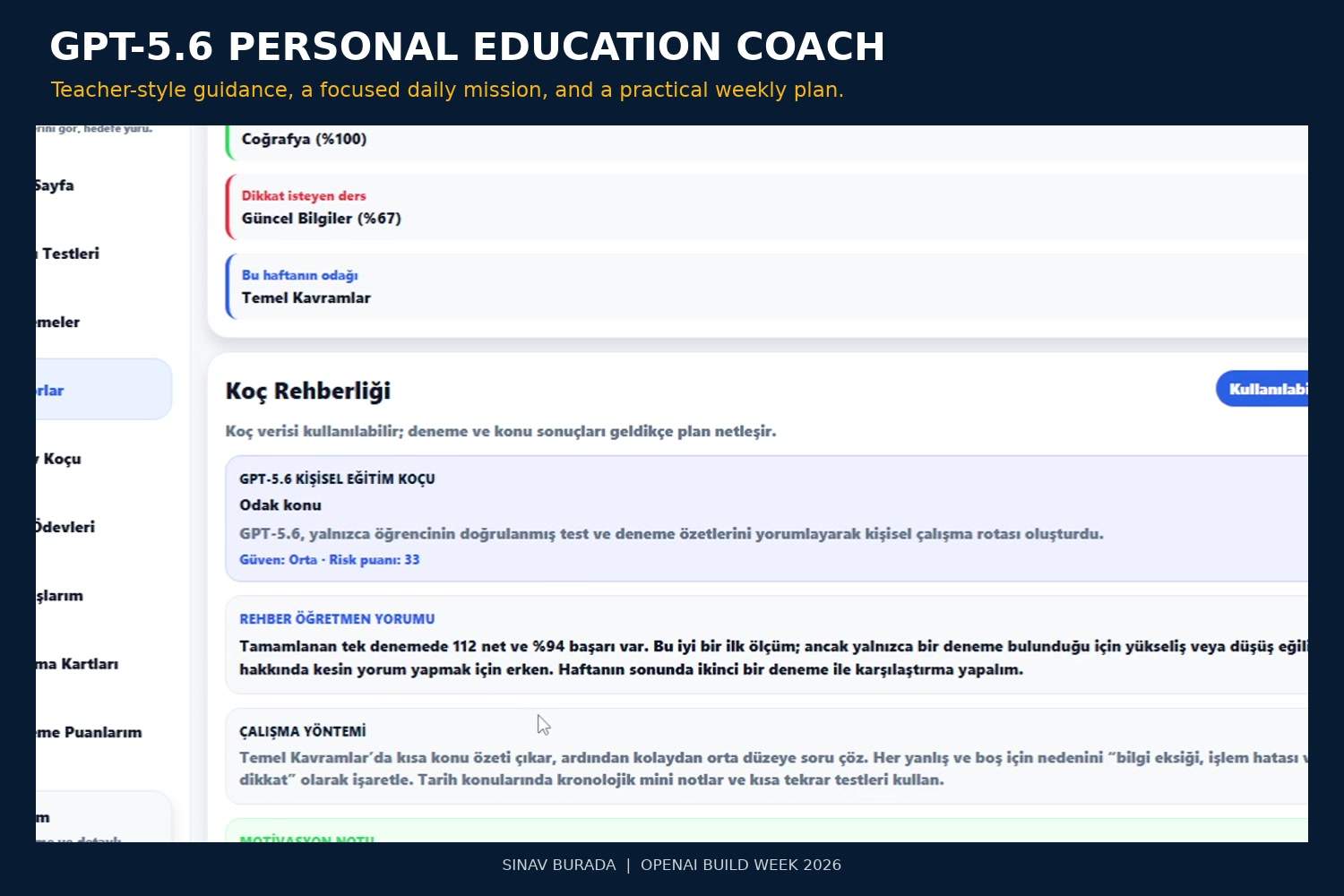
GPT-5.6 turns verified performance into teacher-style guidance, study methods, and focused missions.
-
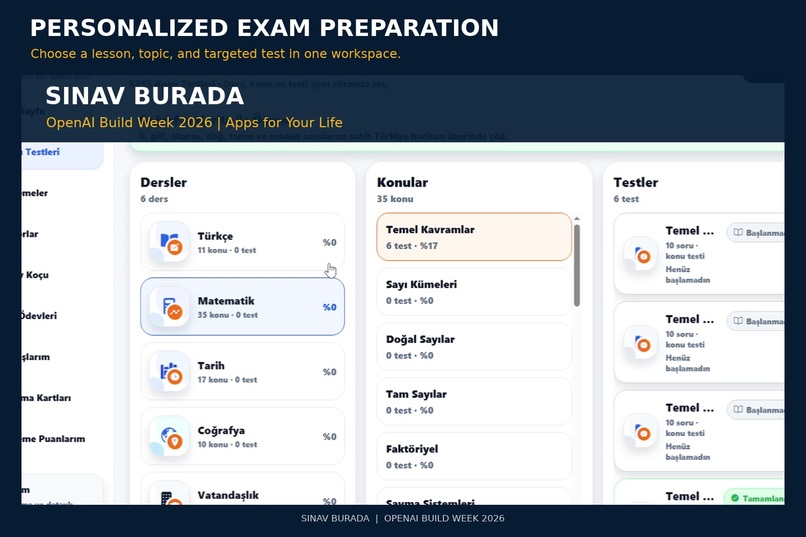
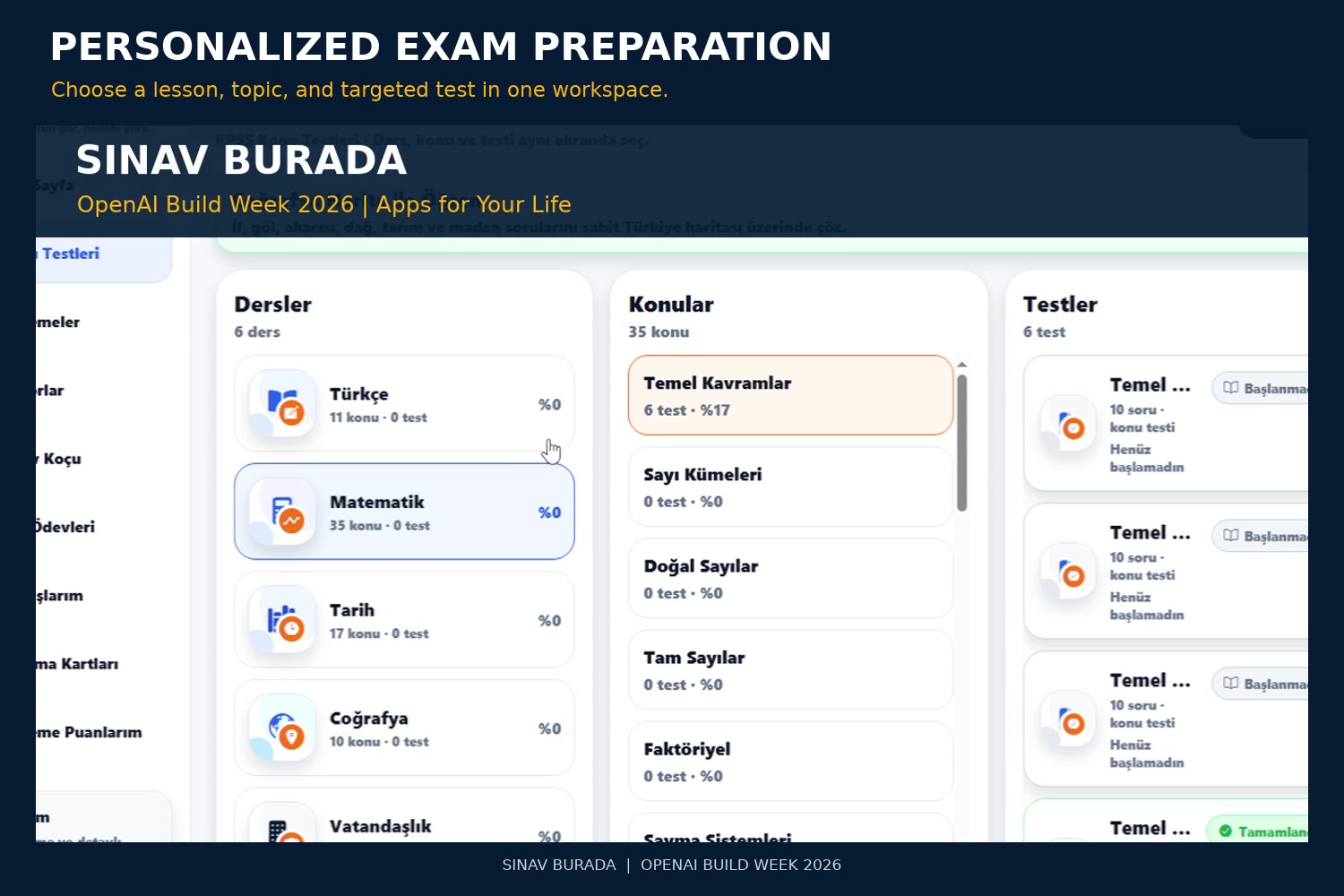
Students choose a lesson, topic, and targeted test from one focused workspace.
Inspiration
Exam preparation platforms usually tell students how many questions they answered correctly, but they rarely explain what to do next. Students see scores, percentages, and charts, yet still have to decide which topic deserves attention, how to study it, and what an achievable daily plan should look like.
I built Sınav Burada to close that gap. The goal is to transform verified student performance data into a clear and practical study direction.
What it does
Sınav Burada is an AI-powered exam preparation and personal coaching platform.
Students can:
- Solve timed topic tests and full practice exams
- Work with rich-text, mathematical, map, chart, and geometry questions
- Draw directly on geometry figures using built-in pen tools
- Review correct, incorrect, and unanswered questions
- Track lesson- and topic-level performance
- See net scores, success rates, time usage, and performance trends
- Receive focused daily missions and weekly study plans
After a student completes tests or practice exams, the platform creates a verified performance summary. GPT-5.6 interprets this summary and produces:
- A concise performance assessment
- A teacher-style guidance note
- A recommended study method
- A motivational message
- A focused daily mission
- A practical weekly plan
The model is not asked to invent student history or diagnose the learner. It works only with the verified performance summary supplied by the application.
How I built it
Sınav Burada uses React Native and Expo for a shared web and mobile experience, with Firebase providing authentication, database services, and server-side Cloud Functions.
The coaching workflow follows these steps:
- The student completes a topic test or practice exam.
- The application calculates correct, incorrect, blank, net, and timing values.
- Performance is aggregated by lesson and topic.
- A limited, structured summary is sent securely through a Firebase Cloud Function.
- GPT-5.6 returns structured coaching guidance.
- The client validates and displays the response as actionable missions and plans.
- If the AI service is unavailable, a deterministic local coaching fallback keeps the experience functional.
The OpenAI API key is stored as a server-side secret and is never exposed to the client.
How I used Codex
Sınav Burada existed as an exam preparation platform before Build Week. During the event, I used Codex to meaningfully extend it into a working AI coaching experience.
Codex helped me:
- Connect existing test and practice-exam analytics to the new coaching workflow
- Design the structured input sent to GPT-5.6
- Create predictable structured AI outputs
- Build and secure the Firebase Cloud Function
- Keep the OpenAI API key outside the client application
- Implement loading, error, validation, and fallback states
- Diagnose Firebase configuration, deployment, CORS, and secret-version issues
- Improve the performance dashboard and coaching interface
- Test the system with limited data, topic-test data, and full practice-exam results
- Refine the product story and demonstration flow
I made the product, education, privacy, and user-experience decisions while Codex accelerated implementation, debugging, and iteration.
Geometry and rich question content
A distinctive part of Sınav Burada is its structured question-rendering system.
Geometry questions are not limited to static screenshots. Figures can be rendered as structured content, and students can use built-in drawing tools to mark angles, draw lines, test an approach, and undo their work.
The platform also supports mathematical notation, maps, charts, and rich educational content. This is especially important for creating a realistic digital exam-solving environment.
Challenges
One major challenge was ensuring that the coach used real student evidence instead of producing generic or unsupported recommendations. I addressed this by sending only aggregated, verified performance data and requiring a structured response.
Another challenge was reliability. An external AI request may fail because of connectivity, configuration, quota, or service availability. I therefore kept a safe local coaching fallback so that the student never reaches a broken or empty experience.
Firebase deployment also required careful debugging. I worked through runtime configuration, CORS behavior, project configuration, authentication, secret versions, and OpenAI API validation.
Finally, the interface needed to avoid overwhelming students. Instead of producing a long list of tasks, the coach prioritizes a small number of clear actions.
What I learned
I learned that adding AI to an education product is not primarily about generating more text. The difficult and valuable part is deciding:
- Which data the model should receive
- Which data it should never invent
- How its output should be constrained
- How recommendations become actionable
- How the application behaves when AI is unavailable
- How to communicate uncertainty when student data is limited
I also learned how effective Codex can be as an engineering collaborator when the human remains responsible for product direction and validation.
What's next
Next, I plan to:
- Improve coaching based on longer-term performance trends
- Add stronger cost controls, caching, and usage limits
- Expand adaptive practice-exam generation
- Improve accessibility and mobile/tablet interaction
- Refine geometry drawing after zooming
- Add more transparent explanations for why each mission was selected
- Continue evaluating recommendations with educators and real student feedback
Sınav Burada aims to help every student see the gap and take the next step.
Built With
- ai
- analytics
- api
- artificial
- authentication
- cloud
- codex
- edtech
- education
- expo.io
- firebase
- firestore
- functions
- generative
- gpt-5.6
- intelligence
- javascript
- learning
- manager
- native
- openai
- personalized
- react
- secret
- typescript

Log in or sign up for Devpost to join the conversation.