Inspiration
Public decisions can affect thousands or millions of people, yet affordability, accessibility, communication, participation, and implementation risks are often discovered only after rollout.
We created Simulens around one question:
Can a decision be stress-tested against an inspectable synthetic society before it reaches the real world?
Simulens is not intended to replace surveys, public consultation, field research, or expert judgment. It provides an additional decision-support layer that helps teams identify risks, expose assumptions, and compare revisions before implementation.
What it does
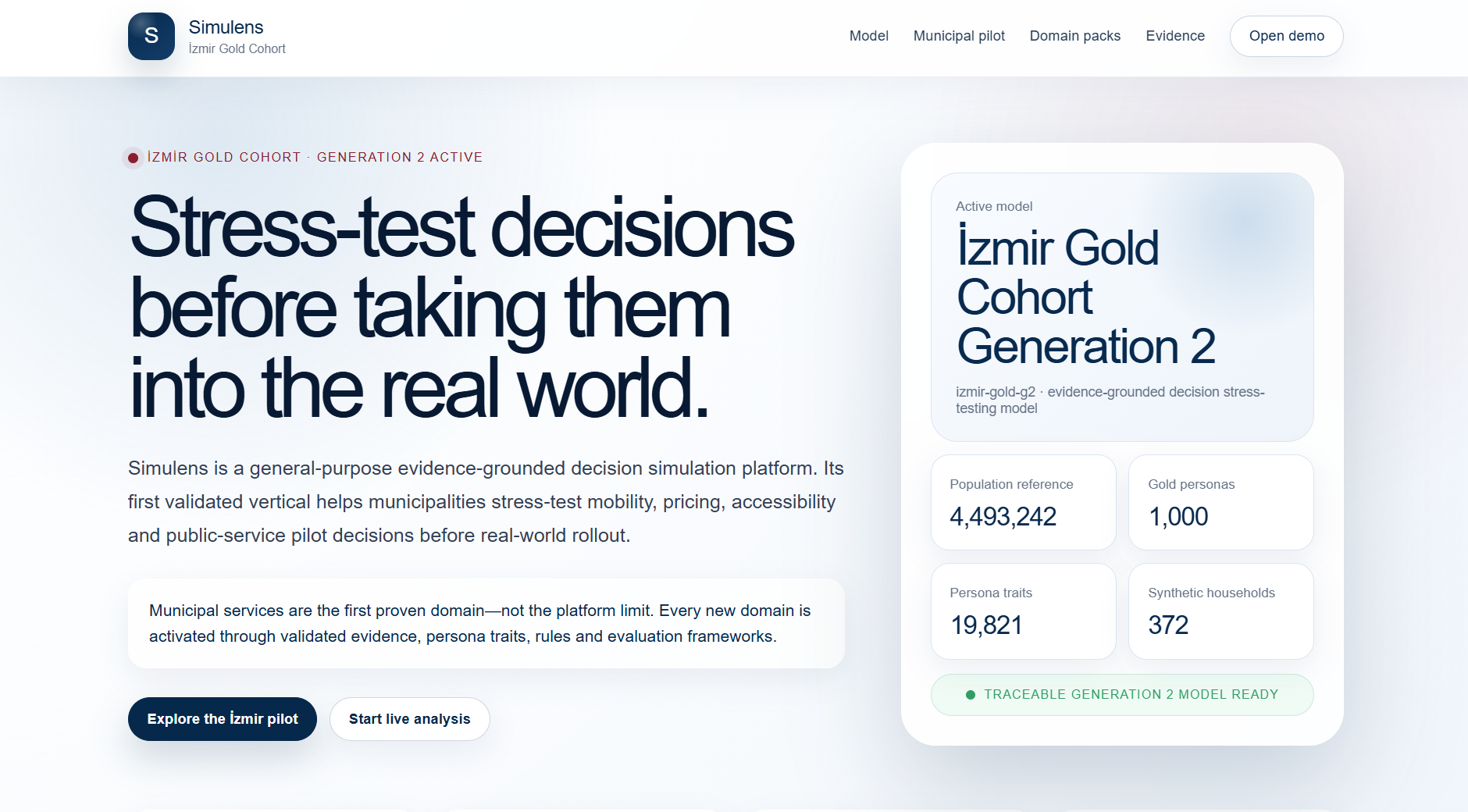
Simulens is an evidence-grounded synthetic society laboratory for stress-testing municipal decisions.
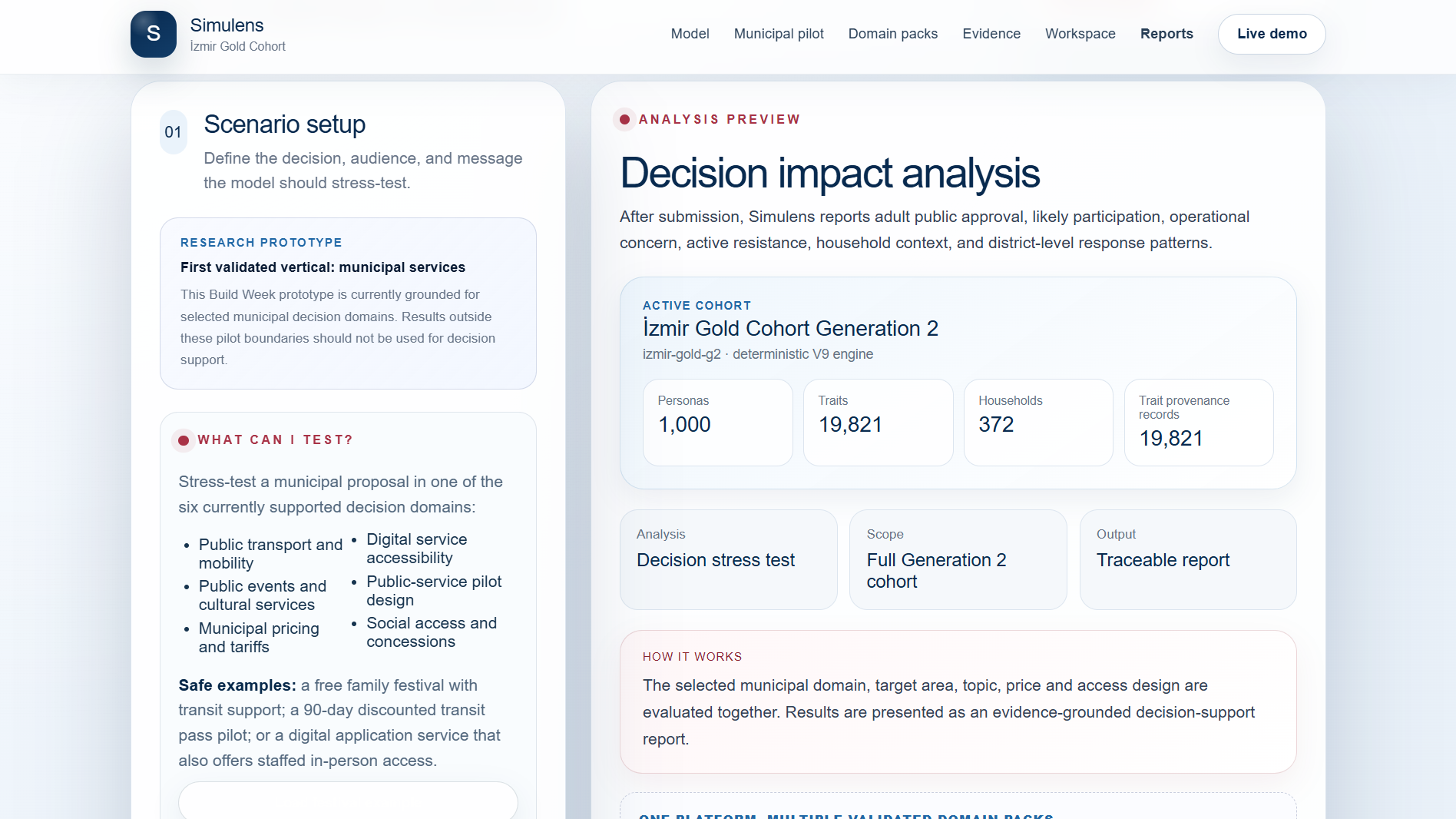
Its first validated model is the İzmir Gold Cohort Generation 2, containing:
- 1,000 synthetic personas
- 372 synthetic households
- 19,821 traceable persona trait records
- A population reference of 4,493,242 residents
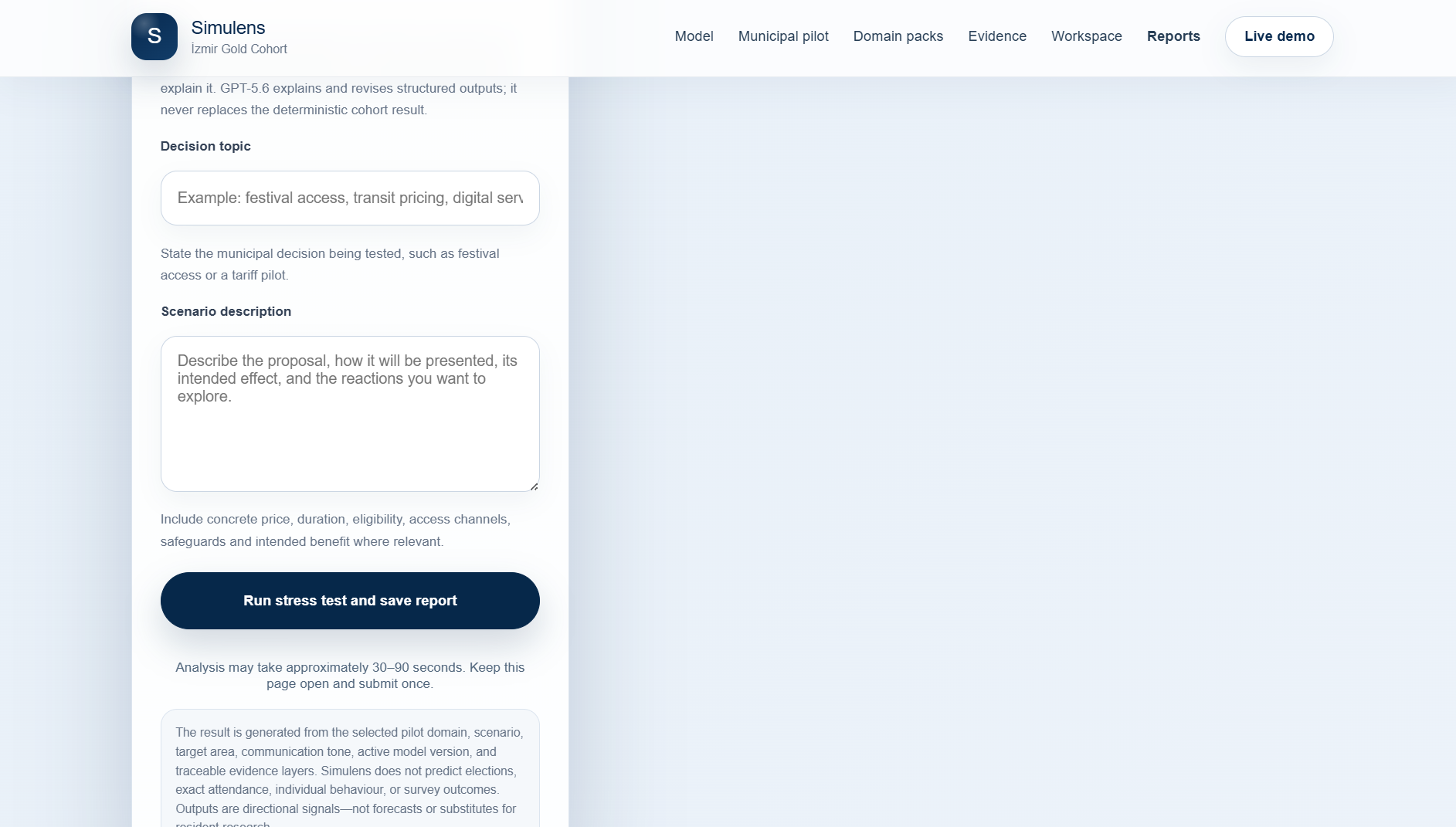
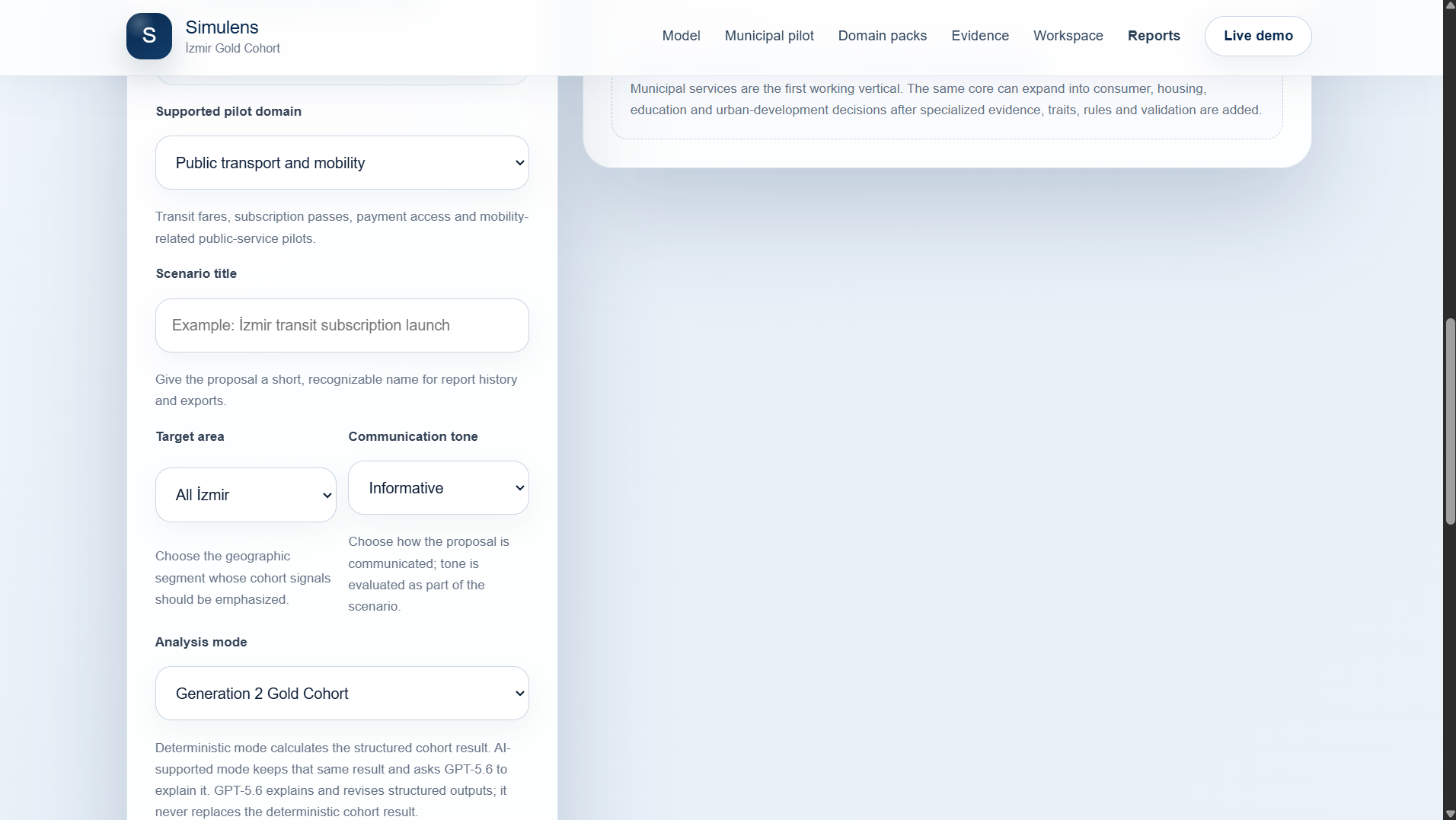
Users structure a proposal through guided fields covering the decision domain, target group, geography, communication tone, pricing, intended outcome, and implementation details.
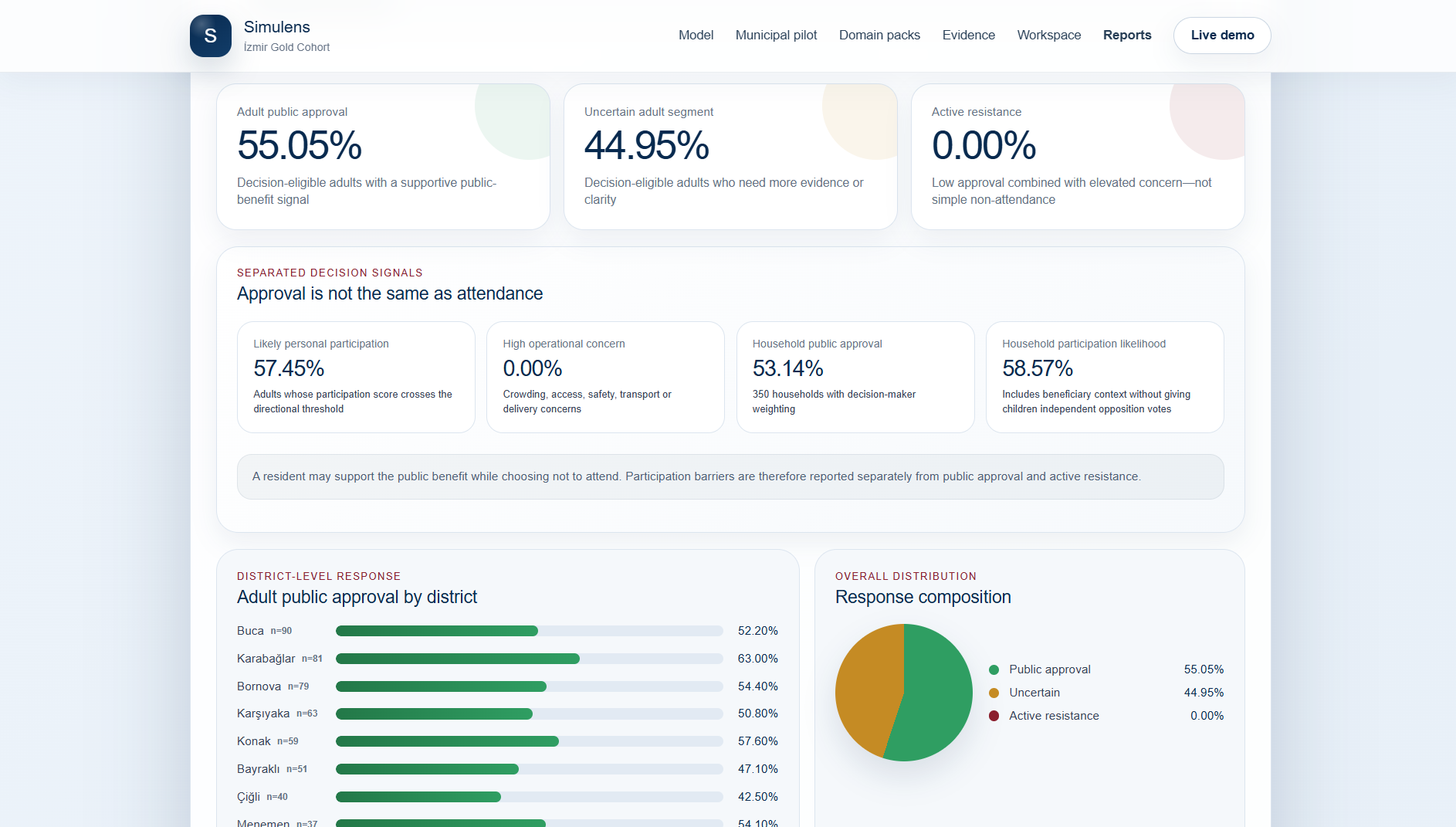
The deterministic household engine evaluates the complete cohort and separates the result into distinct signals:
- Adult public approval
- Likely personal participation
- Operational concern
- Active resistance
- Uncertainty
- Household and district-level effects
This distinction matters because supporting a public benefit is not the same as personally using or attending it.
Simulens preserves an inspectable chain from evidence and calibration records to persona traits, household context, simulation responses, and final reports. No identifiable real-person profiles are used.
GPT-5.6 can also propose a revised scenario. However, the recommendation is never accepted automatically. Simulens re-runs the candidate against the same cohort and comparison seed, then accepts, flags, or rejects it according to the measured result.
How we built it
Simulens was built as a working PHP and MySQL web application with:
- A structured evidence center
- Generation 2 persona and household records
- A deterministic simulation engine
- Domain-specific decision rules
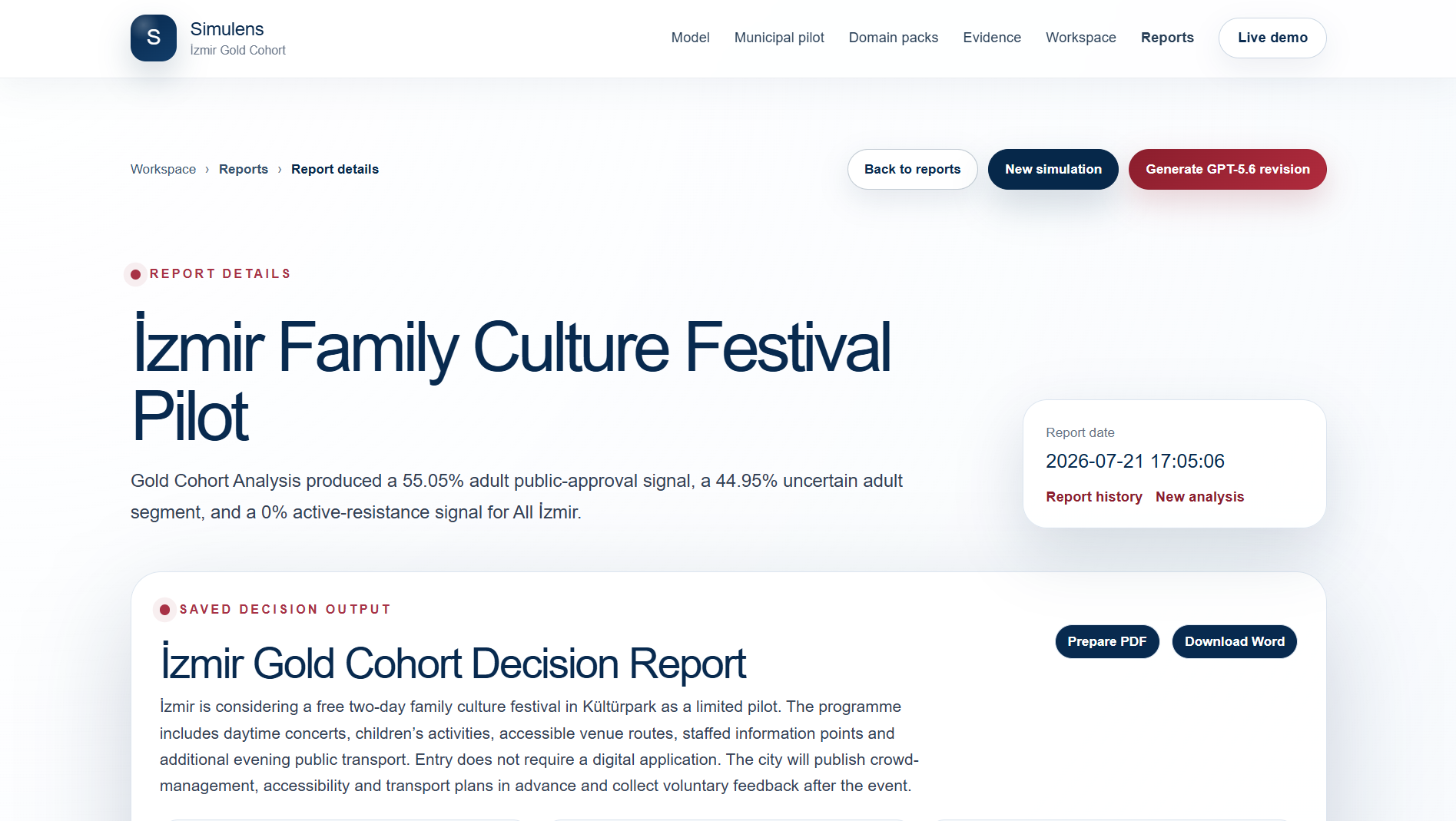
- Explainable report generation
- GPT-5.6 scenario optimization
- Baseline-versus-candidate validation
- Persona quality auditing
- Word and print-ready PDF exports
- A password-free public Build Week demo
The current validated domain packs cover public transport, public events, municipal pricing, digital accessibility, public-service pilot design, and social access.
New sectors cannot be activated with a prompt alone. Each additional domain requires dedicated evidence, persona traits, decision rules, and validation tests.
Codex supported the final release-engineering and quality-assurance process. It helped audit comparison integrity, preserve deterministic seeds, strengthen shared verdict calculation, improve optimizer and parser consistency, add persona-quality controls, review public demo safety, and create reproducible release tests.
The existing cohort methodology, scoring engine, household rules, and decision thresholds were deliberately preserved.
Challenges we ran into
The most difficult challenge was preventing the system from becoming an opaque AI score generator.
We had to keep clear boundaries between:
- Evidence used for cohort calibration
- Contextual web research
- Assumptions
- Persona traits
- Deterministic scoring rules
- GPT-generated interpretation
- Final validation results
Another major challenge was ensuring that baseline and revised scenarios were compared fairly. A candidate evaluated against a different seed or cohort could appear better simply because the comparison conditions changed.
To prevent this, Simulens locks the original comparison seed and evaluates both scenarios against the same cohort.
We also had to model household behavior carefully. Adults provide independent decision signals, while children remain beneficiaries who influence household participation context without casting independent opposition votes.
Accomplishments that we're proud of
We are proud that Simulens is a working system rather than only a concept or presentation.
The public demo allows visitors to:
- Create a structured municipal scenario
- Evaluate all 1,000 personas
- Inspect approval, participation, concern, resistance, and uncertainty
- Review household, segment, and district effects
- Examine evidence, assumptions, warnings, and limitations
- Ask GPT-5.6 to generate a candidate revision
- Re-test that revision against the same deterministic cohort
During our demonstration, a GPT-5.6 revision produced a worse result. Simulens rejected the candidate instead of presenting it as a false improvement.
This represents one of the project's central principles:
AI recommendations should be tested, not merely trusted.
We are also proud of the traceable Generation 2 cohort, the read-only persona quality audit, the reproducible comparison process, and the sanitized source repository prepared for judging.
What we learned
We learned that explainability cannot be added only at the reporting stage. It must be part of the evidence model, persona generation process, simulation engine, comparison logic, and user interface from the beginning.
We also learned that generative AI becomes more useful when placed inside a measurable validation loop.
In Simulens, GPT-5.6 is not the final decision-maker. It generates a reviewable candidate that the deterministic system must independently test.
The project also demonstrated how Codex can contribute beyond initial code generation by supporting codebase auditing, test creation, release engineering, security review, and methodological consistency.
What's next for Simulens
The İzmir municipal model is the first working vertical of the broader Simulens platform.
Future validated domain packs may include:
- Consumer and retail decisions
- Housing and home services
- Education access
- Urban development
- Additional municipalities and geographic cohorts
Each expansion will require its own evidence, persona traits, rules, calibration process, and validation framework.
Our long-term goal is to create reusable and inspectable infrastructure for testing complex decisions before real-world rollout.

Log in or sign up for Devpost to join the conversation.