


Inspiration
The diagnostic journey for brain tumor patients is emotionally taxing and painfully slow. Waiting weeks for an MRI to be analyzed without clear answers leaves both patients and clinicians in a state of uncertainty. We aimed to bridge the gap between the scan and meaningful insight by leveraging AI and medical imaging data.
What it does
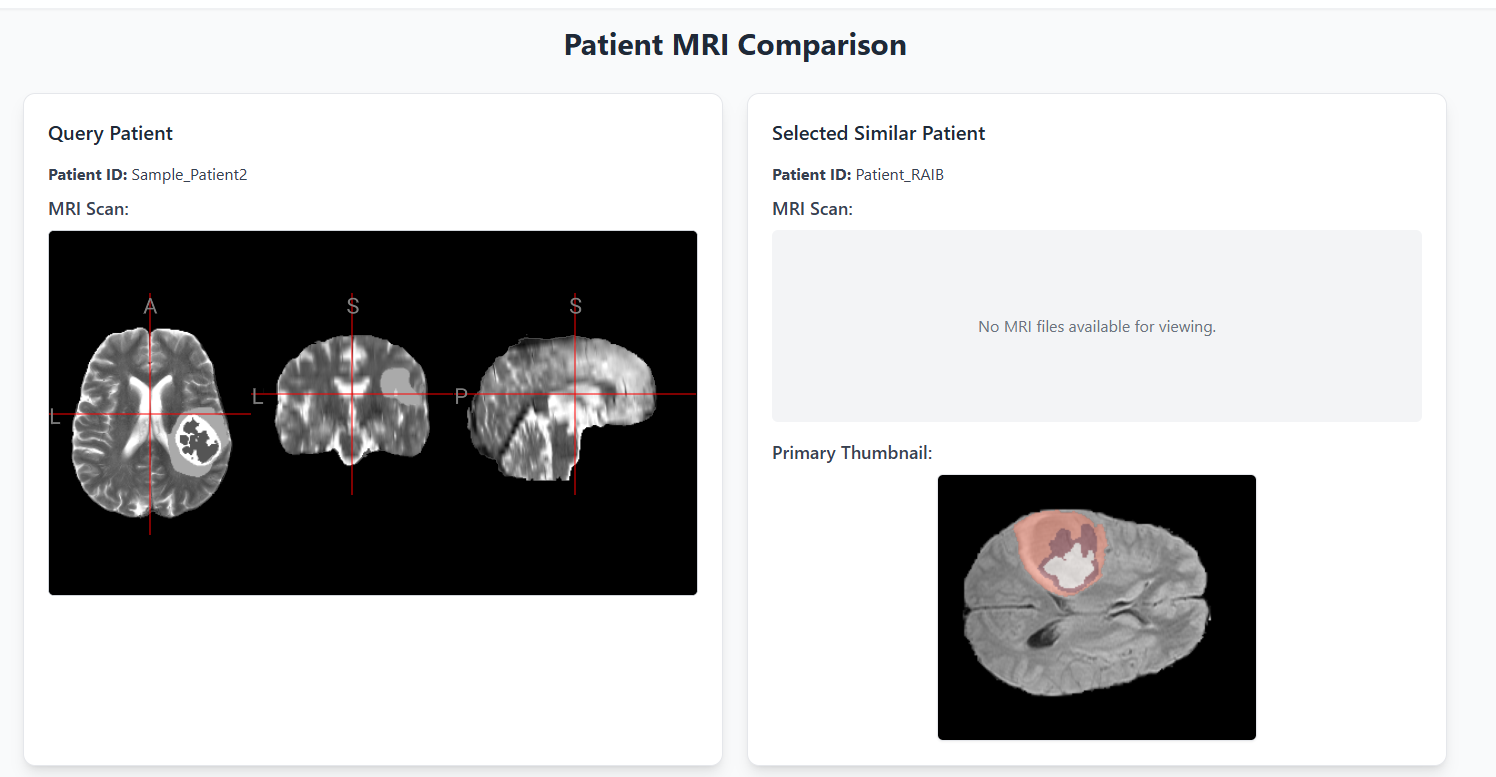
Simri is an AI-powered MRI similarity search engine. It lets doctors, researchers, and clinicians upload a brain MRI and instantly retrieve visually and structurally similar cases from a database, including relevant diagnostic information. This empowers faster research, informed discussions, and deeper understanding, without the wait.
How we built it
Frontend: Built with Next.js and TypeScript, with Niivue for in-browser medical image visualization.
Backend: A Hugging Face-hosted API using Python and the TIEP model to generate vector embeddings from multi-sequence MRI scans.
Storage: MRI scans are securely uploaded to an AWS S3 bucket.
Search: MongoDB Atlas with Vector Search powers instant similarity lookup against thousands of MRI embeddings.
Challenges we ran into
Parsing and handling multi-modal DICOM/NIfTI scans efficiently.
Integrating Niivue for interactive and performant visualization.
Hosting the TIEP model reliably on Hugging Face and ensuring the embedding was consistent across modalities.
Accomplishments that we're proud of
End-to-end pipeline: from drag-and-drop MRI upload to similarity results in seconds.
Seamless UI that allows real-time side-by-side comparisons.
Integrated TIEP deep learning model with real clinical potential.
Scalable and secure infrastructure ready for expansion.
What we learned
Medical data requires both precision and sensitivity, both technically and ethically.
Vector search in medical imaging has huge potential but demands careful model design.
Small UX improvements (like loading states or scan previews) significantly improve trust and usability in healthcare tools.
Building with healthcare in mind forces you to focus on speed, security, and clarity above all.
What's next for Simri
Expand the dataset beyond BraTS to include diverse, real-world tumor cases from multiple institutions and populations.
Enable advanced filtering by metadata, such as patient age, tumor type, treatment protocol, and outcomes — helping clinicians find the most relevant matches faster.
Add segmentation overlays and 3D model comparisons to enhance visual exploration and better understand tumor structures over time.
Integrate clinician feedback loops into the platform to ensure usability, trustworthiness, and continuous model improvement.
Begin clinical pilot studies in research hospitals and academic labs to validate utility, accuracy, and impact in real-world diagnostic settings.
Evolve Simri into a modular tool that can be embedded into any radiology or research database — allowing healthcare systems to plug in Simri and gain instant similarity search capabilities on their own local MRI data, securely and privately.
💡 The goal: Make Simri not just a standalone platform, but a trusted infrastructure tool for every hospital's imaging workflow.
Built With
- amazon-web-services
- huggingface
- mongodb
- next.js
- niivue
- python
- typescript

Log in or sign up for Devpost to join the conversation.