-
-
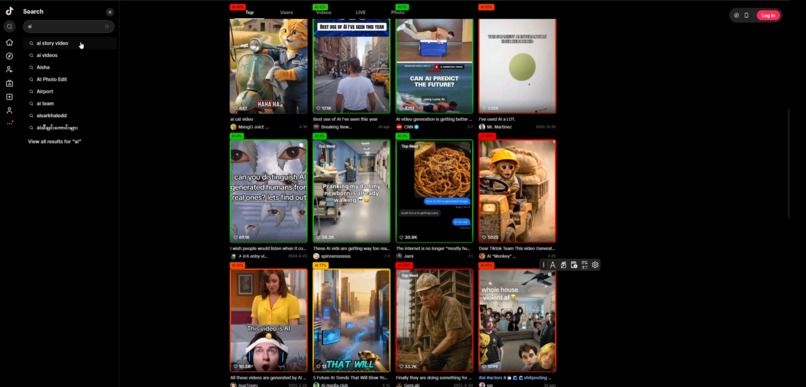
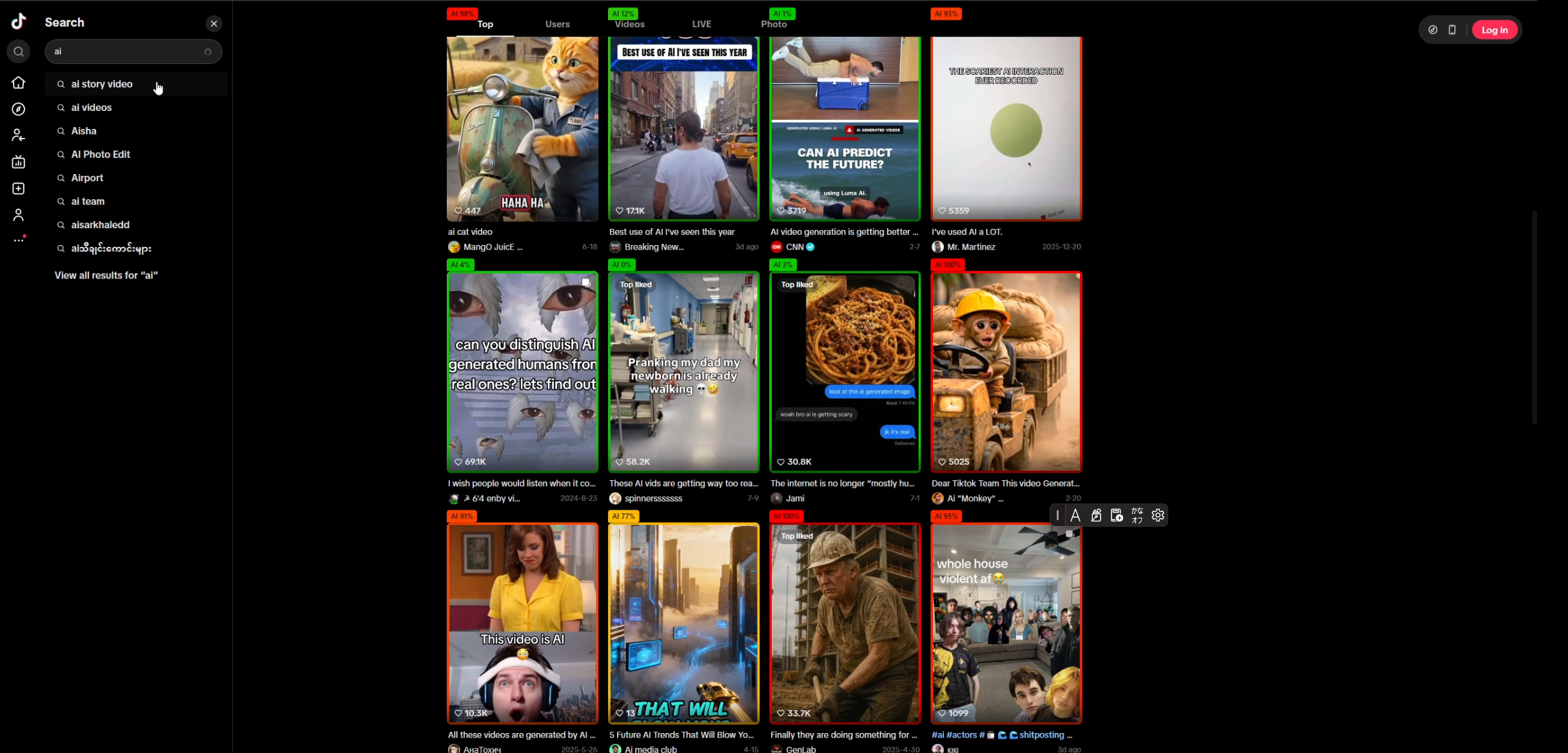
Simplicity extension running in real time in a webbrowser
-

Simplicity
-
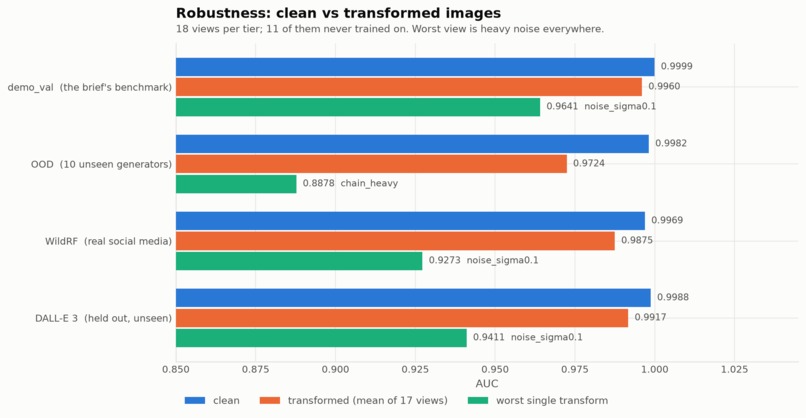
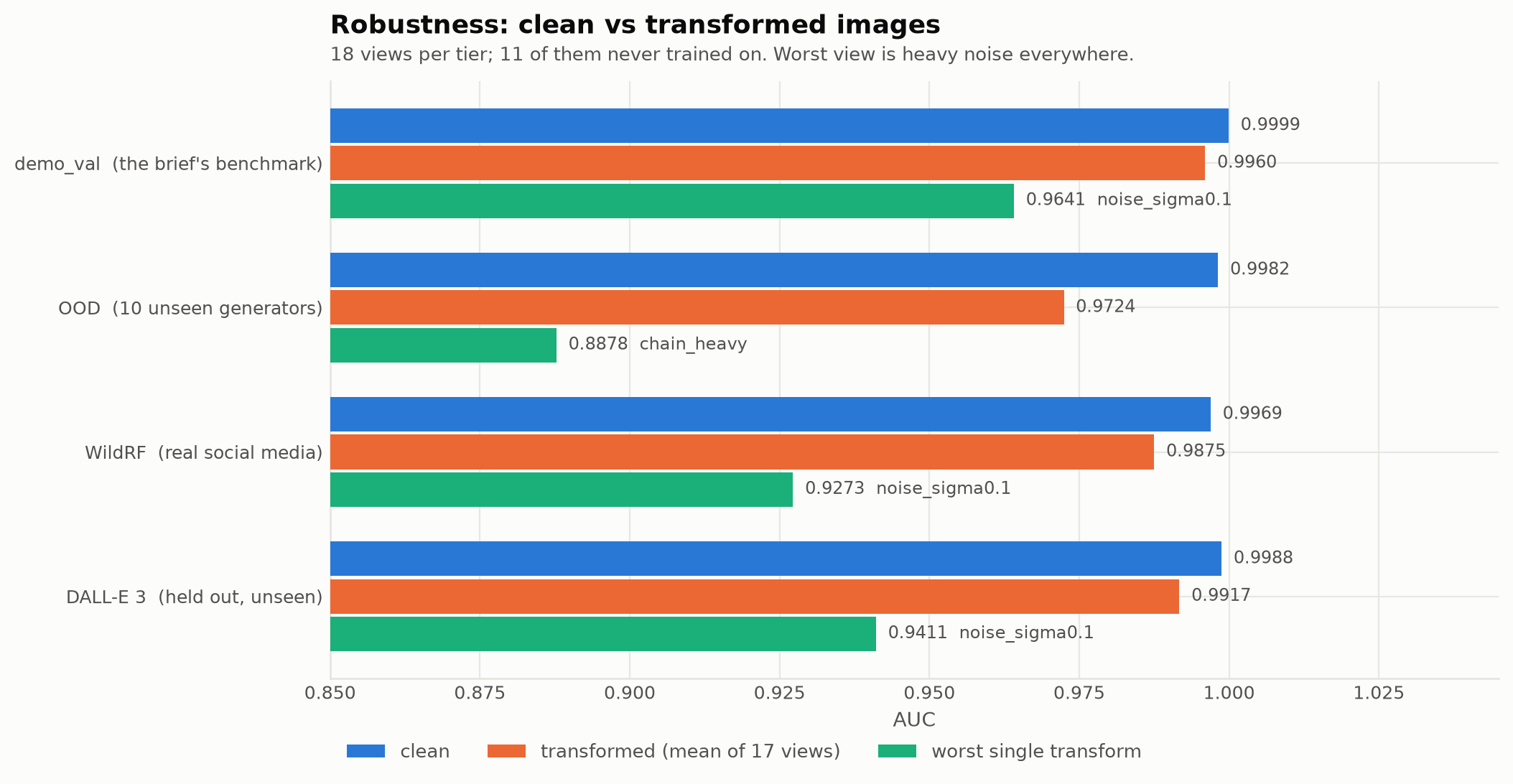
Validation performance. demo_val is the competition's COCO val2017 and DALLE Advanced dataset. The other three are self sourced
Simplicity
Simplicity is a modern AI image detection model that uses a linear classifier trained on the image embeddings of a vision foundation model to reliably detect AI images robustly across a range of adversarial transforms. Training data was augmented using the stated transforms to improve in the wild robustness. All images were ran through the backbone model to obtain embeddings which the linear classifier was then trained on.
Simplicity ships with a chrome extension that automatically identifies ai images in your browser as you browse and flags them for you
For more information on installation, usage, and setup see the demo video: https://www.youtube.com/watch?v=y0ximH3GmGM or the project page: https://github.com/not-sekiun/Simplicity
Tools: VS Code, git, uv (dependency + venv management).
Models: PE-Core-L (timm/vit_pe_core_large_patch14_336.fb), frozen. Raced against DINOv3-L and MetaCLIP2-H.
Libraries: PyTorch, torchvision, timm, HuggingFace datasets + hub, scikit-learn, pandas, NumPy, Pillow, tqdm; FastAPI + uvicorn for the demo.
Datasets: Tiny-GenImage (training + heldout), AIGC-Detection-Benchmark (OOD eval; a disjoint later slice for train_ext), SID_Set (reals), Unsplash (wtcherr/unsplash_5k), WildRF (arXiv:2406.09398), COCO val2017 + WildFake DALL·E Advanced (demo-val). Photoroom/midjourney-v6-recap, bitmind/nano-banana, OpenDatasets/dalle-3-dataset
Papers: "Simplicity Prevails" (arXiv:2602.01738) — the frozen-backbone + linear-probe recipe. UniversalFakeDetect, Ojha et al. CVPR 2023 — linear probes generalise where deep classifiers do not. WildRF, arXiv:2406.09398.

Log in or sign up for Devpost to join the conversation.