-
-
Overview
Inspiration
The inspiration for Simplicity Puzzle Hunt came from the desire to make blockchain technology and cryptography more engaging and accessible through gamification, and wanted to create something that would:
- Demonstrate Simplicity's real-world capabilities - Show that this emerging technology can handle actual value transfer in practical applications
- Bridge education and entertainment - Make learning cryptography and blockchain concepts exciting with real monetary incentives
- Revive the spirit of early Bitcoin puzzles - Honor the tradition of cryptographic challenges that helped grow the Bitcoin community
- Prove the power of trustless systems - Show how smart contracts can create fair, transparent games without intermediaries
We were inspired by classic cryptographic CTF competitions, Bitcoin's early treasure hunts, and the vision of a future where smart contracts are provably secure and mathematically verifiable. Simplicity Puzzle Hunt brings these ideas together into an interactive platform that's both educational and thrilling!
What it does
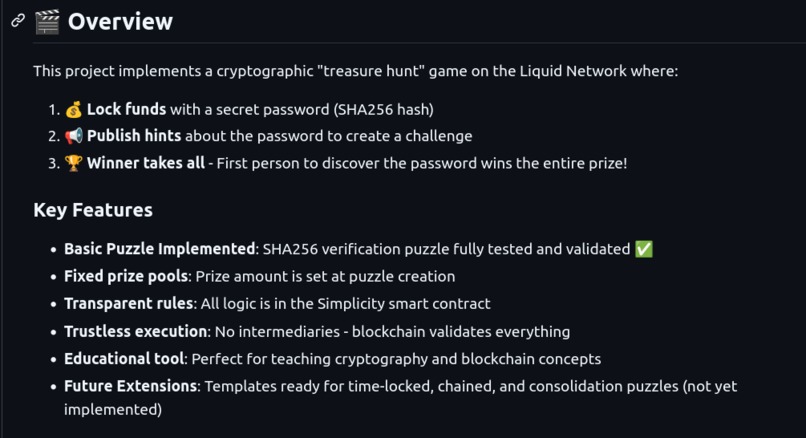
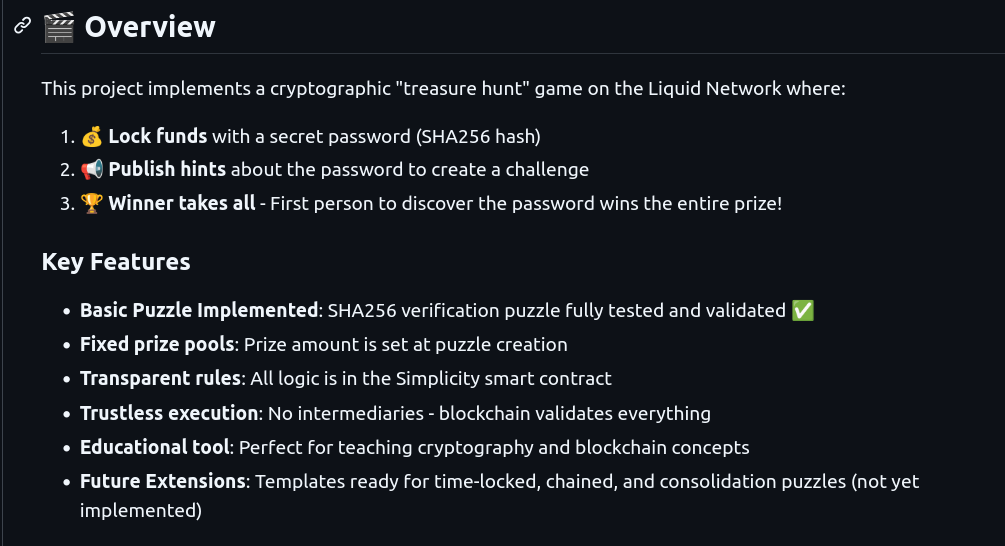
Simplicity Puzzle Hunt is an on-chain cryptographic treasure hunt game built on the Liquid Network using Simplicity smart contracts. It creates an exciting challenge where:
- Puzzle creators can lock funds (L-BTC) with a secret password protected by SHA256 hashing
- Puzzle solvers compete to discover the password based on published hints
- Winner takes all - The first person to find the correct secret claims the entire prize pool
- Trustless execution - Everything is validated by blockchain smart contracts, no intermediaries needed
The project implements a fully functional puzzle system where anyone can create cryptographic challenges with real monetary incentives, making it perfect for educational CTF competitions, marketing campaigns, or teaching blockchain and cryptography concepts.
How we built it
The project was built using a powerful stack of cutting-edge blockchain technologies:
- Rust programming language
- Simplicity smart contract language
- Elements Platform
- Liquid Network testnet
- Taproot (Contract Merkle Root)
The architecture consists of:
- Simplicity contracts (
puzzle_jackpot.simf) - Core contract logic for SHA256 verification - Rust CLI tools -
create_puzzle.rsandsolve_puzzle.rsbinaries for user interaction - Elements daemon integration - Direct blockchain communication for UTXO management and transaction broadcasting
- JSON-based puzzle storage - Public and private files for puzzle metadata management
- Taproot structure - Advanced Bitcoin scripting using Taproot's script tree for contract deployment
Challenges we ran into
- Simplicity Nature - In simplicity we have a limitation of non Turing complete that's limited the features we planned.
Accomplishments that we're proud of
Despite the challenges, we achieved several significant milestones:
- Successfully implemented and tested a complete SHA256 puzzle system on Liquid testnet
- Created intuitive CLI tools with beautiful, user-friendly output and comprehensive error handling
- Built a modular architecture that separates puzzle creation, solving, and management
- Developed 5 different puzzle contract templates (basic, time-locked, chained, consolidation, hybrid)
- Implemented robust secret format handling supporting strings, hex numbers, and hex byte strings
- Created an automatic puzzle management system with archiving capabilities for solved puzzles
- Established proper fee calculation and UTXO verification for production-ready transactions
- Built a configurable Elements wrapper making the project portable across different installations
What we learned
- Simplicity language fundamentals - Understanding witness values, parameters, jets (built-in functions), and CMR (Commitment Merkle Root)
- Taproot deep dive - How Bitcoin's Taproot works at a low level with script trees, leaf versions, and control blocks
- Elements/Liquid architecture - Confidential transactions, asset IDs, and how sidechains extend Bitcoin
What's next for Simplicity Puzzle Hunt
More Challenges, User Friendly Interface, Prepare the project to be viable in a "real-world" because it's proof of concept in this moment, Best Documentations, etc.
Built With
- elements
- liquid
- rust
- simplicity

Log in or sign up for Devpost to join the conversation.