-
-
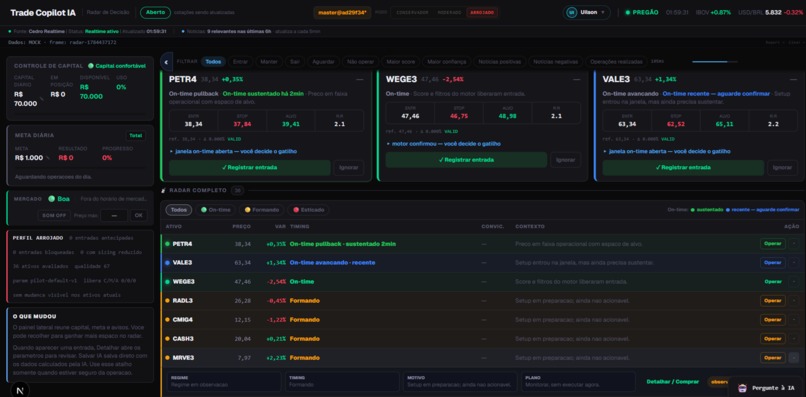
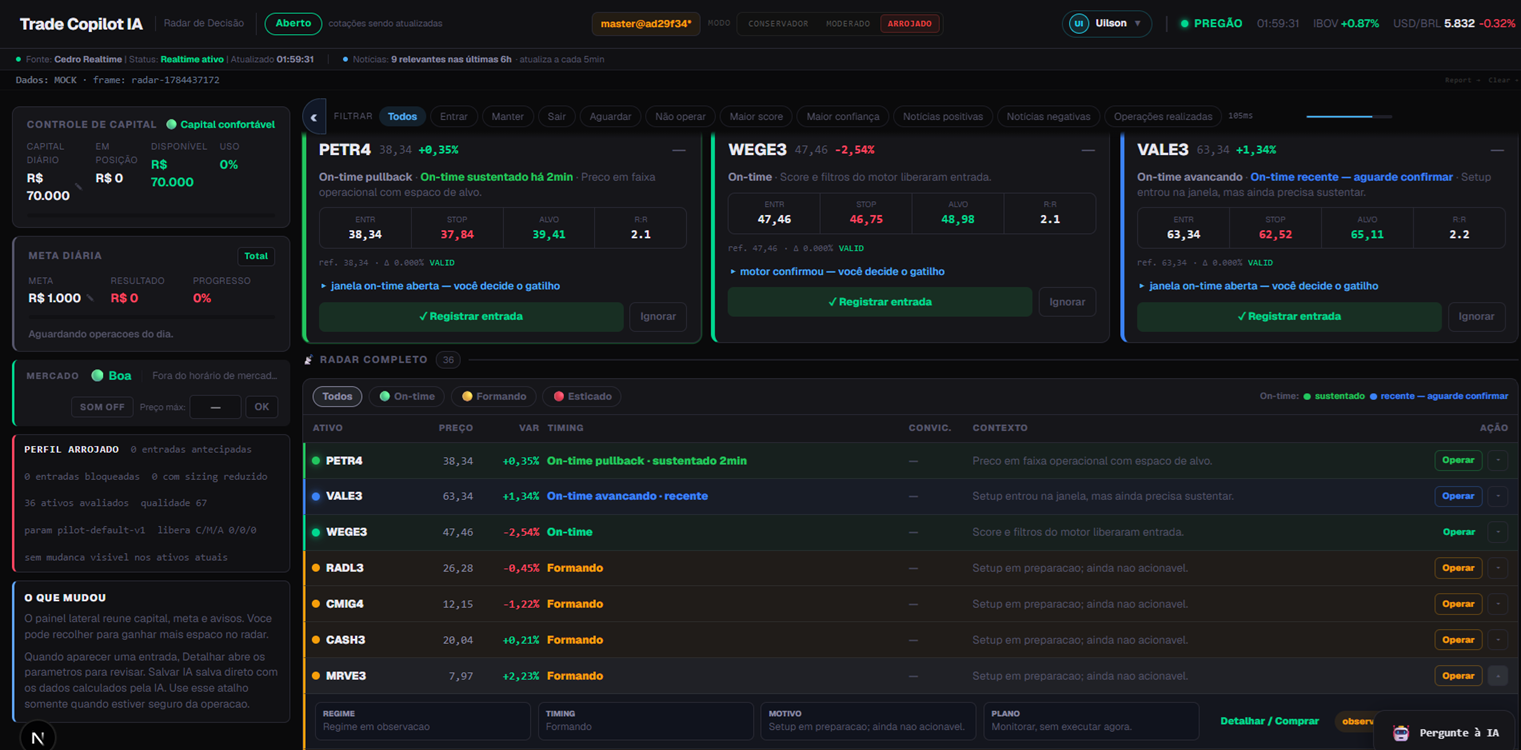
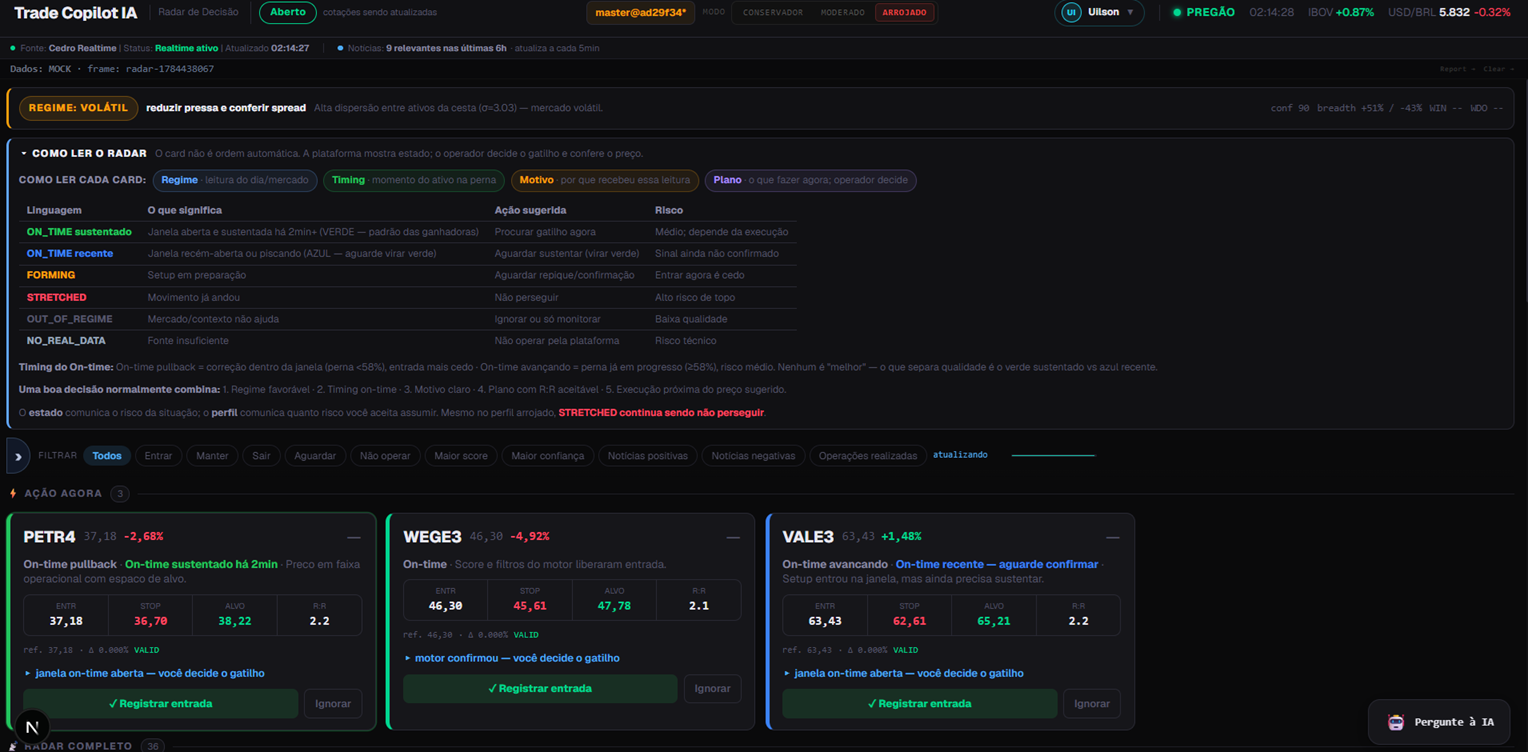
AI-assisted ON_TIME radar detecting actionable market windows before capital deployment.
-
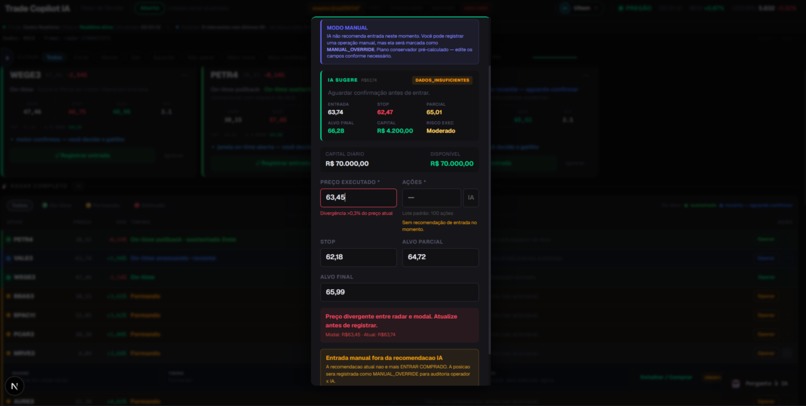
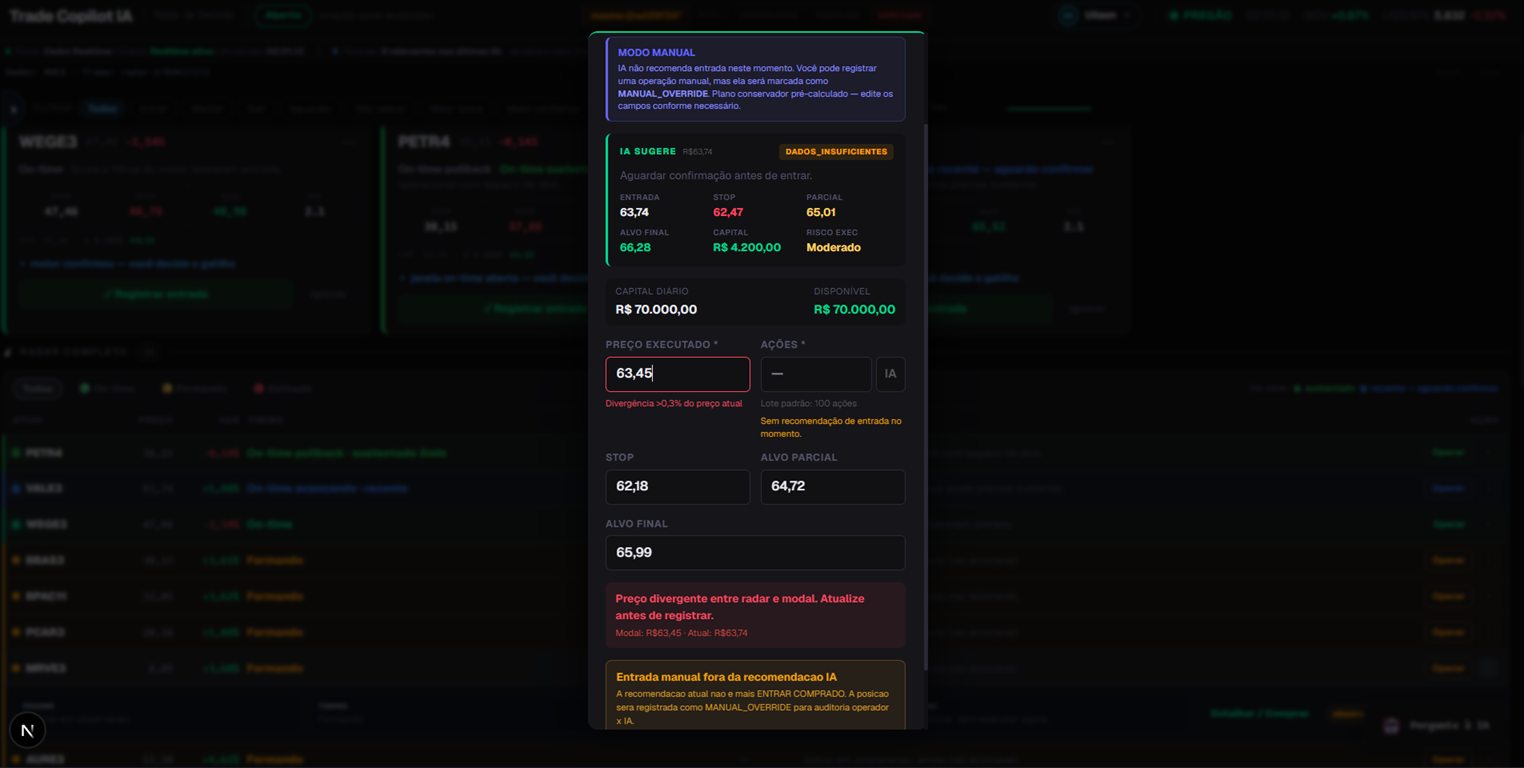
Human-in-the-loop trade registration with risk, entry, stop, and target validation.
-
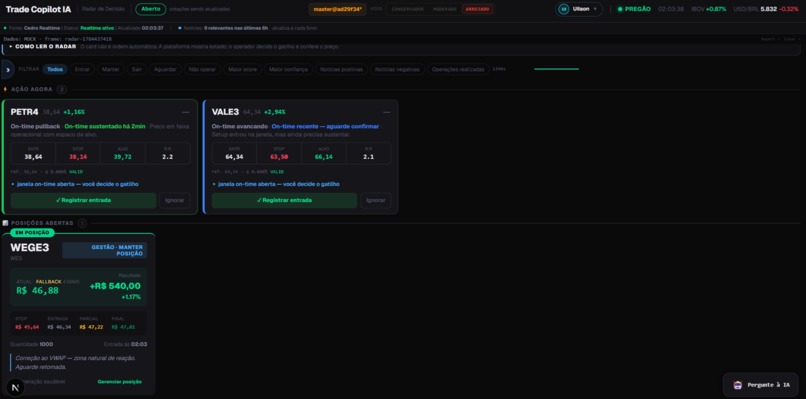
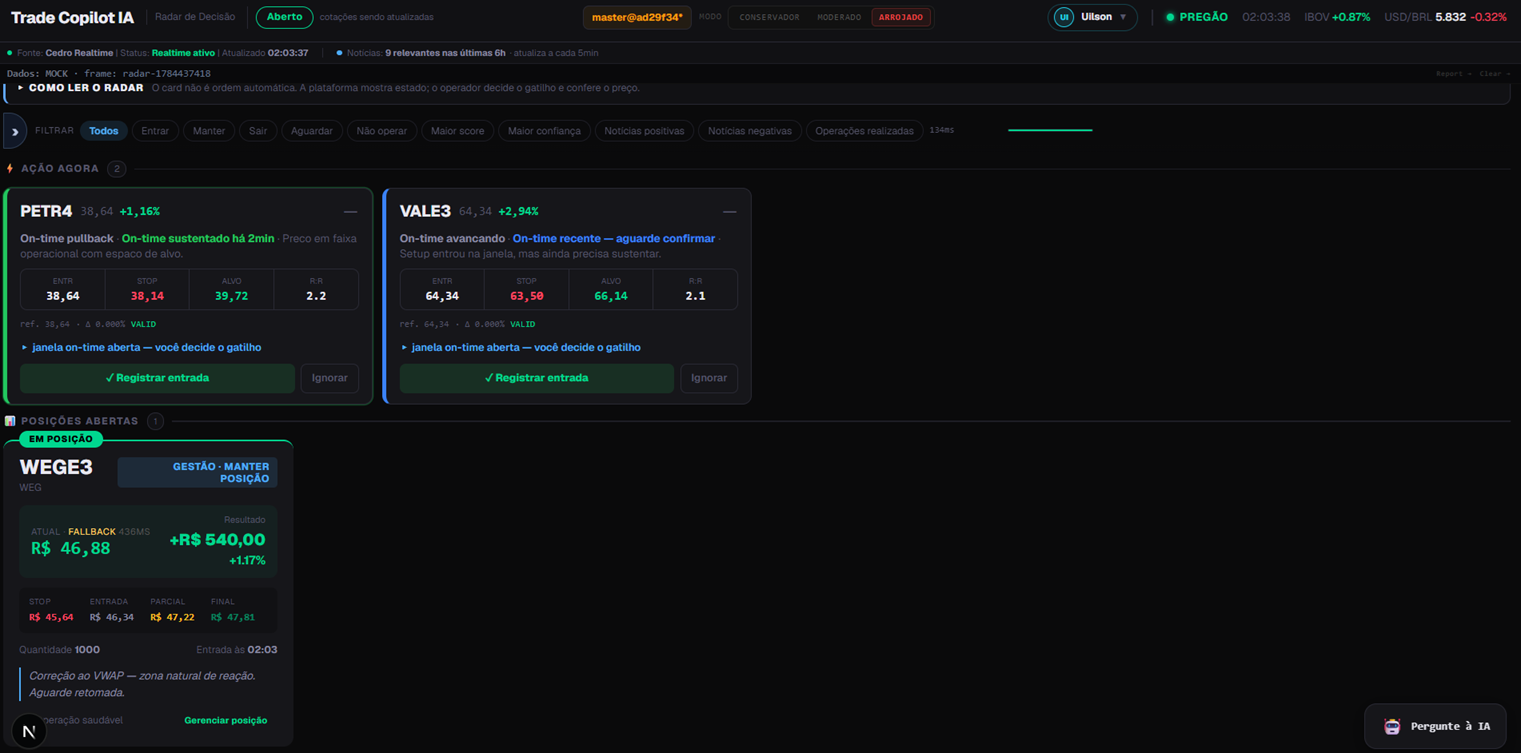
Live portfolio position cards tracking exposure, performance, risk, and trade status.
-
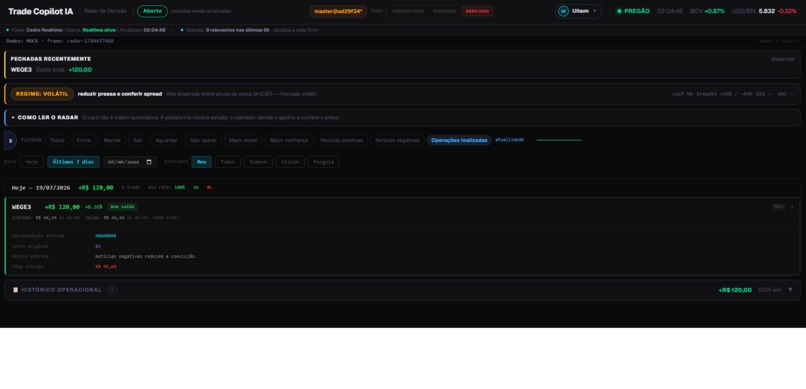
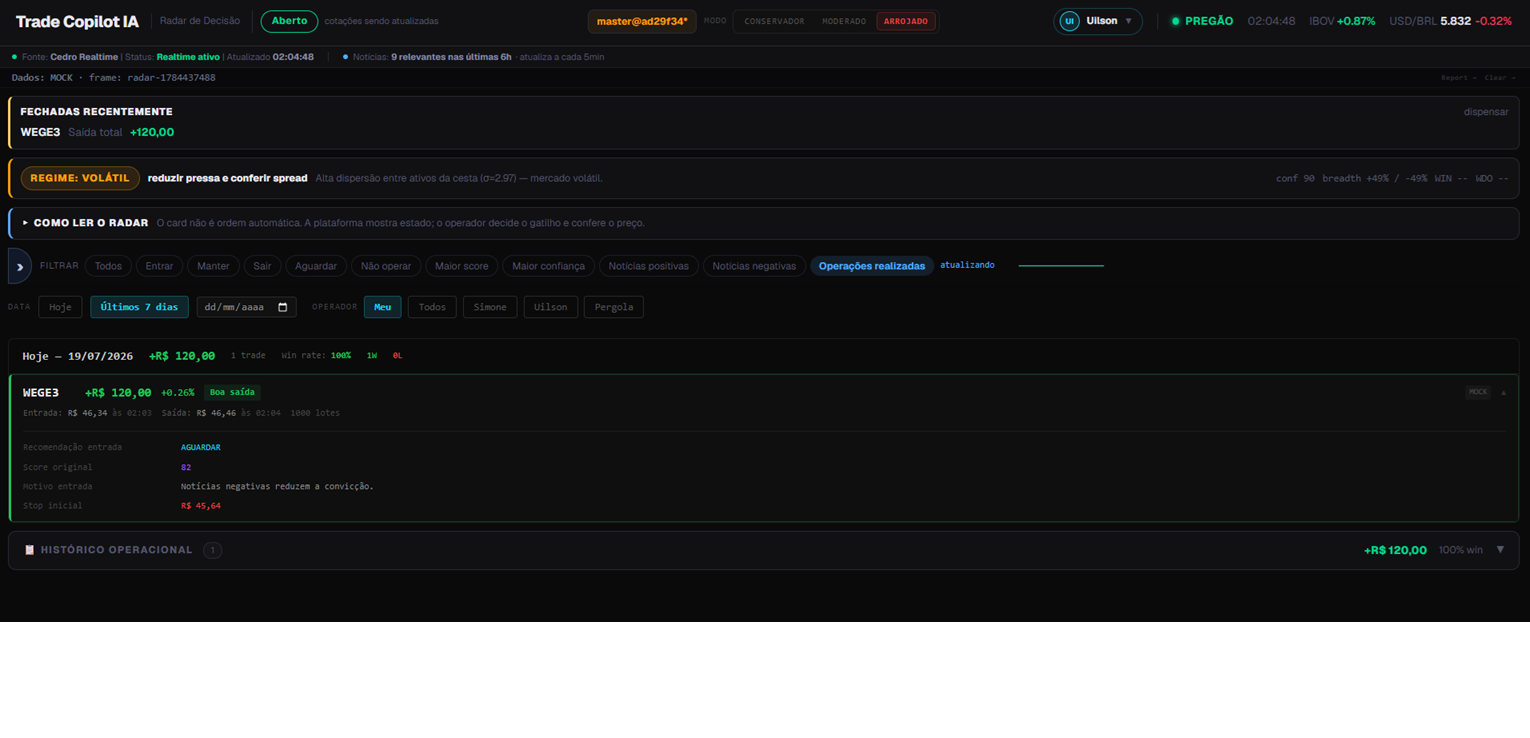
Structured operations log for monitoring entries, exits, outcomes, and execution history.
-
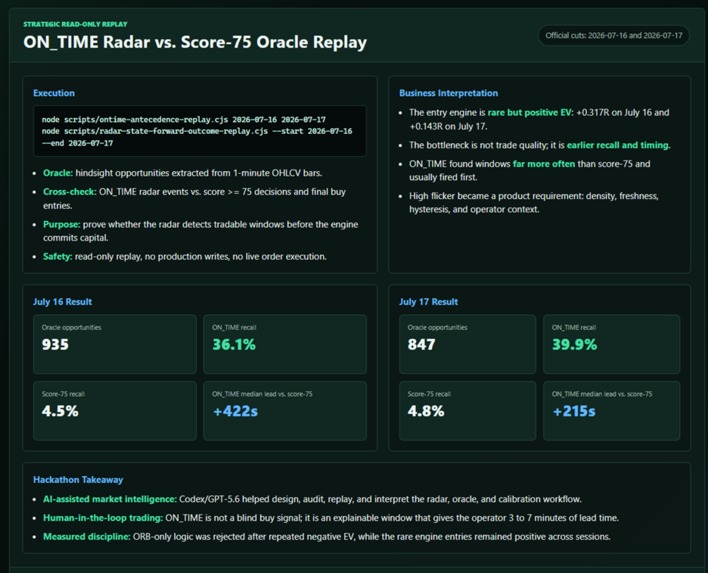
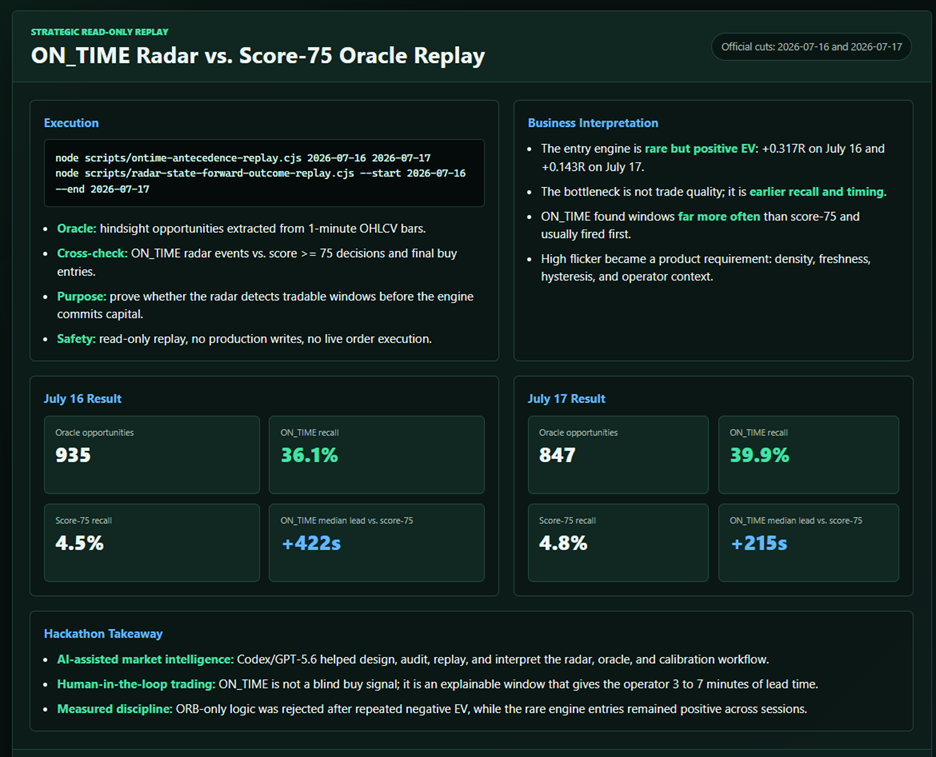
Read-only oracle replay measuring signal timing, recall, and market decision quality.
-
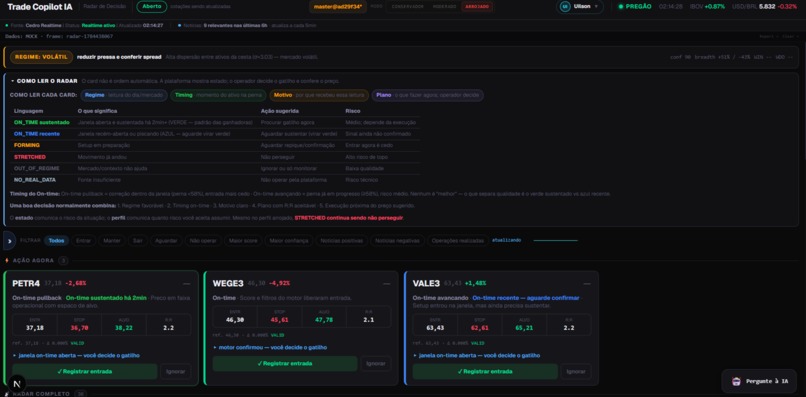
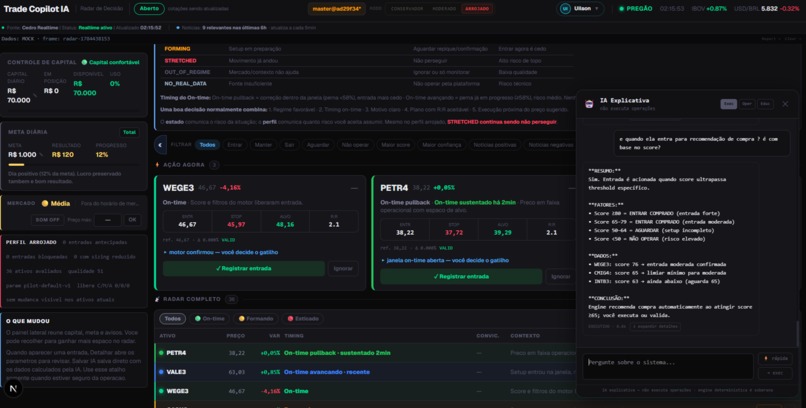
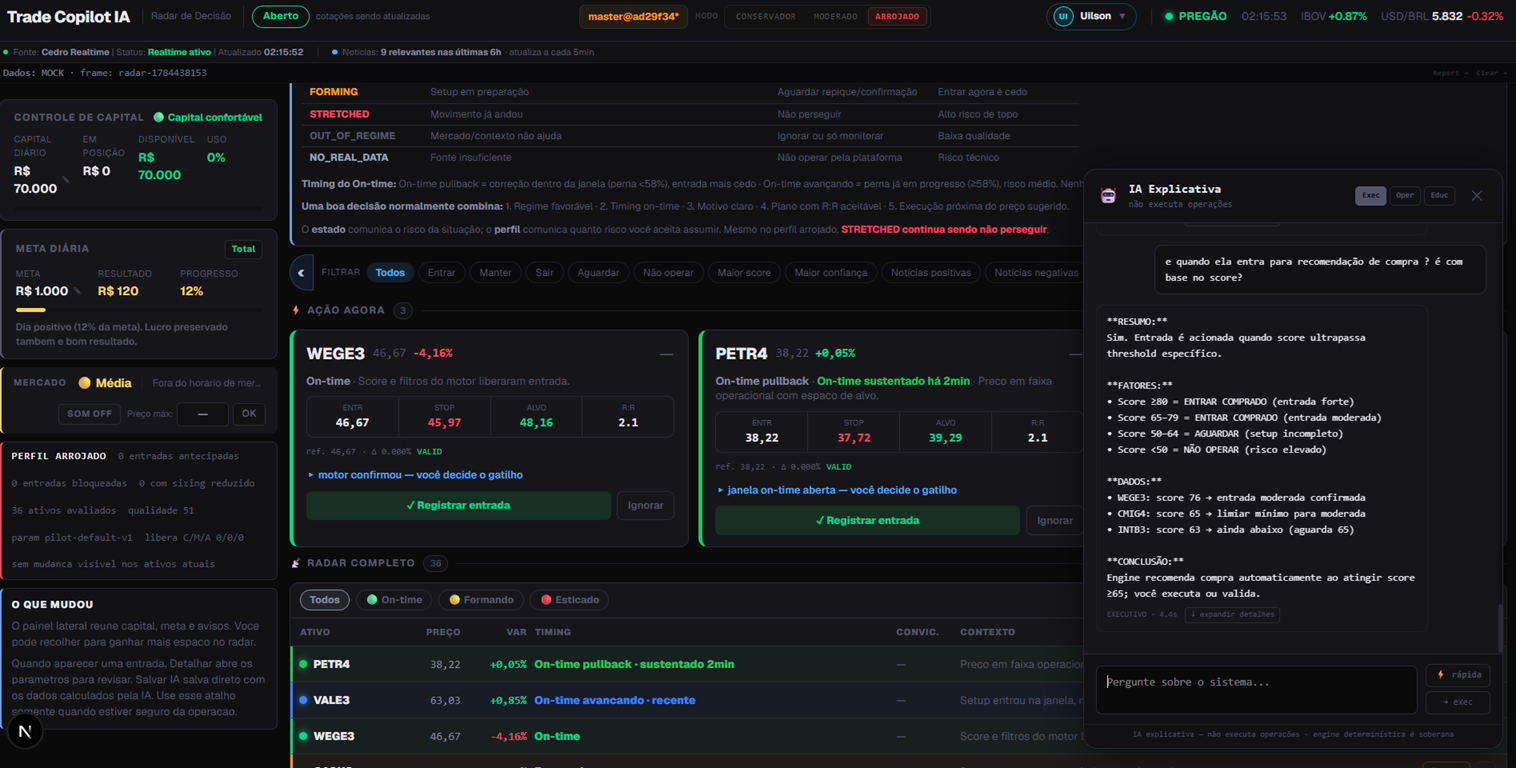
Conversational AI assistant for market context, platform guidance, and decision support.
-
Inspiration
Retail trading in Brazil is extremely difficult for ordinary people. Many individuals are exposed to oversimplified chart patterns, unrealistic promises, and emotional decision-making in a market that is fast, complex, and shaped by liquidity, spreads, slippage, institutional flow, and high-frequency behavior.
Simple Trade Copilot IA was created to make this complexity more understandable and safer to navigate. The goal is not to replace the human trader, but to protect the human operator with objective market context, risk controls, replay evidence, and explainable decision support.
On a personal level, this project is also a statement: this is not about being rusty.
I had not written production code since 2009, after moving into Software Engineering leadership. I am also the father of a beautiful autistic daughter, and my daily routine is divided between therapy sessions, school schedules, family responsibilities, and leadership work. Building something this sophisticated as a solo engineer under those constraints would not have been possible without AI.
OpenAI GPT models and Codex became force multipliers across engineering, auditing, product thinking, market analysis, replay validation, oracle design, and documentation. They helped turn vision, fragmented time, and domain knowledge into a working platform. This project demonstrates how AI can reopen the door to hands-on creation for people who have the ideas, discipline, and lived experience, but not unlimited time.
What it does
Simple Trade Copilot IA is a human-in-the-loop decision-support platform for B3 day trading. It does not execute autonomous trades. Instead, it helps the operator understand when the market is forming a possible opportunity, whether the timing is still valid, and how much risk is being taken before capital is deployed.
The platform works like an operational radar:
- ON_TIME Radar: monitors a diversified universe of Brazilian assets and classifies each symbol into operational states such as
FORMING,ON_TIME,STRETCHED, andENGINE_ACTIONABLE. - Contextual Decision Engine: combines price action, volatility, volume, trend location, market regime, and microstructure context to avoid late entries and overextended moves.
- Risk-Aware Trade Planning: calculates entry, stop, target, and position sizing based on a fixed monetary risk unit, so every trade can be evaluated before execution.
- Portfolio and Operation Tracking: shows active positions, daily capital context, executed operations, and current decision status in a single interface.
- AI Conversation Layer: allows the user to ask questions about market context, platform behavior, and operational reasoning without losing the trading workflow.
AI Safety Harness:** the conversational assistant is constrained by validated platform context. It can explain market states, risk, and workflow behavior, but it cannot execute trades, invent unsupported recommendations, or override deterministic risk gates
The current Build Week version is designed as a protective cockpit: the AI supports the decision, the platform exposes risk, and the human remains responsible for final action.
How I built it
The platform was built from scratch with a modern TypeScript stack and a strong emphasis on traceability, replayability, and operational safety.
- Application Layer: Next.js 16, React 19, and strict TypeScript power the web platform, dashboards, radar states, trade forms, and portfolio views.
- Market Data Layer: a Cedro Crystal integration ingests B3 market data through server-side infrastructure, including quotes, trades, candles, and microstructure-related signals.
- State and Decision Layer: the platform aggregates live data into canonical radar frames, OHLCV bars, contextual decisions, and explainable operational states.
- Storage Layer: SQLite with WAL support stores decisions, context snapshots, replay inputs, and historical evidence used for auditing and calibration.
- Replay and Oracle Layer: independent read-only scripts compare radar states and engine decisions against forward market outcomes, allowing the system to be evaluated with evidence instead of intuition.
- AI-Assisted Development: Codex and GPT were used throughout the process to implement features, review Claude-generated changes, audit prompts, refine business strategy, analyze market behavior, design replay/oracle logic, and maintain documentation.
For the demo, the platform can run in a controlled mock mode. This allows the judges to see radar states, trade registration, portfolio cards, oracle reports, and AI guidance without depending on live market hours or sending real orders.
Challenges I ran into
Building this as a solo project required solving technical, market, and product challenges at the same time.
- Market Data Reliability: early versions mixed real-time and stale data too easily. We had to introduce canonical radar frames, source tracking, freshness checks, and explicit stale-state handling so the operator could trust what the screen was showing.
- The 14GB WAL Incident: an early architecture logged too much raw tick data and caused the database WAL file to grow beyond 14GB during a single session. The solution was to throttle persistence, prune aggressively, and store only the information that mattered for decisions and replay.
- Late Signal Detection: classical breakout logic often appeared after the best part of the move had already happened. Replay analysis showed that waiting for traditional confirmation could create phase lag and expose the user to exhausted entries.
- Separating Signal Quality From Signal Frequency: the engine entries were rare but showed positive expectancy in replay. The problem was not only whether the engine could find good trades, but whether the radar could identify earlier actionable windows with enough context for the human operator.
- Human UX Under Pressure: trading interfaces can create anxiety if information moves too fast. The platform had to balance real-time updates with visual stability, explainability, and guardrails that reduce impulsive decisions.
Accomplishments that we're proud of
- ON_TIME Radar: we built a state-based radar that identifies operational windows before the final engine recommendation appears, giving the human operator more time to evaluate context.
- Replay and Oracle Evidence: read-only oracle replays showed that ON_TIME states captured market opportunities far more often than score-only engine entries and often appeared minutes earlier.
- Positive-EV Entry Discipline: while the engine is selective, replayed entry episodes showed positive expectancy across evaluated sessions, supporting the idea that quality and timing should be separated.
- Phantom Digital Twin: the platform includes a counterfactual shadow layer that evaluates strategies without risking real capital.
- Risk Gates and Economic Filters: the system can mute trades when reward-to-risk, resistance, stretched price action, or market regime make the setup unattractive.
- AI-Augmented Solo Execution: Codex and GPT helped a solo engineer build, audit, validate, document, and refine a platform that would normally require a broader engineering and research team.
What I learned
We learned that a trading assistant is not valuable because it produces more signals. It is valuable when it improves timing, context, discipline, and risk awareness.
- Price Alone Is Not Enough: candles show where price has been, but operational decisions also require liquidity, volatility, volume, market regime, and microstructure context.
- The Best Signal May Be a Window, Not a Command:
ON_TIMEis intentionally not a blind buy signal. It is an explainable window that tells the operator when an asset deserves attention before capital is committed. - Replay Beats Opinion: oracle and replay scripts changed the product direction. They showed which strategies had negative expectancy, which entries were too late, and where the radar added practical value.
- Human-in-the-Loop Is a Safety Feature: in financial decision-making, AI should support judgment, expose risk, and reduce cognitive load. It should not hide uncertainty or automate capital deployment without controls.
- AI Can Restore Creative Leverage: Codex and GPT made it possible to bridge a long gap away from daily coding and transform leadership experience, market knowledge, and limited time into a working product.
What's next for Simple Trade Copilot
- Security Hardening: add authentication, role-based access, audit logs, secret management, rate limits, broker-side controls, and production compliance reviews.
- Broker-Side Guardrails: keep autonomous trading disabled by default and require explicit human confirmation for capital deployment.
- Live Microstructure Shadowing: expand real-time capture of book depth, aggression, and liquidity pressure for deeper offline analysis.
- Adaptive Calibration: continue refining ON_TIME density, hysteresis, market-regime filters, and partial target behavior based on replay evidence.
- Multi-Setup Expansion: add more structured setups such as pullbacks near VWAP, support rejections, and regime-aware continuation patterns.
- Macro Veto Layers: use mini-index and mini-dollar behavior as contextual filters to avoid equity trades during broad market liquidation or currency stress.
Built With
- amazon-ec2
- apis
- machine-learning
- node.js
- phantom
- react
- sqlite
- tailwind
- typescript


Log in or sign up for Devpost to join the conversation.