Inspiration
AI assistants are already great places to develop ideas and write social posts. But getting those posts published often means copying text into another tool, adjusting it for each network, uploading media, and scheduling everything separately.
SimplePost closes that gap. Instead of adding another AI writer to a social media scheduler, it brings publishing to the AI assistant you already use.
The idea is simple: Your AI writes. SimplePost publishes.
What it does
SimplePost is an open-source social publishing platform for people, AI agents, and applications. It lets you preview, validate, publish, and schedule content across 11 social platforms, including X, LinkedIn, Instagram, Threads, and Bluesky.
You can work through an AI assistant using MCP, use the web scheduler directly, or integrate publishing into your own workflows through the TypeScript SDK, HTTP API, and CLI.
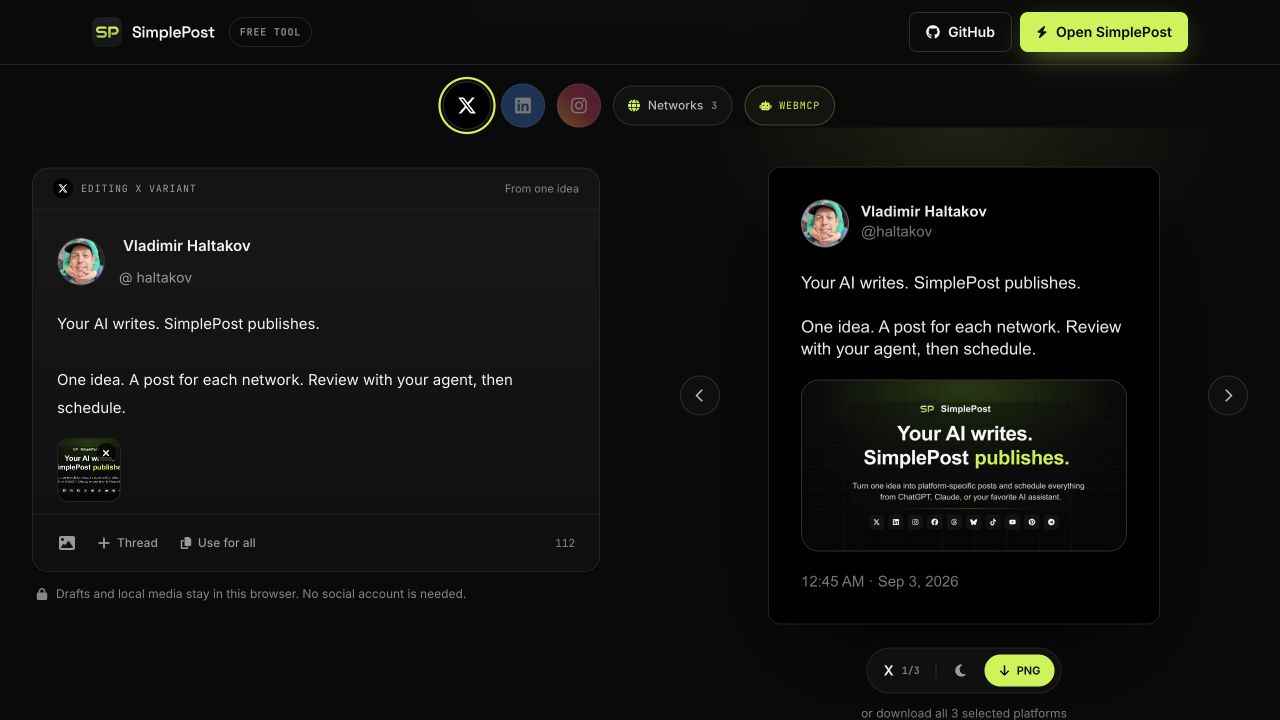
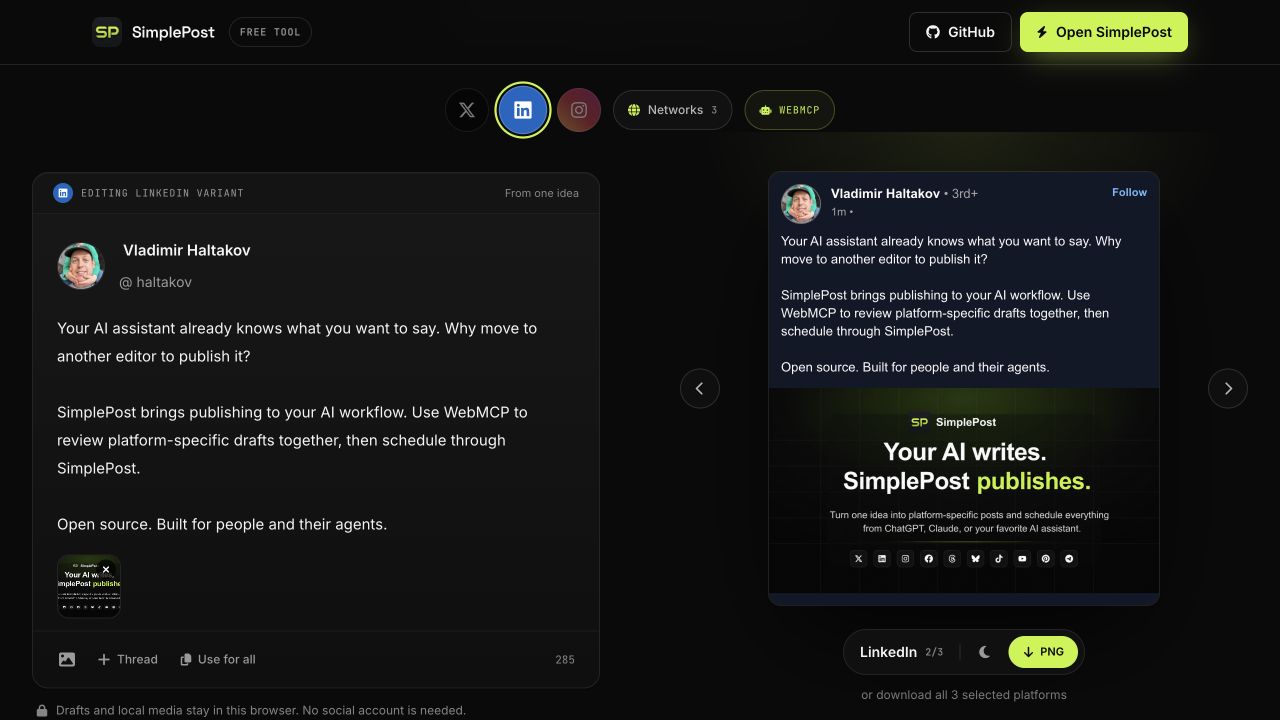
The goal is not to copy the same message everywhere. One idea can become several platform-specific posts, with different text, media, and thread structures.
Where WebMCP fits
WebMCP brings the person and their agent into the same visual workspace.
SimplePost’s free social media preview tool exposes structured tools that let a browser agent read the current drafts, render platform-specific versions, edit individual previews, configure profile details, and bring a particular preview into view.
For example, a user can ask:
Turn this launch announcement into posts for X, LinkedIn, and Instagram, then show me the previews.
The agent prepares the versions and renders them on the page. The user can edit them directly or ask for changes, such as shortening the X version or making the LinkedIn post more technical. Both work with the same underlying content.
The preview experience requires no signup or connected social accounts. Its WebMCP tools do not publish anything. After the user approves the content, the agent can retrieve a structured handoff for a separate, authenticated SimplePost publishing workflow.
WebMCP handles the shared browser workspace; the remote MCP server handles authenticated publishing and scheduling.
How I built it
SimplePost is built around a shared TypeScript SDK that handles platform-specific publishing. The web scheduler, HTTP API, CLI, and MCP server build on that foundation.
The web applications use Next.js and React, with PostgreSQL and Prisma supporting the scheduler’s persistent data. OAuth connects AI clients to the user’s SimplePost account without exposing raw social platform credentials to the assistant.
Social previews come from a separate open-source rendering library shared across the product. It supports platform-specific layouts, profile identities, text, images, videos, and threads.
The WebMCP integration connects structured tools directly to the preview page’s React state. Tool inputs are validated before changes are applied, and manual edits are reflected in the state the agent can read.
Challenges
One challenge is keeping a consistent publishing interface across platforms with different authentication flows, media requirements, content limits, and error responses. A shared SDK centralizes those differences without pretending every network works the same way.
Another is coordinating human and agent edits. The preview page needs to remain an ordinary, usable editor while also exposing meaningful operations to an agent. Both interaction paths update the same drafts, and changing a preview clears its previous approval.
A third challenge is separating experimentation from external actions. Preparing a preview should not accidentally publish a post. The public WebMCP tools stay local to the preview experience, while publishing requires a separate authenticated action.
What I learned
Building SimplePost reinforced that generating content is only one part of an AI-assisted workflow. Reviewing it, adapting it to its destination, and controlling what happens next matter just as much.
The WebMCP integration also highlighted the value of shared, visible state. An agent can do the repetitive work while the person sees the result, makes direct edits, and guides the next step.
That is the experience SimplePost aims to create: keep the AI assistant you prefer, make the publishing work easier, and stay involved in what goes out under your name.
Built With
- next.js
- postgresql
- tailwindcss
- typescript


Log in or sign up for Devpost to join the conversation.