-
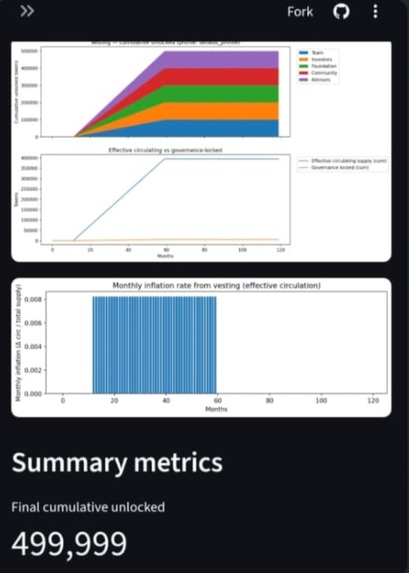
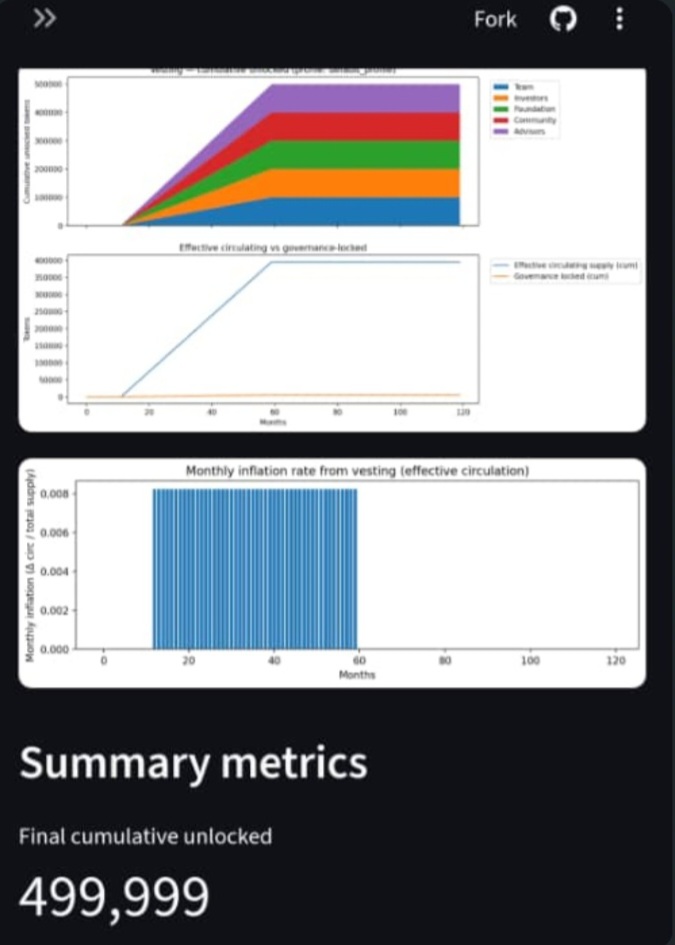
THE VESTING SIMULATOR RESULT.
Inspiration
One of the core goals of every protocol is sustainability. the ability to grow, reward participants, and remain valuable over time without collapsing from poor incentives or hype cycles.
In Web3, sustainability isn’t just about longevity. It’s about achieving economic balance, where every actor — users, builders, stakers, and investors is properly incentivized to act in ways that strengthen the ecosystem.
What Does Sustainability Mean? In simple terms, sustainability means a protocol can fund itself, reward its users, and maintain stability without relying on endless emissions or short-term speculation. It’s the point where the token economy becomes self-reinforcing, not self-destructive.
Yet, sustainability remains one of the biggest obstacles for Web3 protocols. Even with breakthrough technology, many projects fail economically because their token models can’t support long-term value creation. About 90% of startups fail and in Web3, poor tokenomics ranks among the biggest causes, alongside weak product–market fit and poor community engagement.
By 2023, trackers identified over 4,000 “dead coins”, mostly from Web3 and DeFi sectors.
65% collapsed due to broken incentive models that killed trading volume. 22.5% were scams or rug pulls, caused by misaligned team motives. 10% were short-lived ICOs with unsustainable token structures.
In 2022 alone, tokenomics-related failures caused over $790 million in investor losses across major projects.
Real-World Collapses
Terra (LUNA & UST): A $40B collapse after the stablecoin peg broke under unsustainable 20% yields. This is seen as the ultimate tokenomics failure.
Iron Finance (TITAN): Went from $1B to $0 in hours after a liquidity attack exposed hyperinflation.
Axie Infinity (SLP): Lost 99% of its value as reward emissions outpaced player growth.
Celsius (CEL): Collapsed under unsustainable returns and manipulation, freezing $190M in user funds.
Most of these collapses trace back to one key issue, the absence of effective economic modeling.
In Web3, Modeling Means Simulating how emissions affect price and liquidity. Testing how staking, burning, or rewards impact user retention. Forecasting sustainability under market or community stress.
The Two Major Barriers for effective modelling for founders is
- Lack of Awareness — Many founders don’t know how to model token economies effectively.
- High Cost — Professional modeling and simulation tools are expensive or inaccessible.
What it does
SIMLAB is a tokenomics simulation toolkit built to solve these problems.
It lets projects design, test, and visualize their token economies before deployment — making sustainability measurable, predictable, and transparent.
Model Vesting & Distribution Simulate how emissions and unlocks affect circulating supply over time.
Predict Token Survival Estimate how long a token can sustain value under different demand and activity levels.
Align Incentives Test reward structures for different ecosystem roles — users, builders, and validators.
Scenario Simulation Run “what if” tests on staking rates, inflation, burns, and protocol fees.
Real-Time Visualization View your token economy dynamics through interactive charts and dashboards.
How we built it
At its core, a token economy can be expressed as a dynamic system:
P_t = \frac{D_t}{S_t}
where:
= token price at time
= aggregate demand index
= circulating supply
The system’s sustainability depends on maintaining a balance between emission growth and demand growth:
\frac{dS}{dt} \leq \frac{dD}{dt}
If emissions outpace demand growth, price declines — triggering a downward feedback loop in user participation and liquidity.
Modeling allows founders to simulate these feedback effects before they happen.
Challenges we ran into
Modelling these type of variables requires maths and economic reasoning behind it and these variables can't be fully captured or fully modeled.
Also making it simple for a simple user to understand a parameter and what that parameter does and how it affects your decision making.
There are other factors that affects token economies that can't really be quantified so thus can't be modeled.
And it's currently in its prototype stage as it's not a full app yet but testing is live.
Accomplishments that we're proud of
Distribution has started and the feedbacks on it has been really great and the numbers are going up.
What we learned
I have learnt that at its current stage, modeling different projects in different sectors require different model structure and at its current stage it doesn't effectively do that as the parameters are all the same for any type of project.
What's next for SIMLAB
Modelling different scenarios just to pick the most favorable isn't enough. By studying historical data of various unsuccessful and successful protocols in different sectors and their token structures, it builds a model that's effectively able to give advise and counsel you on modeling your token economy based on the type of protocol and sector you want to build in, making it Smart. SIMLAB specifically for your needs
Built With
- python
- streamlit

Log in or sign up for Devpost to join the conversation.