-
-
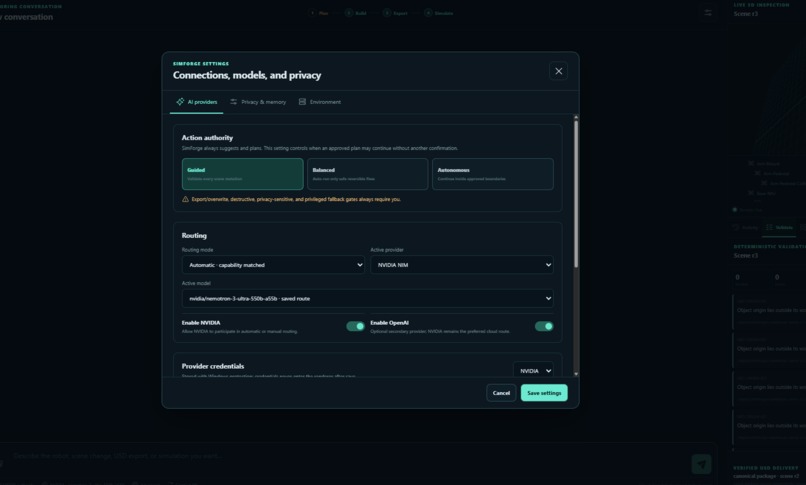
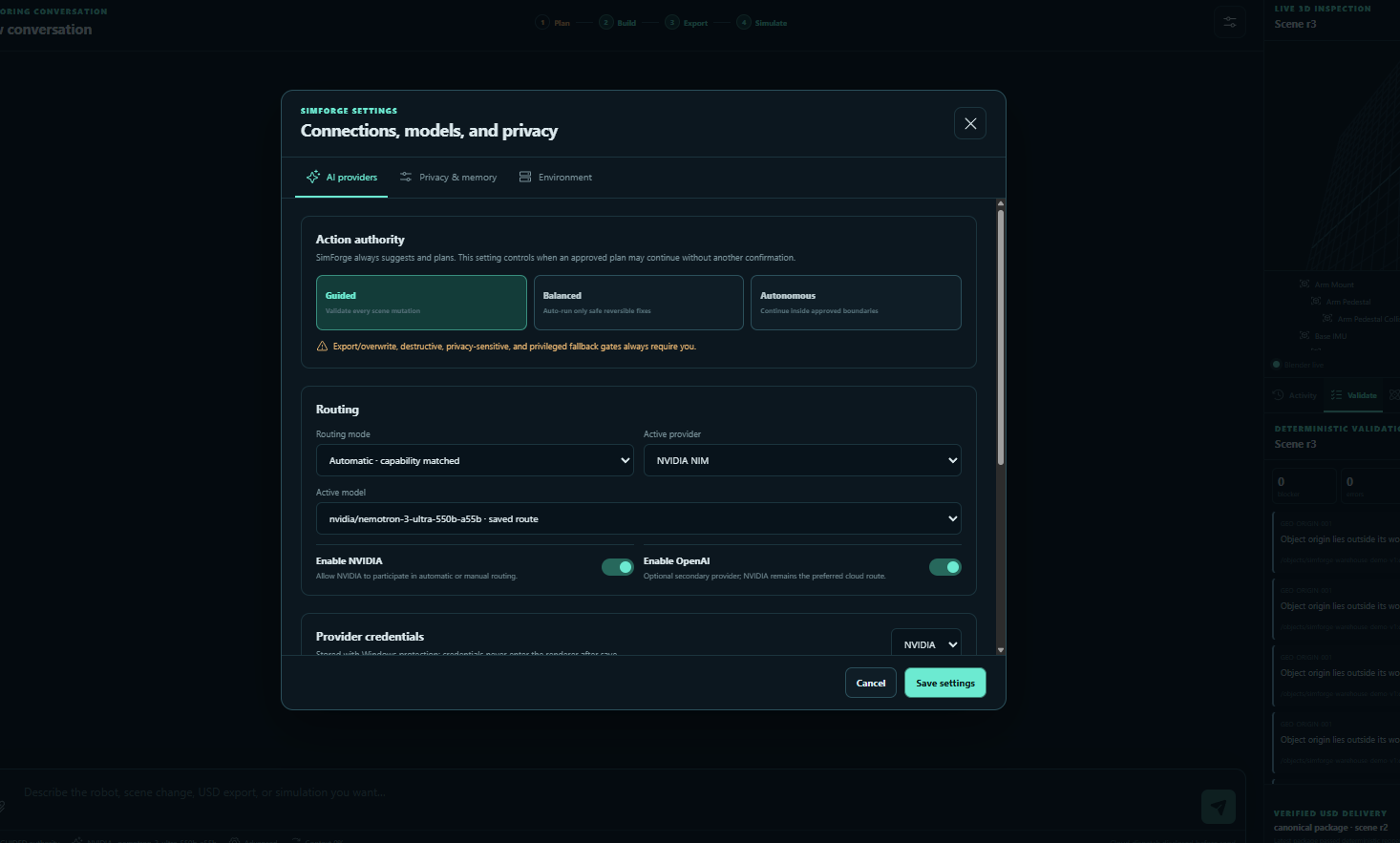
AI providers (nvidia free api default)
-
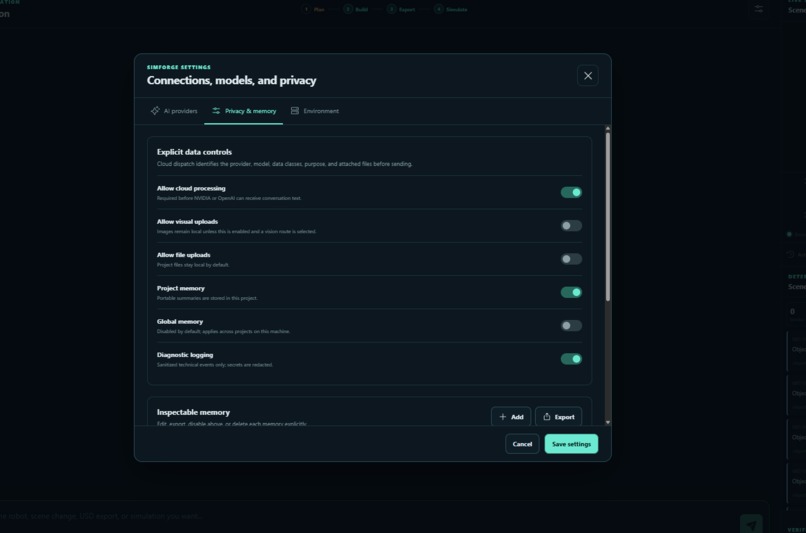
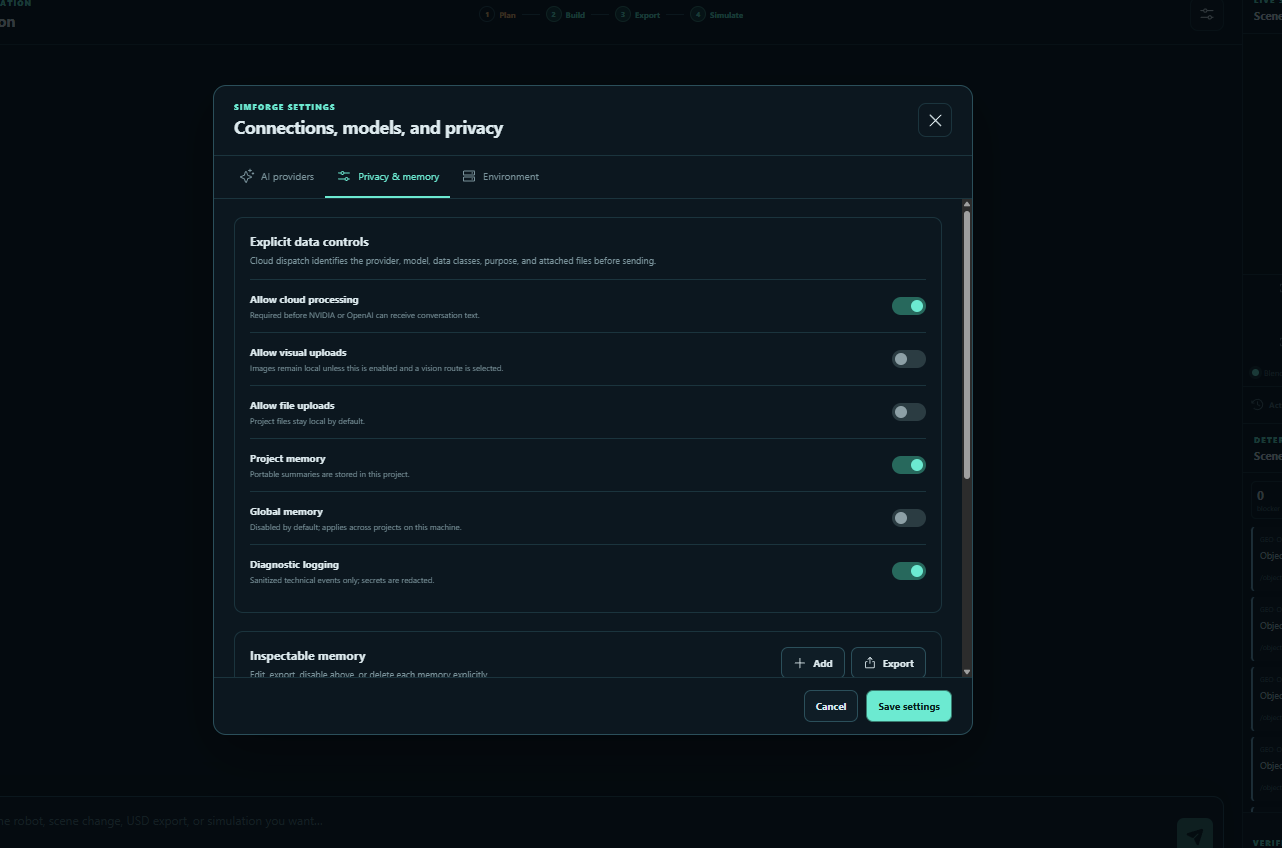
privacy and memory settings
-
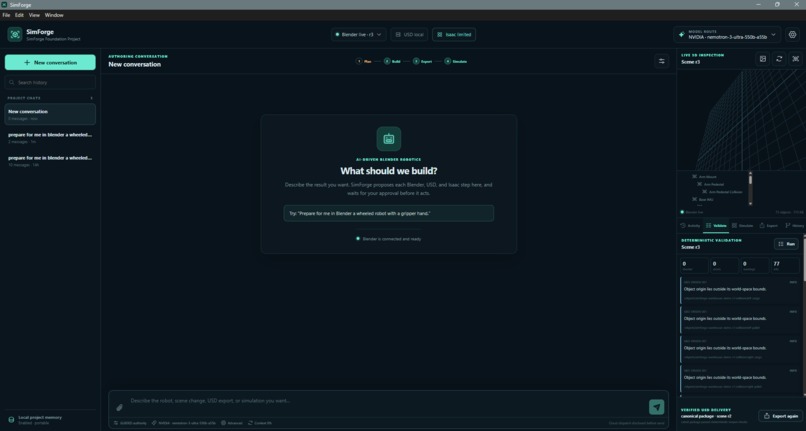
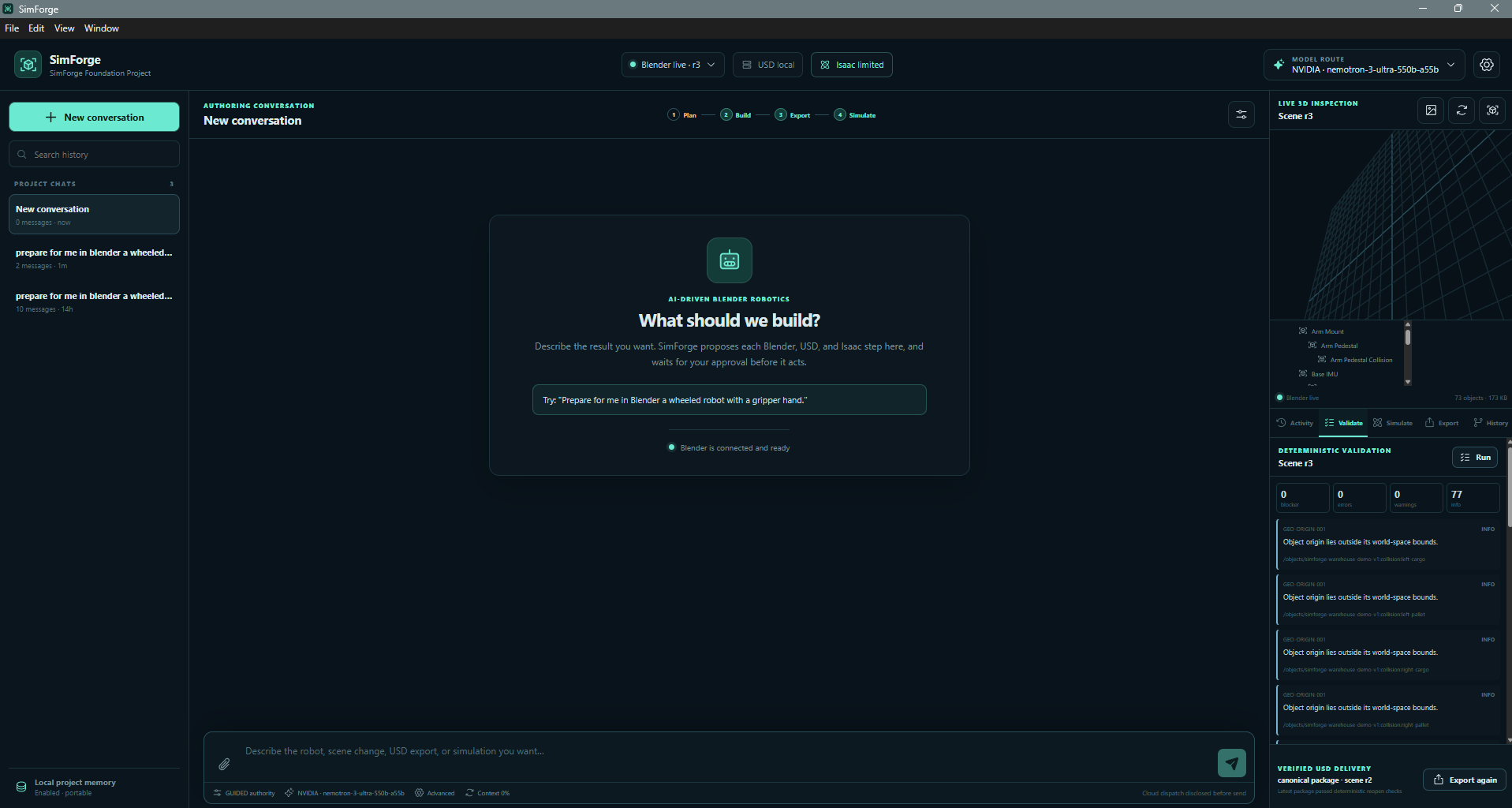
Main Simforge
-
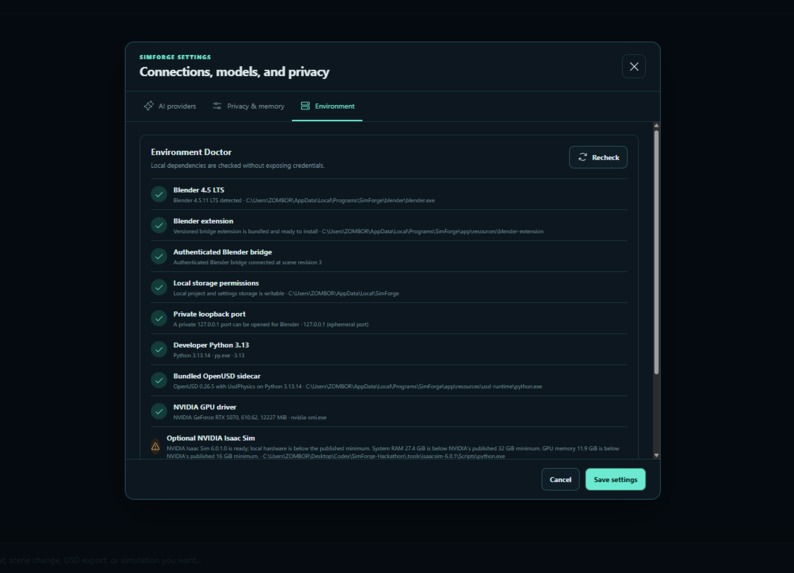
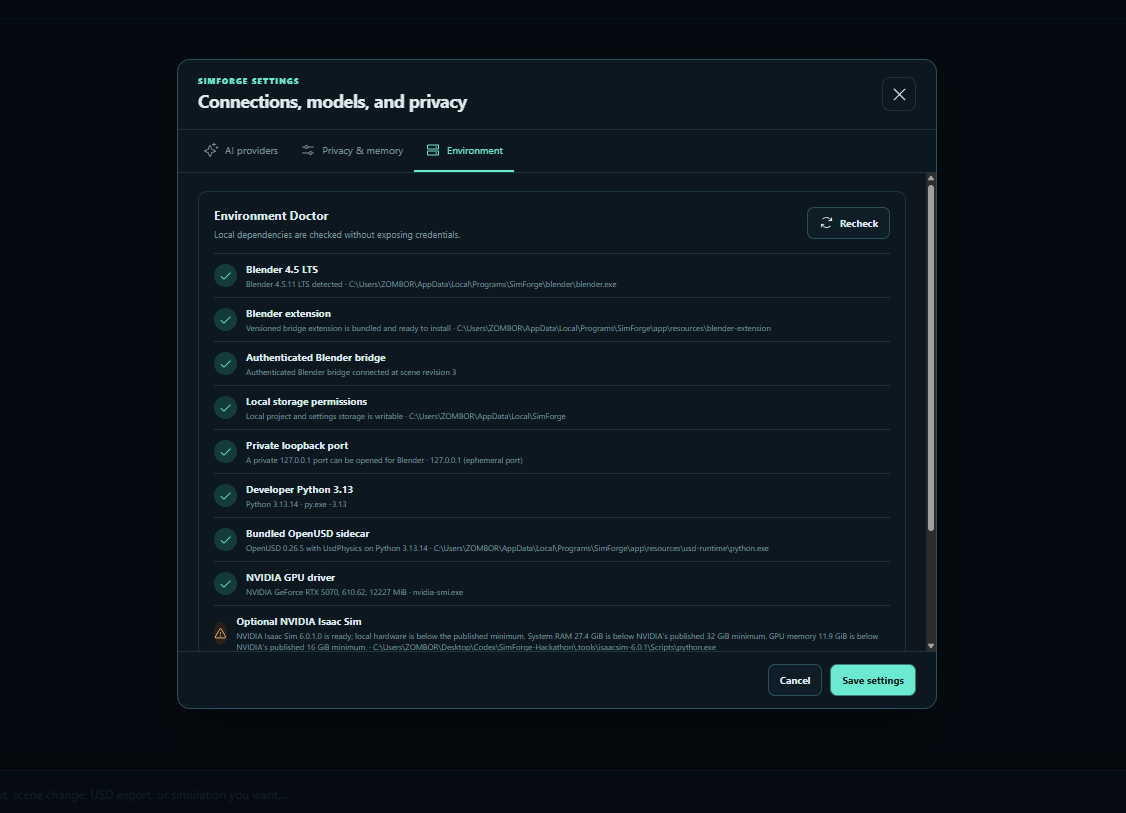
environment checks
-
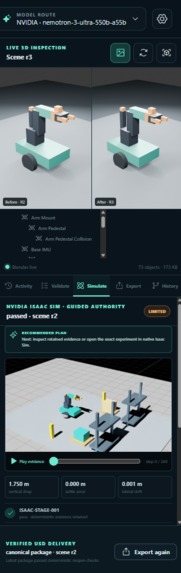
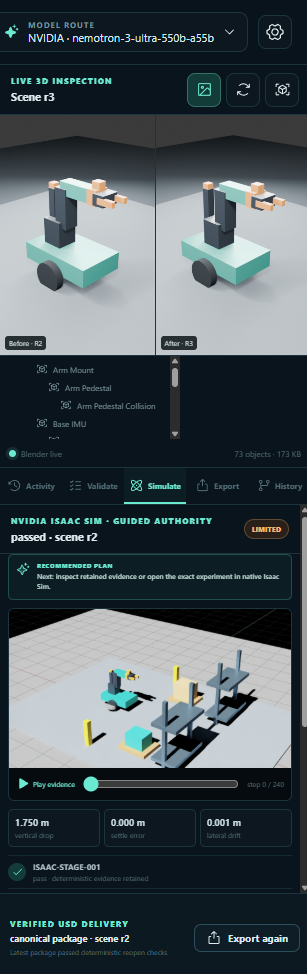
Side panel with view 3d ports and replays
-
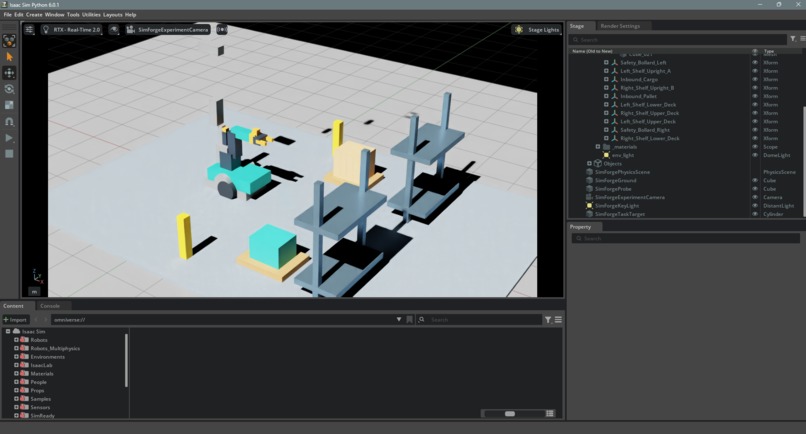
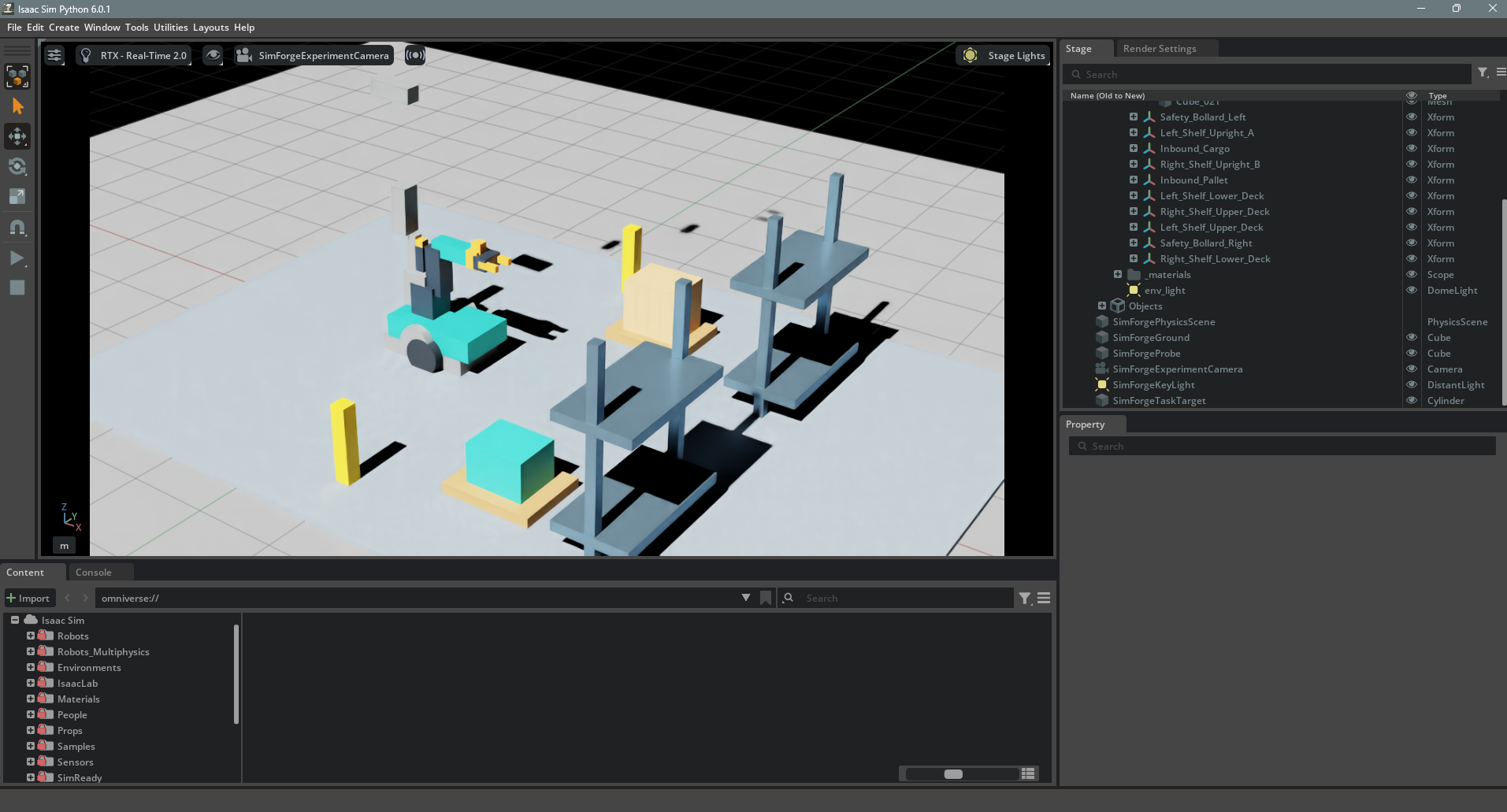
isaac sim view
-
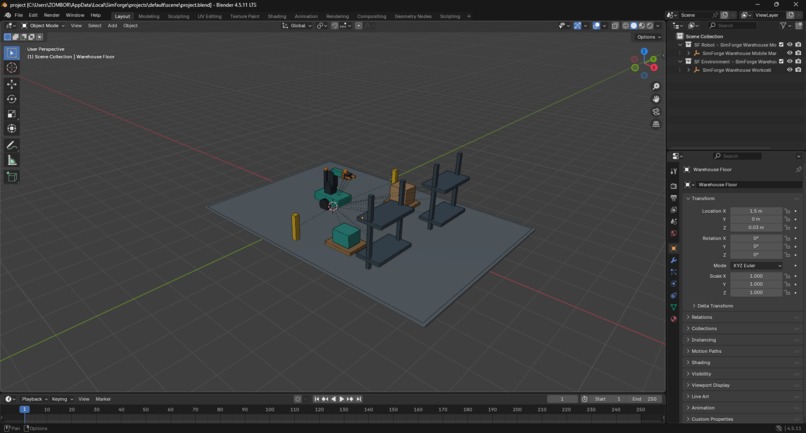
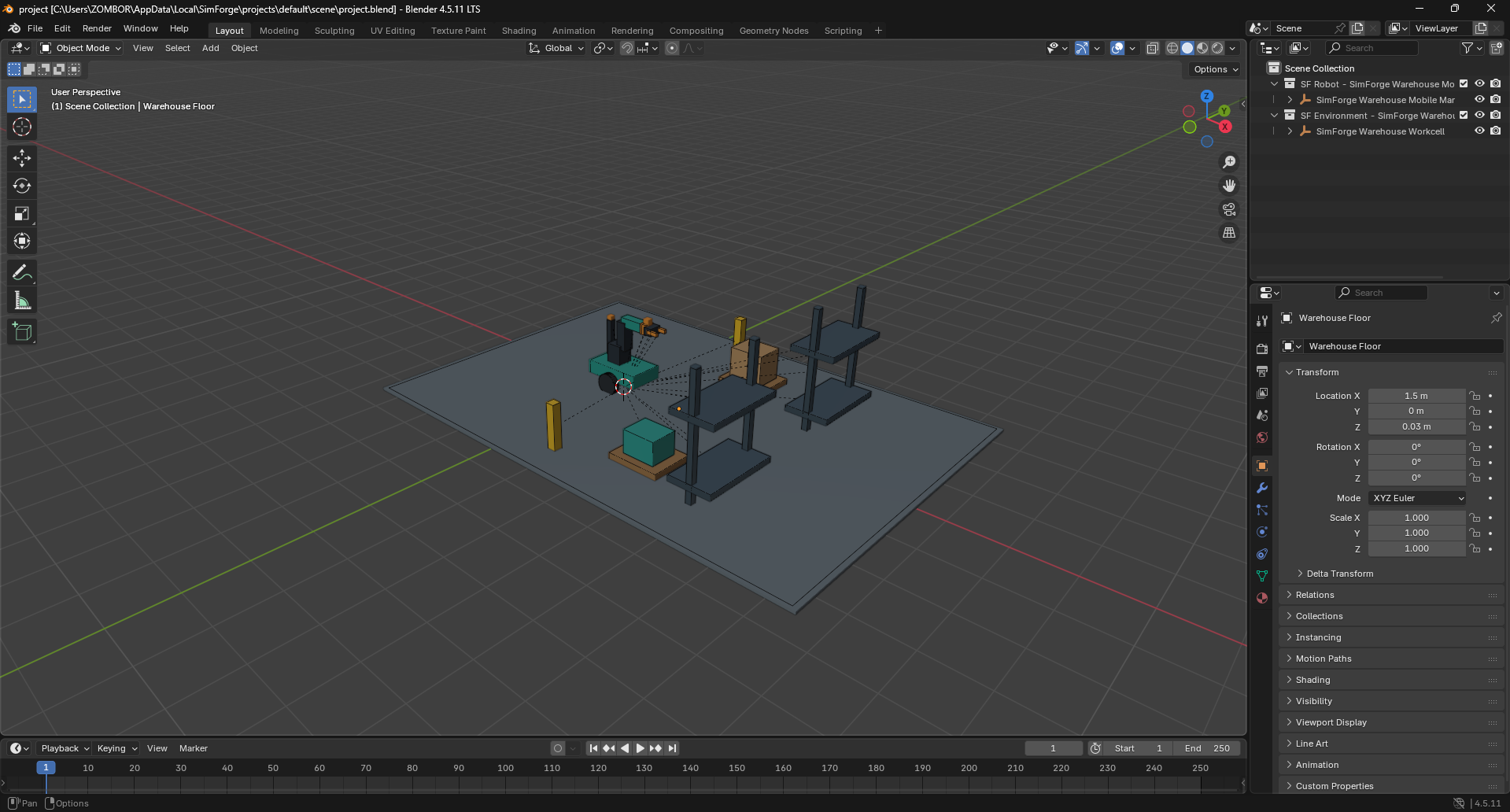
Blender view
Inspiration
We reject the assumption that the future of robotics must look like us. The human body is not an engineering optimum. It is an evolutionary compromise: fragile joints, limited strength, poor stability, inefficient movement, and a shape produced by millions of years of survival .. not by the requirements of warehouses, farms, hospitals, factories, oceans, space, or disaster zones. So why are we trying to reproduce it everywhere? The future is not one robot trying to do everything. The future is the right machine for the right task. But today, designing that machine is painfully fragmented. A creator must jump between Blender, scripts, collision setup, physics configuration, USD packaging, and simulation software. Every handoff can silently destroy information. Every iteration demands specialized knowledge. AI can generate attractive geometry, but attractive geometry is not a robot and a model saying that something works is not engineering evidence.
SimForge is our attempt to change that. Our long-term goal is a human-controlled loop that begins with a task and searches toward the robot best suited to perform it: Imagine. Build. Validate. Simulate. Fail. Learn. Evolve.
What it does
SimForge turns human intent into an engineering process that can be seen, inspected, challenged, and approved. In the demo, a user asks for a wheeled robot with a gripper. SimForge proposes a plan, waits for approval, then creates the robot and warehouse workcell directly in Blender. It records a checkpoint, validates geometry and robotics metadata, exports a modular OpenUSD package with physics layers, reopens that package to verify it, and sends it to NVIDIA Isaac Sim. The first simulation exposes a real stability issue. SimForge explains the deterministic evidence, proposes a bounded Blender correction, waits for approval, re-exports the corrected USD package, and reruns the simulation to a passing waypoint result.
How we built it
SimForge is a Windows desktop application built with Electron, TypeScript, React, SQLite, Blender 4.5 LTS, OpenUSD, Python, and NVIDIA Isaac Sim. A sandboxed desktop renderer communicates through narrow validated IPC with a local main process. A Blender extension uses an authenticated loopback bridge for structured scene operations. Blender remains the visual source of truth; deterministic validation and OpenUSD reopen checks provide the engineering evidence. NVIDIA/Nemotron is the primary demo route. SimForge also includes an optional OpenAI Responses API provider: when a compatible GPT-5.6 model is available at runtime, it can be selected as a provider-neutral planning/chat model. The recorded demo uses NVIDIA free api; no model is allowed to silently mutate Blender, export, or simulate.
Challenges we ran into
The hardest problem was not generating a robot. The hardest problem was making multiple complex engineering systems feel like one tool. Blender, OpenUSD, simulation platforms, AI providers, physics schemas, and desktop security were never designed to behave as one continuous experience. Each speaks a different language. Each introduces its own failure states. SimForge had to become the bridge. We also learned that simplicity is expensive. A clean four-stage interface Plan, Build, Export, and Simulate requires a large amount of architecture underneath it. The workflow still needs polishing, and dependence on large external applications remains a barrier. We want to move toward a system where creators spend less time installing, configuring, and translating and more time inventing.
Accomplishments that we're proud of
Three days ago, SimForge did not exist. Now, a person can describe a robot in ordinary language and watch it become a structured 3D design inside Blender. That design can receive joints, collision geometry, sensors, materials, and physics metadata. It can become a modular OpenUSD package. That package can be reopened and verified. It can enter NVIDIA Isaac Sim. It can fail. A much needed failure, because it gives evidence. That collected evidence can produce a correction. And the corrected robot can return to simulation and pass. We built the beginning of an idea-to-physics loop in three days. We see so much more that needs to exist that it is difficult to pause and feel proud. But for one moment, watching an idea leave language, acquire a body, collide with physics, fail, change, and succeed felt like seeing the first movement of something much larger.
What we learned
Robotics has accumulated complexity for decades. Some of that complexity is real. Physics is real. Geometry is real. Safety is real. But some of it is simply inherited friction. A process does not become correct because experts have tolerated it for years. Complexity does not become valuable because someone built an identity around mastering it.
When knowledge is guarded by unnecessary interfaces, inaccessible workflows, and normalized inconvenience, technology stops serving the greater cause and begins protecting its gatekeepers.
SimForge is built on the opposite belief:
Deep technology should become easier to command without becoming less rigorous.
The future of robotics should not belong only to people who have spent years learning where every hidden parameter lives. It should also belong to the person who sees a problem, imagines a machine, and dares to ask:
Why does this robot not exist yet?
What's next for SimForge Evolve
Our next target is an end-to-end ROBOTICS TOPOLOGY OPTIMIZATION.
Imagine standing inside a warehouse, farm, home, laboratory, or disaster site. You take out your phone. You film the environment. Then you describe the outcome:
Move these objects safely between these two locations. Inspect this pipe without stopping production. Harvest this crop without damaging it. Reach this collapsed area without risking another human life.
You upload the footage and the task to SimForge.
The system reconstructs the environment, identifies constraints, and begins generating robot candidates. Different bodies. Different wheels, legs, arms, grippers, sensors, materials, and centers of gravity. Each candidate enters simulation. Each is tested. Each is broken by edge cases. Each failure becomes information. The weak designs disappear. The stronger designs evolve.
Around thirty minutes later, SimForge presents the designs that performed best, not because an AI said they looked correct, but because geometry, physics, simulation, and stress tests produced proof.
Our final product is not a 3D model. It is not a chatbot. It is not another humanoid.
Our product is the shortest path between a human need and the machine best designed to serve it.
Do not force the world to adapt to the robot. Evolve the robot until reality has nothing left to reject.


Log in or sign up for Devpost to join the conversation.