◉ SIMBIONTE
A work of art that is not a picture, but a population. Made with code, noise, and the conviction that art should breathe.
At a Glance
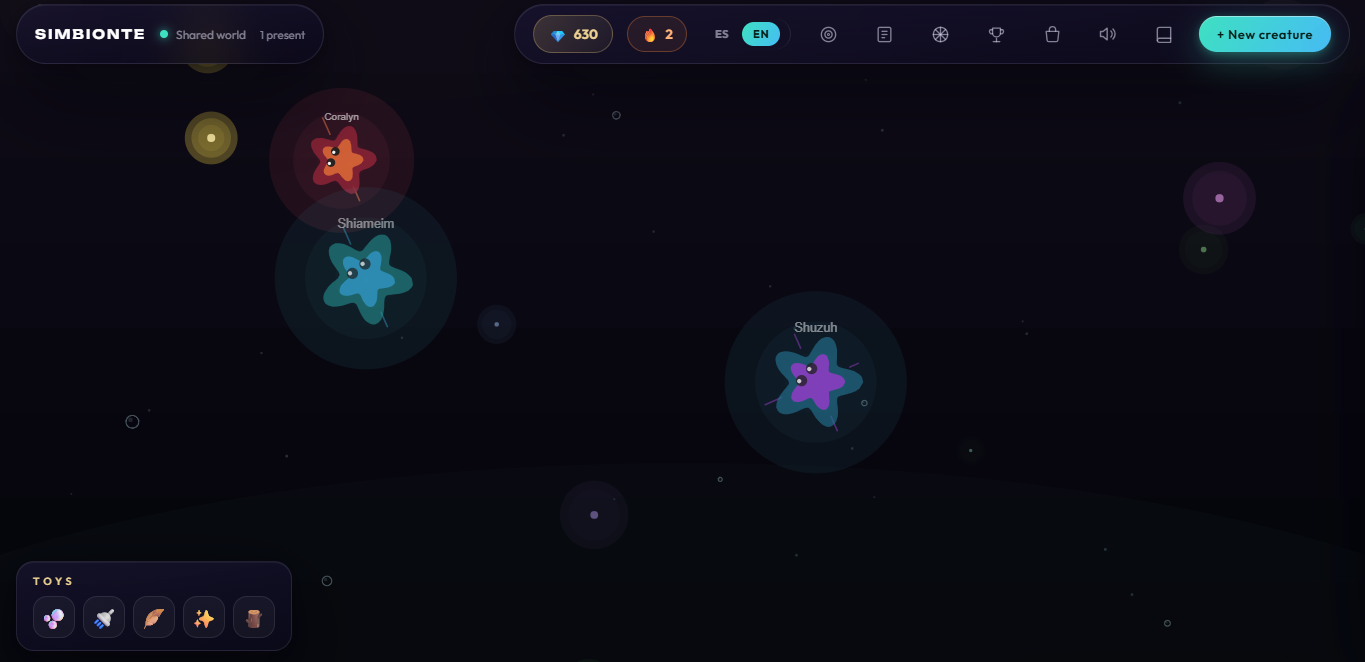
SIMBIONTE is a persistent, browser-based ecosystem inhabited by generative creatures — none of which were designed by a human hand. Every creature is born from the body of a real visitor: three seconds of voice, a few seconds of gesture, and a single drawn stroke are fused into a 20-gene digital genome that determines the creature's anatomy, movement, color, and singing voice.
Then the visitor leaves — and the creature does not. It keeps swimming, courting, reproducing, aging, and eventually dying in a shared world populated by the creatures of every other visitor on the planet. Its descendants carry fragments of a stranger's voice into generations that stranger will never see.
One link. No installation. No account required.
Inspiration
Almost every "art + AI" hackathon project follows the same script: write a prompt, receive an image, post it, move on. It is clever, but it is not a new medium — it is a faster paintbrush wearing a new coat.
So when we read the theme — create art that could not exist without technology — we refused to answer it with another generator. We wanted to answer it literally. That led us to a harder question:
What if the audience didn't operate the artwork — what if the audience was the artwork?
You can paint without a computer. You can sculpt without code. Neither medium disappears when you unplug it. But a collective, persistent, continuously evolving organism, fed in real time by the bodies of strangers across the planet, is ontologically impossible without technology.
Here, technology is not the tool that produces the art. It is simultaneously the medium, the canvas, and the biological material. That distinction is the entire reason SIMBIONTE exists.
What It Does
1. The Birth Ritual
A visitor does not make a creature. They donate the genetic material for one, through three acts:
| Input | What the visitor does | What it becomes in the creature |
|---|---|---|
| 🎙️ Voice | Speaks, hums, or whispers for 3 seconds | Its colors, its glow, and the musical note it sings |
| 🖐️ Gesture | Moves an index finger freely for a few seconds | How it swims — fast or slow, elegant or erratic, social or solitary |
| ✍️ Stroke | Draws one continuous free line | Its literal anatomy — body lobes, spines, eyes, cilia |
These three signals fuse into a 20-gene genome: an actual data structure, not a metaphor. On screen, the fusion is visualized as a double helix of particles that converges until the creature hatches, arriving with a procedurally generated name and a poetic epithet — "born of a low voice and a spiraling stroke."
2. What Happens After You Close the Tab
This is the line that separates SIMBIONTE from a generative-art toy.
The creature outlives you. It continues living in a persistent, real-time world shared with every other visitor's creatures.
Creatures reproduce. Drag your creature toward another to preview genetic compatibility, then propose a courtship. Offspring inherit mixed genes from both parents through our own genetic algorithm — meaning a creature born in Peru can have descendants with one born in Japan.
The world remembers. Creatures age and die, leaving fossils that permanently record their lineage: who created them, which voice they came from, how many descendants they left behind.
The world narrates itself. An AI chronicler observes every birth, courtship, and death, and writes the ecosystem's mythology live — an evolving body of folklore authored by events no one scripted.
The art escapes the browser. Every visitor can download a birth certificate (1080×1350 PNG) of their creature: a personal, shareable artifact that carries the ecosystem out into the world and brings new genomes back in.
3. The Layer of Participation
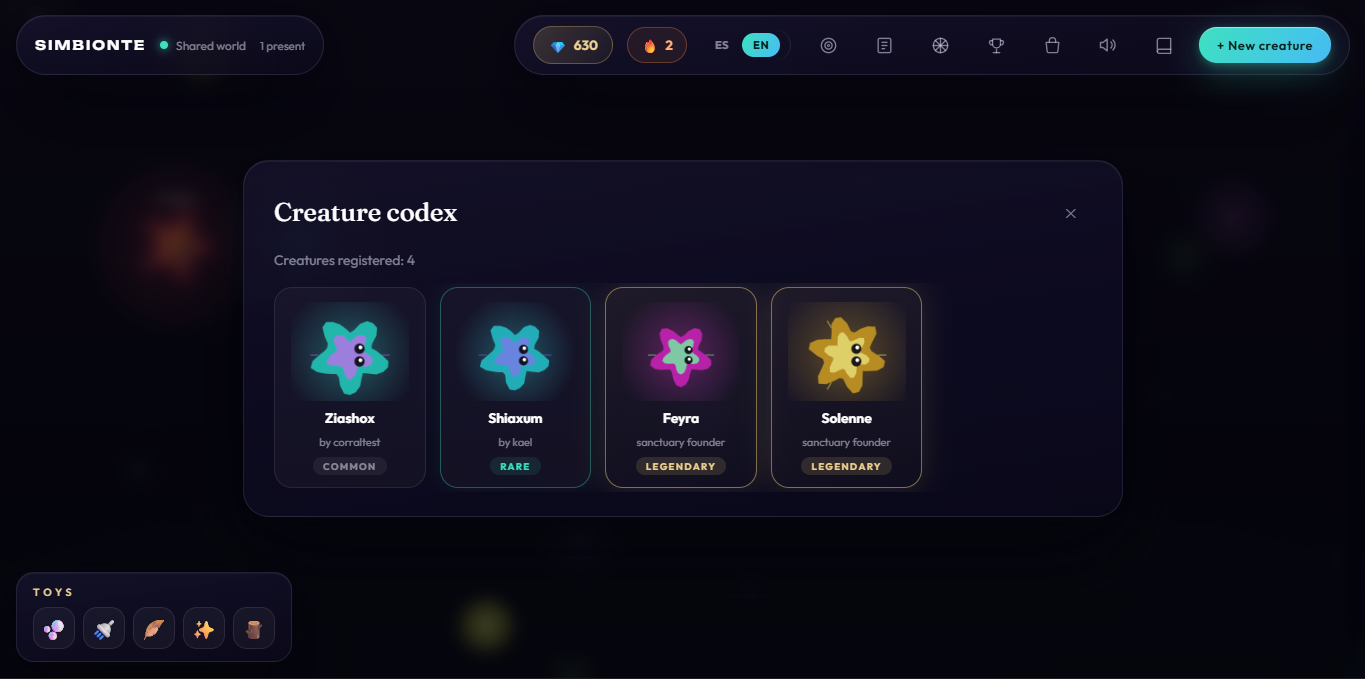
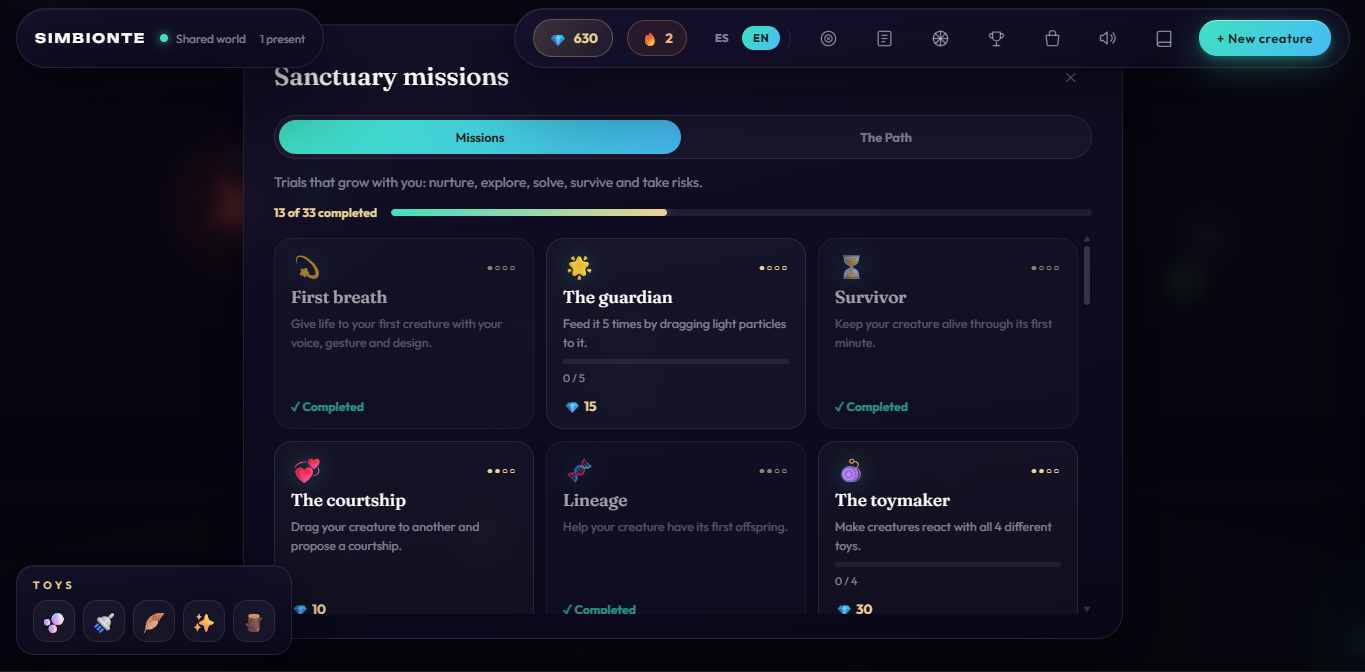
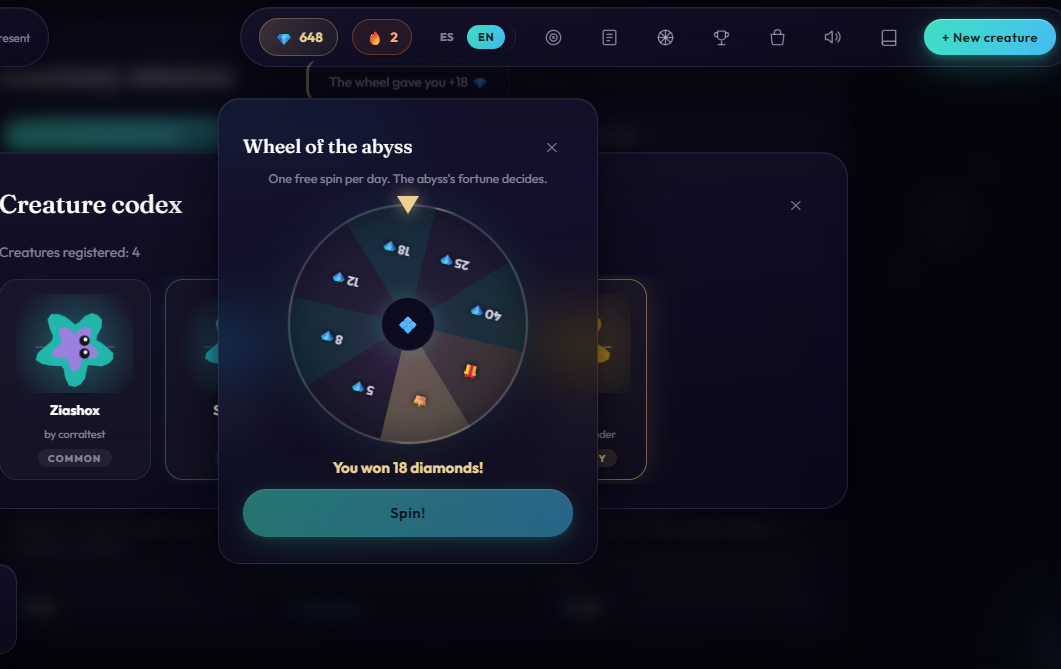
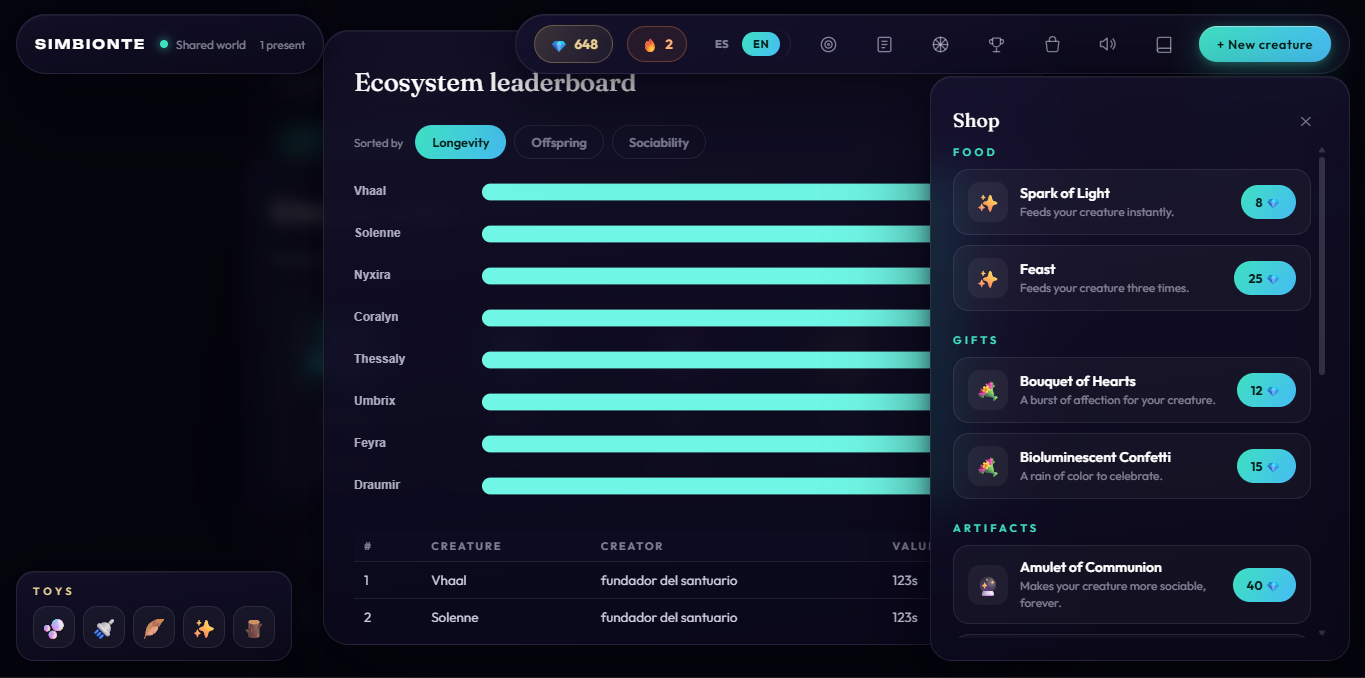
Around this living core we built systems designed to keep people invested in a world built by other people: 22 sanctuary quests, a 20-step progression path with reward chests, a daily prize wheel with visit streaks, an in-world economy and shop, a Codex of creatures captured through an aiming mini-game, and a live leaderboard ranking creatures by longevity, number of descendants, and sociability.
How We Built It
Design principle: the demo must survive contact with reality
We deliberately chose proven, browser-native technology over anything exotic, for one reason: the experience has to work on real judges' machines, on real conference Wi-Fi, on the first try. Nothing to install. Nothing to configure. One link.
Architecture
| Layer | Technology | What it does |
|---|---|---|
| 🎨 Visual engine | p5.js | Not a single pre-drawn sprite exists in the codebase. Every body, eye, glow halo, and trailing cilium is computed from equations bound directly to that creature's genome. Change the genome, and the anatomy changes. |
| 🎙️ Voice pipeline | Web Audio API | Microphone signal analyzed entirely client-side: zero-crossing rate approximates pitch, RMS approximates energy, spectral centroid approximates brightness. Three numbers extracted from a human voice — nothing recorded, nothing uploaded. |
| 🧬 Evolution engine | Original code | 20 genes, 50/50 per-gene crossover, random mutation noise, compatibility distance, procedural naming. Written from scratch — the one component we refused to outsource, because it is the conceptual heart of the project. |
| 🌐 Shared world | Node.js · Express · Socket.io | The server holds the single source of truth about who is alive, broadcasting births, movements, and deaths so every visitor sees the same reality at the same moment. |
| 🗄️ Memory | Supabase (PostgreSQL + Auth) | Creatures, genealogies, wallets, and quests persist across sessions. Visitors receive an automatic anonymous session, upgradable to a full account without losing progress — and if auth fails, the app degrades gracefully to guest mode. |
| 🎵 The choir | Tone.js | Inherited sound genes are synthesized into a real, audible voice. The ecosystem doesn't just look alive; it sounds alive — a slowly shifting generative chorus sung by its own inhabitants. |
| 📜 The chronicler | Claude API + local fallback | Ecosystem events become short mythic tales in real time. Without an API key, a hand-built local "myth loom" takes over: the world's narrative is never silenced. |
Build order
We built in layers, deliberately: one procedural creature that had to be beautiful on its own → the birth ritual → real-time multiplayer → reproduction and persistence → narrative and sound → polish. Polish came last, because polish on a weak foundation is just decoration.
Challenges We Ran Into
Turning messy human input into a fair genome. Raw microphone and pointer data are noisy and wildly inconsistent between people. A whisper and a shout; a nervous gesture and a smooth one. All of it had to be normalized into creatures that were genuinely distinct yet equally valid, with no single input dominating the genome. Striking that balance took far more iteration than writing the algorithm itself.
Engineering against the empty room. Free-tier real-time hosting sleeps after inactivity, and a judge opening a cold link should never meet a dead, empty ocean. So we built Sanctuary Mode: if the shared server can't be reached in time, the frontend quietly populates with simulated ancestral creatures. The world is allowed to degrade — it is never allowed to look dead.
Resisting scope creep without losing ambition. Quests, a shop, a wheel, a leaderboard: each addition risked turning the project into an unrelated game wearing an artistic skin. Our discipline test for every feature was a single question — does this deepen the feeling of a living, co-created organism? If the answer was no, it didn't ship.
Treating privacy as a constraint, not a footnote. The controls felt biometric, so the promise had to be absolute: voice and gesture never leave the browser in their original form; only a handful of normalized numbers are ever transmitted or stored. This meant auditing every code path until the promise held everywhere — not only where we first tested it.
Accomplishments We're Proud Of
- The full ritual works end to end, with real human input. Live microphone → gesture → stroke → DNA fusion → birth → sound → living mythology. Tested in production, with a clean console, generating coherent epithets and folklore from genuinely donated genomes.
- Zero hand-designed creatures. We set the constraint on day one — no sprites, no templates, no shortcuts — and never broke it. Every living thing in this world traces back, through mathematics, to a real person's body.
- The demo cannot show an empty world. Sanctuary Mode means SIMBIONTE degrades gracefully under any network condition. That reliability was designed, not lucky.
- A genetic algorithm we own completely. Crossover, mutation, compatibility distance, procedural names — original code we can defend line by line.
- Art that leaves the browser. The birth certificate turns a session into a keepsake, and every shared certificate is another person discovering a world they can add to.
What We Learned
A work of art can be a population instead of a piece. This changes the meaning of interactivity itself: visitors don't click to preview variations of something already finished — they contribute genetic material to something that keeps existing, keeps changing, and keeps affecting strangers long after they leave.
Constraints give life. Refusing to design anything by hand forced every visual and behavioral detail to be grounded in math tied to real human interaction. That constraint — more than any single feature — is why the ecosystem feels alive rather than merely decorative.
Reliability is a creative decision. Sanctuary Mode taught us that "what does the visitor see when everything fails?" is a design question, not just an operations one — and answering it well is part of the artwork.
What's Next for SIMBIONTE
- 🧬 A deeper genome. Capturing the rhythm and silence of the voice, the pressure and acceleration of the gesture — expanding beyond 20 genes toward a richer individuality.
- 📱 A mobile-native ritual. Device motion sensors replace pointer movement, so "donating a gesture" becomes the literal physical motion of the phone in your hand.
- 🌊 Ecosystem weather. Worldwide shared events — tides, blooms, auroras — that temporarily rewrite reproduction and behavior rules for every visitor at once. A world with seasons, not just a population.
- 🔌 A public API. Letting other creative coders spawn creatures into the shared world from their own projects, turning SIMBIONTE from a hackathon entry into a canvas that belongs to everyone.
Why This Answers the Theme
An image generator produces artifacts that a painter could, in principle, have made more slowly. SIMBIONTE produces something no other medium can hold: a living population whose every inhabitant is the mathematical descendant of a real human body, evolving in real time across the planet, remembering its own dead, and narrating its own mythology.
Unplug it and there is no slower version. There is only nothing.
Made with code, noise, and the conviction that art should breathe. ◉
Built With
- anthropic
- canvas
- claude
- claude-api
- css3
- express.js
- generative-art
- genetic-algorithm
- git
- github
- html5
- javascript
- multiplayer
- node.js
- p5.js
- postgresql
- procedural-generation
- real-time
- render
- socket.io
- supabase
- tone.js
- vercel
- web-audio-api
- websockets


Log in or sign up for Devpost to join the conversation.