Inspiration
SIMBA Autonomous Energy Operations Agent grew from a real energy-management problem at the University of Zimbabwe. A campus-wide study using half-hourly smart-meter data from 22 substations showed that electricity costs are driven heavily by peak-period consumption, maximum demand, operational scheduling, and concentrated high-demand facilities. Central Kitchens emerged as the largest single consumer, while peak-energy and demand charges represented major controllable cost components.
The original SIMBA-EMS concept was developed to move beyond energy monitoring toward forecasting, optimisation, anomaly detection, and controlled demand management for institutional electricity users in Zimbabwe.
For the Africa Deep Tech Challenge, we extended that foundation into an autonomous AI energy-operations agent designed for constrained African computing environments.
What it does
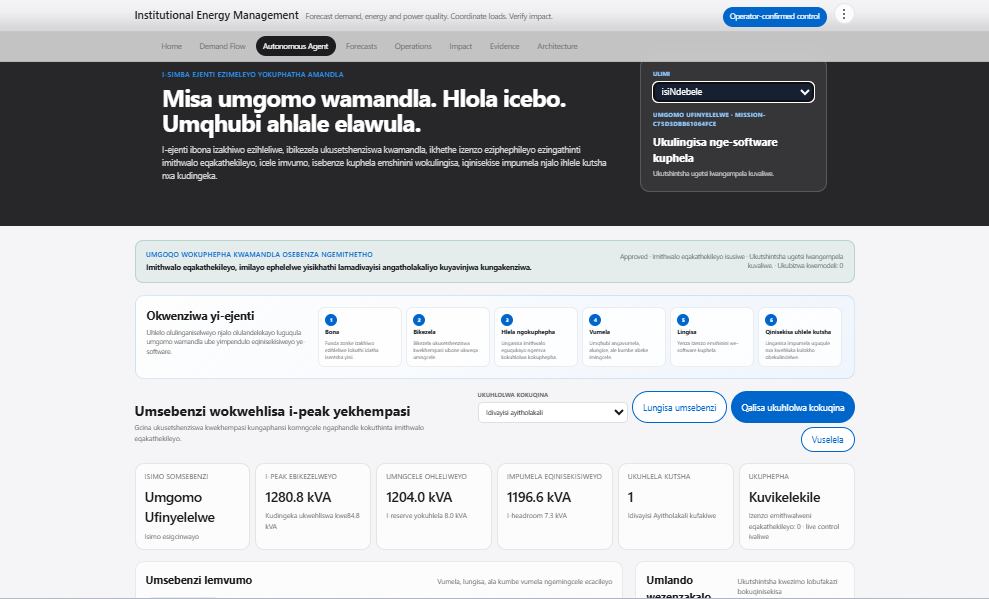
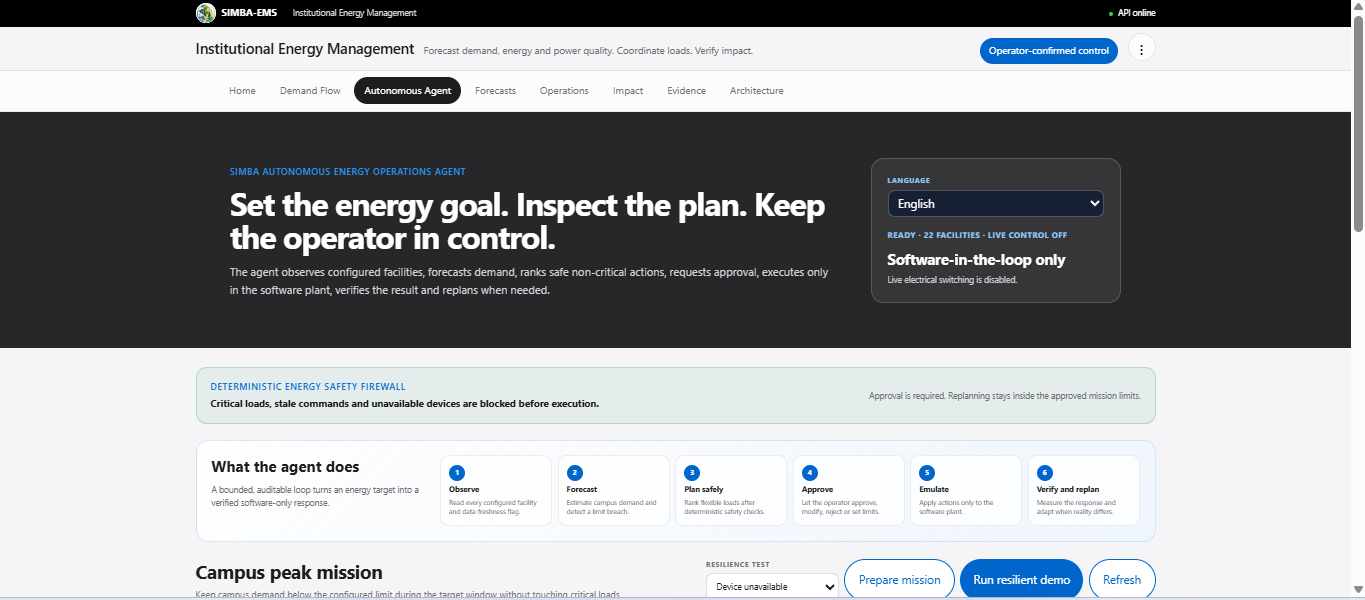
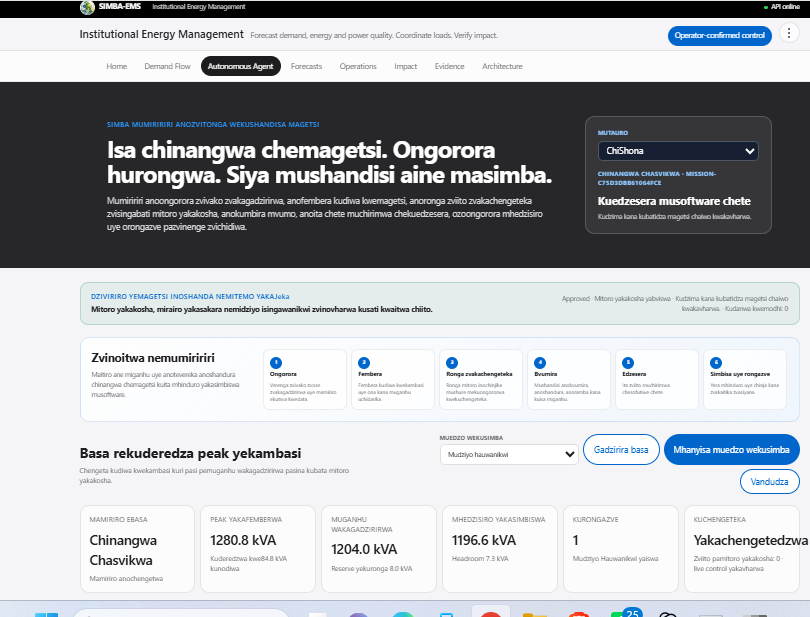
SIMBA continuously reasons about an institutional energy system and follows an operational loop:
- Observe current and forecast demand.
- Detect when demand is likely to exceed an operating limit.
- Generate candidate actions for non-critical loads.
- Apply deterministic electrical safety constraints.
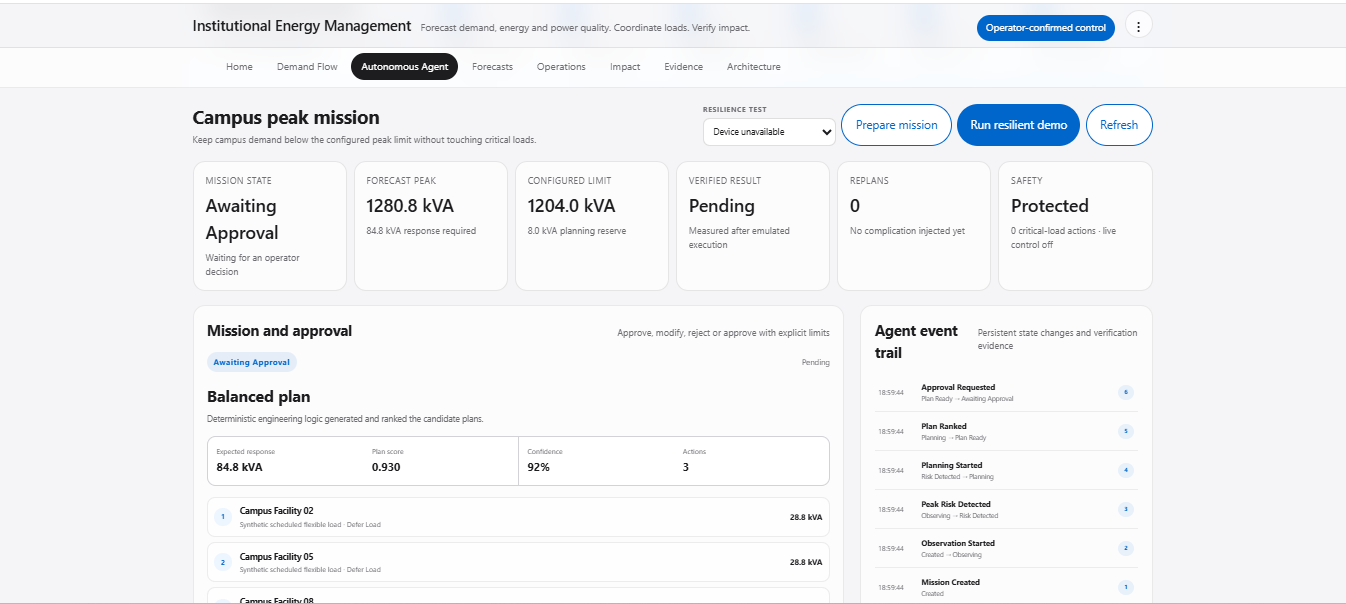
- Require operator approval before execution.
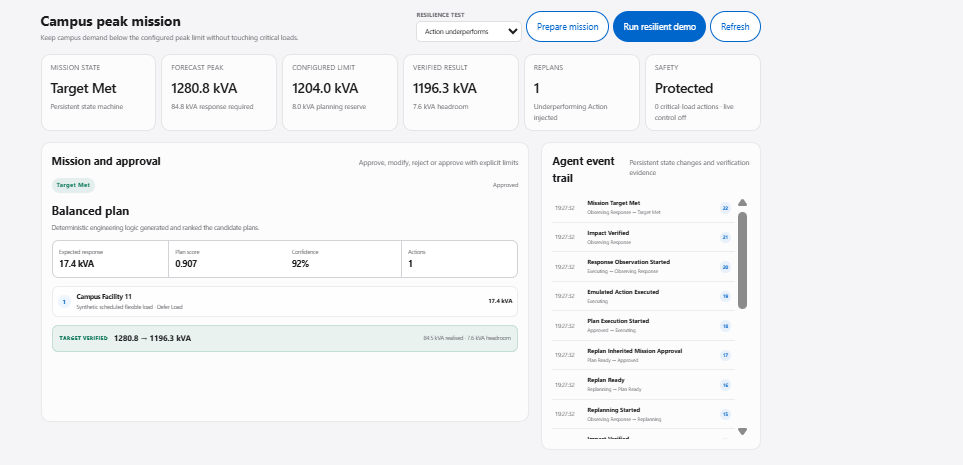
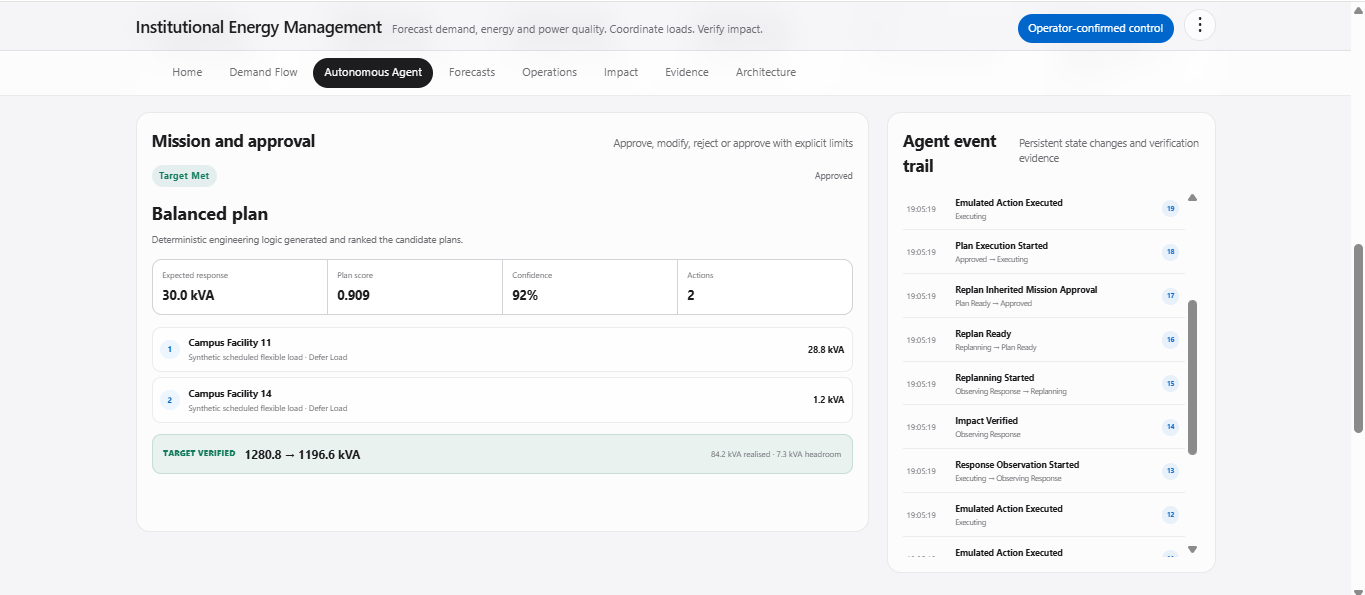
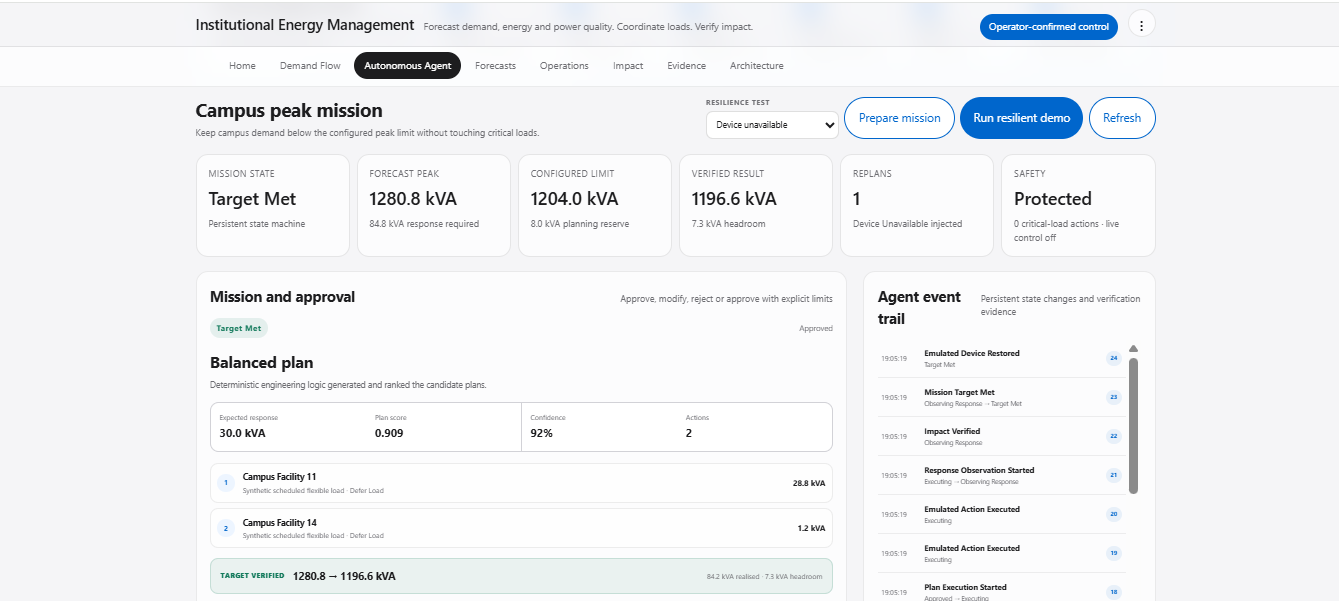
- Emulate the approved action, verify the result, and replan if the target is not achieved.
The agent is designed around a strict separation between AI reasoning and electrical safety enforcement. The local language model helps select and explain actions, while deterministic engineering rules decide what is electrically permissible.
Critical loads are excluded from controllable actions. Unavailable devices are rejected. Reduction limits and action limits are enforced independently of the model.
The current competition build operates in software-in-the-loop mode, with live electrical switching disabled. This lets us demonstrate autonomous planning, failure handling, verification, and replanning without exposing physical infrastructure to uncontrolled AI actions.
How we built it
The system combines:
- a local Qwen3-1.7B model running through llama.cpp,
- deterministic power-system and safety services,
- demand forecasting and peak-risk logic,
- an approval-gated action workflow,
- software-in-the-loop electrical response simulation,
- post-action verification and dynamic replanning,
- an audit trail of observations, decisions, approvals and outcomes,
- and a browser-based operator dashboard.
The application is designed to run locally on an 8 GB CPU laptop without cloud inference, making it suitable for institutions where connectivity, cloud costs, privacy, or computational infrastructure are constraints.
We also developed multilingual interface support, including African-language packs, while retaining structured electrical quantities, safety states and operational decisions.
Challenges
The main challenge was making the system genuinely agentic without allowing the language model to become the electrical safety authority.
A model can propose an action that sounds reasonable but violates an operational constraint, targets a critical load, assumes an unavailable device, or fails to achieve the required reduction. We therefore designed SIMBA so that deterministic safety checks sit outside the model and remain authoritative.
Another challenge was handling failure after an approved action. Instead of assuming that a command achieves its predicted result, SIMBA measures the emulated response, compares it with the target, and launches another planning cycle when necessary.
We also had to balance model capability against hardware constraints. The competition version therefore prioritizes a compact local model, deterministic engineering services, and a small runtime rather than dependence on large cloud models.
What we learned
We learned that autonomous AI for physical infrastructure should not mean unrestricted AI control.
For energy systems, a more defensible architecture is:
AI reasoning + deterministic engineering constraints + human approval + measured verification + autonomous replanning.
This approach allows the agent to adapt when conditions change while preserving electrical safety boundaries.
The University of Zimbabwe energy study also showed why this matters operationally. Institutional demand changes with academic schedules, occupancy, catering activity and other operational factors, and the highest-value interventions are often concentrated in a small number of facilities.
What's next
The next stage is to connect the autonomous agent to real smart-meter telemetry while retaining approval-gated operation, then progressively validate forecasting, recommendation quality and control performance against live institutional conditions.
Longer term, SIMBA is intended as a locally hosted energy-operations platform for universities, hospitals, hotels, industrial facilities and other African institutions facing peak-demand costs, constrained grids, expensive cloud services and limited energy-management automation.
Built With
- agents
- autonomous
- css
- demand
- demand-side
- energy
- fastapi
- forecasting
- html
- iot
- javascript
- linux
- metering
- power
- python

Log in or sign up for Devpost to join the conversation.