-
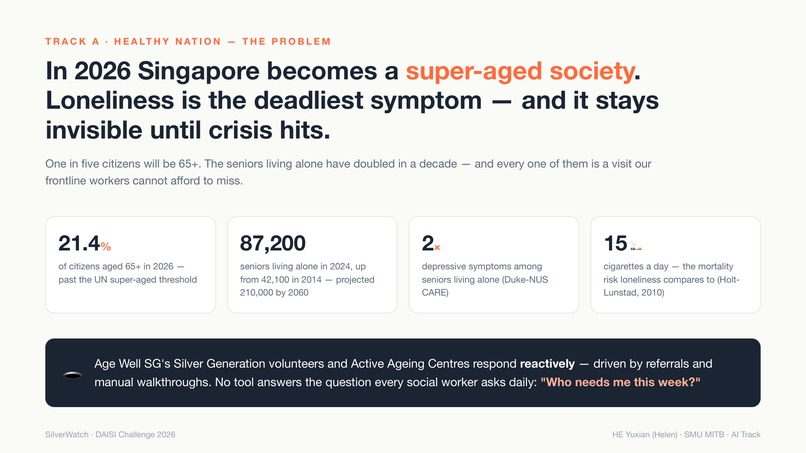
Singapore turns super-aged in 2026. Loneliness hits like 15 cigarettes a day — and stays invisible until crisis.
-
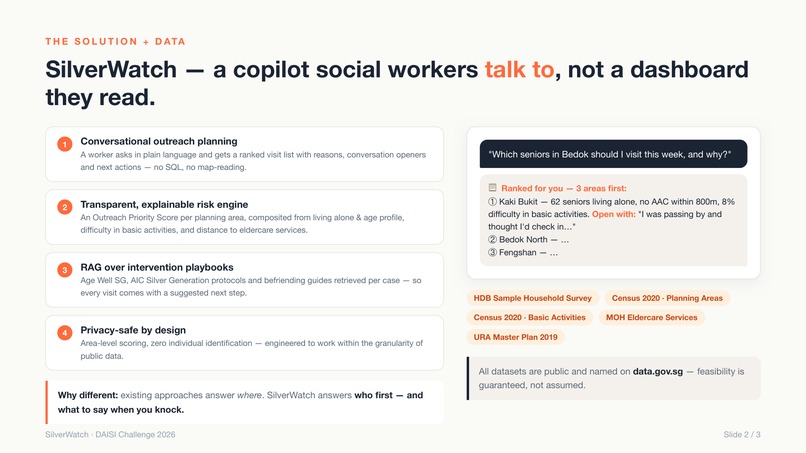
▎ A copilot social workers talk to: "Who in Bedok should I visit this week?" — ranked answers with reasons.
-
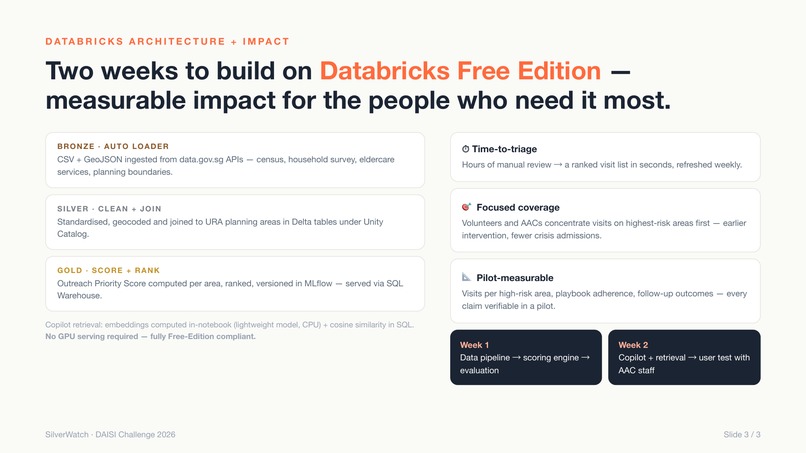
Two weeks on Databricks Free Edition: medallion + Unity Catalog + MLflow, GPU-free RAG — triage in seconds.
SilverWatch — A Social Worker's Copilot
Inspiration
Singapore crosses the super-aged threshold in 2026, and seniors living alone have doubled in a decade (42,100 in 2014 to 87,200 in 2024, projected 210,000 by 2060). Loneliness among them carries a mortality risk comparable to smoking 15 cigarettes a day. Frontline social workers under Age Well SG want to reach these seniors early — but today their outreach is reactive, built on referrals and manual walkthroughs. Nobody can see the risk map until a crisis makes it visible.
What it does
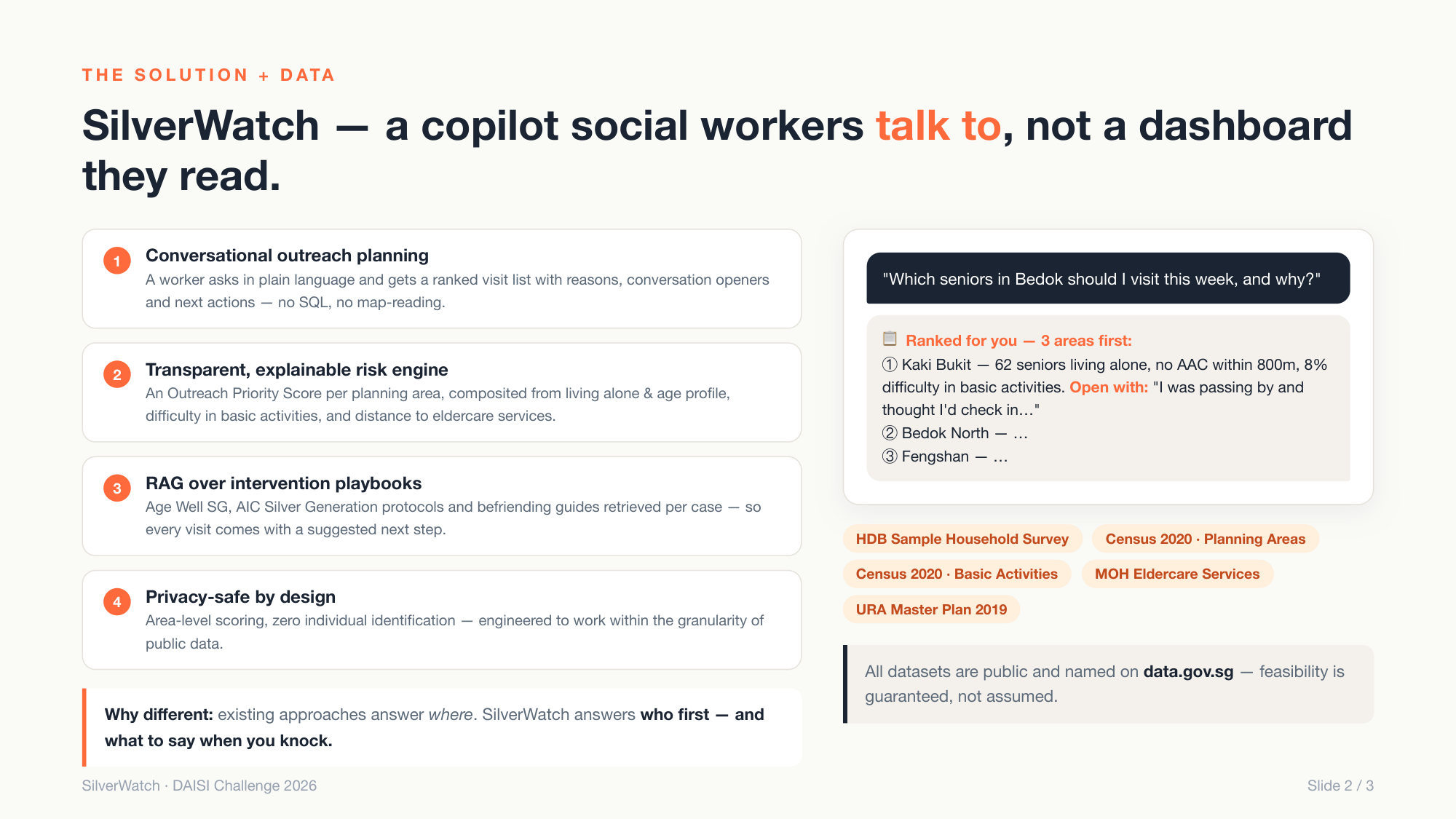
SilverWatch is a conversational copilot for social workers and Active Ageing Centre volunteers. A worker asks in plain language — "Which seniors in Bedok should I visit this week, and why?" — and gets a ranked outreach list with reasons, suggested conversation openers, and next actions retrieved from intervention playbooks (Age Well SG, AIC Silver Generation protocols). Under the hood, a transparent risk engine composites public signals — living alone, age profile, difficulty in basic activities, and distance to eldercare services — into an explainable Outreach Priority Score per planning area. Scoring stays area-level and privacy-safe by design: the tool prioritises where to go first without identifying any individual.
How we built it
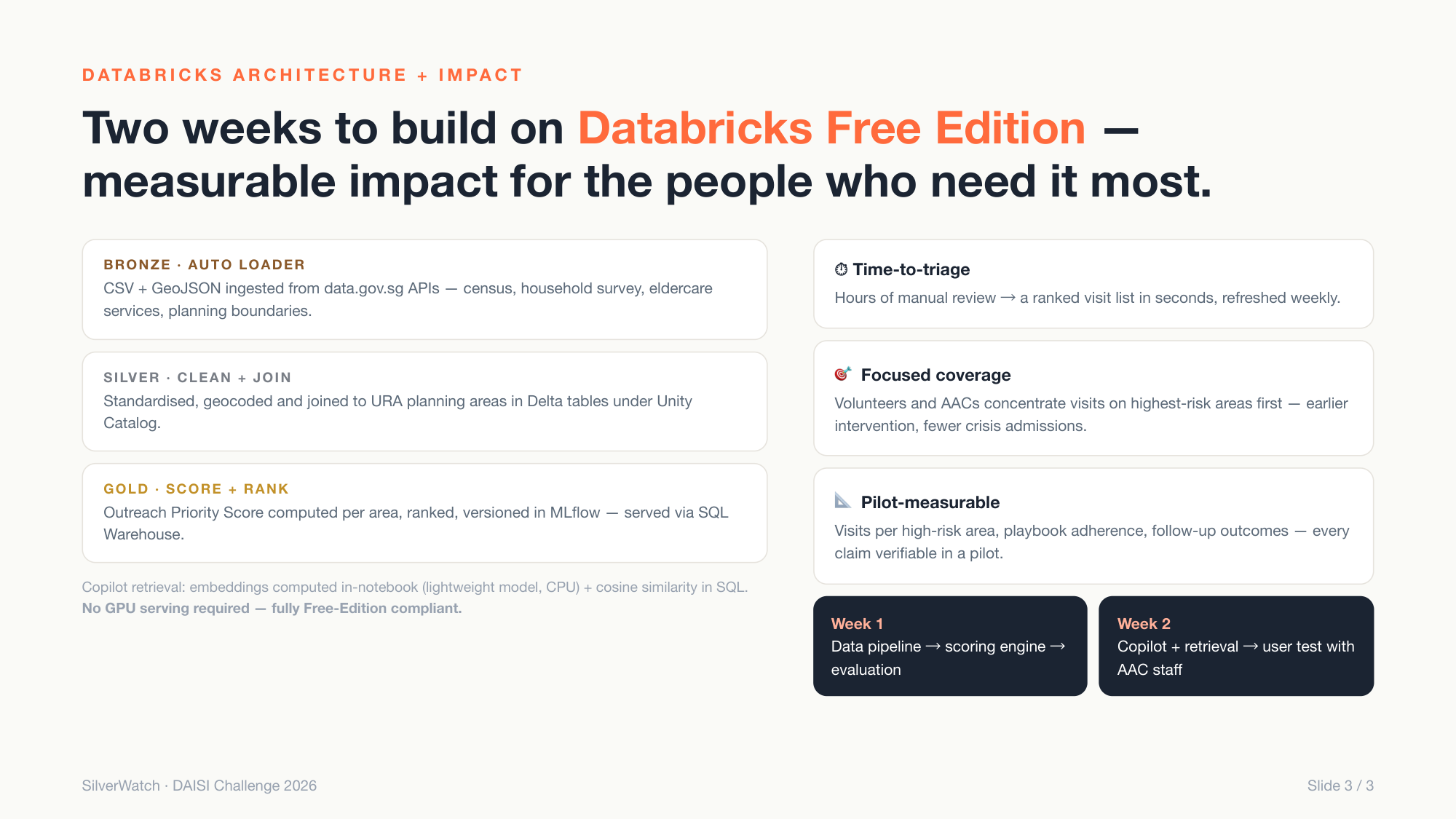
Databricks Free Edition with a medallion pipeline: Auto Loader ingests CSVs and GeoJSON from data.gov.sg (HDB Sample Household Survey, Census 2020, MOH Eldercare Services, URA planning boundaries) into Bronze, cleaned and joined in Silver, scored and raoverns the datasets andMLflow tracks the scoring model. A SQL Warehouse serves the risk API; the copilot's retrieval laye with cosine similarity in SQL, so no GPU servin
Challenges we ran int
- **Designing for non-ters don't want anotherdashboard to learn — they want answers in the flow of their day. That pushed the design from "risk het copilot, which is muchharder to make trustworthy.
- **Explainability vs. ML score would be irresponsible in a sociaparent weighted composite of public signals is deier for agencies to adopt.
- **Privacy within publevel, notindividual-level — the risk engine had to deliver actionable signal without over-claiming precision, and the copilot must never imply it can identifyspecific senior.
- Free Edition constraints. No GPU serving and limited compute meantdesigning the retrieval + cosine similarity inSQL) around what a 2-person-week build can actually run.
## Accomplishments that we're proud of Turning "who needs me thy social worker asksdaily — into a product sevel, explainable,privacy-safe, and builda weeks. We're also proudof differentiating against the dashboard-style submissions we saw in the gallery: SilverWatch tely when you knock*.
What we learned
Public data is richer thgranularity (Census 2020, HDB surveys, MOH facilipart is composing signals into a score that social workers can defend to their managers. We also learned that retrieval-augmented copilots are achievable without GPUs when embeddings are computed offline and similarity runs in SQL.
What's next
A two-week build sprint:eline, scoring engine and evaluation; Week 2 delivers the copilot interface and a user test with AAC staff, measuring time-to-triage and coverage of high-risk areas.

Log in or sign up for Devpost to join the conversation.