-
-
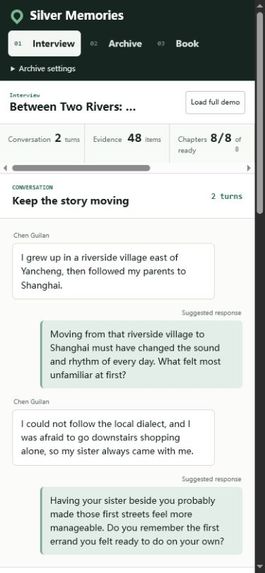
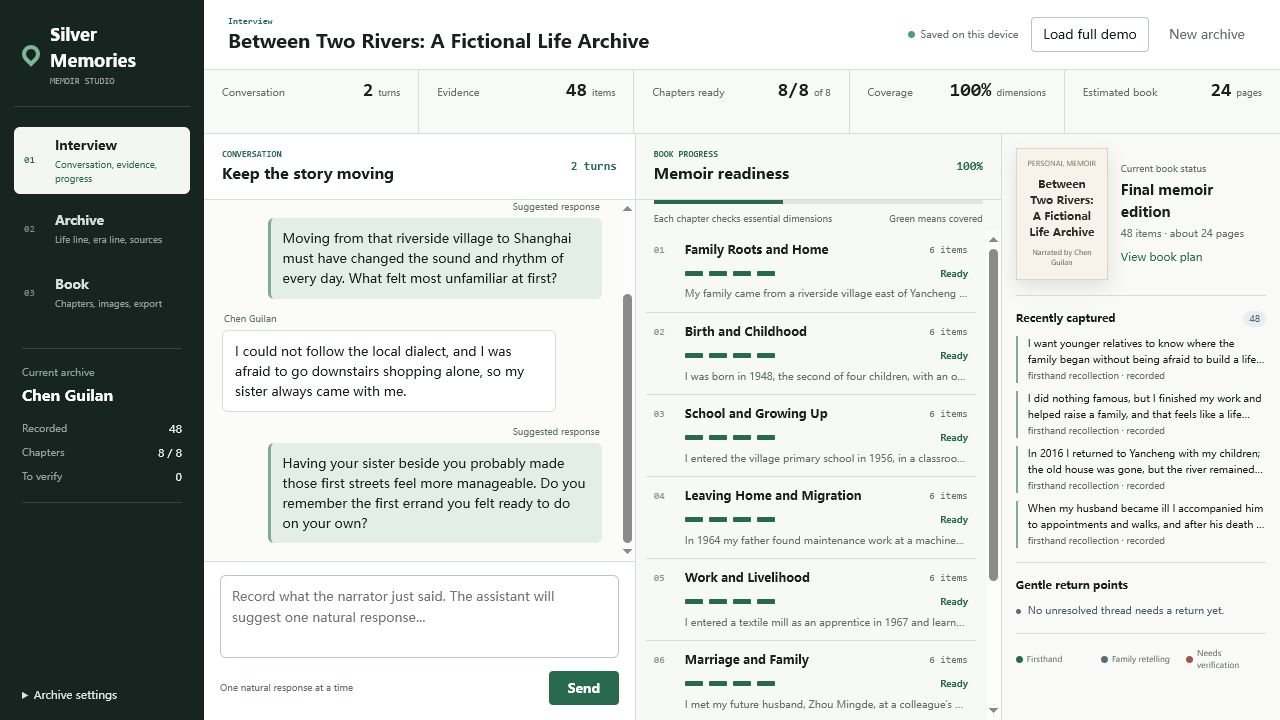
English interview workspace showing natural conversation, 48 fictional evidence records, and complete chapter readiness.
-
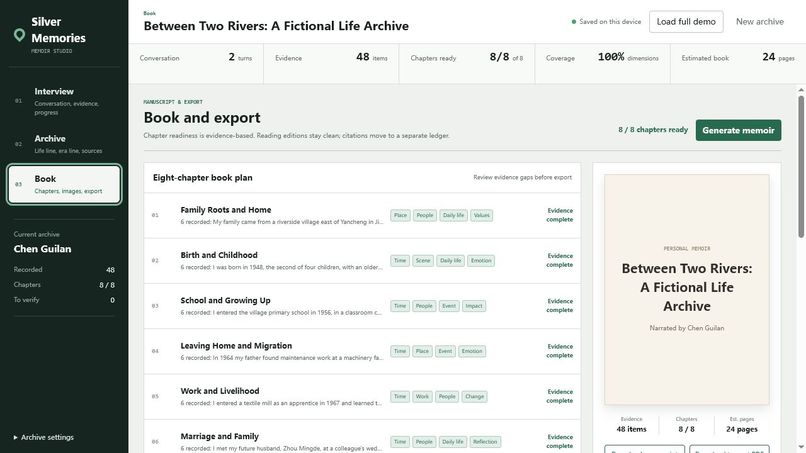
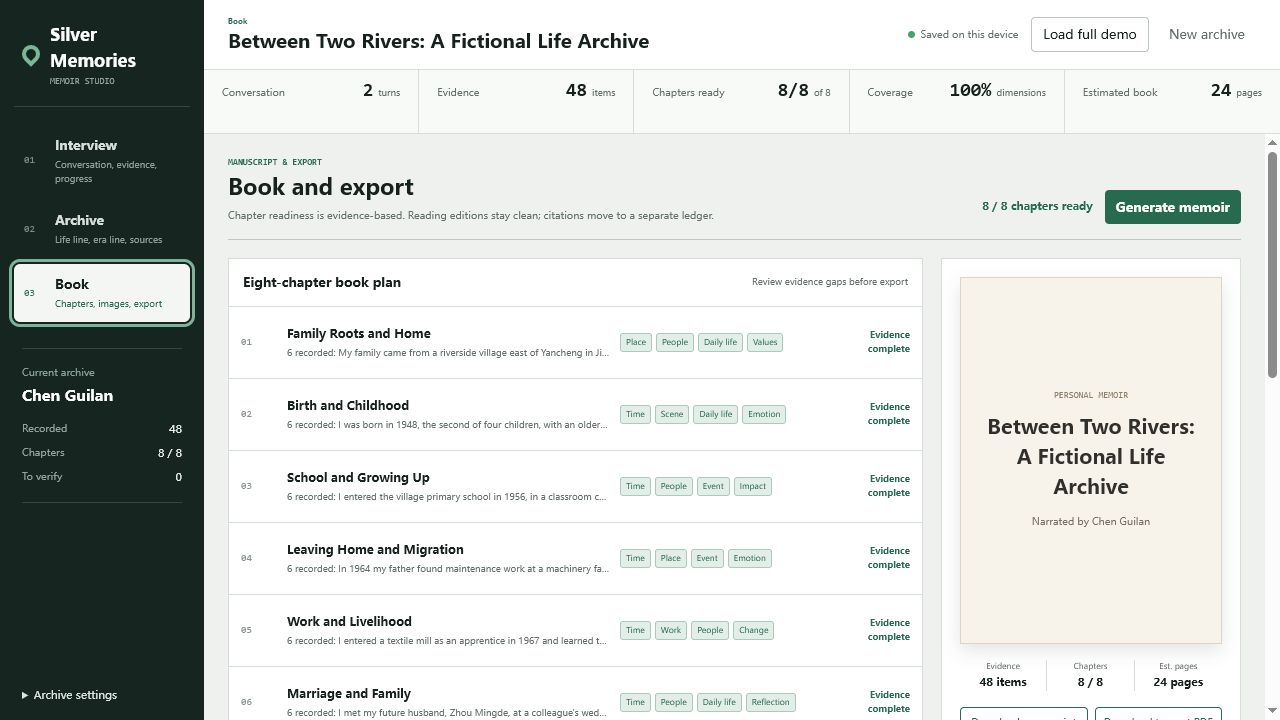
Eight-chapter English book plan with evidence coverage, clean TXT/PDF export, and a separate verification ledger.
-
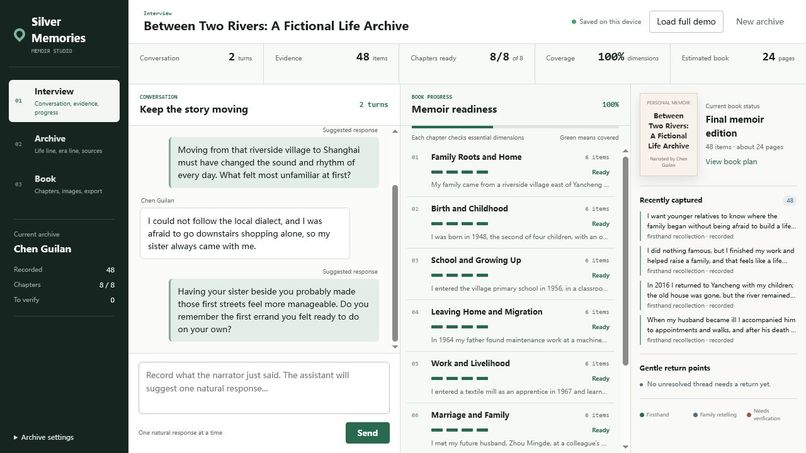
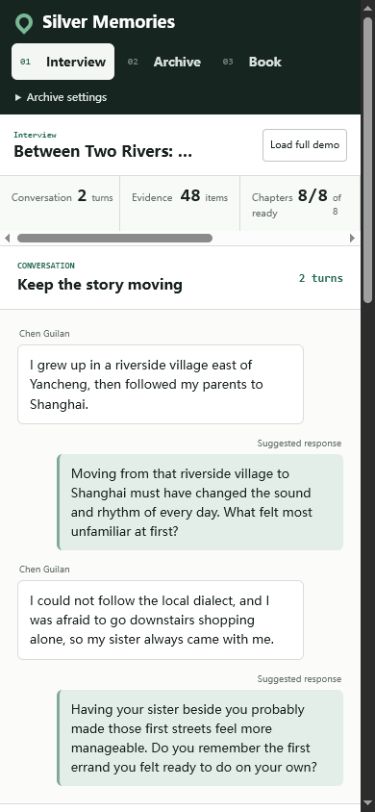
Responsive English interview workspace for recording family conversations on mobile.
Inspiration
Many families want to preserve an elder's memories, but a blank recorder and a list of questions can make the conversation feel formal and exhausting. We wanted to make the first step easier: let a younger family member talk naturally, while the system quietly keeps the details that may later become an oral-history archive.
What it does
Silver Memories is a local-first oral-history interview companion. A family member types or transcribes what an elder has just said. The app suggests one natural next line in the voice of a younger relative, rather than driving the elder through a questionnaire.
At the same time, it builds a small interview ledger:
- information that was actually said is retained as a source-labelled clue;
- firsthand memories, family retellings, and unverified details are visibly separated;
- unresolved threads are kept for a later, more natural return instead of becoming the next forced question;
- guardrails reject unsupported disaster, migration, birthplace, and causal claims before a reply is shown.
The workspace then turns the same evidence into four inspectable views: a personal life tree, an age-aligned era tree, a source ledger, and an eight-part memoir plan. Missing historical context stays visibly marked as waiting for reliable sources, and a chapter is never described as ready from only one or two clues.
From the book view, the user can generate an evidence-grounded manuscript and a professionally typeset reading edition. The output follows the narrator's language: Chinese testimony produces a Chinese memoir, while English testimony produces idiomatic English memoir prose rather than a literal translation. The current renderer supports A5, 5.25 x 8 inch compact, 6 x 9 inch trade, and 7 x 10 inch illustrated layouts.
Editorial evidence codes remain available during review, but they are removed from the formal TXT and PDF. The source ledger is delivered as a separate verification file, so the finished book reads naturally without losing traceability. The public demo contains 48 fictional evidence records across eight complete chapters; sparse projects are explicitly labelled as proofs instead of being presented as finished biographies.
The included demo archive is entirely fictional. It demonstrates the intended flow without exposing a real family's recording, identity, or private history.
How we built it
- Python standard-library HTTP server and JSON persistence for a small local-first service
- Vanilla HTML, CSS, and JavaScript for a lightweight browser UI
- DeepSeek Chat API for the next conversational line, with a local fallback when no key is available
- deterministic context compaction, evidence extraction, source labels, unresolved-thread planning, and a reply validation layer around the model
The model is deliberately not asked to invent a life story. It receives only the current conversation and recorded evidence, then proposes one short conversational response. A validation layer blocks several high-risk patterns such as asserting an unmentioned disaster or presenting a family migration cause as fact.
Challenges we ran into
The difficult part was not calling a model; it was keeping the experience humane. A conventional chat prompt quickly becomes a disguised form: it repeats details, pushes for chronology, or assumes historical causes. We separated the system into a deterministic record layer and a small conversational layer, then added conservative checks for unsupported claims.
Accomplishments that we're proud of
We built a usable local prototype that demonstrates the full core loop: conversation, grounded next-line suggestion, source-aware clue capture, respectful deferral of unclear topics, life/era timelines, evidence-based memoir planning, multilingual writing, and clean book export. The workspace makes the AI's working memory inspectable instead of hiding it behind a chat bubble.
What we learned
For oral history, helpfulness is not the same as asking more questions. A good system needs to know when to pause, when to follow a feeling rather than a fact, and when a detail belongs in a separate "to verify later" bucket.
What's next for Silver Memories
We plan to add consent and authorization records, audio transcription imports, a configurable era/place evidence library, family and era timelines, source review, and book-ready memoir templates. These steps will remain separate from the conversational layer so that a polished manuscript never erases uncertainty in the underlying testimony.
Built with
Python, HTML, CSS, JavaScript, DeepSeek API, JSON
Demo notes
Run START_MEMOIR_INTERVIEW.bat, then open http://127.0.0.1:8766. Use Load demo archive to see the fictional end-to-end flow.
The demo video follows the complete product promise in one continuous story: a family-style conversation, the full eight-chapter information-acquisition progress, and the actual generated memoir. The competition build uses an English interface, English fictional archive, English narration, and English callouts for international judges. The final segment shows the clean reading edition and the separately delivered evidence ledger.
Built With
- css
- deepseek-api
- html
- javascript
- json
- python
