-
-
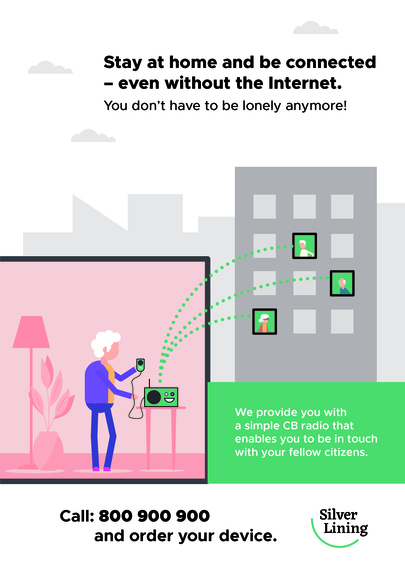
The elderly will get to know about the Silver Lining from the posters and leaflets visible at the places commonly visited by them.
-
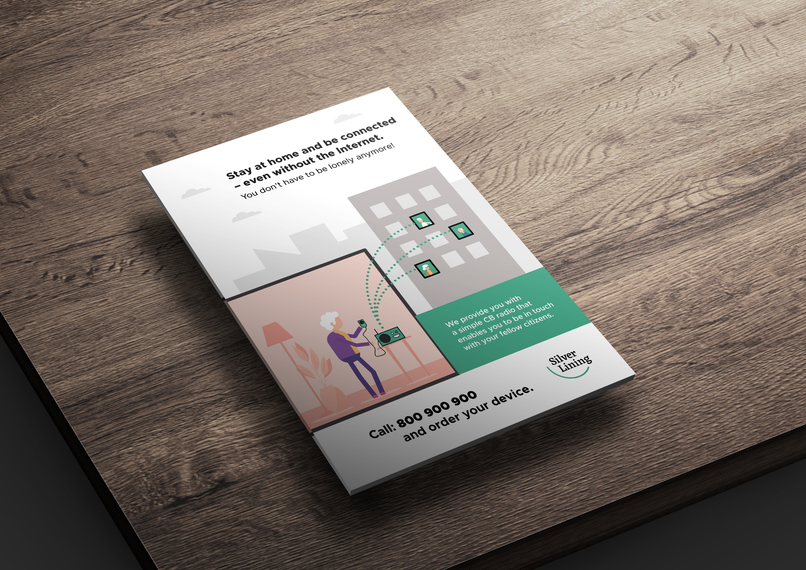
The elderly will get to know about the Silver Lining from the posters and leaflets visible at the places commonly visited by them.
-
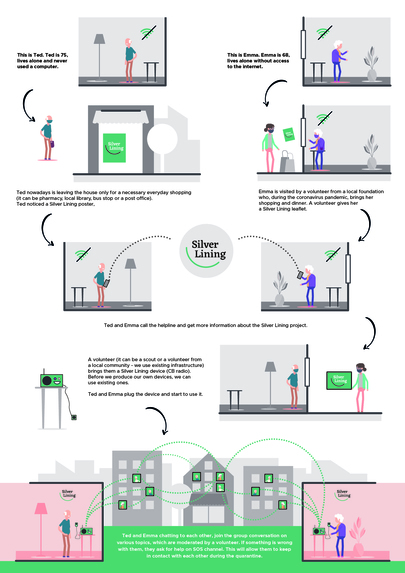
How it works? Infographic
-
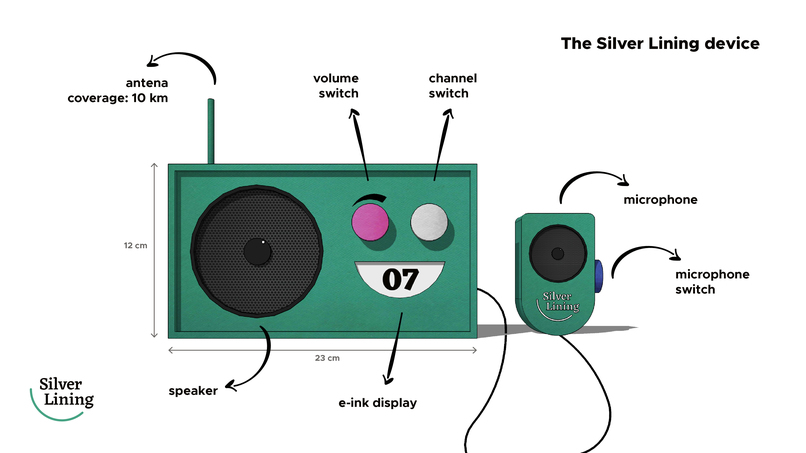
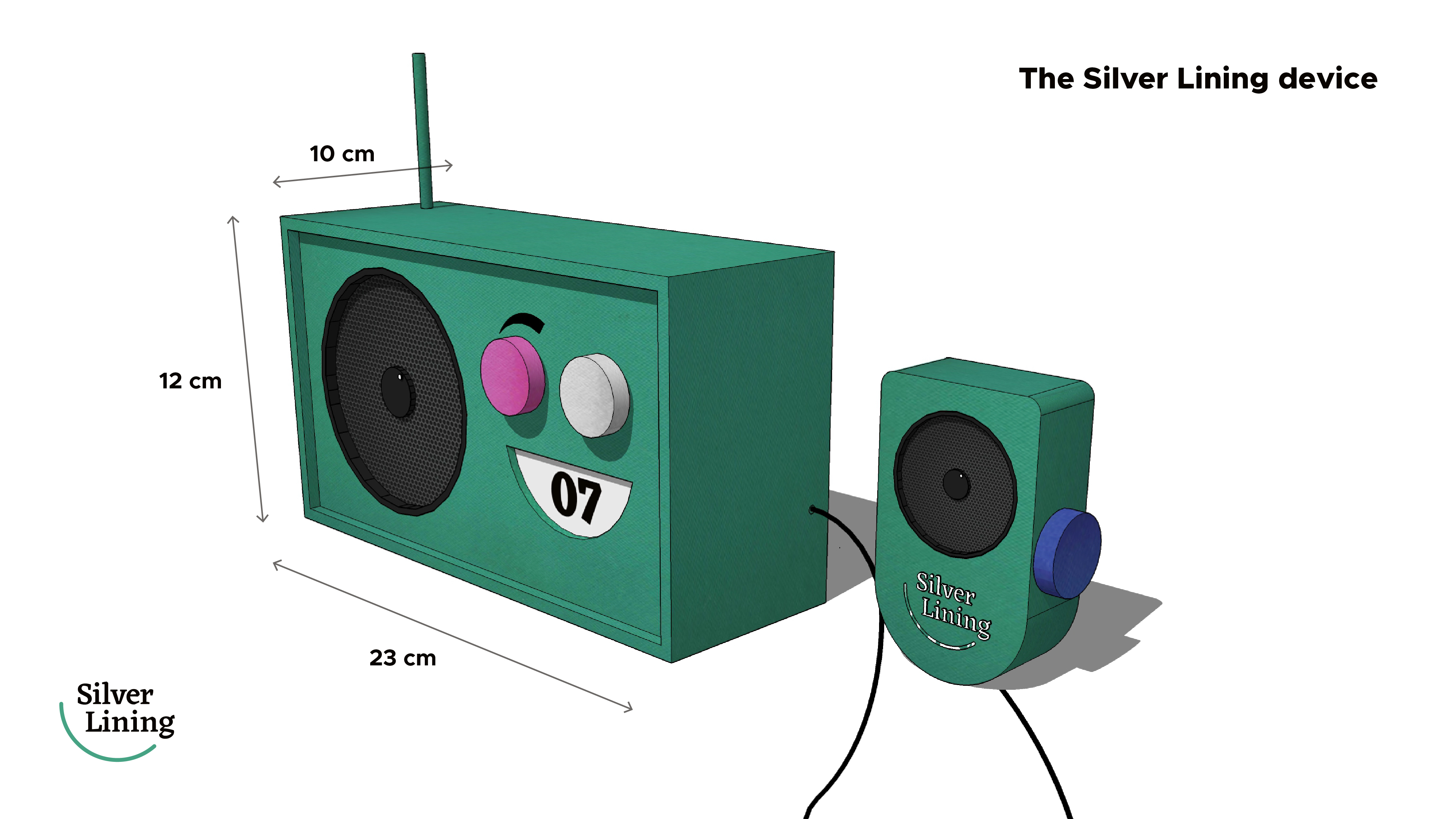
Silver Lining devices adapted for the elderly's needs (having user-friendly buttons, relevant colours and hardcoded channels.
-
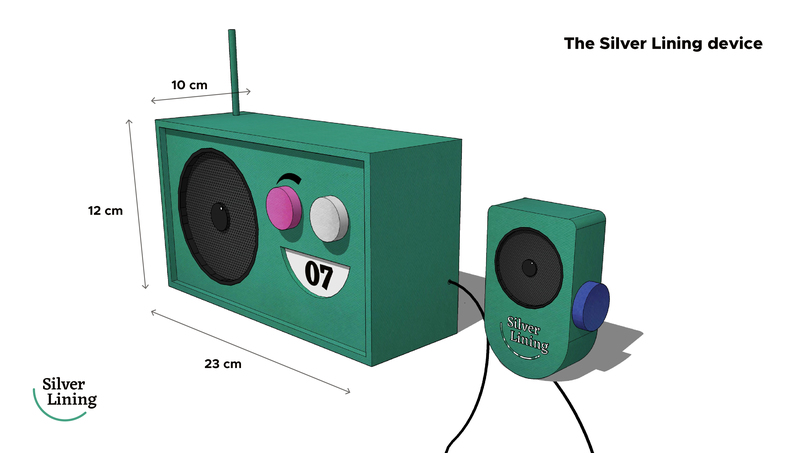
Silver Lining devices adapted for the elderly's needs (having user-friendly buttons, relevant colours and hardcoded channels.
-
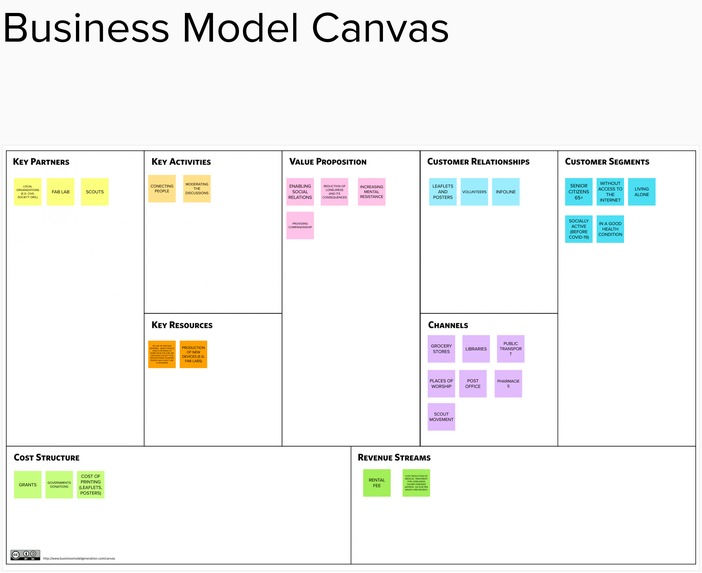
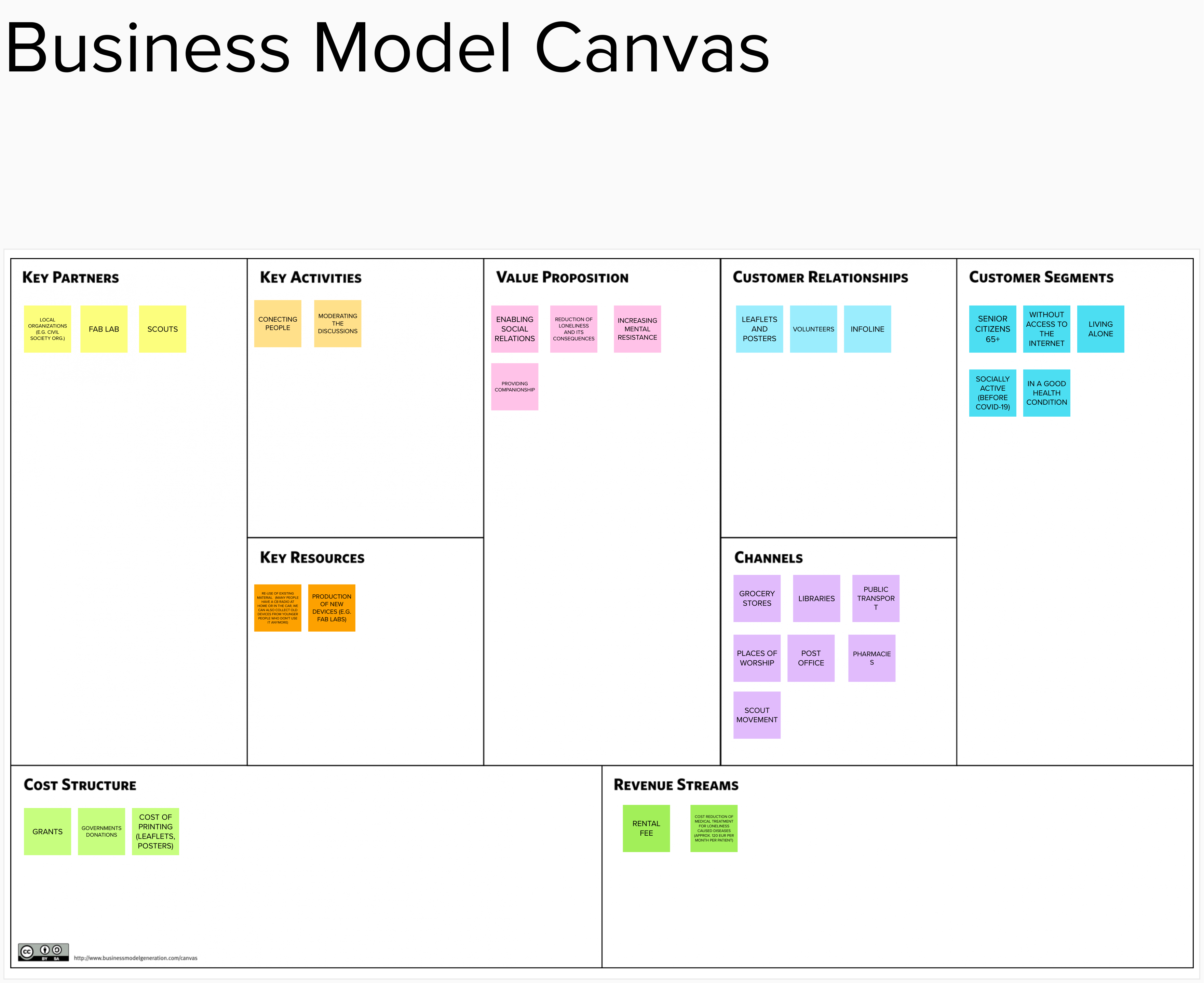
The business model will be based on diversified funding sources, such as public funding, private donors and financial input from the users.
-
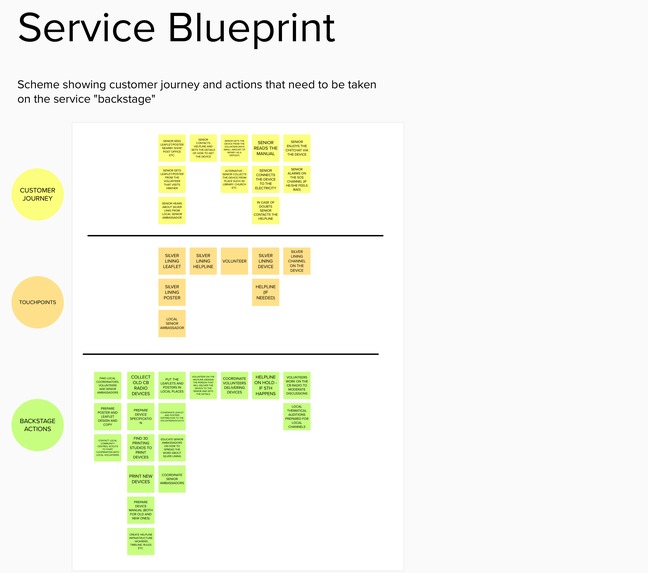
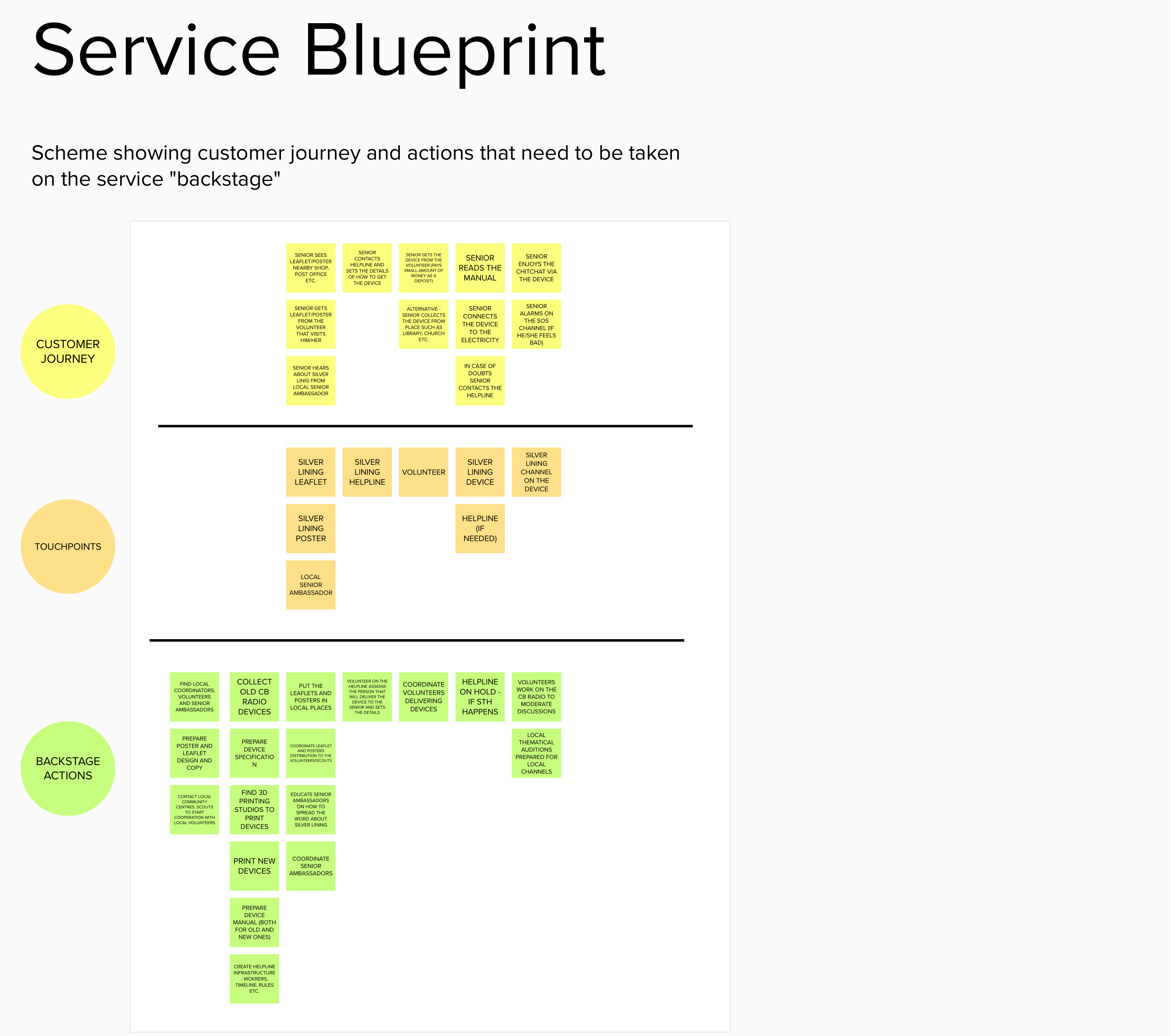
Scheme showing customer journey and actions that need to be taken on the service "backstage"
-
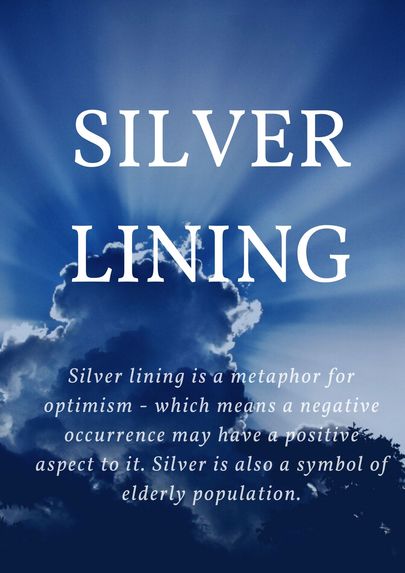
Our solution is called Silver Lining, which is a metaphor for optimism, as any negative occurrence may have a positive aspect.



The problem your project solves
Problem: Loneliness and self-isolation of the elderly during the quarantine
We choose to work on the challenge concerning elderly, as the silver tsunami continues to grow. Data show that 19% of the European population is over 65 now. Amongst them: (1) 32% live alone and (2) more than a half don't use the internet even once a week (Eurostat, 2018). It is forecasted that the proportion of people aged 65 and older will double between 2010 and 2050 and that the number of people aged 85 years and older will rise from 14 million to 19 million by 2020 and to 40 million by 2050 (according to the World Health Organization).
One third of the elderly live alone, more than a half of them have no access to the internet. Before the pandemia, they kept themself busy by attending classes, religious services, visiting friends or simply going for a walk. Now they are literally cut off from the outside world.
The coronavirus and self-isolation means for them being more lonely than ever. Which may be dangerous, because loneliness is thought to act on the body in a way that is similar to chronic stress. Evidence shows it can be as harmful to our health as smoking, and people with a high degree of loneliness are twice as likely to develop Alzheimer’s Disease as people with a low degree of loneliness. Therefore, long isolation can affect those people’s health and make them search for medical help in the time when hospitals are already full.
Our mission is to build a solution that will help elderly people feel less lonely by giving them an easy to use tool that will allow them to be connected to others even when they are not allowed to go outside because of the COVID-19 pandemia, or even without the access to the Internet.
The solution we bring to the table
The solution: Silver Lining - a CB radio-based service, allowing elderly people to keep in touch with others, even during the CODIV-19-lockdown, or without the access to the Internet.
How it works?
Elderly are equipped with simple CB radio-based devices. Each device is already pre-configured, so the only thing they need to do is to simply plug it in. Then, they can turn it on and immediately become a part of the chat that’s running on the channel. If they want to speak, they just need to press the button, so others can hear them. If they are not feeling like talking, they can still listen to others and enjoy the time together. If they need help, they can switch to the SOS channel with just one click, so a professional or a volunteer can answer their needs. The coverage of one device is c.a. 10 km, so the elderly can be in touch with their neighbours and fellow citizens.
How it answers the problem?
Thanks to our service the elderly gain the possibility to be in touch with others in a simple (without the Internet connection) and safe (without the need to go outside) way. They can have a chat, establish new friendships, keep social interactions, feel like they are still a part of the local community, enjoy the time together - this way, they fight loneliness being apart together. What makes it unique? It uses a device elderly people already know and many of them have used it before - thus, it makes it easy-to-use. It is an Internet-free service, so it is suitable for the people who do not have any digital skills. Plus, in case of the Internet blackout (that may be caused by the network overload that is seen during the pandemia-led lockdown), it may serve as a tool for wider groups of people. CB radio devices are cheap, so they can be bought easily; they can be also collected from the people who don’t use it anymore (e.g. because they prefer mobile apps); finally - they can be easily DIY-built (e.g. with the usage of 3D printers).
Why “Silver Lining”?
Our solution is called Silver Lining, which is a metaphor for optimism, as any negative occurrence may have a positive aspect. Silver is also a symbol of elderly population. We believe that our solution is just the same: something positive that was born from a negative situation and suited for the elderly.
The implementation process:
Our solution is easy to implement quickly. In the 1st phase (a pilot phase), we plan to organize a collection of old CB radio devices from the people who don't use them anymore, adjust them to the project needs and distribute them among the elderly. Later on, we will produce our own Silver Lining devices adapted for the elderly's needs (e.g. having user-friendly buttons, relevant colours and hardcoded channels, which will make them impossible to accidentally put them out of tune) - the prototype can be turned into a ready to use product very quickly using a 3D print and existing technology.
There will be a social campaign organized in local communities. The elderly will get to know about the Silver Lining from the posters and leaflets visible at the places commonly visited by them, such us shops, local billboards, local culture centres, post offices, pharmacies, open-air markets etc. The information about the solution will be also distributed by the volunteers who are in contact with the seniors, e.g. those that bring them shopping or lunches. We also plan to create a network of the ambassadors - seniors from local communities that are already accustomed to CB radios (e.g. they have one, or have used one in the past), that will spread the word about the project and animate local Silver Lining communities.
To get the Silver Lining device, the elderly will be asked to call a helpline. The volunteers answering the phone will be ready to answer their questions and to let them find out more about the project. Then, they will assign a person that will bring the Silver Lining device straight to elderly person’s home. The distribution of the devices will be managed by the places commonly visited by the elderly, i.e. libraries, churches, local civil society organizations, or delivered by volunteers, e.g. scouts. While getting a Silver Lining device the elderly will be asked to pay a small deposit (e.g. 10 euro), that will be paid back upon the return of the device.

Silver Lining.
As soon as the seniors have the Silver Lining device at home, they can immediately use it. The only thing they need to do is to plug the device in and turn it on. The device will be pre-configured, so there shouldn't be any problems. But if there are some, the elderly can try to find the solution in a user-friendly manual, or call the helpline. There will also be local coordinators assigned, ready to assist in case any technical problems arise.
After turning the device on, the elderly can listen to the chat that’s running on the channel. If they want to speak, they just need to press the button, so others can hear them. If they are not feeling like talking, they can still listen to others and enjoy the time together. If they need help (e.g. when they do not feel well), they can switch to the SOS channel with just one click, so a professional or a volunteer can answer their needs. The coverage of one device is c.a. 10 km, so the elderly can be in touch with their neighbours and fellow citizens.
Business model:
The project is going to be led as a not-for-profit project. The main economic aim of this project is to lower the costs of the healthcare service, which is estimated for 120 EUR monthly per patient. The facilitation of the communication between the elderly is a significant added value to the national health case system in every country. Being in touch with the elderly that have no Internet access accelerates the time of offering them support.
The business model will be based on diversified funding sources, such as public funding (e.g. EU grants), private donors (e.g. via crowdfunding) and small financial input from the users. Please find the details in the business model canvas attached.
Cost structure:
1. CB radio devices:
We assume that the elderly - the target group of this project - is a group in need thay may not be able to cover all the costs connected to the participation in the project. Thus, they will not be asked to buy their own CB radio devices - they will be able to rent them, giving a small deposit (10 EUR) that will be paid back upon the return of the device.
In the 1st phase of the project (a pilot phase) we will re-use old CB radios collected from the people that don’t use it anymore. If the demand will be higher, then we can also buy additional devices (their cost is c.a. 50 EUR/device). Then, we will start to produce dedicated Silver Lining devices (looking as those shown in the prototype). We will establish cooperation with hackerspaces and fab-labs that will help us to print the devices on 3D printers. Hackerspaces, fab-labs and volunteers will offer support in case of the device breakdown or any technical problems.
2. Promotion and dissemination:
We plan to establish cooperation with local NGOs and institutions that will spread a word about the project among the elderly. The costs of promotional materials (leaflets, posters, etc.) will be covered by grants and other public funding.
3. Coordination:
We plan to use existing infrastructure (institutions, like libraries, NGOs, scouts), so the project may be a part of other existing services offered to the elderly and may be run by local volunteers-coordinators. Other coordination costs will be covered by public funding.
4. EU Support:
We recommend the EU to dedicate and supervise the frequency to use in Silver Lining project, and take patronage over standardization and unitization of provisions regarding the use of CB radio across Europe.
Silver Lining works like a Facebook group, but offline: it connects people, gives them opportunity to talk to each other, to exchange information, and to make new friendships. Therefore, it gives the elderly a new opportunity of being among others even without going outside.
Our solution is scalable and expandable. The channel can be used to not only organize simple chats but also to organize broadcasts or radio-classes. It has also a potential to become a Wi-Fi-based solution: in the future, the Silver Lining device can be adjusted to work not only on CB radio waves but also on the Internet. Thereby providing the elderly with access to the Internet, while still using the simple and well-known device.
But what is most important, the solution can be implemented as soon as possible by installing the simplest, old fashioned equipment. Many people already have a CB radio at home or in the car. So the resources to implement Silver Lining are minimal.
What you have done during the weekend
We are happy that we managed to work as in the design sprint, along with the service design method. We went through all the stages of the double diamond process. First, we did some desk research on elderly people and isolation, then we have chosen our target group which is very specific. Then we went through the process of choosing our value proposition and ideation. After that we were working on the business model, to make our ideas more grounded. We designed a service blueprint - the path showing both the customer journey and actions that need to be done at the backstage. The effect of our work was a prototype that has been consulted with some representatives of our target group, and the final pitch with the video.
Our biggest challenge was the target group we chose - elderly people living alone and with no Internet access, which means the communication with them may be seen as limited. Therefore, we were forced to leave behind thinking about designing digital tools such as applications, social media, websites etc. and design something tangible. It was a challenge to design an offline solution while almost everything is transferred to online nowadays.
We are proud of the very good cooperation in our team. We are also proud of our way of thinking, that has been changing during the process, and that we finally managed to transfer our digital learnings and online solutions to the offline world. We learned how important our target group is for the future world and - at the same time - how fragile and vulnerable it is. The design process required a lot of different perspectives and skills to pull together into a complete project. We learned how to use our own, unique skills to complete one, big challenge. For most of us this was the first hackathon, and we are happy that we completed a project with a purpose for social good.
The solution’s impact to the crisis
The COVID-19 pandemia forced people to stay at home. Those who are familiar with ICTs (information and communication technologies) were able to easily switch from offline to online: to have video-chats with their loved ones, to work remotely, to do online shopping, etc. For others, the lockdown is much more burdensome - they have no possibility to find alternatives to their everyday habits: they can’t meet their friends or neighbours, as they can’t go outside, they can’t borrow a book, as the libraries are closed, they can’t go to the green market to buy some groceries and have a chat, as it may be potentially dangerous because of the virus. Thus, the whole COVID-19-related situation makes them feel much more lonely than ever before. And loneliness, according to the research, may have a significant negative impact on their health.
The Silver Lining service may serve as a tool to answer the needs of the elderly: we may say it can become the same tool for them as the Internet is for the digital natives. Thanks to it they can be in touch with others, they can entertain, or even ask for help, if needed.
The Silver Lining uses CD radio-based devices, which are cheap and well-known for many people, thus it can be easily implemented, both on a small and on a larger scale. It uses not only existing technology, but also existing infrastructure: libraries, NGOs, scouts communities and others, thus it is not expensive, so it can be implemented both in reach and in poor communities.
The necessities in order to continue the project
Establishment of a cooperation with companies responsible for creating and assigning CB radio channels in a particular area/country in order to ask for channels dedicated to Silver Lining project. Recruitment of local coordinators: people and/or institutions (e.g. libraries, NGOs that work with the elderly) that would be responsible for promoting the project in the local community, distributing Silver Lining devices among the elderly and facilitating the channels. Funding for the organization of the social campaign. Funding for the production of the Silver Lining devices (please note: in the pilot phase we plan to use as many of the old CB radio devices as possible, but if the demand of the devices will be higher than the number we will manage to collect, then we will start to produce dedicated Silver Lining devices (looking as those shown in the prototype).
Credits
In our materials we have used media from the following sources:
- Music: Scott Holmes Together we stand
- Illustrations: inspired by Freepik resources
Built With
- servicedesign


Log in or sign up for Devpost to join the conversation.