Inspiration
Most music platforms are designed to push what is already popular. We wanted to build something that does the opposite: uncover forgotten artists and reconnect people with cultural archives that have slowly disappeared from modern listening habits. Sillon was inspired by the idea that emotions in music survive across generations, even when the artists themselves are forgotten.
What it does
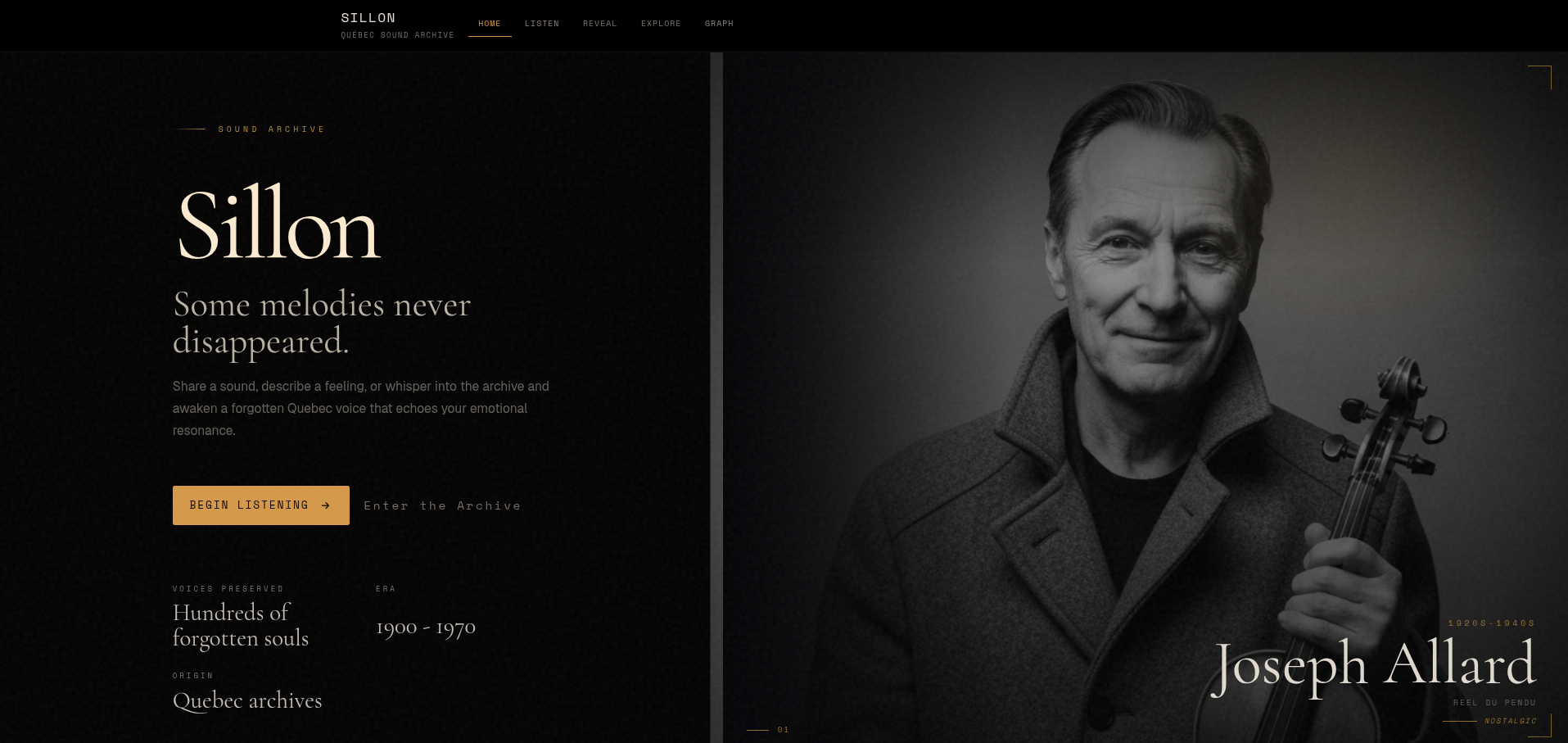
Sillon is an interactive sound-art experience where users can hum a melody, upload a sound, or describe a song they love. The system searches a curated archive of historical Quebec recordings and reveals a forgotten artist whose music shares similar emotional or melodic patterns. The experience combines archival audio, cinematic visuals, and real-time analysis to make musical discovery feel immersive rather than algorithmic.
How we built it
We built Sillon as a responsive web experience using React, TypeScript, Tailwind CSS, Three.js, and Framer Motion for the frontend. For audio analysis and matching, we used Python, FastAPI, librosa, and FAISS vector search. Historical recordings and metadata were curated from Library and Archives Canada, the Virtual Gramophone archive, and the Internet Archive.
Challenges we ran into
One of the biggest challenges was balancing technology with emotion. It was easy to make the project feel like a generic AI music app, but much harder to make it feel cinematic, artistic, and culturally respectful. We also had to deal with noisy archival recordings, inconsistent metadata, and the challenge of creating believable audio matches across completely different eras of music.
Accomplishments that we're proud of
We’re proud of turning historical archives into something interactive and emotionally engaging instead of static. We’re also proud of the visual identity and reveal experience, especially the moment where modern music and century-old recordings synchronize together in real time. Finally, we’re proud that the project feels artistic without sacrificing technical depth.
What we learned
We learned that the strongest interactive experiences come from emotional clarity, not feature count. We also learned a lot about real-time audio analysis, audiovisual storytelling, responsive design, and how to work with imperfect historical datasets while still creating meaningful user experiences.
What's next for Sillon
We want to expand Sillon beyond Quebec archives and explore musical connections across cultures, migrations, and generations. We also want to develop the relationship graph further into a living map of musical influence and eventually turn Sillon into a full interactive installation or museum experience.

Log in or sign up for Devpost to join the conversation.