Inspiration Warehouse silo operations are complex, expensive to test in real life, and highly sensitive to small decision changes. We wanted a safe way to experiment and optimize before deployment.
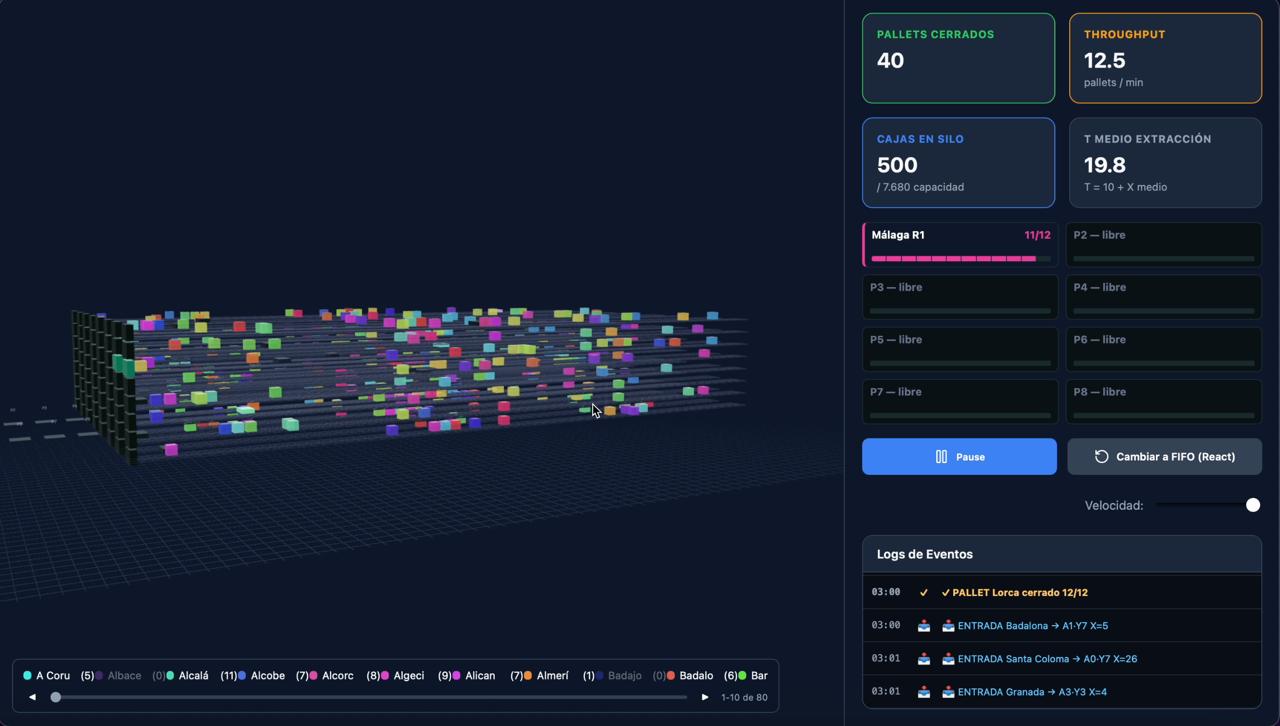
What it does SiloFlow is a digital twin that simulates box storage/retrieval in warehouse silos, compares strategies (FIFO vs heuristic-driven), and reports KPIs like completed pallets, pallets/minute, and movement time/cost.
How we built it We built a Python simulation core for silo physics and operations, then added input/output decision heuristics (ABC zoning, load balancing, candidate selection by shuttle cost, blockage handling). We ran scenario-based evaluations and visualized traces with a React + Three.js frontend.
Challenges we ran into The hardest part was balancing conflicting goals: throughput, travel cost, and blockage risk. We also had to model realistic constraints (depth, levels, shuttle availability) without making the simulator too slow.
Accomplishments that we're proud of We moved from a simple FIFO baseline to a tuned heuristic pipeline that significantly improves efficiency and reduces operational cost. We also built a reusable experimentation framework, not just a one-off script.
What we learned Small heuristic changes can have large system-level effects. Measuring everything with consistent KPIs is essential, and simulation-first development is a strong approach for logistics optimization.
What's next for SiloFlow Next steps include real-time WMS integration, adaptive/learning-based heuristics, larger stress-test scenarios, and a decision-support dashboard for operations teams.
Built With
- html
- jupyter
- python
- react
- typescript
- vite

Log in or sign up for Devpost to join the conversation.