Inspiration
If you’re like us, you’ve probably gone through the hoops of LinkedIn, Indeed, Glassdoor, and many other job sites! During this time of quarantine, many of us have spent our time applying to internships and jobs. But if you’ve ever dealt with these job sites, you must have gotten one of the mass-emailed “I am sorry to inform you that there were many candidates this year”, “We appreciate you applying, please check our career site for more jobs”, Sign up for this newsletter so we can spam you with jobs that you’ll never get!
But at the end of the day, the big question is why are job applicants judged just based on their statistics? What is the point of sites that simply ask you for a list of your experiences and then regurgitate your resume? Why are there so many repeated jobs across different job boards?
We decided that we would change this by creating a project-oriented job searching site to not only help you find jobs, but help you find like minded individuals to pursue your passions with. It’s a smooth and friendly experience that avoids the clutter and overwhelming spirit of other job sites. In order to distinguish ourselves from other sites, we programmed a key algorithm that sorts out repeated jobs, a database to store user projects, and a clean and aesthetic UI.
Is there a need? What about LinkedIn?
Now, we didn’t want to jump into coding right away, because we wanted to create a solution that was actually beneficial to the community. While it was our goal to create a final product to show off at the hackathon, we were more focused on social impact. What we discovered was that users are actually struggling!
As one user mentioned, “sometimes… I wonder if these job sites even work. I spend so much time filling out applications, just to get spat out by an automated machine.”
Well do they work? Not really.
After doing a short research study with users across the internet, we found that over 80% of the students struggled with finding jobs on LinkedIn, while another 70% found mainstream job sites incredibly overwhelming. Another 50% thought that the ability of showing off your own personal portfolio would more accurately reflect their personal abilities and skills.
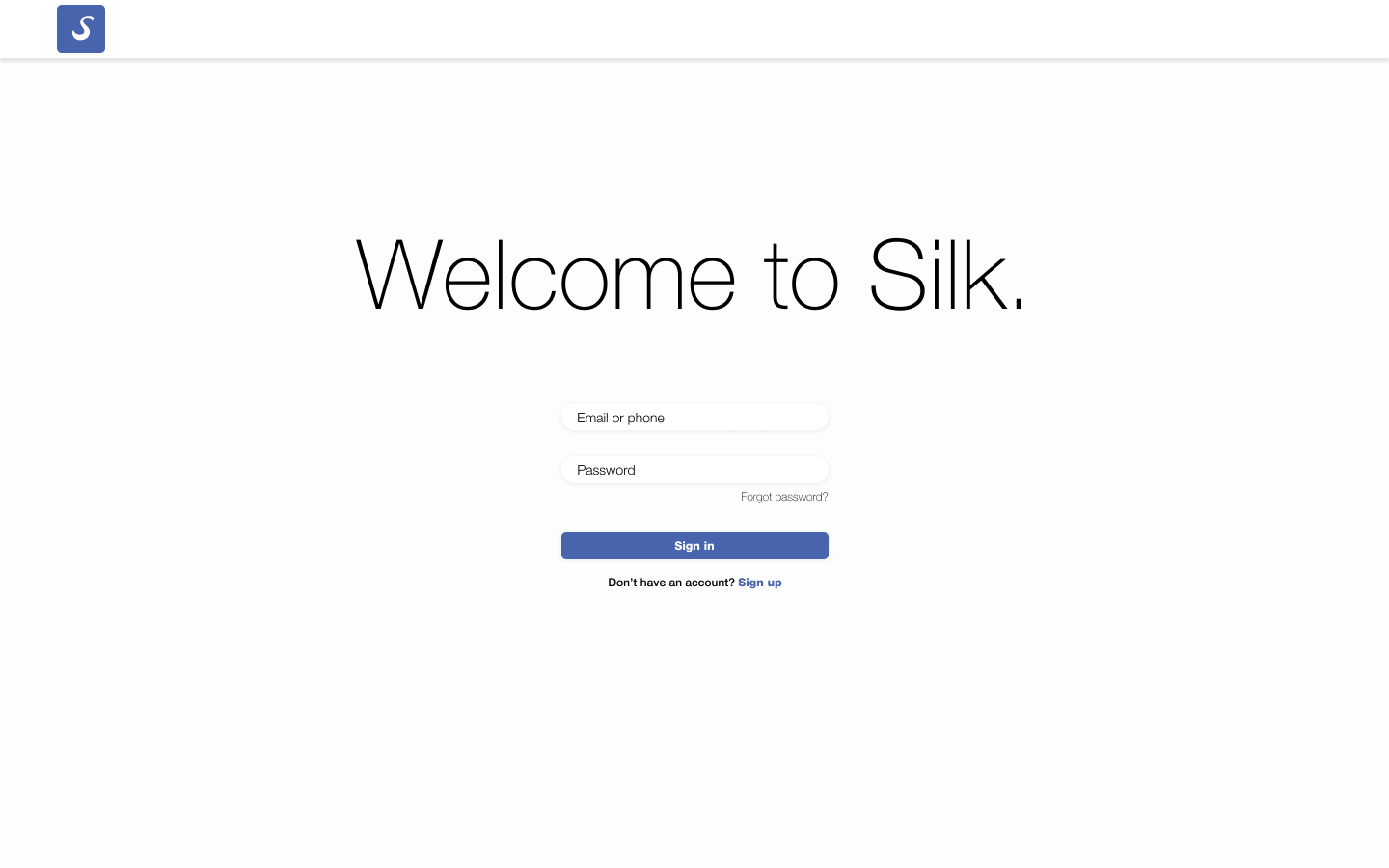
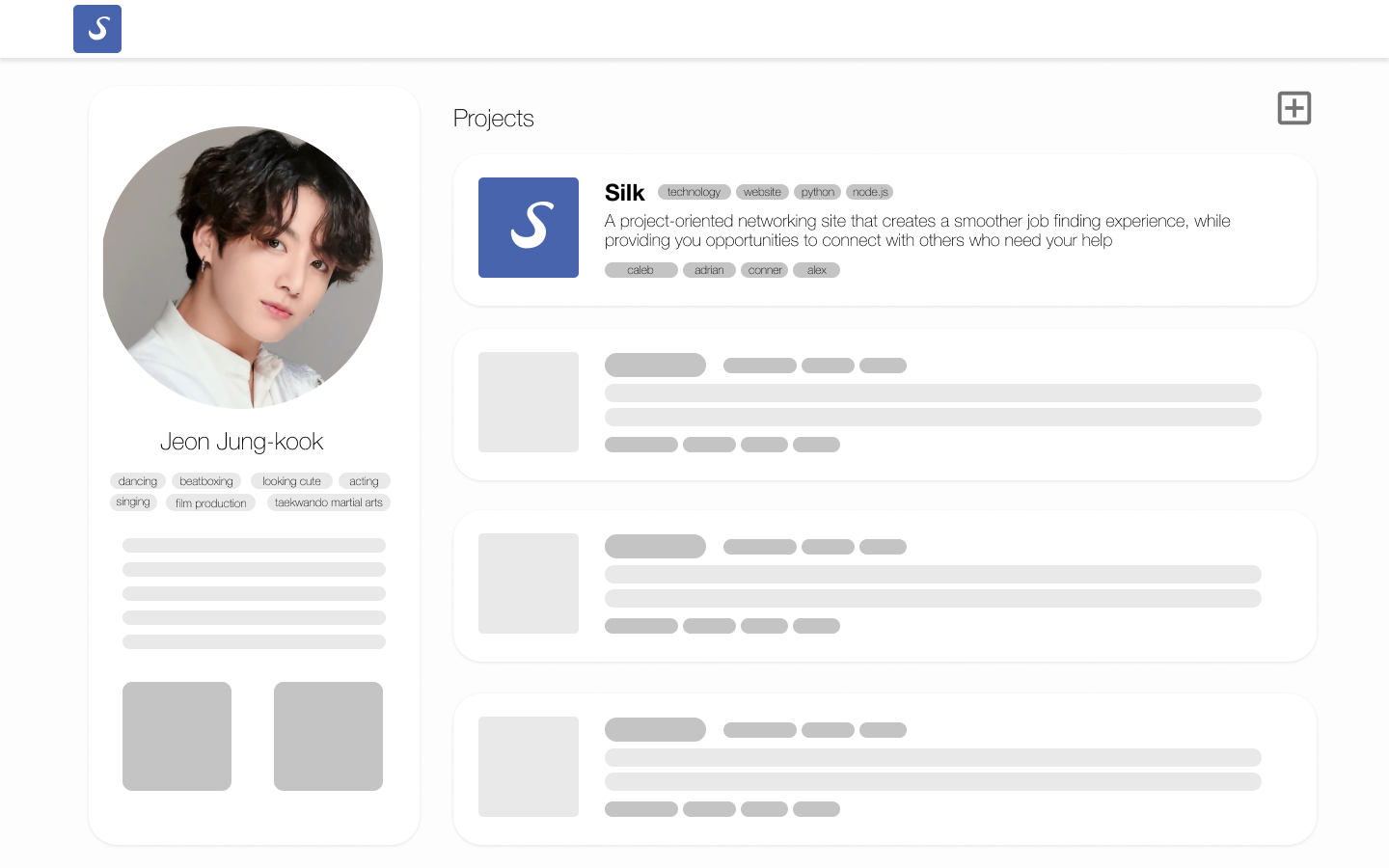
As a result, we decided to create a simple, yet minimalistic front-end in order to make users feel more comfortable and connected to the platform. As a project-oriented site, users are able to show off skills beyond their resume, without having to design an entire portfolio website. We determined through user research, that this would be incredibly beneficial and would allow us to create a competitive job searching site, different from any other.
Who is it for?
Silk is designed for everybody!! In fact, we designed it with the purpose to help underprivileged groups like women and minorities to succeed. In order for people in our world to find jobs, many often have a lack of understanding on how to take advantage of job searching sites. Silk helps to bridge that gap by allowing users to show off their projects in a visual and interactive way, instead of reading lines upon lines of boring old resume.
How does it work?
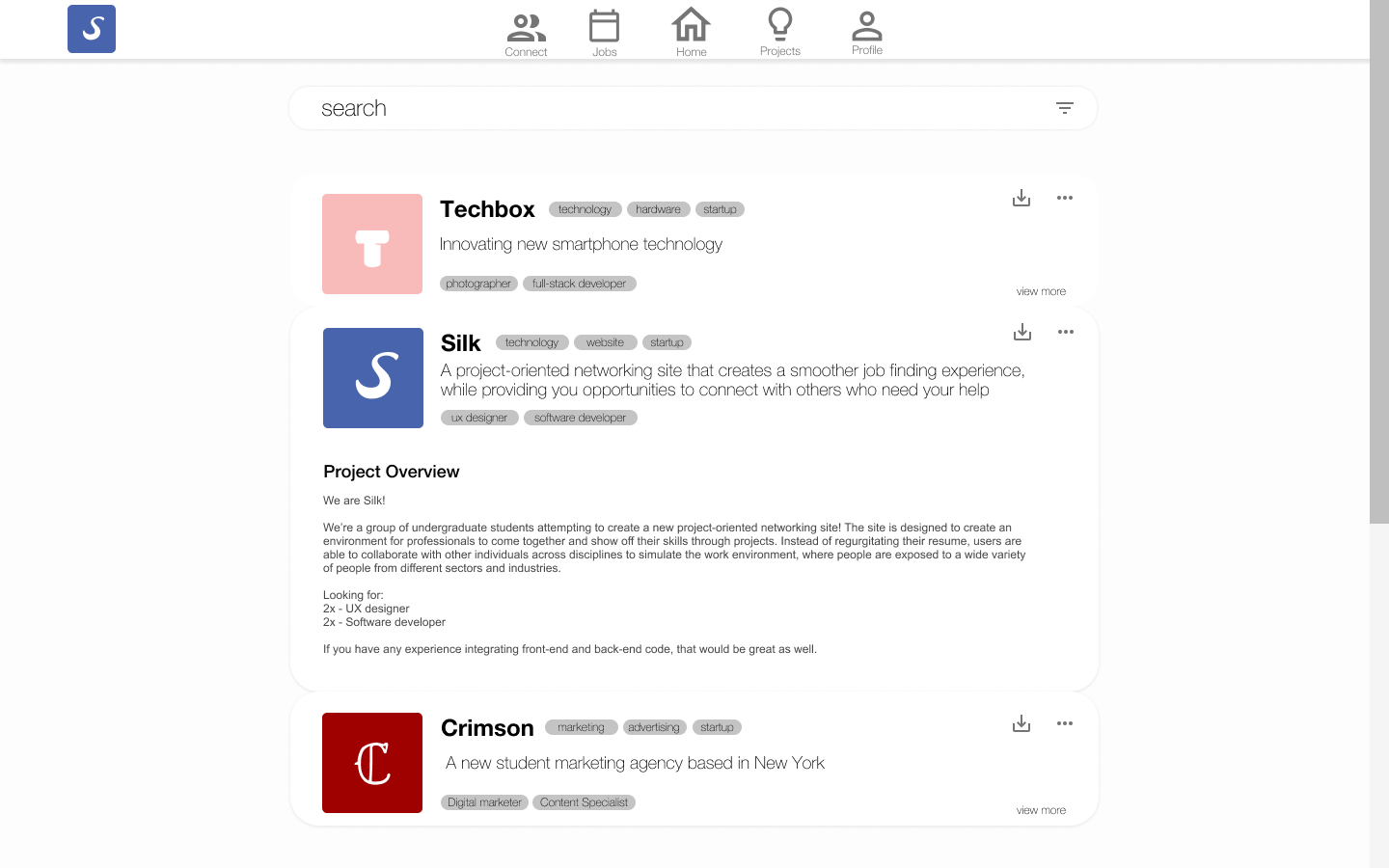
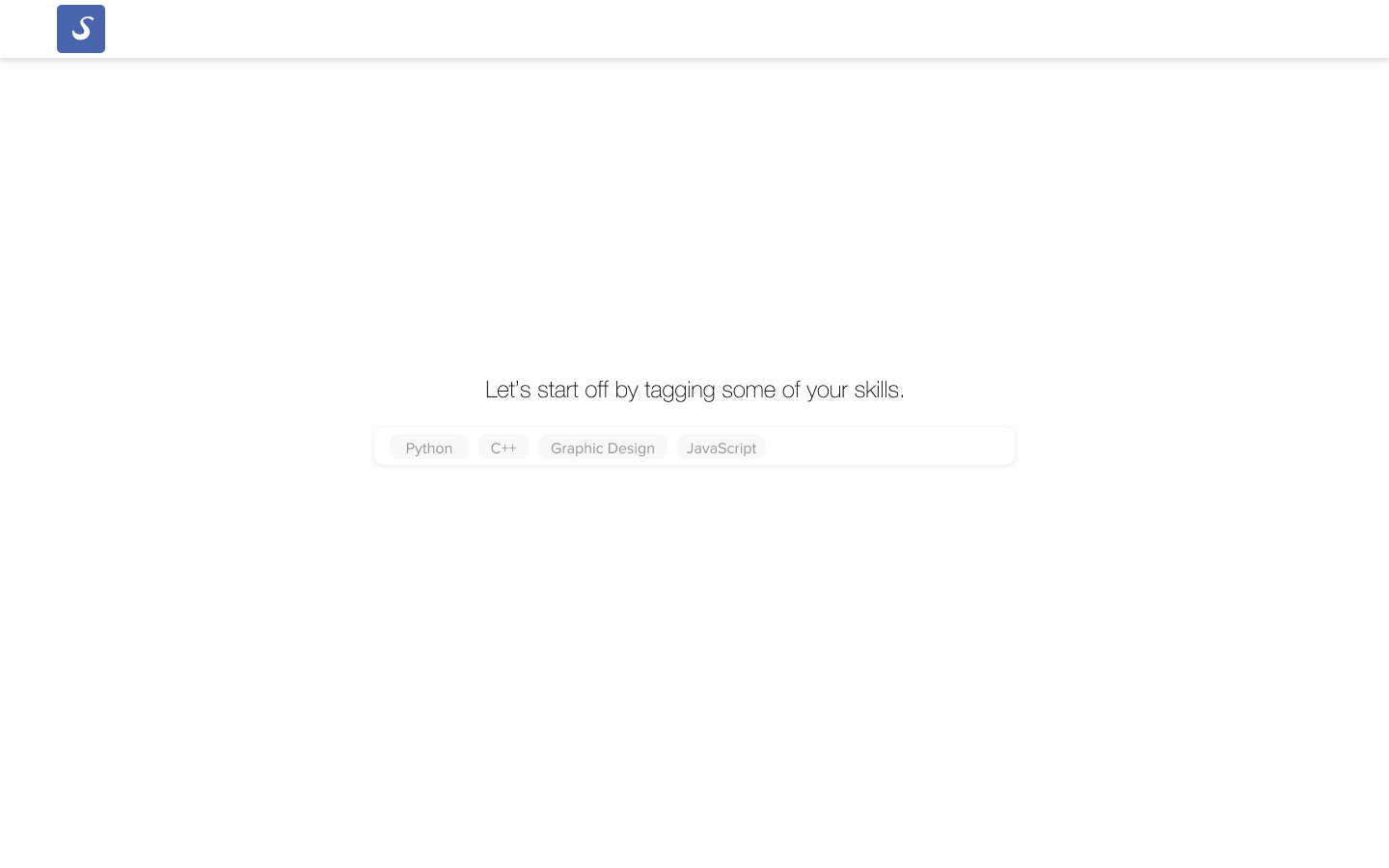
The website has two main functionalities: to find jobs and projects according to your specific skill set and interests. For the job searching aspect of the website, users are asked to fill in their skills and specific job preferences, which is then processed and fed through the Github job API to retrieve relevant job postings. As for projects, individuals can input their skills and interests in specific fields to find relevant projects in which they could potentially join. Along with the user sign ups, these are stored into a database using the MongoDB API. Users can also create project postings where they describe what the project is about and how it’s being made, as well as what is still currently needed. A major issue in the world revolves around frictional employment; where skills are needed, but users are unable to find the employers and employers are unable to find the users. By adding a project function to a job posting site, employers are given more information to make an educated decision. This cuts down costs and risks for the employers, because they are able to get a reliable workforce. In addition, the users are also able to benefit because they are able to connect with others who are interested in building projects together, while showing off their awesome work to potential employers.
How we built it
By integrating the knowledge we gained from the MongoDB web development session, we were able to create a database that stores user-data. This helped us create a system for signing up users, and giving them their own dedicated user profile. In addition, we used a variant of the database and applied it to the project function, which allowed us to store all of the project datasets into MongoDB. This was integrated with Python and Flask to run the backend of the code, with the front-end built with CSS and HTML. Flask ran many of the functions that fetched the database from MongoDB, and also stored data that we received from users while they signed up or created new projects. This would allow users to store the projects they created, and give them the opportunity to search for projects based on categorized search results. To create the interactive skill set taglist, we used React.js to program a function that allowed us to sort through jobs based on our interests and skill sets.
Challenges & Adapting for User Experience
Oh boy. We’re a team of recently switched computer science majors, along with a sociology major. Throughout this hackathon, we spent most of our time learning new programming languages that we haven’t used before. While it would’ve been easier to collaborate together, we lived in different time zones, separated across the world. This was the first hackathon for most of us, so we had a very limited understanding of how hackathons were.
In addition, we faced a big struggle with duplicative job postings. Since sites like Glassdoor, Indeed, LinkedIn, and Google Jobs use the same database for job listings, many of them are repeated and distributed to applicants as if they were unique. Since we allowed users to list a variety of skills, we didn’t want to individually search for every job under that category, as it would lead to hundreds and thousands of duplicates. However, we didn’t want to get rid of that function, because it’s incredibly important for users to be able to highlight their most important skills. We decided that it’s incredibly inconvenient for the user to manually sift through each job and take out repeated ones, so we decided to code an algorithm that ignores repeated job postings.
Another struggle that we faced was styling each individual job card because many of them were out of sync as they appeared on the screen. In order to keep the same model of aesthetic and cleanliness, we decided that we needed to create a system that would ensure each card was in line and in shape. While we could’ve used a simpler model of simply displaying the card on the screen in basic boxes, we realized that aesthetics were crucial to our business model in appealing to Gen-Z audiences as they become one of the most dominant user bases in American history.
Key takeaways
As this is the first hackathon for a lot of us, we felt quite accomplished with the amount that we did in such a short period of time. With projects like these, we’re used to the tasks being more spread out in terms of timing, so to have everything so densely packed together was really exciting and fun! Another reason we’re really proud of this project is because we’re a group of individuals that haven’t necessarily been around programming for our entire college experience, so we’re very proud of the amount of things we were able to learn throughout this hackathon.
But most importantly, we’re proud of creating a product that is welcoming, inclusive, and productive. In a time where technology is our only friend, it is so incredibly vital to create an experience that is soothing and satisfying. Even more so, we were so surprised to find that through this project, we made friends across the world. As a result, our experiences together became a prime model for planning out exactly what we wanted to reproduce. By giving other people opportunities to fully put their personalities and skills on display, we can create a more humane society where people are brought together by their love for innovation.
Testing the Limits of Job Search
One important value of categories is the ability for a business to classify themselves as a small business. Once they are able to categorize themselves, they can also let others on the job site to apply for jobs! By reaching out to small businesses, Silk can create more opportunities for those who are looking for work, and those who are looking for workers. Along with its ability to reach out to individuals through their own passions and interests, Silk is able to completely unify and bring people together.
Why Silk?
If you’re looking to get a more detailed job application that fully represents your abilities, use Silk! We hope to build a community where users can interact with one another in a friendly and personable way. If you’re a hiring manager, please reach out to express any comments you have!
What's next for Silk?
After this hackathon, we’d like to keep working on Silk to create a more efficient backend. This project sparked our curiosity, and with the proper funding, we hope to take it to the public one day. Through a system of complex algorithms and human-centric design, we hope to manifest the smooth job searching experience that we all dream of having. Silk’s infrastructure can be implemented to sites like LinkedIn, Indeed, and Glassdoor to take advantage of their dedicated user base, and provide them with a more comprehensive job search site. But even then, Silk has the potential to become a beast of its own in the competitive market. Despite facing numerous challenges, we’re confident that Silk can take off with the help of the newer generations who are able to appreciate the clean aesthetics.
Even this past weekend, we have discovered the ability of a singular passion to bring people together. We hope to recreate that opportunity for others around the world and create a more humanizing job search experience.
Thank you. We hope to see you as a future user!
Feel free to drop a like below if you enjoyed, and comment any questions that you have!


Log in or sign up for Devpost to join the conversation.