--Inspiration
Hardware design is still one of the most manual and fragile parts of engineering. Writing RTL, fixing syntax and structural bugs, setting up simulations, and understanding FSM behavior often takes far longer than expected, especially for students and early-stage designers.
While AI tools have significantly improved software development workflows, most hardware-focused AI tools stop at code generation and do not address verification, simulation, or behavioral understanding. We were inspired by this gap: why can’t AI assist hardware designers end-to-end, with verification and feedback built in?
-SiliconForge was created to explore this idea.
-- What We Learned
Building SiliconForge taught us that hardware-aware AI systems must be constrained, verifiable, and grounded in real engineering tools.
Some key learnings were:
- Generating RTL alone is not enough; verification is the hardest and most important part.
- Structural analysis using ASTs is essential to detect design intent mismatches early.
- Simulation-driven verification provides a strong grounding signal for AI systems.
- Waveforms and FSM diagrams are critical for building trust in generated hardware designs.
We also learned that AI systems become far more reliable when placed inside closed-loop engineering workflows rather than one-shot generation pipelines.
-- How We Built It
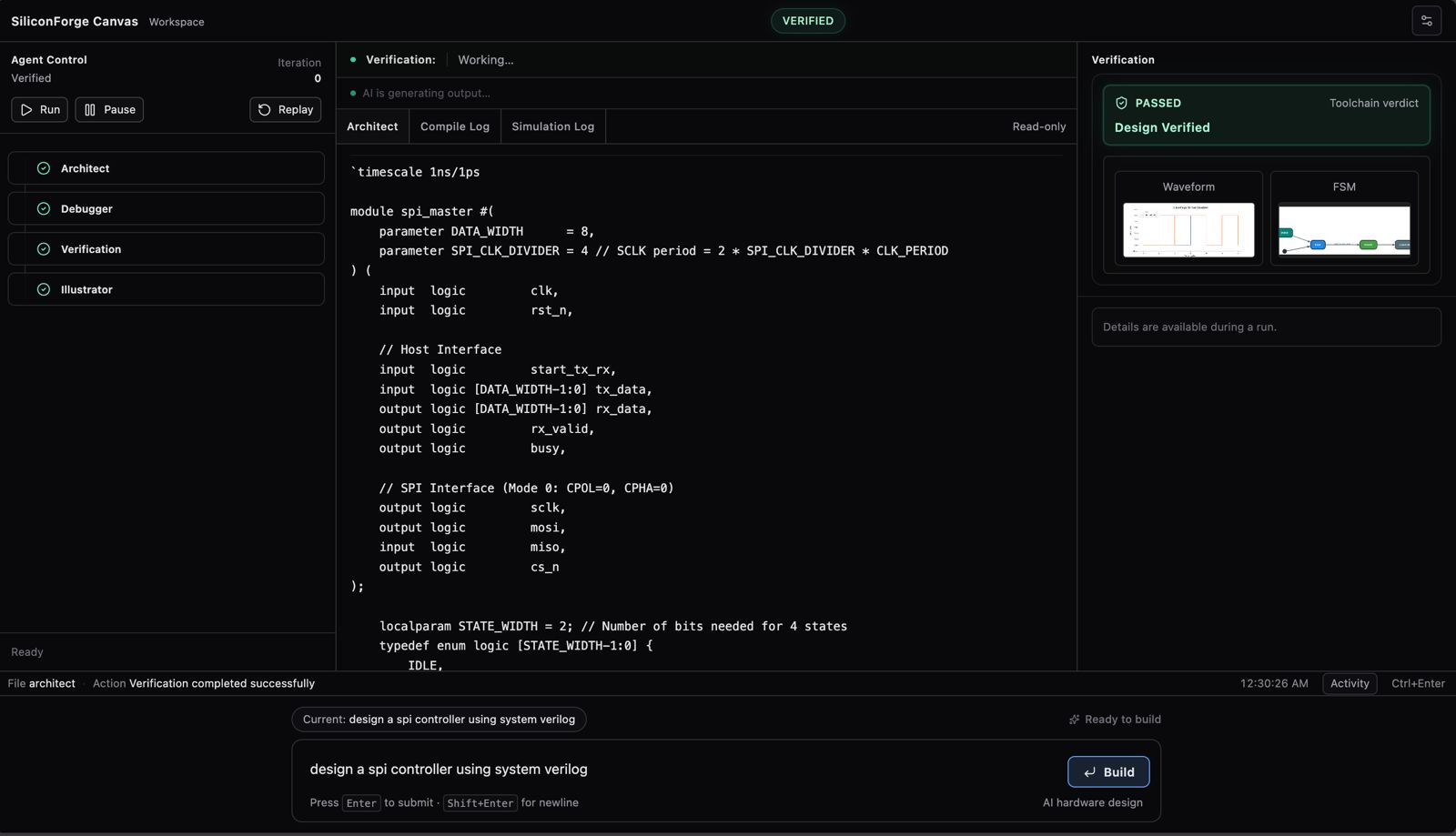
SiliconForge is built as a modular, agent-based system that mirrors how a real hardware engineer works.
At a high level:
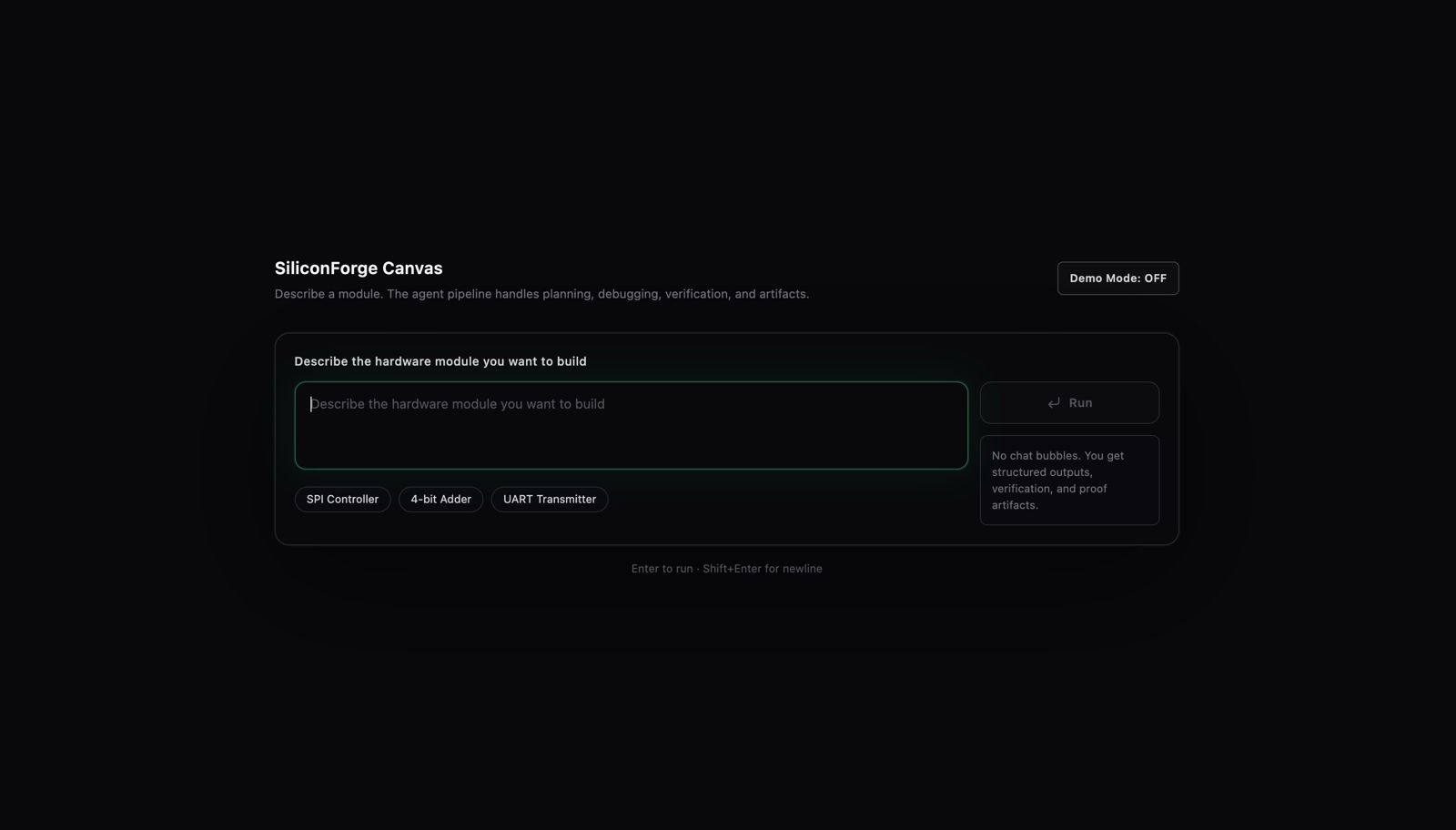
- A frontend allows users to describe hardware designs in natural language and inspect outputs.
- A backend orchestrates the entire pipeline.
- An Architect Agent converts natural language intent into synthesizable SystemVerilog.
- A Structural Verification stage analyzes RTL structure and intent.
- A Debugger Agent automatically repairs designs when compilation or simulation fails.
- Real compilation and simulation are performed using industry-standard RTL tools.
- From simulation artifacts, waveforms and FSM diagrams are reconstructed and visualized.
Every stage is gated, meaning incorrect designs cannot silently pass through the system.
-- Challenges We Faced
One of the biggest challenges was dealing with the strict limitations of real RTL toolchains. Unlike software, hardware compilers are unforgiving, and even small mistakes can cause failures.
Other challenges included:
- Ensuring AI-generated RTL avoided unsupported language constructs.
- Designing a safe self-repair loop that fixes code without corrupting it.
- Reconstructing FSMs reliably from RTL semantics instead of relying on AI-generated diagrams.
- Balancing automation with transparency so users can understand why a design works.
Solving these challenges required tight integration between AI reasoning and traditional EDA tools.
-- Why SiliconForge Matters
SiliconForge demonstrates that AI can move beyond text generation into trusted, verifiable hardware workflows.
By combining agentic AI with structural analysis, real simulation, and visualization, SiliconForge lowers the barrier to entry for hardware design while preserving engineering rigor. We believe this approach can improve how hardware is learned, prototyped, and validated.
-- What’s Next
Future improvements include:
- Multi-module and system-level designs
- Coverage-driven verification
- Formal verification integration
- More advanced FSM and timing analysis
- Support for additional simulators and synthesis tools
SiliconForge represents a step toward autonomous, verification-first hardware design.

Log in or sign up for Devpost to join the conversation.