-
-
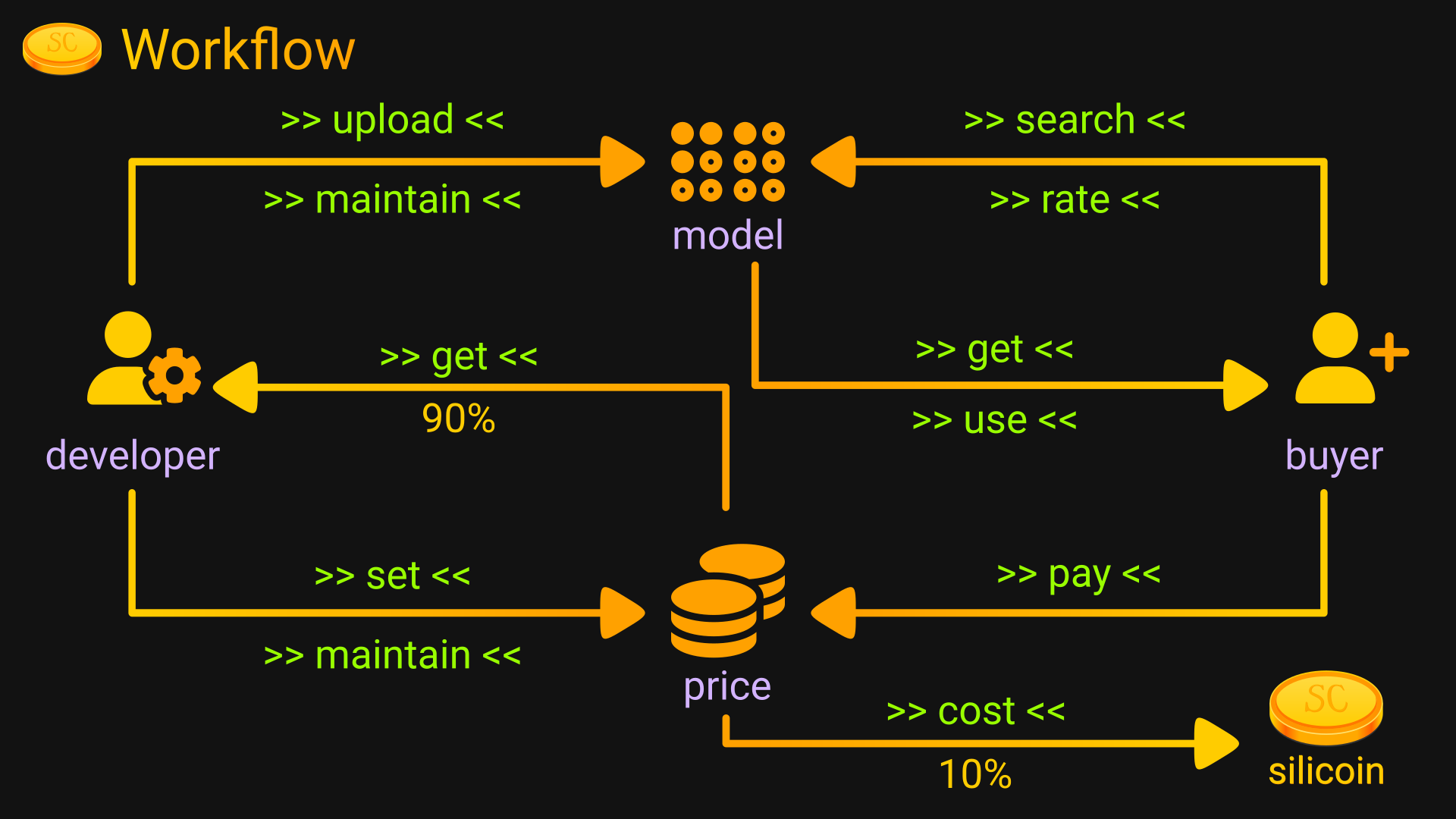
workflow
-
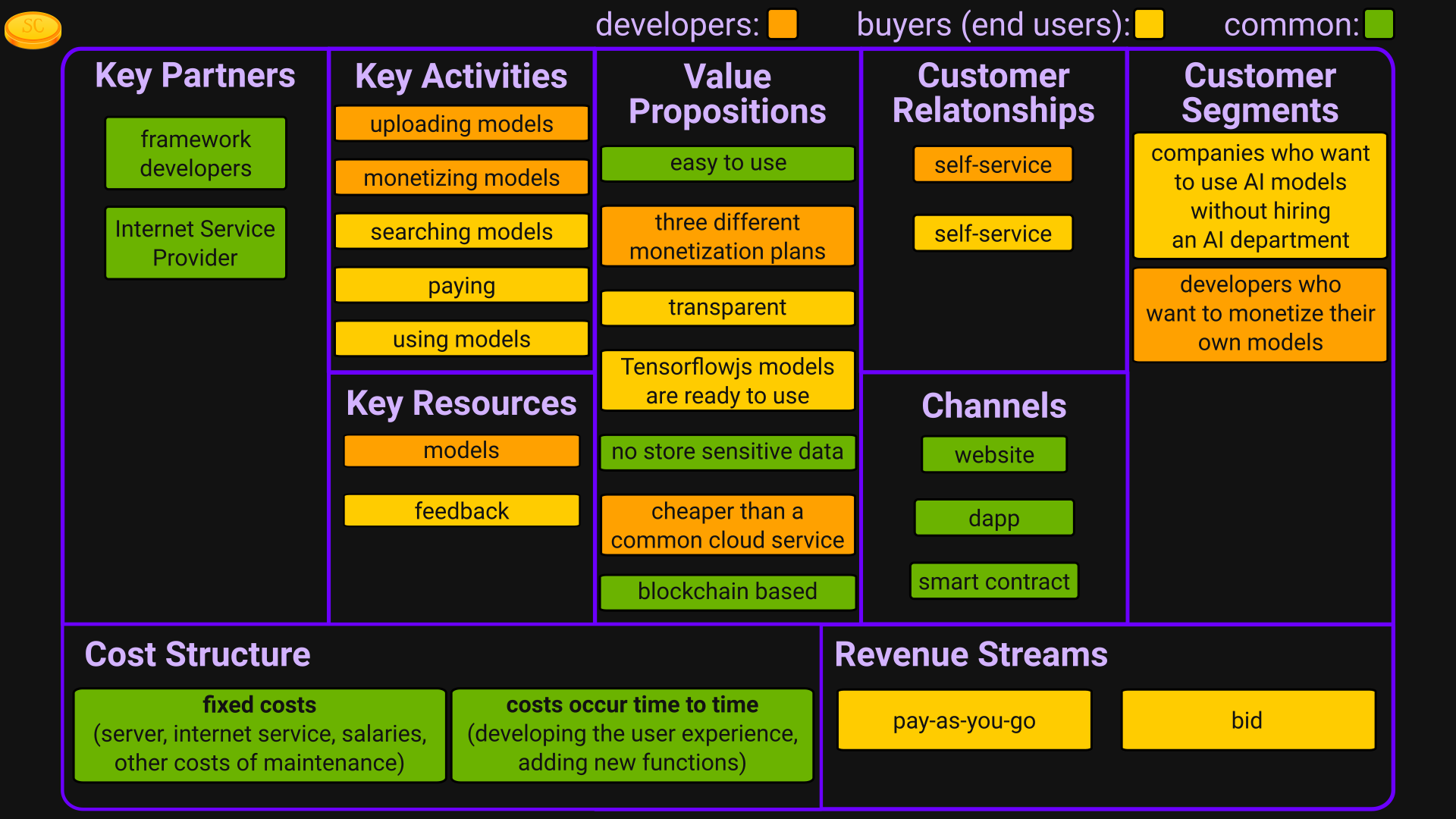
business model canvas
-
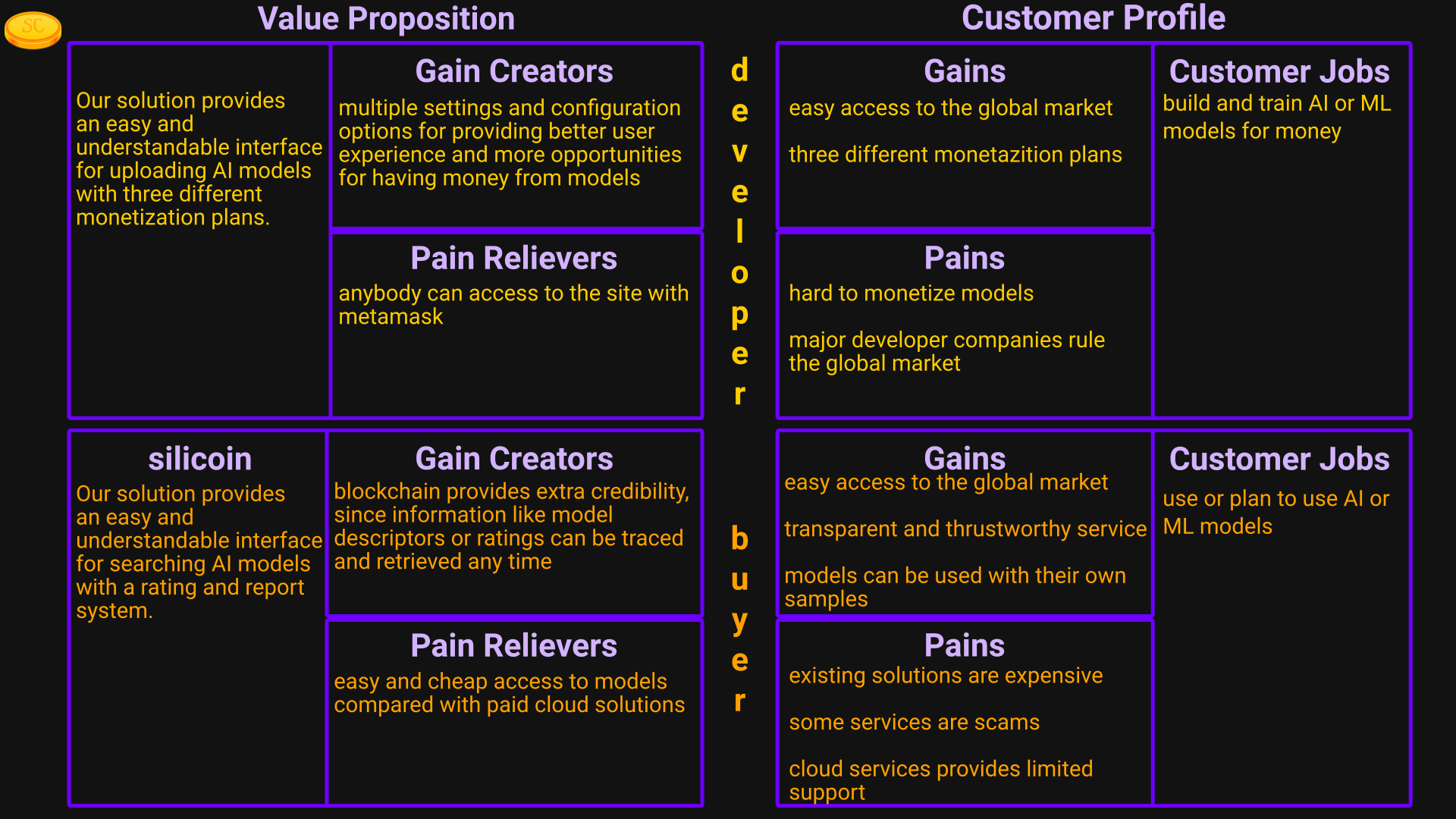
value proposition
-
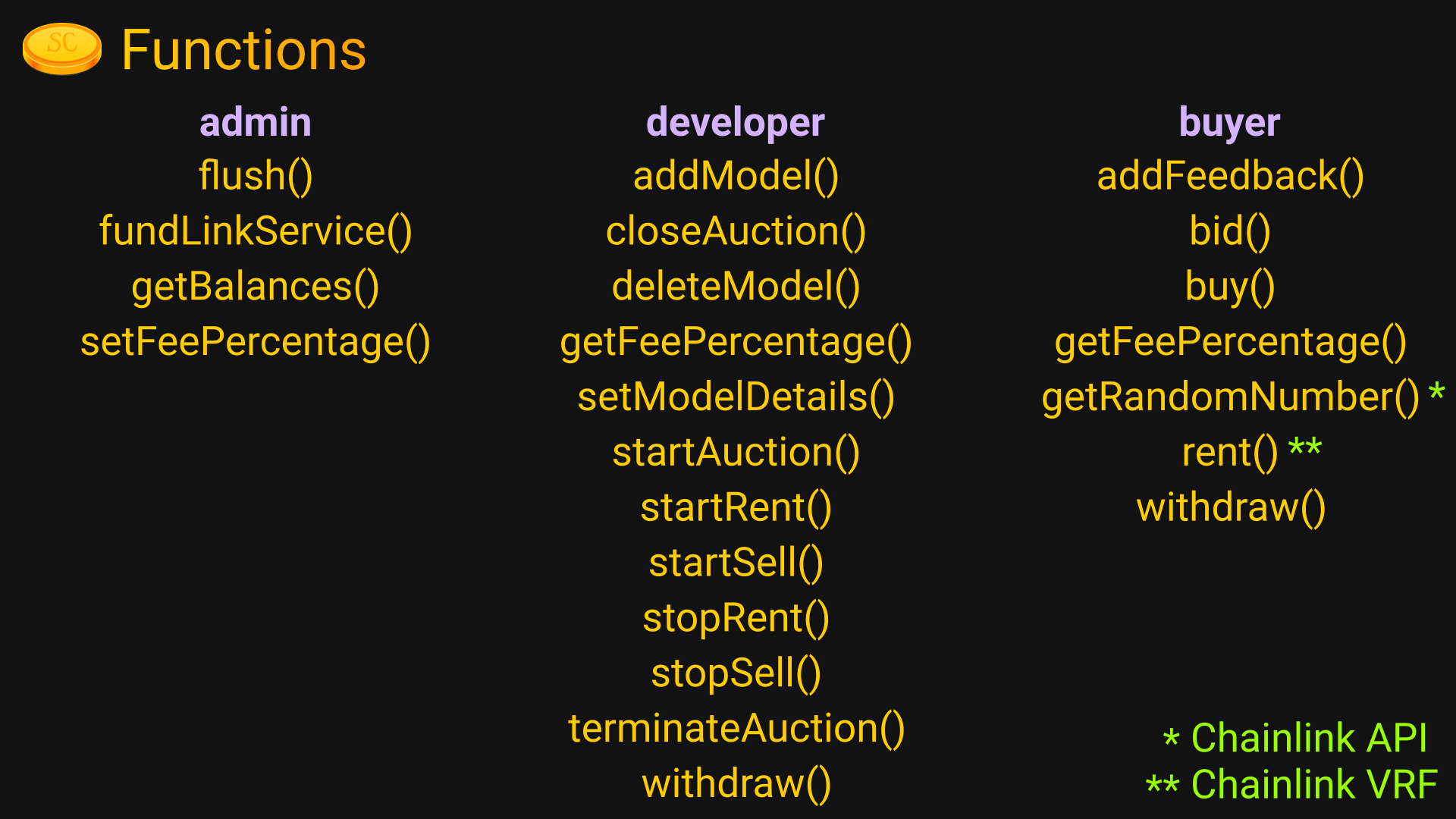
functions
Challenge 🏆
🏆 Silicoin is a brand new idea made for Chainlink Spring 2023 Hackathon. It uses Chainlink API and Chainlink VRF. Silicoin focuses on multiple tracks of this challenge, but the main track is the Chainlink Artificial Intelligence.
What is silicoin? 💛
🤖 Silicoin is a blockchain powered marketplace for artificial intelligence and machine learning models.
Inspiration 💡
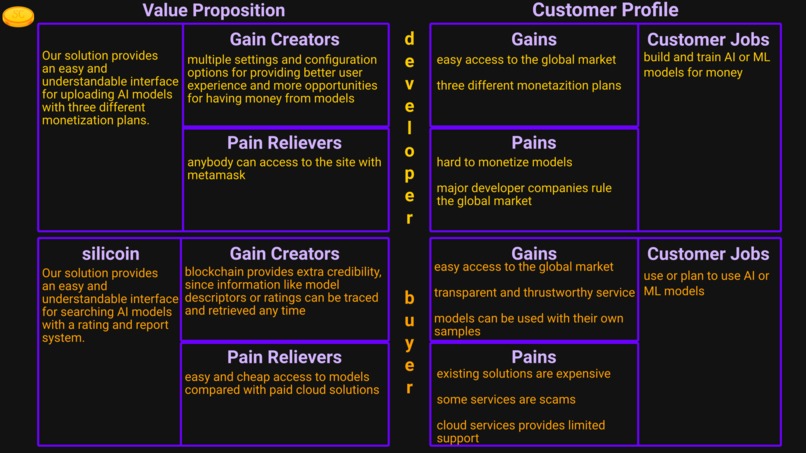
🚧 We are two freelance deep learning developers. There are platforms and marketplaces for artificial intelligence (AI) or machine learning (ML) models, but most of them are closed for freelance developers. Furthermore the cloud-based services provide support on their own infrastructure that can be really expensive. In the best case if a company wants to test a model with its own data, it has to pay for the infrastructure. In the worst case, there is no chance at all to make test runs before paying for the model. Unfortunately the worst cases occur more often. There are scam sites also, that erodes trust. Developers have only a small chance to sell their own model beside the major companies.
🔥 AI is a really hot topic. More and more companies and individuals use some kind of AI or ML in daily practice. This is necessary, since avoiding the usage of cutting edge technologies makes a huge drawback.
Business potential 💰
📈 According to marketsandmarkets.com the total available global artificial intelligence market will increase from $86.9 billion in 2022 to $407 billion in the end of 2027. The estimation of statista.com is more optimistic, since it calculates the market value as $795.3 billion in 2027 and $1847.5 billion in 2030.
📊 When we investigate the total AI market as the potential impact factor to other fields of industry or service, it results in a much huge number. According to PwC the potential contribution of AI to the global economy by 2030 will be $15.7 trillion. Their report identified nearly 300 different use cases for AI models.
📌 Well known big companies like IBM focus on merging and leveraging blockchain and AI together. Furthermore, this is a topic that strongly relates to Chainlink as well. Blogposts and articles from developers or newspapers like Forbes or scientific reaserches, like this, spent a lot of time and character to the fusion of AI and blockchain. These show that our real world experience correlates to the global discussions.
What it does ❓
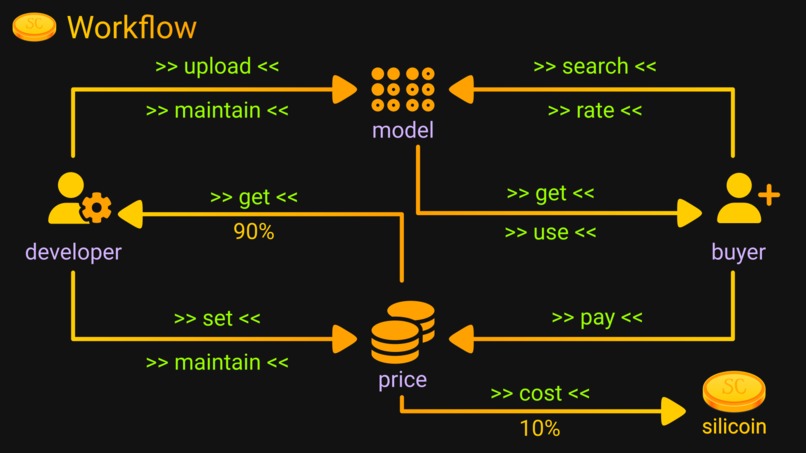
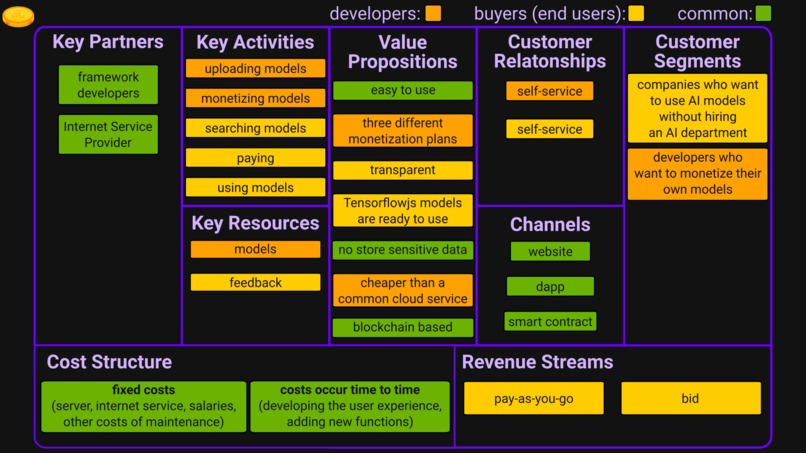
🤝 Silicoin connects the developers with the end customers. Developers can upload models and set up different monetization plans for selling the models. Customers or buyers can search and buy models. Model descriptors are stored in the blockchain. Currently, models are stored on server side, but in the near future we want to migrate the whole storage process into an IFPS blockchain.
Requirements:
✅ ETH wallet with LINK token
✅ Metamask
✅ Webbrowser with Javascript support
How to use as a developer 🔩
For developers, using silicoin as easy and simple. There is an upload form where developers can fill out details about the model. The physical location of the model files can be on centralized servers or on a file service blockchain as well. To protect the work of the developers a one time link API service is also provided.
Developers don’t have to make a deposit to use our service. Silicoin is really open for everyone.
How to use as a buyer 🛒
Customers can search for models on the website. There are different options to filter the results like framework or the paying method. The customer can use the model after the payment. To protect the work of the developers a one time link API service is also provided. If the customer makes a bid for a model and the developer closes the auction without a winner, the system distributes back the money.
How we built it 🔨
🧱 The first step of the building process was to specify our project. We have searched for potential market competitors. We collected all the good practices to implement and all the bad practices to change and make them better.
🧱 After that we built the user experience of the project and we collected all of the potential activities of the user.
🧱 The next step was to figure out which Chainlink services fit the best for our purposes.
🧱 First we implemented the frontend since tiny details can have great effect on the backend in this project.
🧱 The next step was to create the backend.
🧱 The final step was to deploy everything.
Challenges we ran into 💪
💪 Write the smart contract was a little bit challenging for us. We got the famous stack too deep error. The cause comes from our coding style, since usually we write programs where complex variables are necessary for an appealing coding design. So we had to fight a little against our habits, but it was worth it totally. Restructuring the code and working only with primitives is a challenging task. It reminded us of one of our projects where we had to code in Fortran because of two limitations: computational speed and memory size.
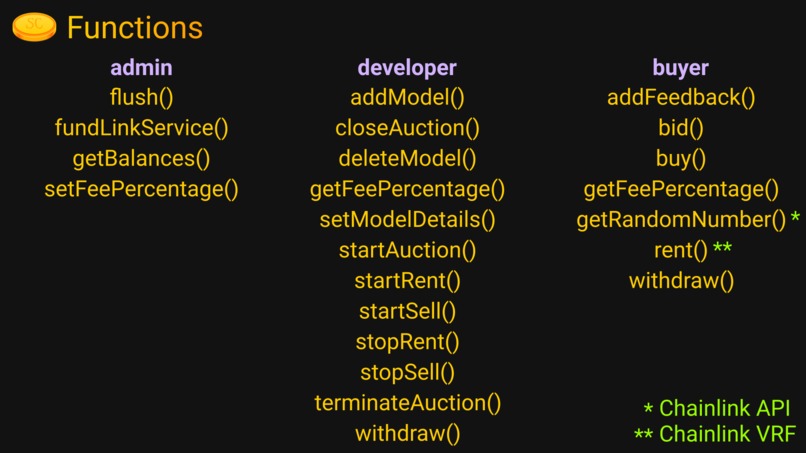
💪 We had to split our code into a main contract and a service contract to guard Chainlink service information a bit. Since the ways to use the API and the VRF services are quite similar, the service contract has a quite complicated structure and the final production version would require further care to be as optimum as possible.
🙃 A fun fact: Our main contract couldn’t be deployed with one more added function due to the size of the compiled code. As we mentioned we are deep learning developers where code is large and complex.
Accomplishments that we're proud of 😎
😎 deployed a smart contract on Ethereum Sepolia Testnetwork: 0x459eBb74Ce8da7Bf0e42a1e64b3B9D8D9A29ED5D
😎 integrate Chainlink API to make a bridge between blockchain and our storage server. The website interface available here: https://silicoin.hyperrixel.com/
😎 integrate Chainlink VRF to provide random numbers
😎 We wrote and deployed smart contracts successfully and we integrated into a web service. Creating something useful for the world is a thing that we are really proud of.
What we learned 📘
🧠 We learned a lot about Chainlink’s infrastructure especially Chainlink API and Chainlink VRF. As we mentioned earlier, because of the stack too deep error, we learned that in the future we have to use primitives only in our blockchain related codes.
🧠 How to optimize a solidity code
🧠 How to create docstrings according to the Natspec rules of solidity.
What's next for silicoin 🚀
We believe in silicoin is a real game changer in the deep learning market. That’s why we want to develop it further. Here are the most important next steps:
🟦 deploy on mainnet
🟦 create a more attractive design
🟦 support more frameworks
🟦 direct Python integration
🟦 direct cloud integration
🟦 store models in blockchains (IPFS)
🟦 VC investments
Built With
- blockchain
- javascript
- php
- remix
- solidity
- tensorflowjs
- vscode


Log in or sign up for Devpost to join the conversation.