-
-
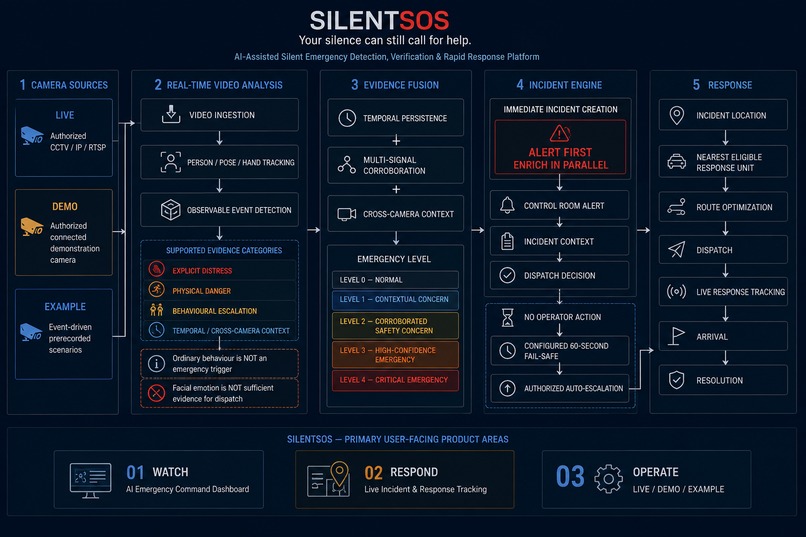
SilentSOS Technical Architechture
-
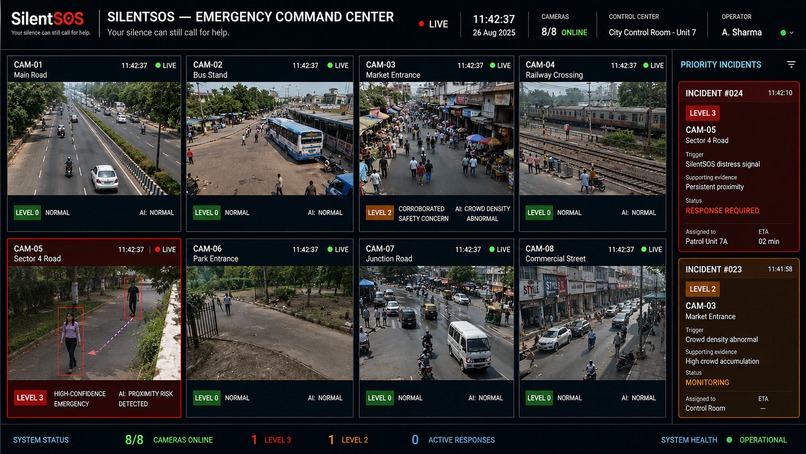
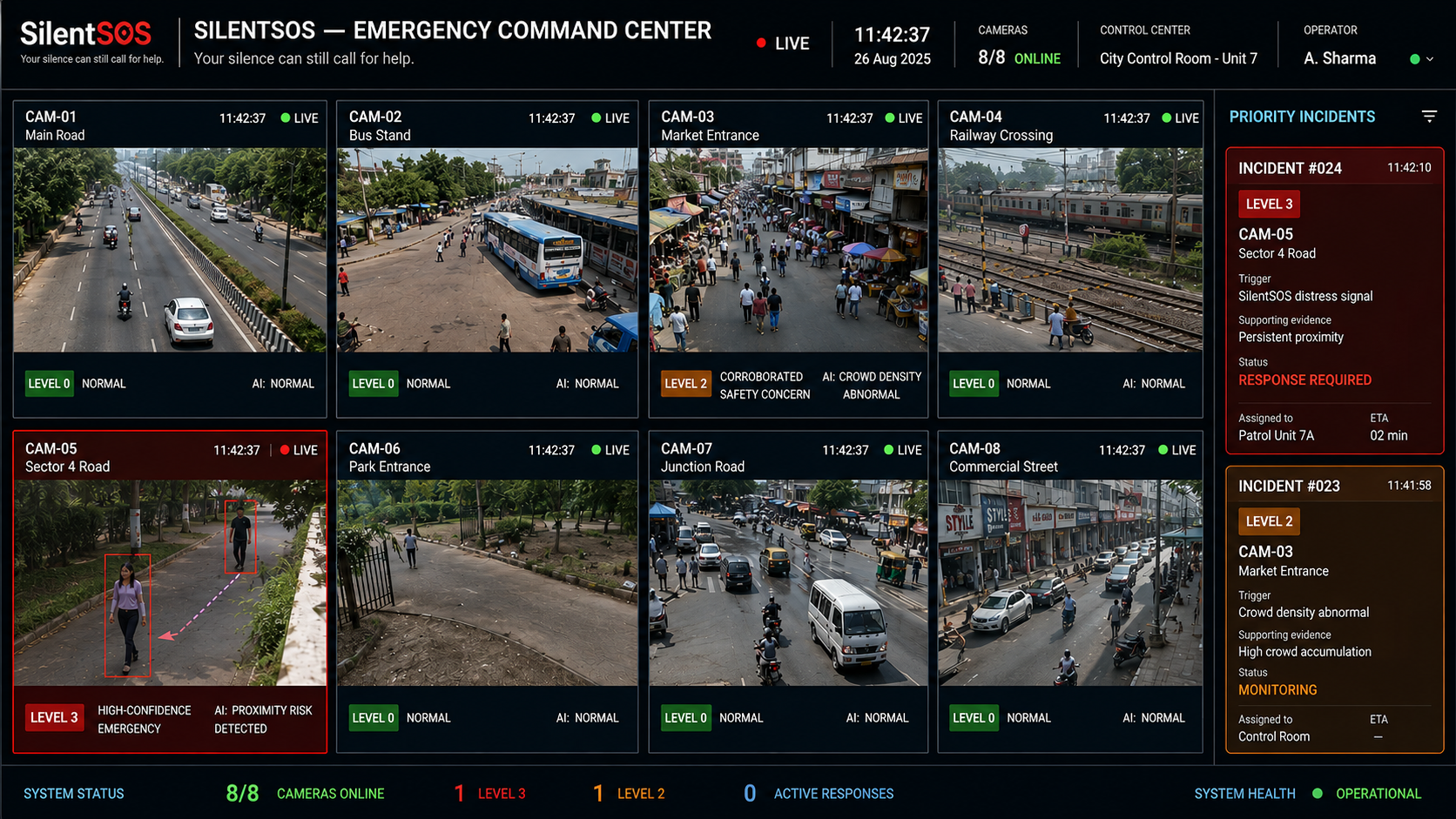
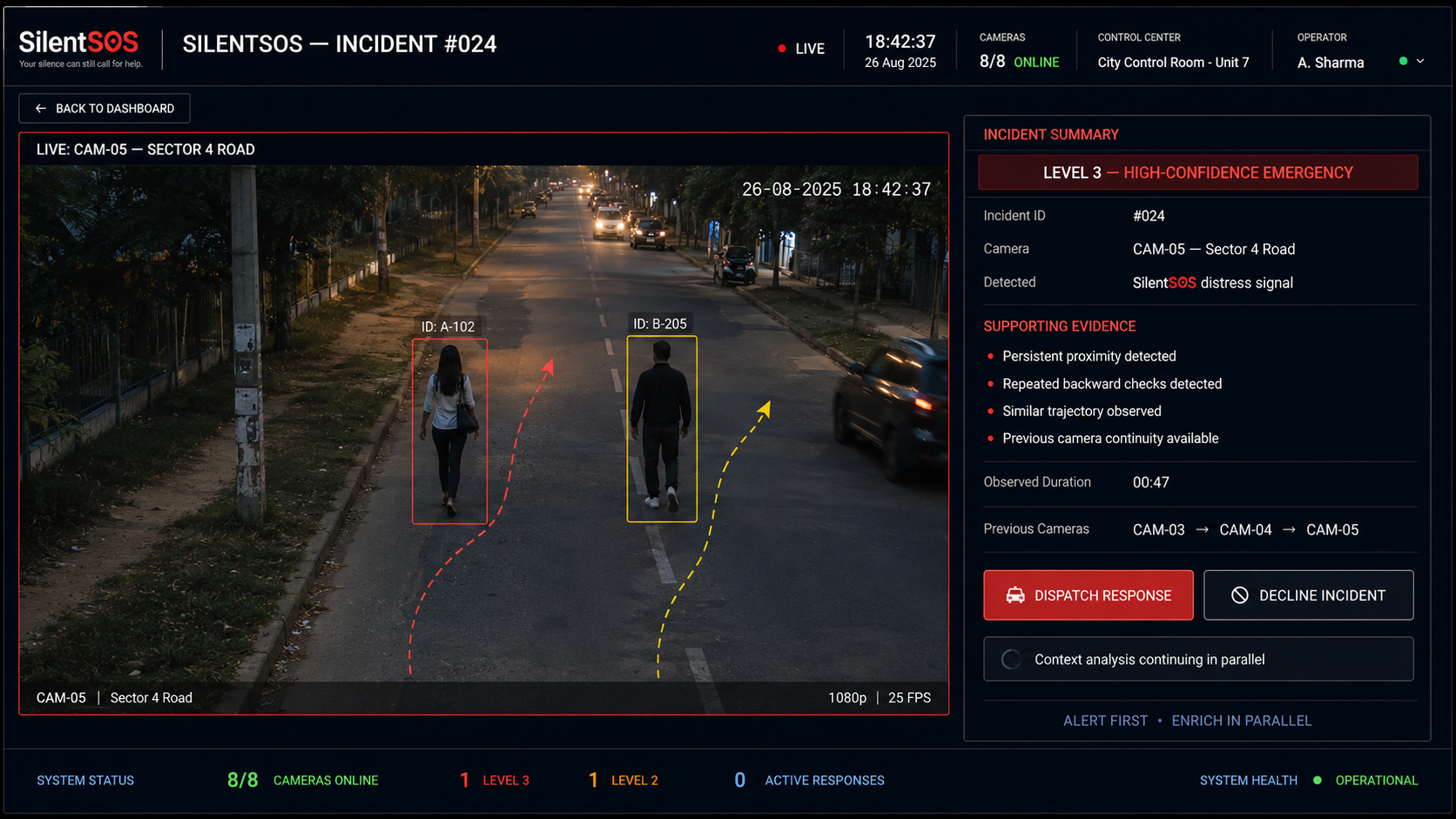
PRIMARY COMMAND CENTER DASHBOARD
-
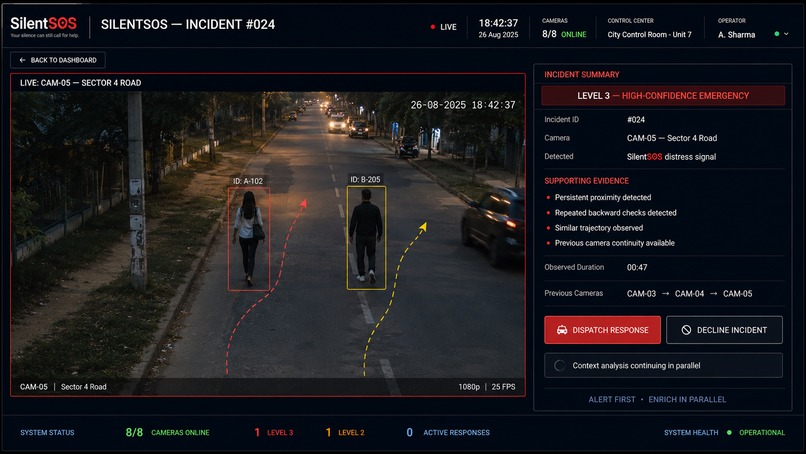
MAXIMIZED EMERGENCY + EXPLAINABLE AI
-
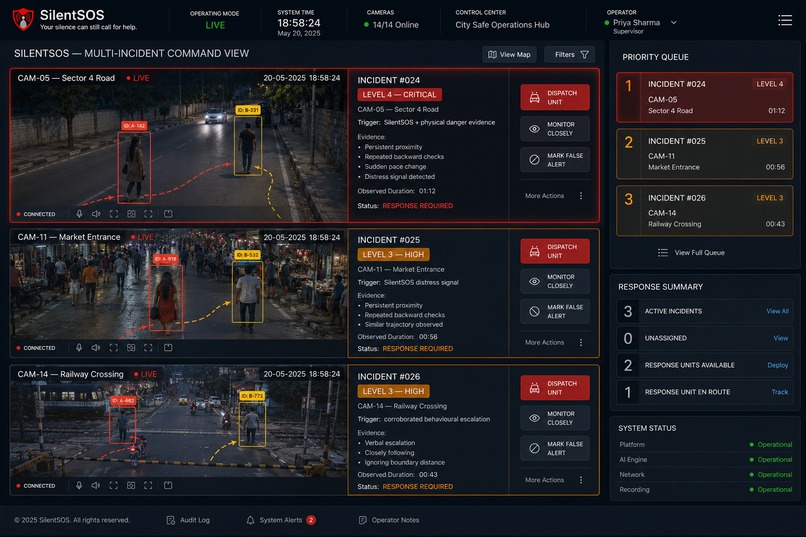
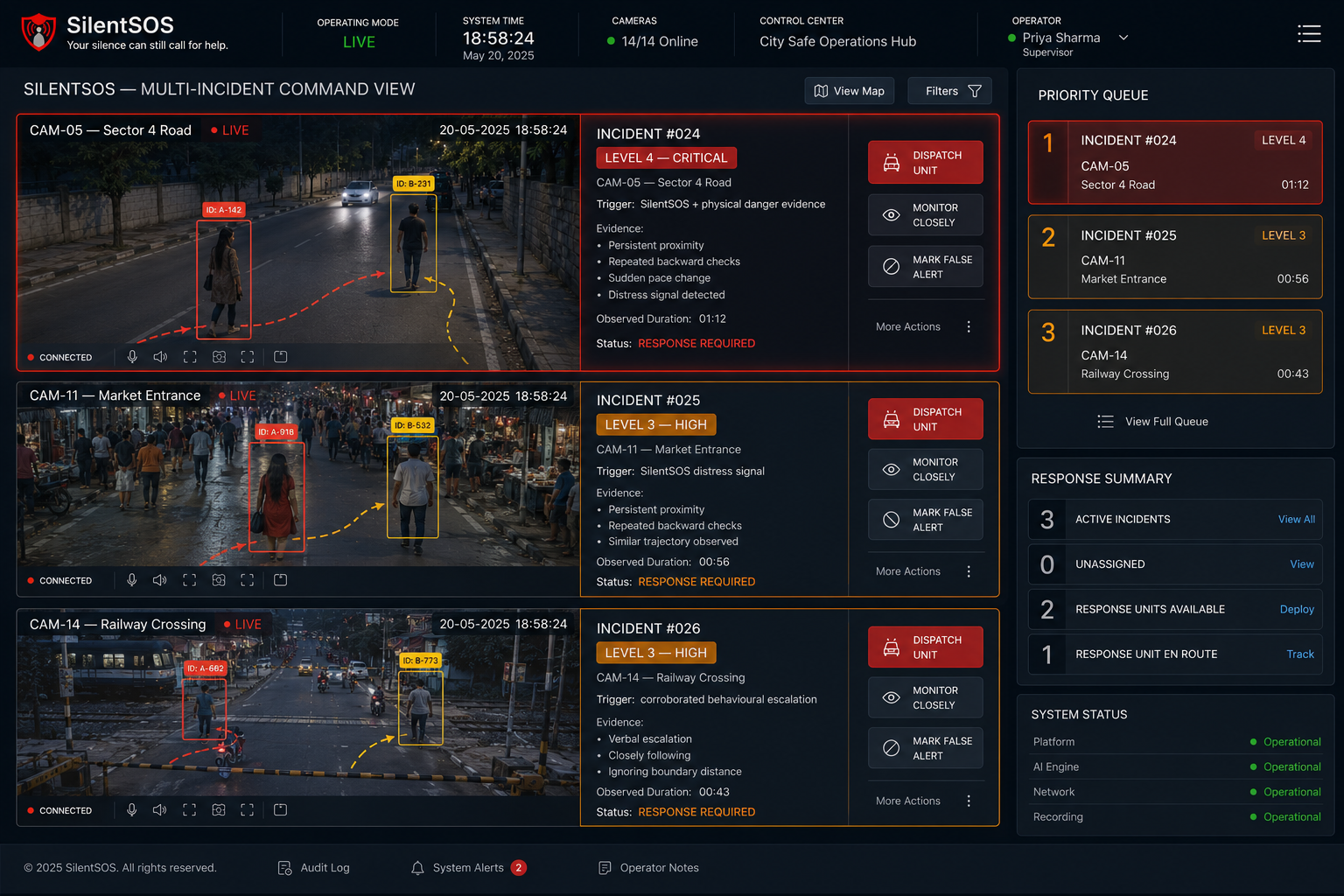
MULTIPLE SIMULTANEOUS EMERGENCIES
-
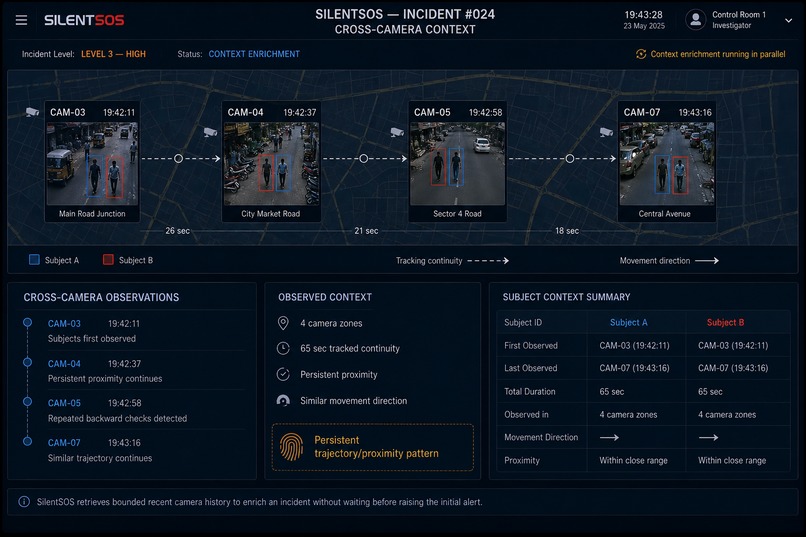
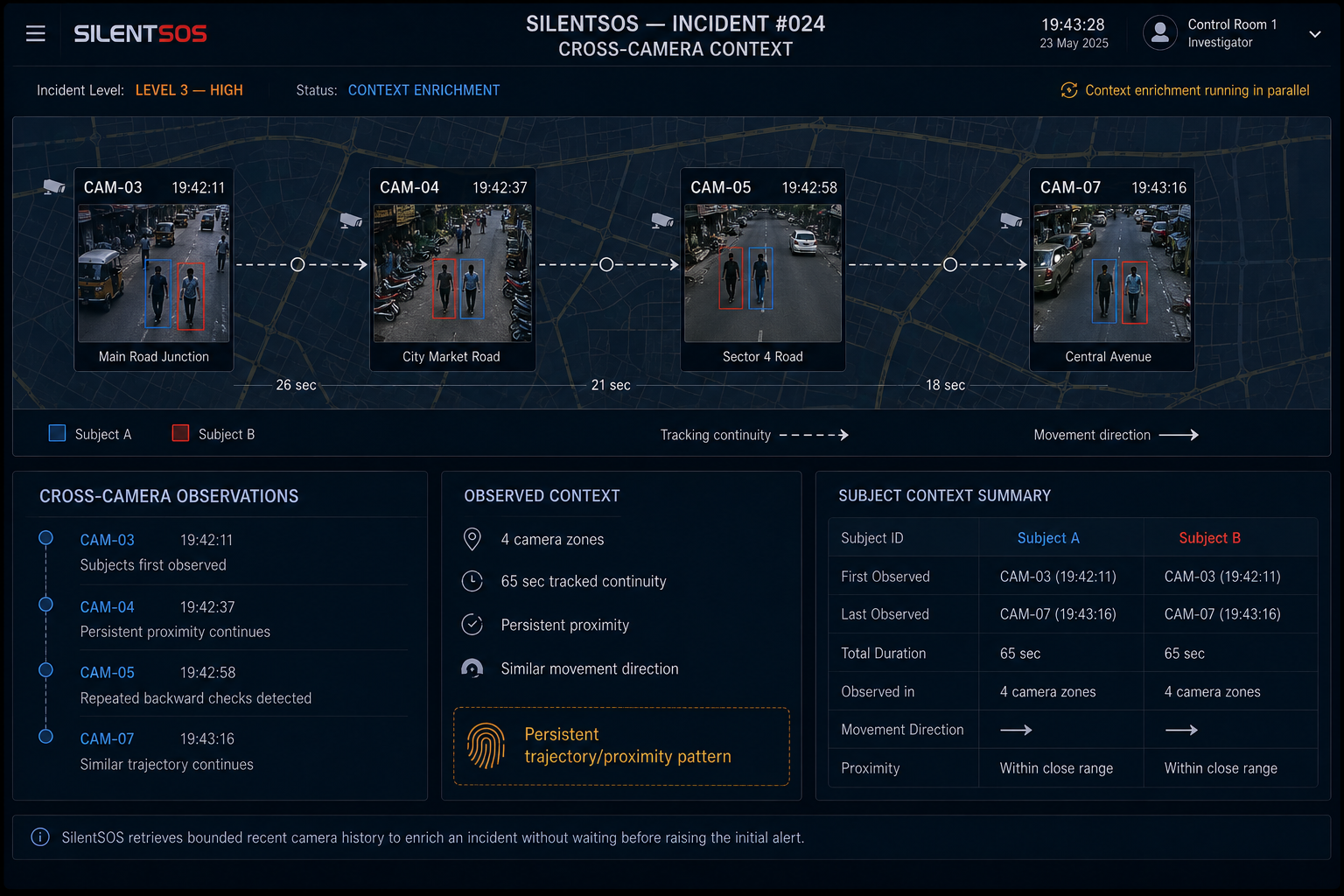
CROSS-CAMERA BACKTRACE / TRAJECTORY
-
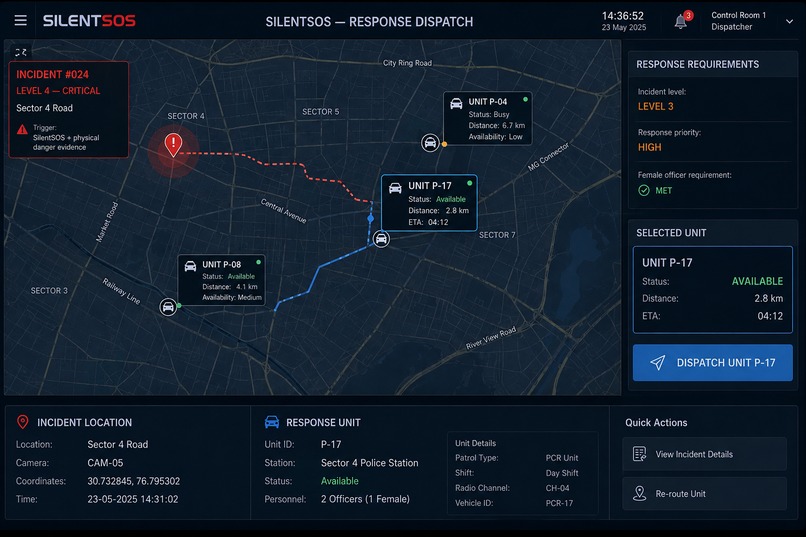
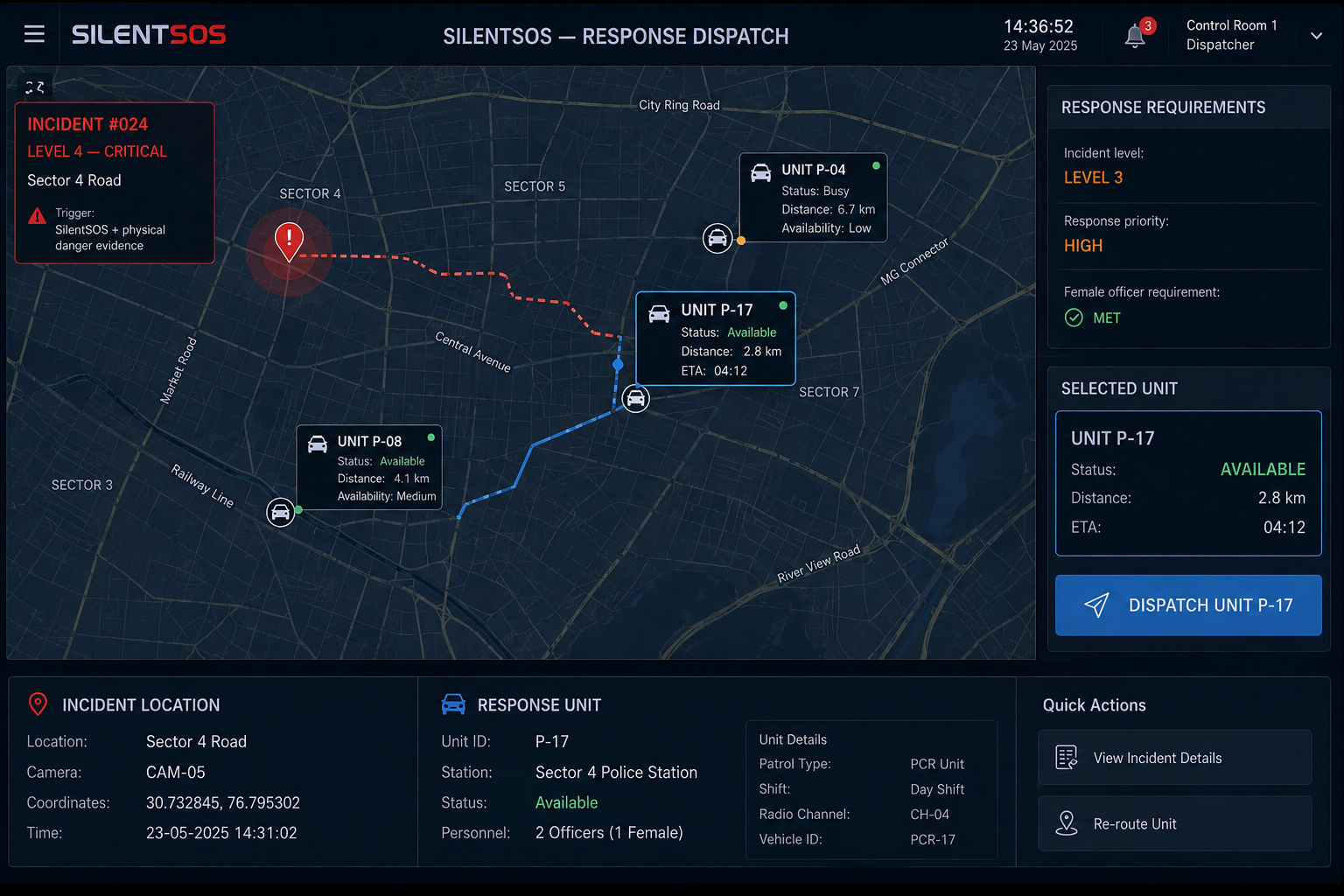
DISPATCH + LIVE RESPONSE MAP
Inspiration
An emergency does not always come with a phone call. A person may be unable to speak, reach their phone, or remember an SOS gesture when they need help most. Meanwhile, CCTV cameras already monitor many public spaces but are mostly passive recording systems.
We wanted to explore whether authorized CCTV infrastructure could become an intelligent early-warning and response layer—without assuming that ordinary behavior means danger.
What it does
SilentSOS analyzes authorized CCTV feeds for observable indicators of potential emergencies. It can recognize explicit distress gestures and supported physical-danger events, while also considering behavioral escalation, persistent proximity and cross-camera movement context.
When sufficiently strong evidence is detected, the system immediately creates a prioritized incident instead of waiting for lengthy verification. Contextual analysis continues in parallel, helping the control room understand what happened and respond faster.
The platform has exactly three operational areas:
WATCH — monitor multiple cameras, identify emergency levels and inspect explainable evidence.
RESPOND — locate incidents, identify an appropriate response unit, optimize the route and track the response in real time.
OPERATE — run the same workflow using authorized LIVE cameras, DEMO camera connections or realistic event-driven EXAMPLE scenarios.
How we built it
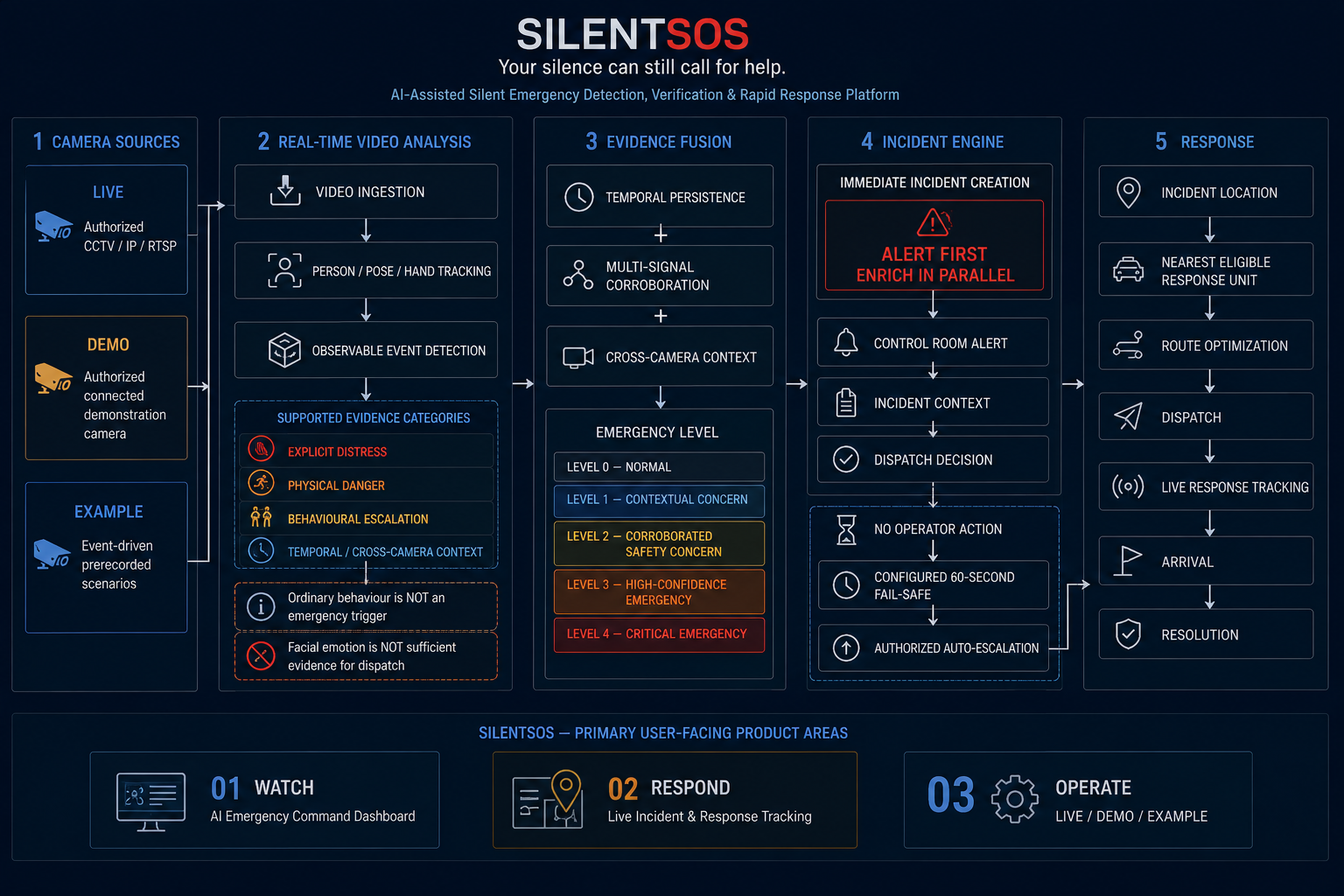
We designed SilentSOS as a real-time, event-driven system connecting video ingestion, computer vision, behavioral analysis, evidence fusion, incident management, geospatial response and live state updates.
The system uses a common processing pipeline across LIVE, DEMO and EXAMPLE modes. Emergency levels are based on defined evidence categories rather than a generic "suspiciousness" score.
The response workflow follows:
Detect → Understand → Alert → Dispatch → Track → Resolve
A key architectural decision was to separate immediate alerting from deeper contextual analysis. Strong emergency evidence creates an incident immediately while cross-camera and temporal analysis enriches the incident in parallel.
Challenges we ran into
The hardest challenge was balancing sensitivity with false alarms. Treating a woman being alone, walking at night, looking nervous, or being near other people as an emergency would make the system unreliable and potentially harmful.
We therefore designed the system around observable evidence, temporal persistence and corroboration rather than assumptions about intent or emotion.
Another challenge was latency. In an emergency, waiting for every verification layer to finish can itself become a problem. Our architecture therefore prioritizes the fast path for alert creation while running contextual analysis concurrently.
We also had to design for multiple simultaneous incidents, cross-camera context, live response tracking and realistic simulation without pretending that mock data is real police data.
Accomplishments that we're proud of
We are proud that SilentSOS is designed as more than an AI detection demo. It connects detection to an actual emergency-response workflow.
The platform can represent the complete lifecycle of an incident—from camera detection and explainable evidence to location, dispatch, route optimization, live response tracking, arrival and resolution.
We are particularly proud of the three-mode architecture, which allows the same workflow to operate with live authorized camera sources, connected demonstration cameras and event-driven emergency scenarios.
What we learned
We learned that building an emergency AI system is not only about making a model detect something accurately.
Latency, false positives, explainability, privacy, authorization, state management and human decision-making are equally important.
We also learned that AI should assist responders rather than make unsupported claims about people's intentions. Strong systems need to communicate why an alert was raised, not simply say that something looks suspicious.
Most importantly, we learned to design for the actual seconds in which a decision matters—not just for a successful technical demonstration.
What's next for SilentSOS — AI-Powered Silent Emergency Response
The next step is rigorous real-world validation: improving detection reliability across different camera conditions, reducing false positives, testing latency under simultaneous incidents, and validating the response workflow with appropriate safety, privacy and operational requirements.
Our long-term vision is simple:
Turn existing authorized CCTV infrastructure from passive observation into an intelligent early-warning layer that can help responders act sooner—when every second matters.
Built With
- computer-vision
- fastapi
- geospatial-mapping
- git
- machine-learning
- mediapipe
- multi-object-tracking
- opencv
- python
- react
- real-time-video-processing
- rest-api
- routing
- sqlite
- tailwind-css
- typescript
- vite
- websockets
- yolo

Log in or sign up for Devpost to join the conversation.