-
-
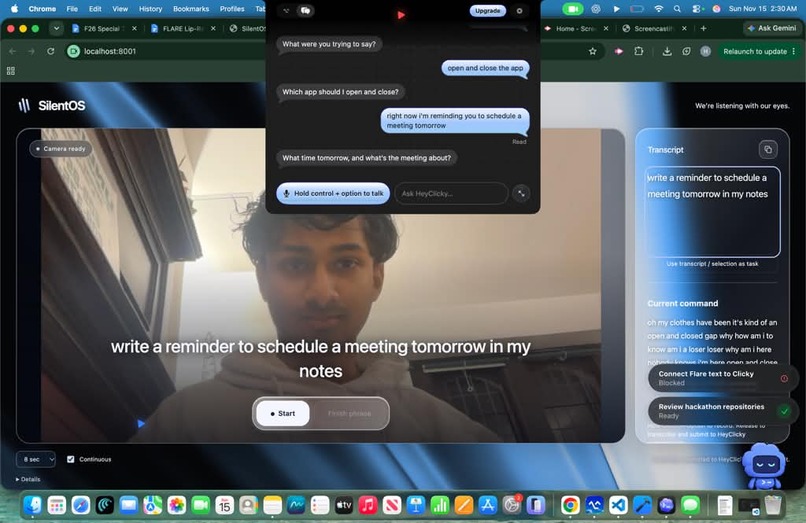
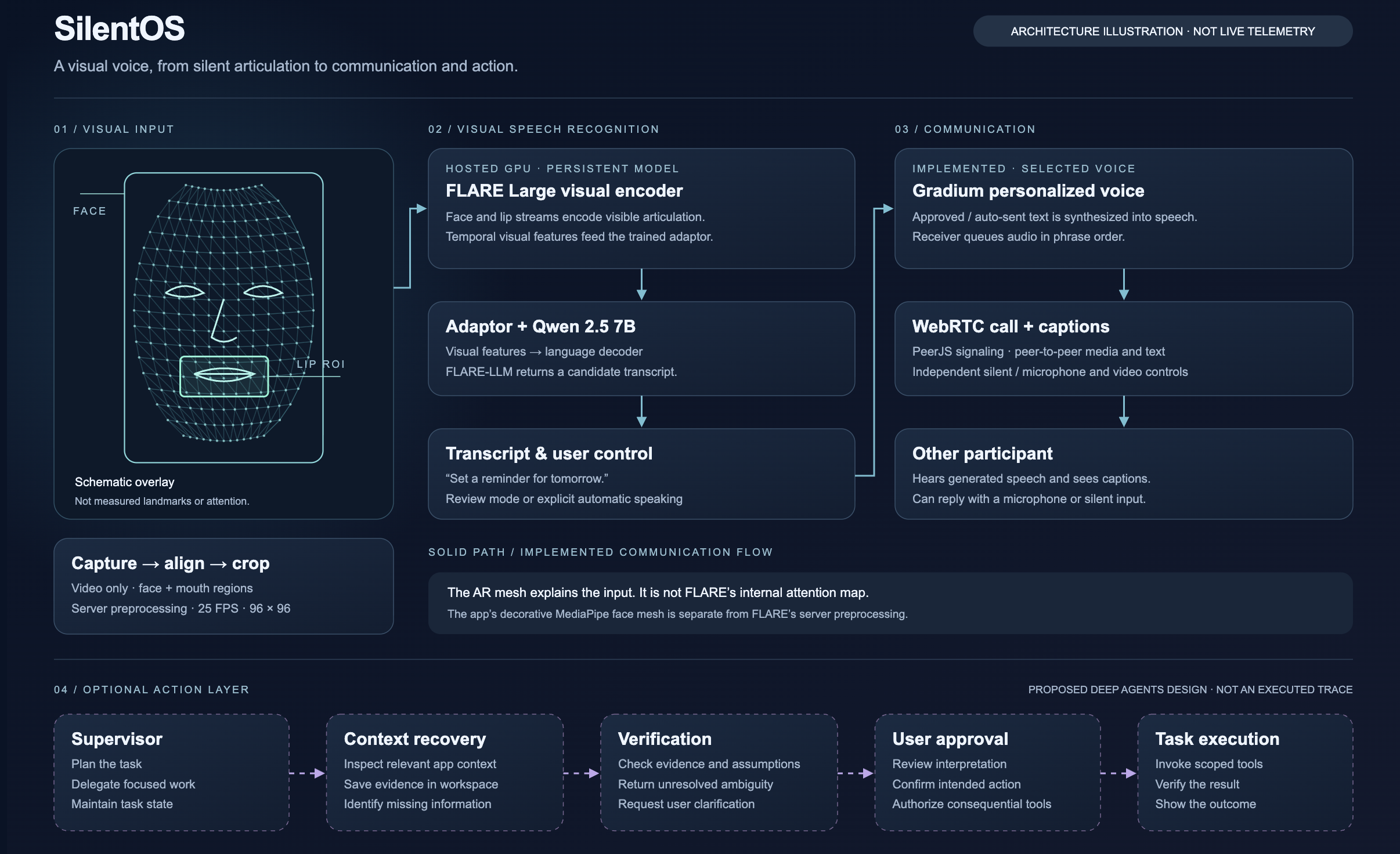
SilentOS being applied agentically
-
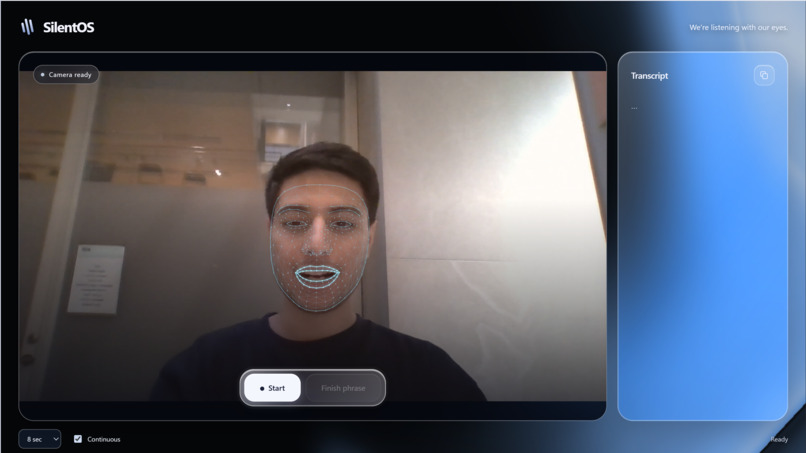
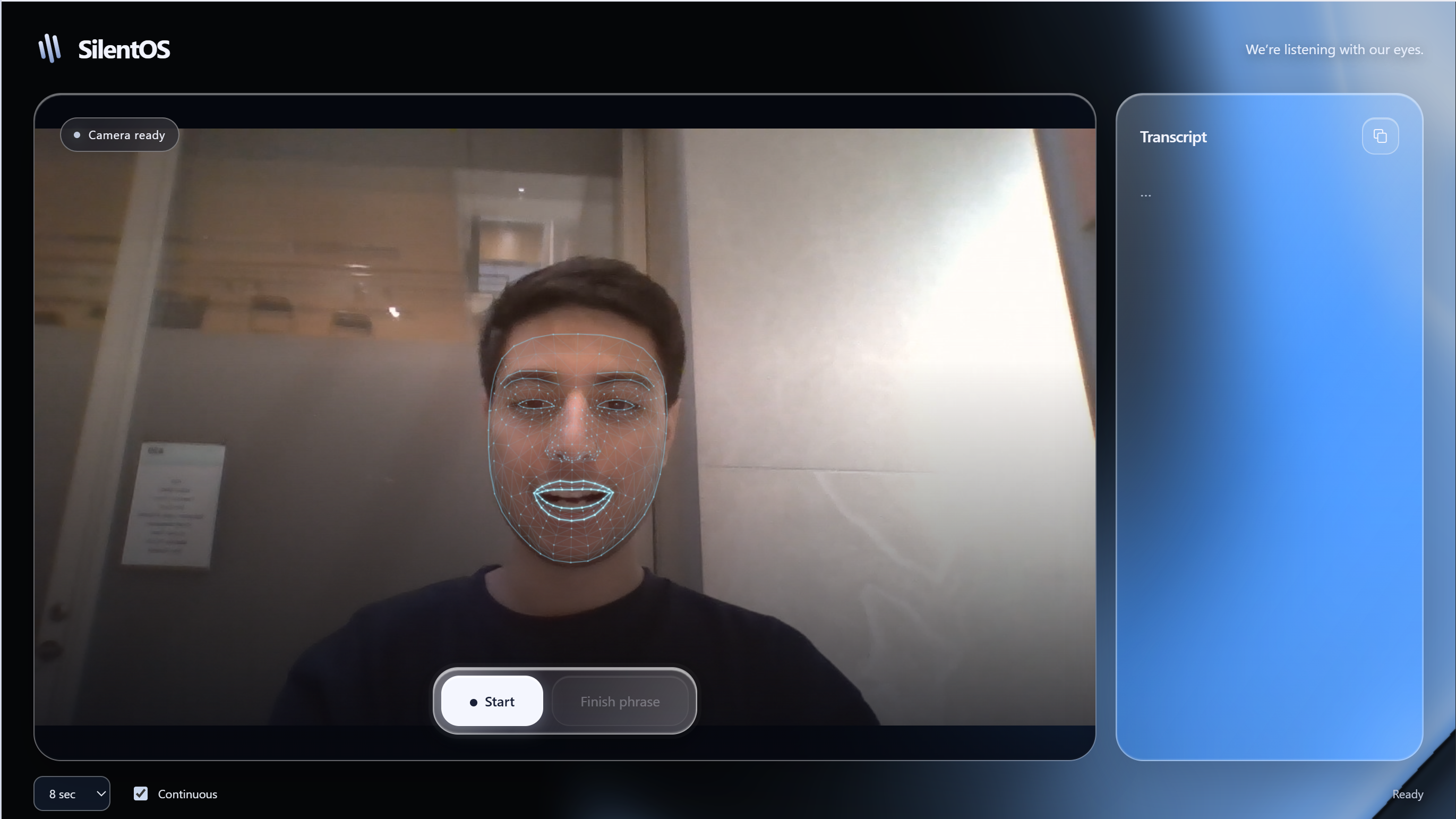
SilentOS LipReading UI
-
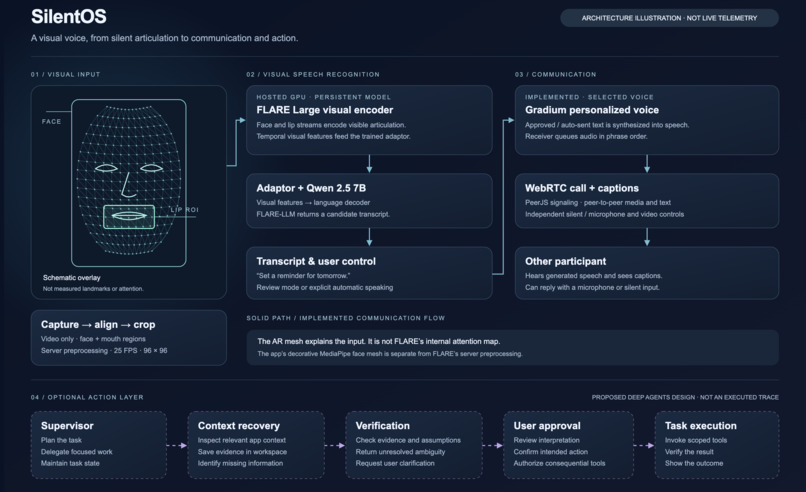
SilentOS: Talk Business. Without Talking.
What if you could take a meeting, send a message, or interact with AI without making a sound?
SilentOS is an AI-powered communication platform that uses computer vision to read your lips and convert silent speech into text and synthesized voice. No microphone required.
Whether you're on a crowded subway, working in a noisy office, sitting in a silent library, or trying not to wake your family, SilentOS gives you a new way to communicate.
And we're thinking bigger than communication. We envision visual speech becoming a universal interface for interacting with AI agents, operating computers, and getting work done without typing or speaking aloud.
💡 Inspiration
The idea behind SilentOS started with a simple observation: we've made talking to computers easier than ever, but we still need the right environment to do it.
Voice interfaces, AI assistants, and virtual meetings are becoming increasingly central to how we work. Yet they share one fundamental limitation: you have to speak out loud.
That becomes a problem surprisingly often.
During HackPrinceton, we spoke with a startup CEO who described a recurring frustration at his company: employees frequently struggle to find available meeting booths when they need to take calls.
It's a problem with real financial consequences. Businesses spend money purchasing or renting individual meeting booths, dedicate valuable office space to them, and lose employee time when people have to search for somewhere quiet to speak.
And the office is just one example.
At home, a barking dog or crying baby can interrupt an important client meeting. On public transportation, background noise makes communication difficult, while speaking aloud can broadcast private business conversations to everyone around you. In libraries and shared workspaces, even ordinary speech becomes disruptive.
What if we could eliminate the need to speak in the first place?
That question became SilentOS.
What It Does
SilentOS uses visual speech recognition to understand what you're saying by watching your lips, rather than listening to your voice.
Our platform is built around two complementary capabilities.
1. Silent Communication
SilentOS captures a user's lip movements through a webcam and converts them into text using a visual speech recognition model.
The recognized text can then be used to generate synthetic speech, creating a pathway for someone to communicate without producing audible words.
The possibilities are compelling:
- Open offices: Take calls without speaking aloud at your desk or competing for occupied meeting booths.
- Remote work: Communicate without transmitting barking dogs, crying babies, or other household noise through your microphone.
- Public transportation: Participate in conversations without competing with transit noise or broadcasting your side of the discussion to an entire train.
- Libraries and shared workspaces: Communicate without disturbing the people around you.
- Late-night collaboration: Work, study, or join conversations without waking others.
Unlike traditional noise cancellation, SilentOS isn't trying to clean up an audio signal. There is no spoken audio input to clean up.
2. Silent Computer Control
Communication is only the beginning.
The same recognized text can also serve as an input interface for AI agents.
Imagine silently mouthing:
"Open my sales presentation."
Or:
"Summarize my unread emails."
Instead of speaking into a microphone or typing out instructions, your visual speech becomes a prompt for an agent that can perform tasks on your behalf.
We explored this capability through a computer-control prototype and Photon-powered agent workflows. While the agent functionality remains an area we're refining, it illustrates our broader vision: your lips could become an input device for your entire digital workspace.
💼 Why It Matters for Business & Enterprise
We believe SilentOS has the potential to create measurable economic value by reducing workplace friction and making existing technology more accessible across different environments.
Reducing office real-estate costs
Individual meeting booths aren't free. Companies pay to purchase or rent them, install and maintain them, and dedicate valuable floor space to their use.
If employees can handle more individual calls without speaking aloud, businesses could reduce their dependence on dedicated phone booths.
That creates opportunities to avoid additional booth purchases, reclaim usable floor space, and potentially reduce future real-estate requirements.
We aren't claiming every meeting room disappears. Collaborative meetings still need collaborative spaces. But not every individual call should require its own room.
Improving employee productivity
Time spent searching for meeting rooms, relocating between workspaces, or waiting for an appropriate environment is time that isn't spent working.
SilentOS introduces an alternative: communicate from wherever you're already sitting.
It also creates a pathway to hands-free, voice-like AI productivity without requiring audible speech.
Reducing workplace interruptions
Open offices have an inherent conflict: employees need to communicate, but their conversations distract everyone nearby.
SilentOS could help reduce audible interruptions by allowing employees to participate in conversations without contributing additional speaking noise to the workspace.
Extending productivity beyond the office
Modern work happens everywhere, not just at a desk.
By reducing the environmental constraints of communication, SilentOS could make commuting time, shared workspaces, and unconventional work environments more practical for certain professional tasks.
For businesses, the opportunity is straightforward: less wasted time, more flexible workspaces, and fewer physical barriers to getting work done.
🛠️ How We Built It
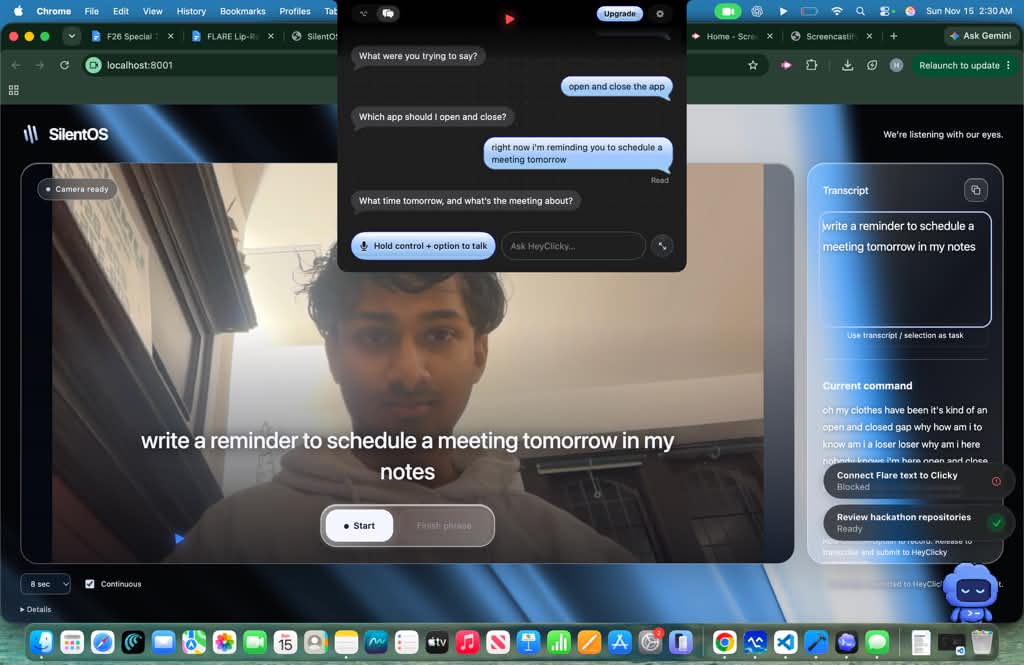
SilentOS combines recent advances in visual speech recognition with a custom browser-based interface and an AI inference pipeline.
The visual speech recognition model
At the core of SilentOS is FLARE, an open-source visual speech recognition framework developed by Jing-Xuan Zhang and collaborators.
FLARE is especially interesting because it jointly models facial information and lip movements, rather than relying exclusively on a tightly cropped mouth region.
Its research architecture uses cross-modal learning to develop visual speech representations and supports language-model-based decoding. Although audio information is used during the research model's training process, visual speech can be decoded from video alone at inference time.
Rather than training an entirely new lip-reading foundation model during a hackathon, we built upon the existing FLARE research and fine-tuned the model to create an interactive application.
We were able to get the word error rate (WER) to 15.9% before LLM passthrough. After processing it through Qwen, we were able to decrease our Lip Reading WER to 13.2%.
The SilentOS application
Our application brings these capabilities together through:
1. Webcam capture
A React-based interface captures video from the user's camera, without requiring microphone audio.
2. Visual preprocessing
Video frames are prepared for the model, including the face and lip information required by FLARE's inference pipeline.
3. GPU-powered inference
The captured visual input is processed through a Python-based inference pipeline running on Vultr GPU infrastructure.
4. Text transcription
The model's predicted words are returned to the application and displayed in a dedicated transcript panel.
5. Communication and agent workflows
The resulting text can serve as input for synthesized speech or downstream AI workflows. We also experimented with connecting silent instructions to agent functionality through Photon.
Our frontend features a custom interface with a live webcam viewport, a facial-mesh visualization, recording controls, and a transcript panel.
The goal was to make sophisticated visual speech recognition feel like an accessible, everyday productivity tool.
🚧 Challenges We Ran Into
Turning research code into an interactive product
FLARE was designed as a research model, not a plug-and-play webcam application.
Moving from curated benchmark videos to arbitrary laptop webcam footage required working through preprocessing, video formatting, model dependencies, and inference integration.
GPU infrastructure and latency
Visual speech recognition is computationally demanding, particularly when running a large model with language-based decoding.
We worked with remote GPU infrastructure and had to manage compute availability, model loading, video transfer, and inference latency.
Making a research model work is one challenge. Making it usable inside an interactive product is another.
The ambiguity of visual speech
Lip reading is inherently difficult because different sounds can produce nearly identical visible mouth movements.
Lighting, head position, camera quality, speaking style, and video resolution introduce additional uncertainty.
We learned that a functioning visual speech model is not automatically a reliable real-world communication system. Accuracy, consistency, and sensible error handling matter enormously.
Integrating computer-use agents
We also explored connecting recognized speech to AI agents capable of performing computer actions.
Although we made progress on the underlying functionality, creating a sufficiently consistent end-to-end agent demonstration within the hackathon timeline proved challenging.
We chose to prioritize demonstrating our core visual-transcription functionality rather than presenting an unreliable agent workflow as a finished feature.
🏆 Accomplishments We're Proud Of
Building a working visual speech interface. We connected webcam input to an AI-powered transcription pipeline and presented the resulting text in a custom application.
Improving the Accuracy of the Model We got the accuracy up to 15.9% WER, and were able to incorporate QWEN to make the output even more accurate, bringing our WER to 13.2%
Bringing cutting-edge research into a practical use case. We took an existing research model and explored how it could become the foundation of a consumer and enterprise communication product.
Building a compelling end-to-end experience. Instead of presenting a model in a notebook, we created a branded interface designed around how people would actually interact with visual speech recognition.
Identifying a real enterprise problem. Speaking directly with a startup CEO at HackPrinceton reinforced that meeting-booth shortages and workplace interruptions are genuine operational frustrations.
Exploring a broader agentic interface. Our computer-control prototype helped demonstrate that silent speech could become more than a communication method. It could become a new way to interact with software.
Most importantly, we're proud of taking a technology that typically lives in academic research and connecting it to problems people encounter in everyday life.
🧠 What We Learned
One of our biggest takeaways is that the value of an AI interface depends as much on where people can use it as on what the model can do.
Voice interfaces are powerful, but they assume speaking aloud is acceptable.
SilentOS challenges that assumption.
We also learned that translating machine-learning research into a usable product requires much more than simply running a pretrained model.
Video preprocessing, hardware constraints, inference reliability, frontend integration, and the user experience are all critical parts of the engineering process.
And perhaps most importantly, we learned how valuable it is to validate a problem directly with potential users.
Our conversation with a startup CEO helped connect a technically exciting idea to a concrete business challenge involving employee productivity, workplace design, and operating costs.
🔮 What's Next for SilentOS?
Our long-term vision is much bigger than silent meetings.
We believe visual speech recognition could become an entirely new category of human-computer interaction.
1. More reliable, real-time communication
Our first priority is improving transcription accuracy, reducing latency, and transitioning toward a more seamless communication experience.
We want to explore:
- More robust recognition across different people, lighting conditions, and camera angles.
- Lower-latency, streaming transcription.
- Personalized synthetic voices.
- Integration with video conferencing and communication platforms.
- On-device processing to reduce dependence on remote inference infrastructure.
- Context-aware correction that improves readability without inventing words the user never intended.
2. A universal interface for AI agents
Imagine an AI assistant that can receive instructions entirely through silent lip movements.
You could draft an email during a meeting, navigate applications in a quiet workspace, or issue instructions to an agent without typing or speaking.
We want to expand our computer-control prototype into reliable integrations with productivity software and agent platforms.
The goal isn't simply hands-free computing.
It's speech-like computing without requiring audible speech.
3. Healthcare and assistive communication
One of the most meaningful possibilities is helping people who have lost the ability to produce audible speech but retain sufficient lip and facial movement.
Potential applications include individuals recovering from surgery, people with certain vocal-cord conditions, and patients with conditions affecting speech production.
With sufficient accuracy, accessibility testing, and clinical validation, visual speech recognition could become another option within augmentative and alternative communication technology.
We see this as a particularly exciting direction for future collaboration with healthcare professionals and accessibility researchers.
4. Gaming and entertainment
Not every application needs to be serious.
Imagine gaming with friends late at night without waking your family or roommates.
Instead of shouting into a headset, you could silently mouth instructions and communicate through a synthetic voice.
The same concept could apply to streaming, virtual reality, and other interactive digital experiences where audible speech is inconvenient.
5. Multilingual communication
Visual speech could eventually connect with translation models.
Imagine silently articulating a sentence in one language and having it delivered to someone else in another.
Achieving this reliably would require substantially more multilingual data and model development, but the potential is compelling.
6. Emergency communication and video analysis
Some of the most unconventional possibilities involve situations where a person cannot communicate audibly.
For example, future visual speech technology might assist in interpreting intentional silent messages during emergencies.
It could also support carefully controlled forensic analysis of video containing visible but inaudible speech, including potentially high-stakes situations.
These applications would require exceptionally strong accuracy, human verification, and strict privacy safeguards. Lip reading from arbitrary video is inherently uncertain, and a mistaken interpretation could have serious consequences.
Still, they demonstrate how far the underlying technology could extend beyond everyday productivity.
7. Privacy-first silent communication
As visual speech recognition improves, privacy will become increasingly important.
We want to explore local inference, secure processing, explicit user consent, and controls that keep sensitive communications under the user's control.
The goal is to help people communicate more freely, not enable unwanted surveillance of their conversations.
🌍 The Bigger Picture
Computers have learned to understand our voices, recognize our faces, and interpret our gestures.
But until now, most conversational interfaces have still depended on making a sound.
SilentOS explores a different future.
One where communication doesn't require a quiet room.
Where interacting with AI doesn't require typing.
Where people who cannot speak aloud have another way to express themselves.
And where businesses can make better use of their time, technology, and physical workspaces.
SilentOS isn't just about reading lips. It's about removing the limitations of audible speech.
Talk Business. Without Talking.
Technologies & Acknowledgments
Technologies: React, JavaScript/TypeScript, Python, PyTorch, GPU inference, computer vision, visual speech recognition, FLARE, AI speech synthesis, Photon (agent workflow exploration).
Research acknowledgment: SilentOS builds upon the publicly available FLARE visual speech recognition research and pretrained models. The underlying FLARE model was developed independently of this hackathon. Our work focuses on integrating visual speech recognition into an interactive communication application, its frontend and inference workflow, and exploring practical enterprise and agentic applications.
