Inspiration
In today's digital world, people subscribe to multiple streaming platforms, productivity tools, cloud services, educational platforms, and other recurring services. While individual subscription charges may seem small, together they can silently drain a significant portion of monthly income.
We realized that people often forget about subscriptions they no longer use, overlook unusual recurring charges, and struggle to understand how much money they could save.
This inspired us to build SilentDrain — an intelligent subscription leak detection system that transforms overlooked recurring expenses into meaningful financial insights.
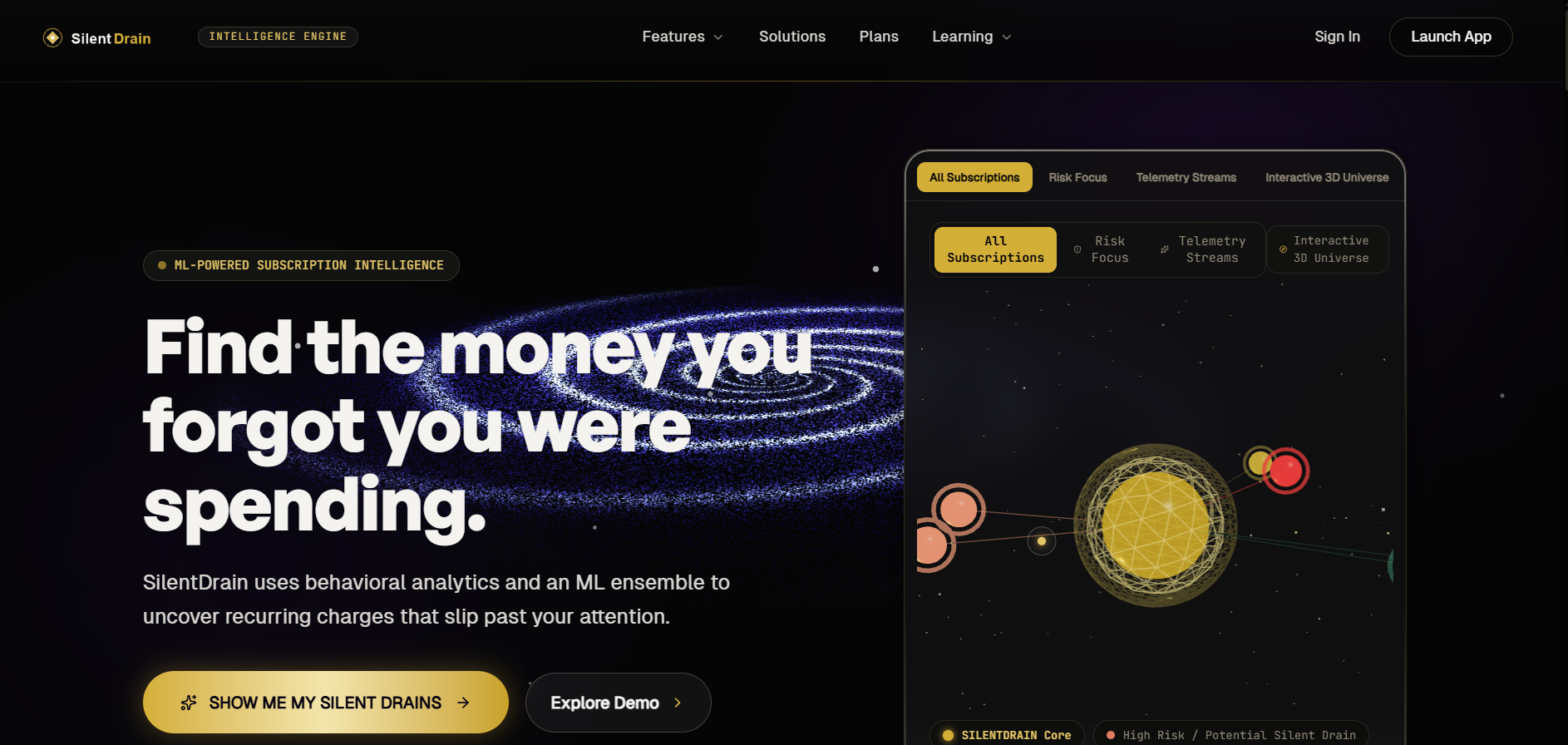
Our vision is simple: Find the money you forgot you were spending.
What it does
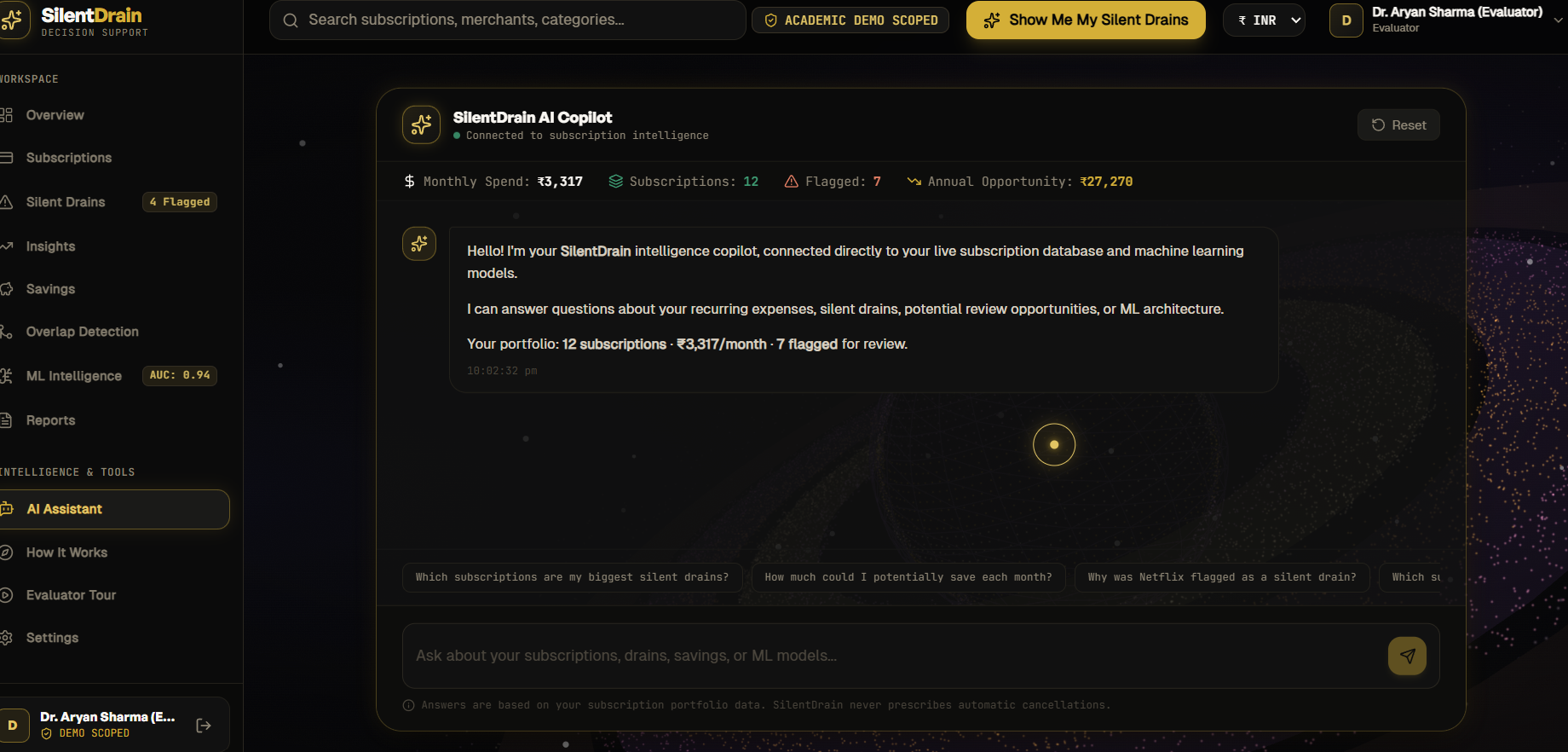
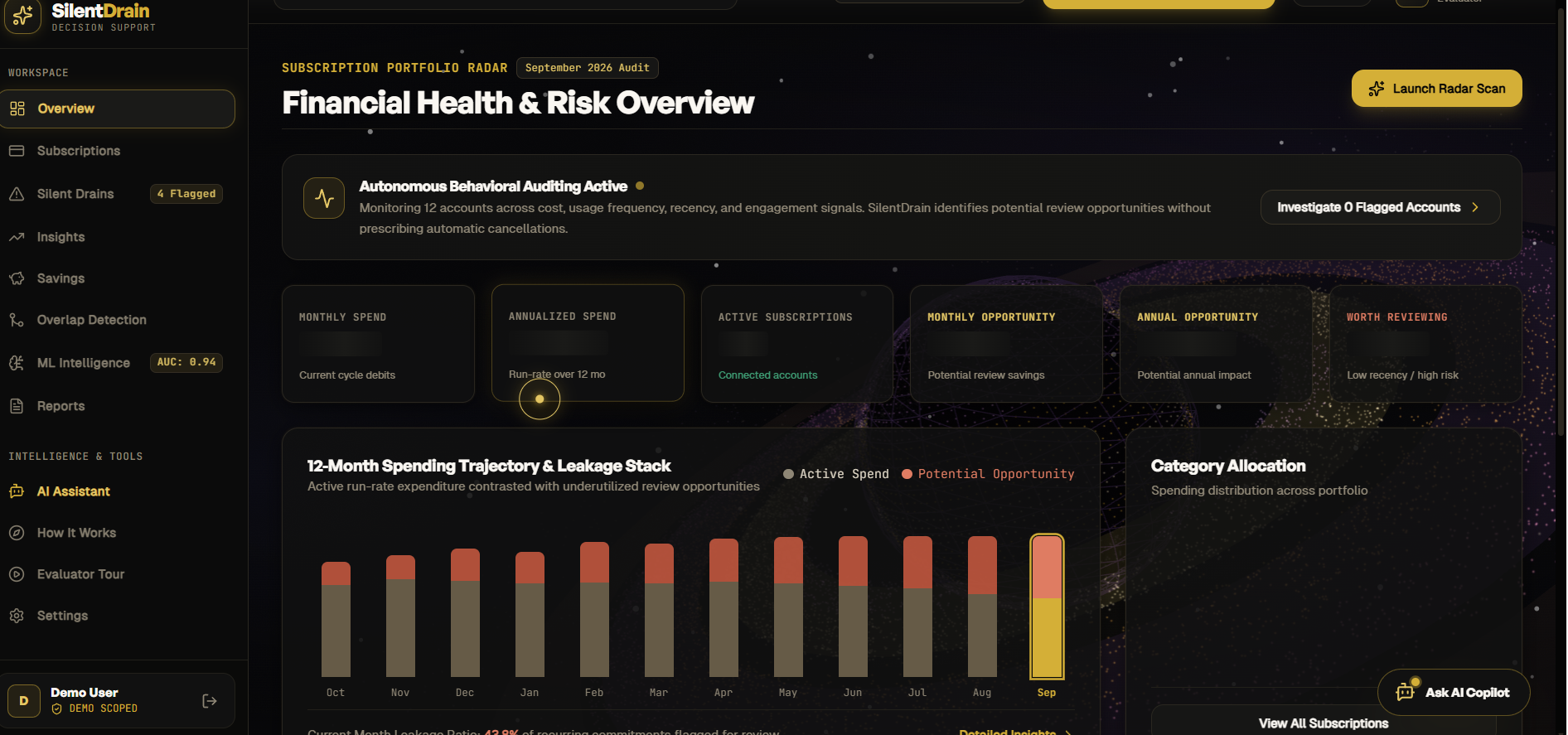
SilentDrain is a machine learning-powered financial analytics system designed to identify unused subscriptions, detect abnormal spending patterns, evaluate subscription health, and estimate potential savings.
Its key capabilities include:
- Subscription Health Classification: Identifies subscription usage patterns and classifies subscription health using machine learning.
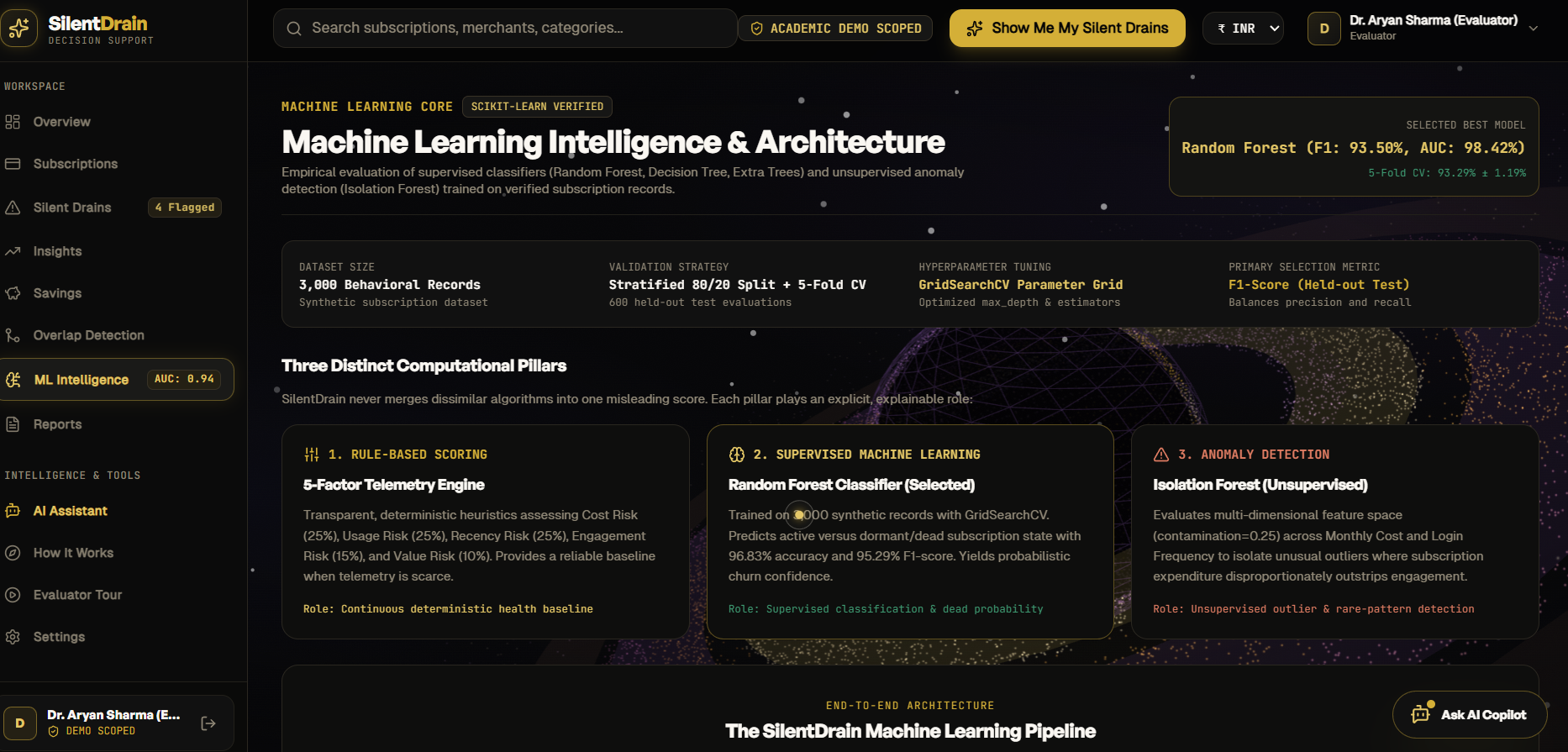
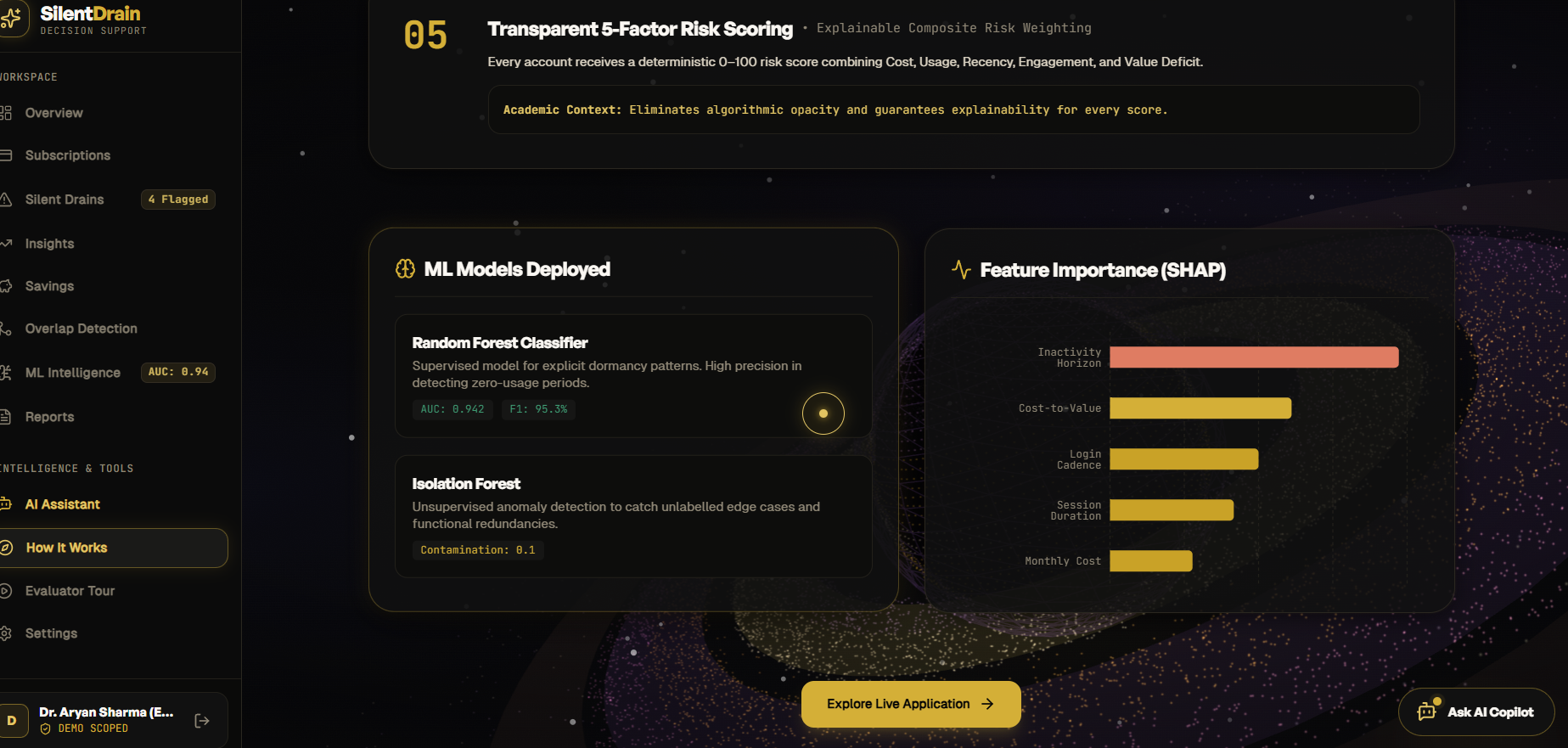
- Multiple ML Models: Implements Decision Tree, Random Forest, and Extra Trees classifiers.
- Anomaly Detection: Uses Isolation Forest to identify unusual subscription and spending patterns.
- Model Comparison: Evaluates multiple models using accuracy, precision, recall, F1-score, ROC-AUC, and execution time.
- Prediction Confidence: Provides confidence estimates for subscription classification.
- Smart Savings Estimation: Calculates potential monthly and annual savings from subscriptions identified as potential financial leaks.
- Automated Reporting: Generates classification reports, model comparisons, confusion matrices, ROC curves, feature importance visualizations, and CSV/TXT reports.
Rather than simply tracking expenses, SilentDrain focuses on identifying where recurring spending may be unnecessary and helping users make more informed financial decisions.
How we built it
We developed SilentDrain using Python and a modular machine learning architecture.
The system follows a structured ML pipeline:
- Data Processing: Used Pandas and NumPy for dataset handling, missing-value treatment, duplicate removal, feature engineering, scaling, and encoding.
- Model Development: Implemented Decision Tree, Random Forest, and Extra Trees classification algorithms using Scikit-learn.
- Model Evaluation: Compared models using multiple performance metrics and cross-validation to identify the best-performing model.
- Anomaly Detection: Integrated Isolation Forest to identify unusual subscription patterns.
- Prediction Engine: Developed prediction functionality with confidence estimation and subscription health analysis.
- Savings Analysis: Implemented monthly and annual savings calculations to quantify potential financial leaks.
- Reporting: Used Matplotlib and automated report generation to communicate results through meaningful visualizations and downloadable reports.
- Model Persistence: Used Joblib to save trained machine learning models for reuse.
The application is organized into modular components for preprocessing, training, evaluation, anomaly detection, prediction, and dataset generation.
Challenges we ran into
One of our major challenges was transforming subscription-related data into meaningful machine learning features. Raw subscription records alone were not sufficient to understand whether a subscription represented a potential financial leak.
We also faced challenges in comparing different classification algorithms, managing data preprocessing consistently, handling unusual spending patterns, and ensuring that the generated predictions could translate into understandable financial insights.
Integrating supervised classification with unsupervised anomaly detection was another important challenge. We addressed these challenges through modular development, systematic model evaluation, feature engineering, and separate analytical components.
Accomplishments that we're proud of
We are proud to have developed a complete machine learning workflow that goes beyond basic expense tracking.
Our major accomplishments include:
- Implementing three different supervised machine learning algorithms.
- Integrating Isolation Forest for anomaly detection.
- Building an automated model comparison and selection workflow.
- Developing subscription health prediction with confidence estimation.
- Creating monthly and annual potential savings calculations.
- Generating comprehensive machine learning evaluation reports and visualizations.
- Designing a modular, reusable architecture for future expansion.
Most importantly, we transformed a common everyday financial problem into a practical machine learning application.
What we learned
Through SilentDrain, we strengthened our understanding of the complete machine learning lifecycle, including data preprocessing, feature engineering, model training, model evaluation, classification, anomaly detection, and model persistence.
We also learned how different algorithms approach the same problem, why model evaluation requires multiple metrics, and how technical predictions can be translated into useful insights for real-world users.
The project helped us understand that building an effective AI-powered solution is not just about training a model — it is about making its output meaningful and actionable.
What's next for SilentDrain
We envision evolving SilentDrain into a comprehensive personal subscription intelligence platform.
Our future roadmap includes:
- Secure bank statement and transaction integration.
- Automatic recurring payment identification.
- Real-time subscription monitoring.
- Personalized AI-powered financial recommendations.
- Intelligent expense forecasting.
- Email and payment renewal notifications.
- A responsive web and mobile application.
- Cloud deployment with secure user accounts and personalized financial dashboards.
Our long-term goal is to help individuals and households gain greater control over recurring expenses, eliminate unnecessary financial leaks, and make smarter spending decisions.
SilentDrain — Find the money you forgot you were spending.
Built With
- anomaly-detection
- artificial-intelligence
- data-analytics
- data-visualization
- decision-tree
- extra-trees
- financial-technology
- isolation-forest
- joblib
- machine-learning
- matplotlib
- numpy
- pandas
- python
- random-forest
- scikit-learn
- vs-code
