-
-
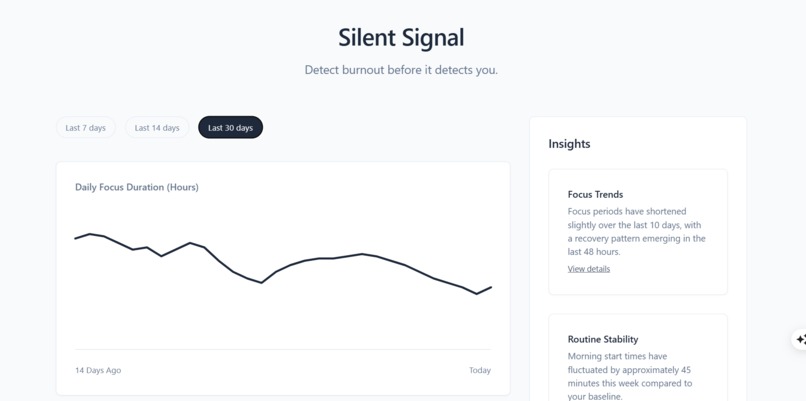
Silent Signal quietly observes long-term behavioral patterns and highlights meaningful changes before burnout becomes visible.

Inspiration
Burnout usually doesn’t happen all at once. It builds up quietly. Focus drops, routines break, motivation fades, and people slowly start feeling disconnected from their work and themselves. The problem is that most of the time, people don’t notice what’s happening until they’re already exhausted.
While looking at existing mental health tools, we realized that most of them depend on users actively reporting how they feel. But burnout is exactly the phase where people stop checking in with themselves. If awareness is missing, self-reporting fails.
This gap is what inspired Silent Signal. We wanted to build something that could notice early warning signs without asking users to constantly explain how they feel. Instead of listening to words, Silent Signal listens to long-term behavior patterns.
What We Built
Silent Signal is a privacy-focused system that looks for early signs of burnout by observing how a person’s daily digital behavior changes over time. It does not read messages, access content, or analyze personal data. It only looks at patterns such as consistency, rhythm, and variation in usage.
The idea is simple: everyone has a natural baseline for how they work and interact. When that baseline starts drifting for a sustained period, it can signal mental fatigue. Silent Signal highlights these changes and helps users become aware before burnout turns serious.
How We Built It
We designed the project around the idea that burnout is not a yes-or-no condition. It is a gradual shift. Because of this, we treated the problem as a behavioral drift detection task rather than a direct prediction.
The system first establishes a personal baseline using long-term behavioral patterns. Current behavior is then compared against this baseline to measure how much it deviates over time. Short-term spikes are ignored, while consistent deviations are treated as warning signals.
A major focus during development was explainability. Instead of showing a vague score, Silent Signal explains what has changed and over what period, so users can understand the signal rather than blindly trust it.
All analysis is designed to run locally, ensuring that user privacy is preserved and sensitive information never leaves the device.
Challenges We Faced
One of the hardest parts was avoiding incorrect alerts. Everyone has bad days, irregular schedules, or short bursts of stress. Triggering warnings too easily would reduce trust in the system.
To solve this, we focused on long-term trends instead of individual data points. Only consistent changes over time are considered meaningful. Another challenge was making sure the project did not cross into medical diagnosis. Silent Signal is not meant to label or judge mental health. It is meant to raise awareness and encourage reflection.
What We Learned
This project taught us that meaningful signals often come from small, repeated changes rather than dramatic events. We also learned that users trust systems more when they understand why something is happening. Most importantly, we learned that respecting privacy is essential when building anything related to mental well-being.
Silent Signal is built on the idea that technology doesn’t always need to ask more questions. Sometimes, it just needs to pay better attention.

Log in or sign up for Devpost to join the conversation.