

Inspiration
The heart of Sikhay—named after the Filipino word for "diligent zeal"—stems from a fundamental belief about the Philippine education system: academic struggle is often a translation issue, not a lack of intelligence. We were deeply inspired by the truth that, "Hindi lahat ng nahuhuli sa klase ay tamad. Hindi lahat ng mababa ang score ay kulang sa talino." (Not everyone who falls behind is lazy. Not everyone with a low score lacks intelligence.)
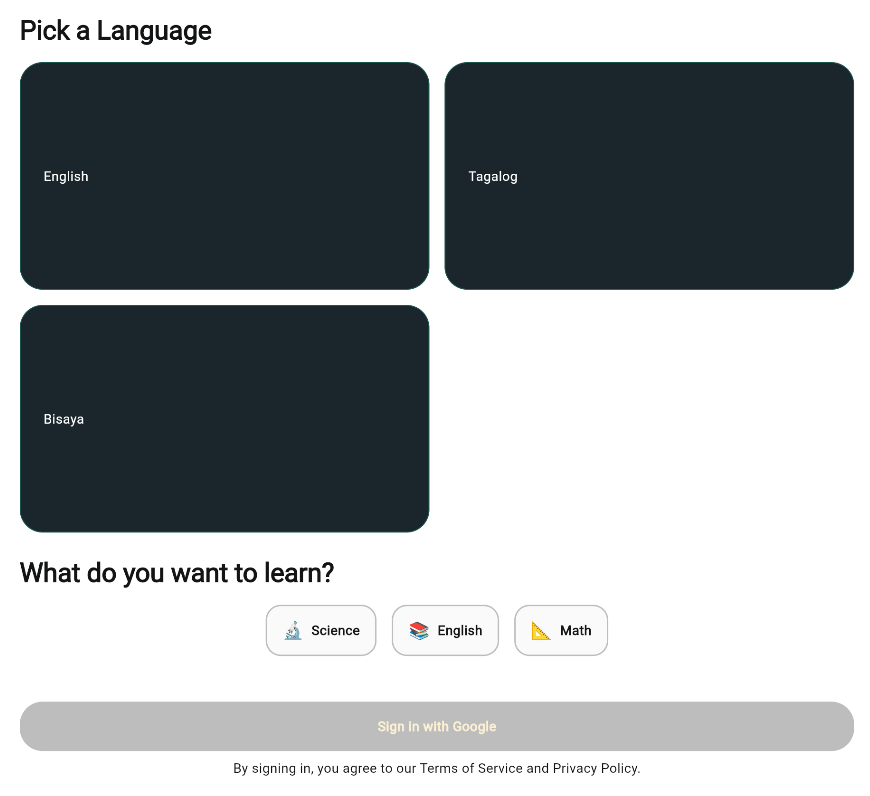
We noticed that Junior High School students frequently fall behind because DepEd textbook concepts are gated behind rigid, standard English definitions rather than the languages they naturally think in. We wanted to build a platform that serves as "Ang tulay mula sa salita patungo sa unawa" (The bridge from words to understanding), ensuring no student is left behind simply because of a language barrier.
What it does
Sikhay is a localized, AI-powered educational platform that transforms complex textbook definitions into intuitive, "native" understanding for Grades 7–10 students. It operates on three core pillars:
Concept Constellation: An interactive, tree-branch visual graph that maps how subjects interconnect. Students navigate this galaxy of topics to unlock new lessons.
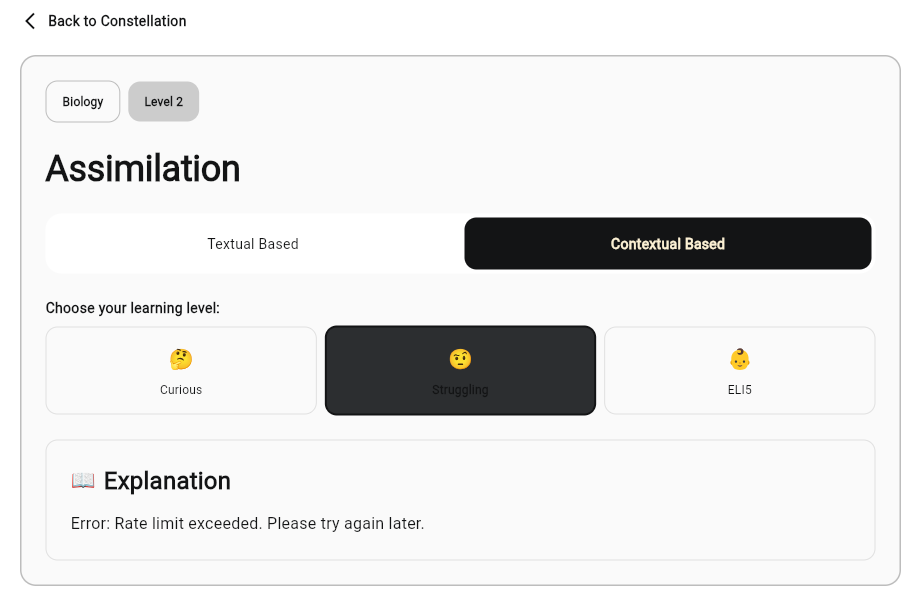
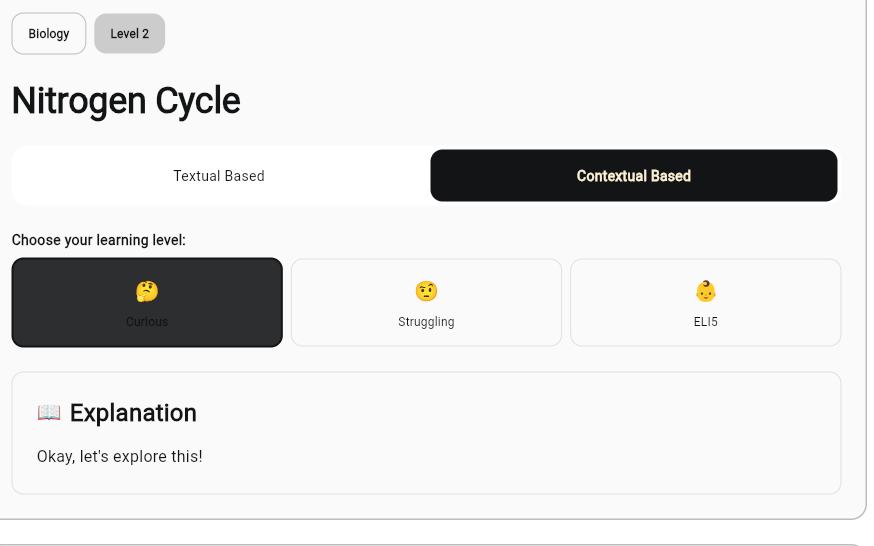
Adaptive Explanations: When a student struggles, the AI Tutor instantly translates and simplifies formal definitions into English, Tagalog, or Bisaya. Students can toggle between academic "Ground Truth" and "ELI5" (Explain Like I’m 5) modes.
Degree of Understanding Loop: Users control their pace through a dynamic emoticon survey:
Crystal Clear: The concept is grasped, and the user advances.
Getting There: Vocabulary difficulty drops, refreshing the sentence into a simpler structure.
Still Confusing: The AI pivots to heavily localized, real-world analogies that resonate with daily Filipino life.
How we built it
We engineered Sikhay for scale, accuracy, and accessibility across platforms.
Frontend: Built with Flutter and Riverpod for a fluid, responsive UI that handles real-time state changes seamlessly.
AI Architecture (Advanced Prompt Engineering): To eliminate AI hallucinations and protect academic integrity, we engineered strict, context-aware system prompts. This constrains the LLM to only draw from pre-approved coreDefinition texts, ensuring it acts as a focused tutor rather than a creative writer.
Backend & Efficiency: Powered by Firebase (Firestore and Cloud Functions). We implemented a "Lazy Cache" system where localized explanations are generated only once, stored in Firestore, and then served instantly (and for free) to the rest of the community.
AI Assistants: We leveraged Gemini and Manus AI during development to accelerate architectural brainstorming, troubleshoot widget trees, and optimize our LLM prompts.
Challenges we ran into
Balancing generative AI with cost-efficiency and absolute factual accuracy was a massive hurdle. Relying on live LLM generation for every user is expensive, slow, and prone to hallucinations. We solved this by engineering our strict prompting constraints and the "Lazy Cache" pipeline. This effectively turns a dynamic AI generation tool into a growing, static, offline-ready database, completely mitigating API cost scaling.
On the frontend, we faced significant UI constraints. Because Tagalog and Bisaya translations are often substantially longer than English, we constantly ran into RenderFlex overflowed errors. We had to deeply rethink our widget tree, utilizing dynamic Wrap and Expanded layouts to ensure the text adapted gracefully to any mobile screen size.
Accomplishments that we're proud of
We are incredibly proud of building a truly empathetic learning loop. The "Degree of Understanding" system doesn't punish students for failing; it simply adjusts its teaching strategy until the student understands.
From a technical standpoint, executing the "Lazy Cache" system is a major win. It allows us to provide a premium, AI-driven educational experience without incurring exponential API costs as the user base grows. Every student who asks the AI to simplify a concept effectively "unlocks" that simplified text for every future student who needs it.
What we learned
Building Sikhay was a masterclass in full-stack engineering and empathetic design. We learned how to effectively implement Large Language Models in factual data, how to optimize cloud database reads, and how to wield Riverpod for complex, asynchronous state management.
Most importantly, we learned that true technological accessibility goes far beyond an internet connection. It requires meeting users exactly where they are, in the language they understand, and with the patience they deserve.
What's next for Sikhay
The immediate next step is expanding our curriculum database to cover the entirety of the DepEd Junior High School syllabus for Science, Math, and English.
Following that, we plan to scale our localization efforts by adding more regional dialects (such as Ilocano and Hiligaynon) to the AI engine. Ultimately, we aim to partner with local schools and educators to pilot Sikhay in classrooms, gathering real-world efficacy data to continuously refine our AI's "ELI5" analogies.


Log in or sign up for Devpost to join the conversation.