-
-
When Every Gesture Matters
Inspiration
What it does
How we built it
Challenges we ran into
Accomplishments that we're proud of
What we learned
What's next for SignWear AI
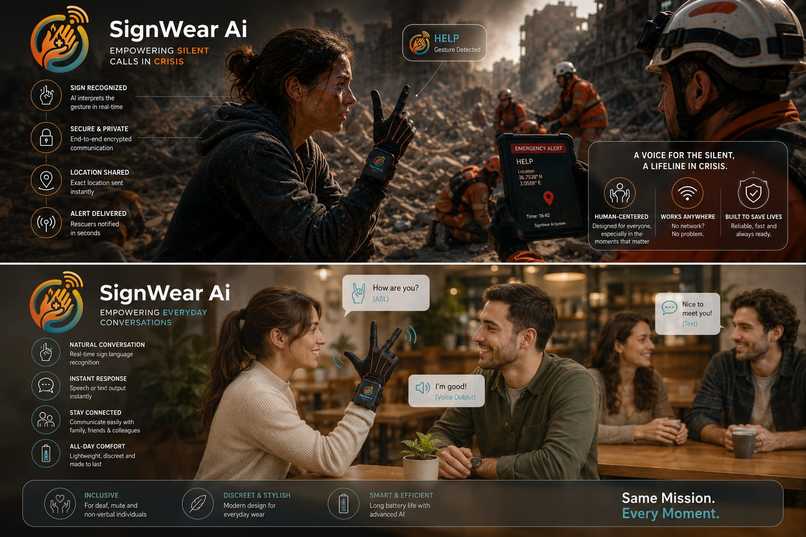
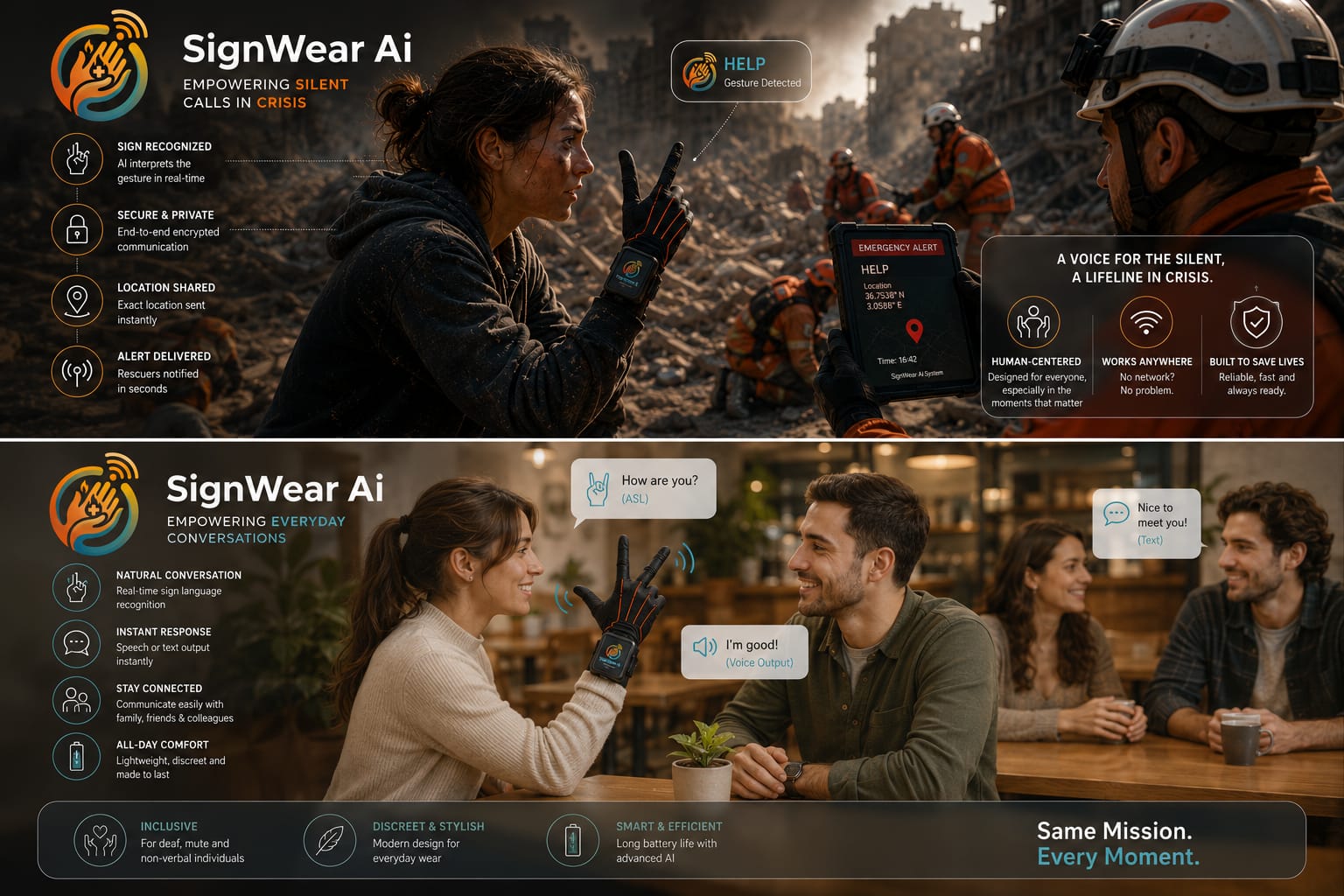
SignWear AI was born from a critical gap in emergency communication systems: when disaster strikes, voice-dependent infrastructure fails, leaving deaf and non-verbal users without a lifeline.
What inspired us: During a natural disaster simulation, we witnessed how emergency services remained dependent on voice-based alerts, completely excluding sign language users. We realized that accessibility isn't a feature—it's a necessity in crisis moments.
What we learned: Gesture recognition at the edge (on-device) is possible with compact neural networks. We discovered that low-latency, battery-efficient processing matters more than cloud connectivity in emergency contexts, and that co-designing with the deaf community fundamentally changes how you approach the problem.
How we built it: We created a five-layer hardware-AI system:
- Sensor Integration — Flex sensors + 6-axis IMU capture hand motion with millisecond precision
- Edge Signal Processing — Real-time filtering and feature extraction at the microcontroller level
- On-Device AI Recognition — A CNN-LSTM model quantized to 8-bit precision, trained on ASL/BSL emergency phrases from native signers
- Secure Communication — End-to-end encrypted mesh networking for reliability during infrastructure outages
- Emergency Response Interface — Multi-channel alerts (text, voice, GPS) that reach emergency services, family, and support networks instantly
Challenges we overcame:
- Gesture ambiguity resolved through confidence thresholding and human validation
- Battery life optimization via aggressive edge computation
- Model quantization without accuracy loss through careful hyperparameter tuning
- Real-time latency under 50ms maintained across all processing layers
Built With
- 6-axis-imu-(lsm6ds3)
- aes-256-encryption
- ble/lora-hybrid-mesh-networking-development:-python-(data-processing)
- cnn-lstm-architecture
- custom-pcb-ai-&-ml:-tensorflow-lite
- environmental
- figma-integration:-restful-apis
- flex-sensors-(5x)
- git
- hardware:-esp32-s3-microcontroller
- ip67
- lithium-polymer-battery
- openstreetmap-gps
- python
- sms/push-notification-gateways
- stress
- synthetic-data-augmentation-firmware:-arduino-ide
- wcag-2.1-accessibility-compliance-testing:-unit-testing-frameworks


Log in or sign up for Devpost to join the conversation.