-
-
app icon
-
app thumbnail
SignSpeak Sign a word. Hear it out loud.
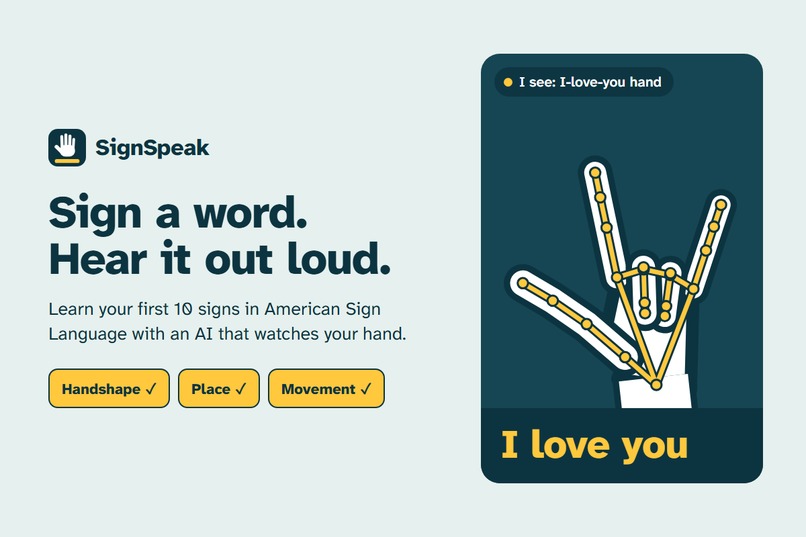
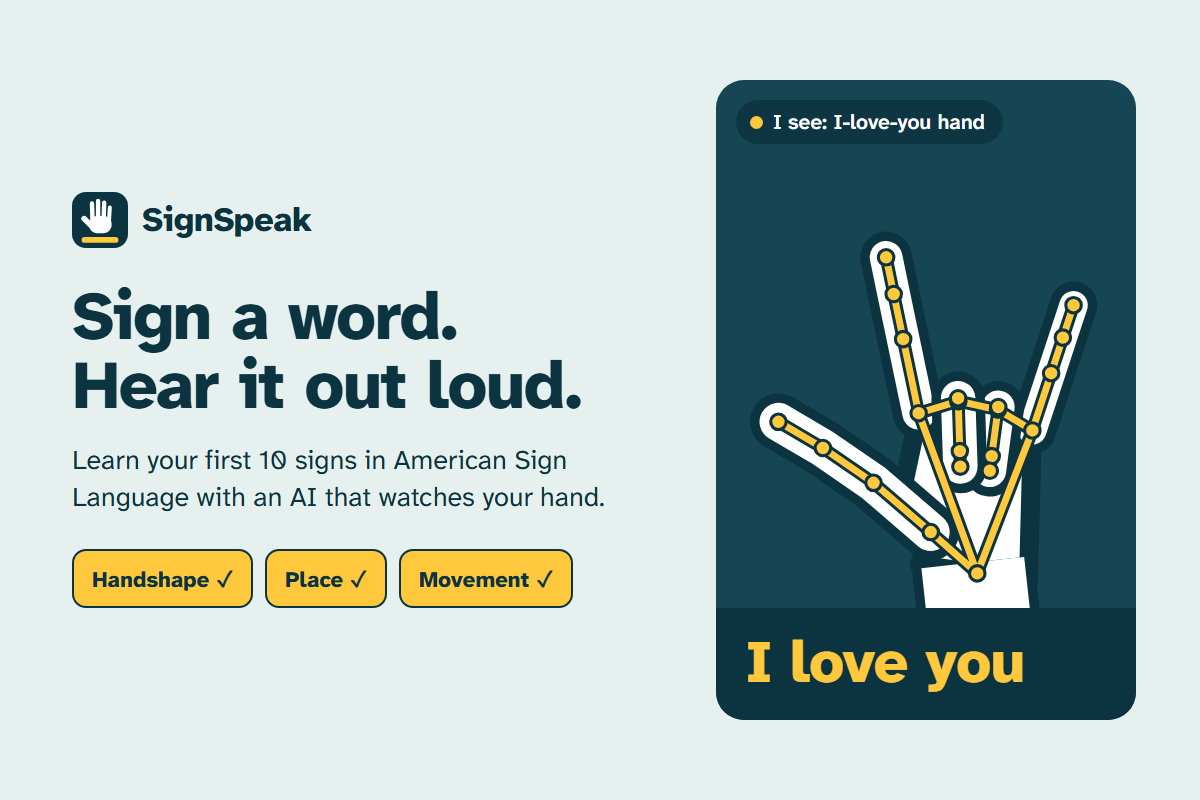
SignSpeak is a web app that helps hearing people learn their first signs in American Sign Language (ASL). Your camera works like a mirror: an AI finds your hand and your face, and when you sign one of 10 ASL signs, the word appears as a live caption and is spoken out loud. Practice mode teaches each sign and lights up the part you got right: the handshape, the place and the movement.
Everything runs in the browser. The video never leaves your device, and there is no account and no paid API.
SignSpeak
Built for the ML Empowerment Build Challenge 3.0 (2026).
What it does Talk mode. Sign, and SignSpeak writes the words as captions under the mirror and says each one out loud. Signs build a sentence (for example "Hello thank you"). Speak reads the whole sentence, Undo removes the last word, Clear starts over. Practice mode. One sign at a time, shown as three tiles: handshape, place and movement. Each tile turns yellow the moment you get that part right, and a hint tells you what to fix ("Spread your fingers apart", "Touch your chin with your thumb"). A yellow ring on the video shows where your hand should go. Sign it 3 times and it's learned (saved on your device). I see. A label on the video always says what the AI sees right now, for example "I see: open hand at your chin", so a wrong guess is easy to understand. The 10 signs Sign Handshape Place Movement Hello Flat hand, fingers together Fingertips at the side of the forehead Out, like a salute Thank you Flat hand Fingertips on the chin Forward and down Yes Fist In front of you Wrist nods up and down No Index and middle finger with the thumb In front of you Fingers snap shut on the thumb Please Flat hand On the chest Rub in a circle Sorry Fist, thumb along the side On the chest Rub in a circle I love you Thumb, index and pinky out In front of you Hold still Mother Open hand, fingers spread Thumb on the chin Tap Father Open hand, fingers spread Thumb on the forehead Tap Eat Fingertips together on the thumb (flat O) At the mouth Tap Some pairs are there on purpose, because they teach how sign languages work: Mother and Father have the same handshape in a different place, and Please and Sorry have the same place and movement with a different handshape.
How to run it It's plain HTML, CSS and JavaScript with no build step. The camera only works from http://localhost or an https:// address, so start a small local server in this folder:
python -m http.server 8000 Then open http://localhost:8000 in Chrome or Edge and press Turn on camera.
The first start needs internet: the browser downloads the MediaPipe library and the two AI models (about 20 MB, then cached).
Live on GitHub Pages: in the repository, open Settings → Pages → Deploy from a branch → main / root. The app then runs at https://.github.io/signspeak/, on phones too.
Tips for good results: good light, one hand up, and your face in the picture (many signs are measured from your face).
Debug view: open the app with ?debug at the end of the address (http://localhost:8000/?debug) to see the numbers behind every decision: how much each finger bends, the finger spread and the scores of the top handshapes.
How it works camera frame → MediaPipe Hand Landmarker: 21 points on the hand, in 2D and 3D → MediaPipe Face Detector: 6 points on the face (eyes, nose, mouth, ears) → features: how much each finger bends, fingertip reach, finger spread, thumb position → handshape: fuzzy rules give each handshape a score from 0 to 1 and a hint → place: where the hand is compared with the forehead, chin, mouth or chest, measured in face widths so it works near and far from the camera → movement: the last 3 seconds of positions (a nod, a circle, a snap, moving away…) → a sign is complete → caption + voice Seeing the hand. Google's MediaPipe models are neural networks that run inside the browser (WebAssembly and the graphics chip). The hand model gives 21 points, including 3D "world" points in meters. SignSpeak uses the 3D points for the handshape, so the rules still work when the hand turns. Handshape (js/features.js, js/handshapes.js). Each finger gets a bend (the sum of the angles at its three joints), a reach (fingertip to wrist) and the distance to the thumb tip. Each handshape is a list of checks like "index finger straight" or "fingers together". Every check returns a soft score from 0 to 1, and the handshape's score is its weakest check. That weakest check is also the hint the app shows. Place (js/location.js). From the eyes and mouth, SignSpeak estimates the forehead, chin and chest, and follows the tilt of the head. Movement (js/recognizer.js). The recognizer keeps the last 3 seconds of frames. Each movement is a small detector: nod counts up and down swings of the knuckles, circle adds up how far the hand turns around its center, snap looks for "open" followed by "closed" within 0.8 seconds, away and down measure how far the hand moved from where it rested. No double words. After a sign, the same sign waits until you drop your hand, and the next 0.9 seconds are ignored, so lowering your hand doesn't start a new sign. Testing 34 automated tests (npm test, or node tests/run.js): a small 3D hand model (js/handmodel.js) builds hands in every handshape, turned at random angles with noise, and "plays" each sign in front of a pretend face. The tests check that each sign is recognized once, that similar movements are not (waving, resting, pointing, dropping the hand after a sign), and that Practice gives the right hints.
Real hands (tests/real-hands.html, open it through the local server): MediaPipe runs on photos of ASL alphabet letters from the public Marxulia/asl_sign_languages_alphabets_v03 dataset. Several letters use SignSpeak's handshapes, and others must not be mistaken for them. Latest run (40 photos per letter; only photos where MediaPipe found a hand count):
Letters Should be Result A, S, E Fist 75 of 79 B Flat hand 22 of 28 U, V Two fingers 39 of 39 Y, L, W, I None of SignSpeak's handshapes 109 of 110 C None 20 of 25 (5 read as a flat hand) O Flat O (the letter O is rounder) 12 of 24 The thresholds were tuned while looking at these photos, so this is a sanity check that the rules fit real hands, not an independent accuracy score.
The whole app, end to end: a photo of a real fist, moved up and down on a fake camera, went through MediaPipe, the recognizer and the screen, and the app wrote and said "Yes". Place and movement for the other signs are covered by the automated tests; trying them with your own camera is the real test.
Drawings (tests/gallery.html) shows every handshape, place and movement picture.
Files File What it does index.html The page: mirror, Talk panel, Practice panel, About css/style.css All the design (see DESIGN.md) js/app.js Connects the camera, the AI and the screen js/vision.js Loads MediaPipe and runs the hand and face models on each frame js/features.js Turns 21 hand points into finger bend, reach, spread and thumb numbers js/handshapes.js The 6 handshapes as lists of checks with hints js/location.js Forehead, chin, mouth and chest from the face points js/recognizer.js Remembers the last 3 seconds and detects each movement js/signs.js The 10 signs: handshape, place, movement and how-to text js/illustrate.js Draws the teaching pictures as SVG from the hand model js/handmodel.js A small 3D hand model (for the pictures and the tests) js/draw.js Draws the yellow hand skeleton and the target ring on the video js/speech.js Says words out loud with the browser's voice js/progress.js Remembers practice progress on this device tests/ Automated tests, the real-photo check and the drawings page design/ The icon and thumbnail source pages Tech MediaPipe Tasks Vision 1.0.1: Hand Landmarker and Face Detector (BlazeFace short range), loaded from jsDelivr and Google's model storage. Web Speech API for the voice, localStorage for practice progress. Atkinson Hyperlegible Next, a typeface made by the Braille Institute for readers with low vision. No framework and no build step, so every line is easy to read and change. Limits SignSpeak knows 10 one-handed signs. ASL is a full language with its own grammar, facial expressions and many two-handed signs, and it is different from other sign languages (for example Israeli Sign Language). SignSpeak is a first step for hearing learners, not a translator. To learn ASL, learn from Deaf teachers, for example at Lifeprint (ASL University).
The rules are hand-written, not learned from signing videos, so people with different hands, cameras and signing styles may need to sign slowly and clearly. The ?debug view shows why a sign wasn't recognized.
Built With
- claude

Log in or sign up for Devpost to join the conversation.