-
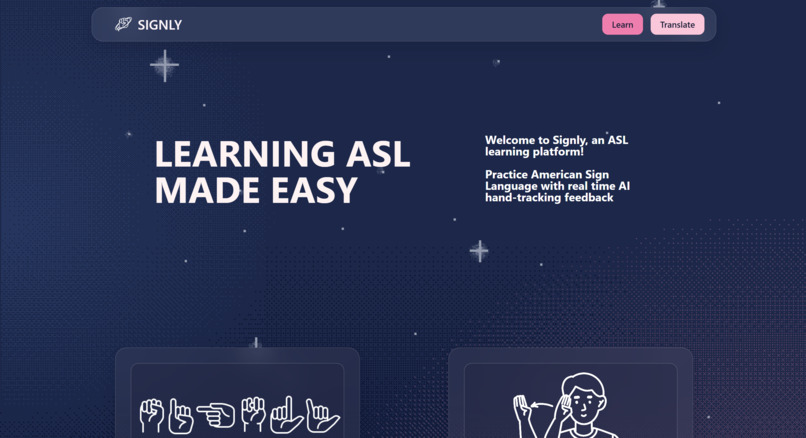
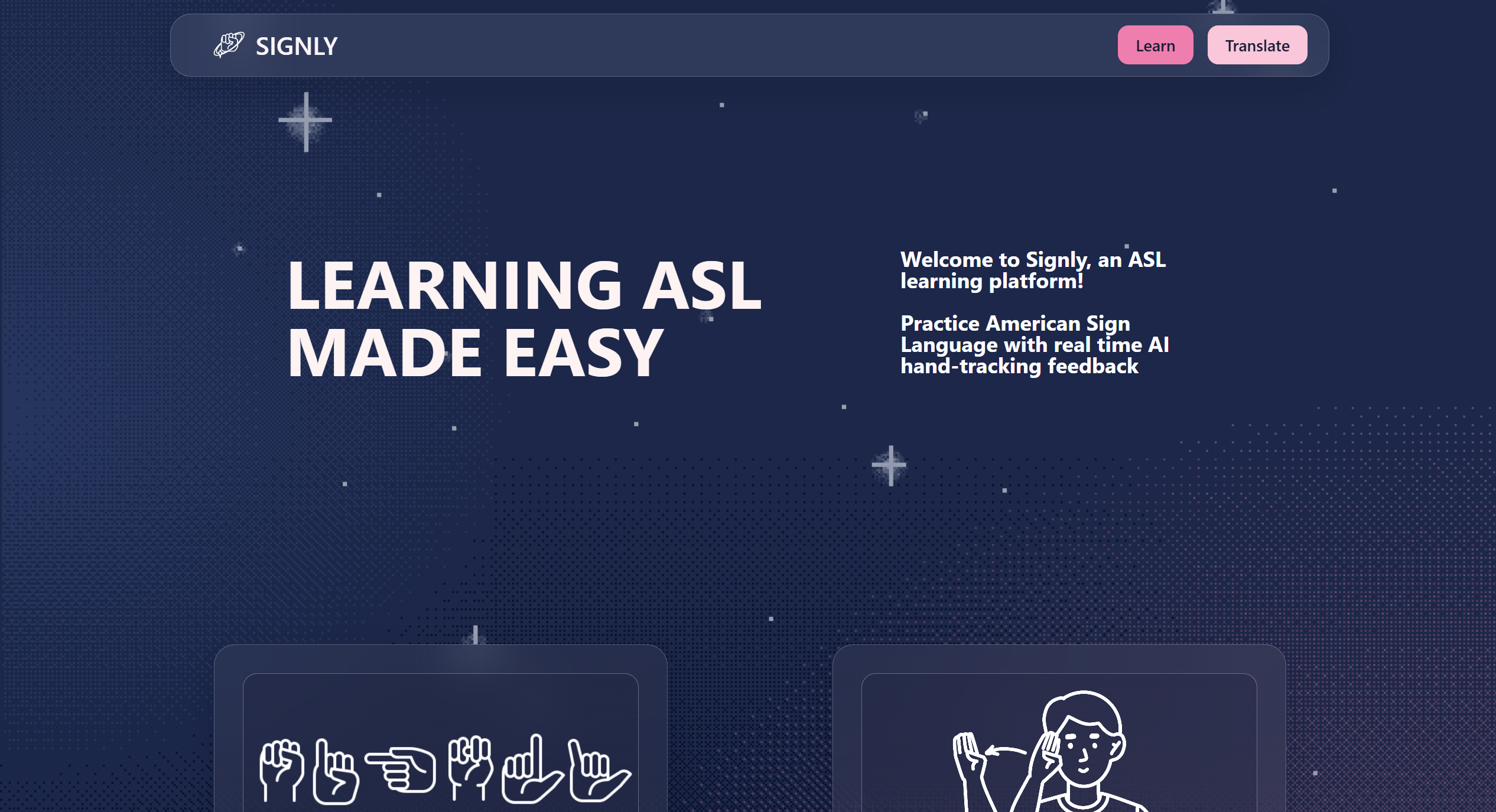
Home Page where users can choose lessons mode or translator mode.
-
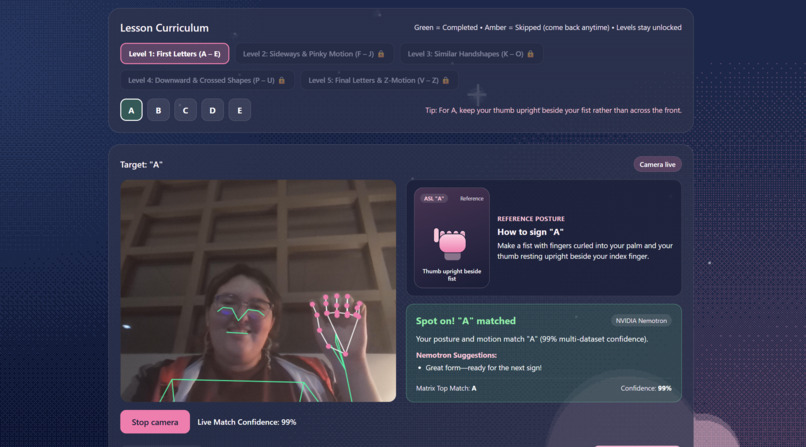
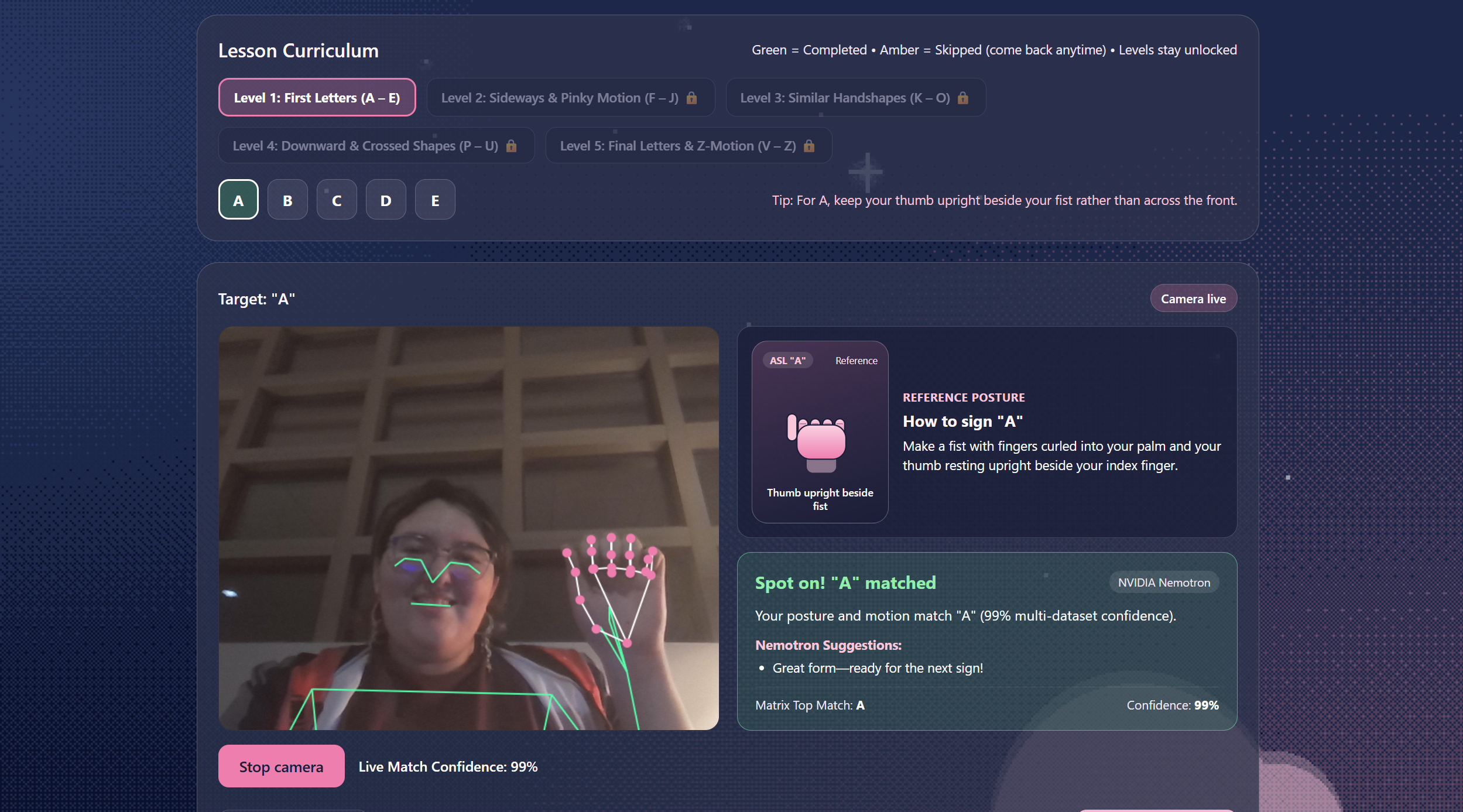
Lessons mode where users learn to sign the alphabet.
-
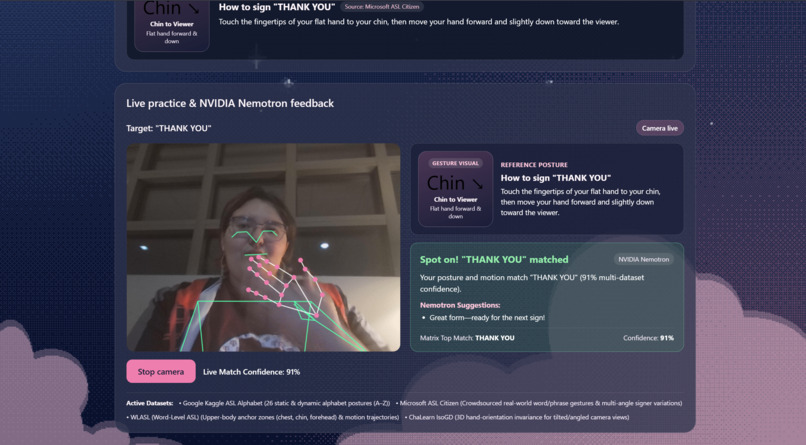
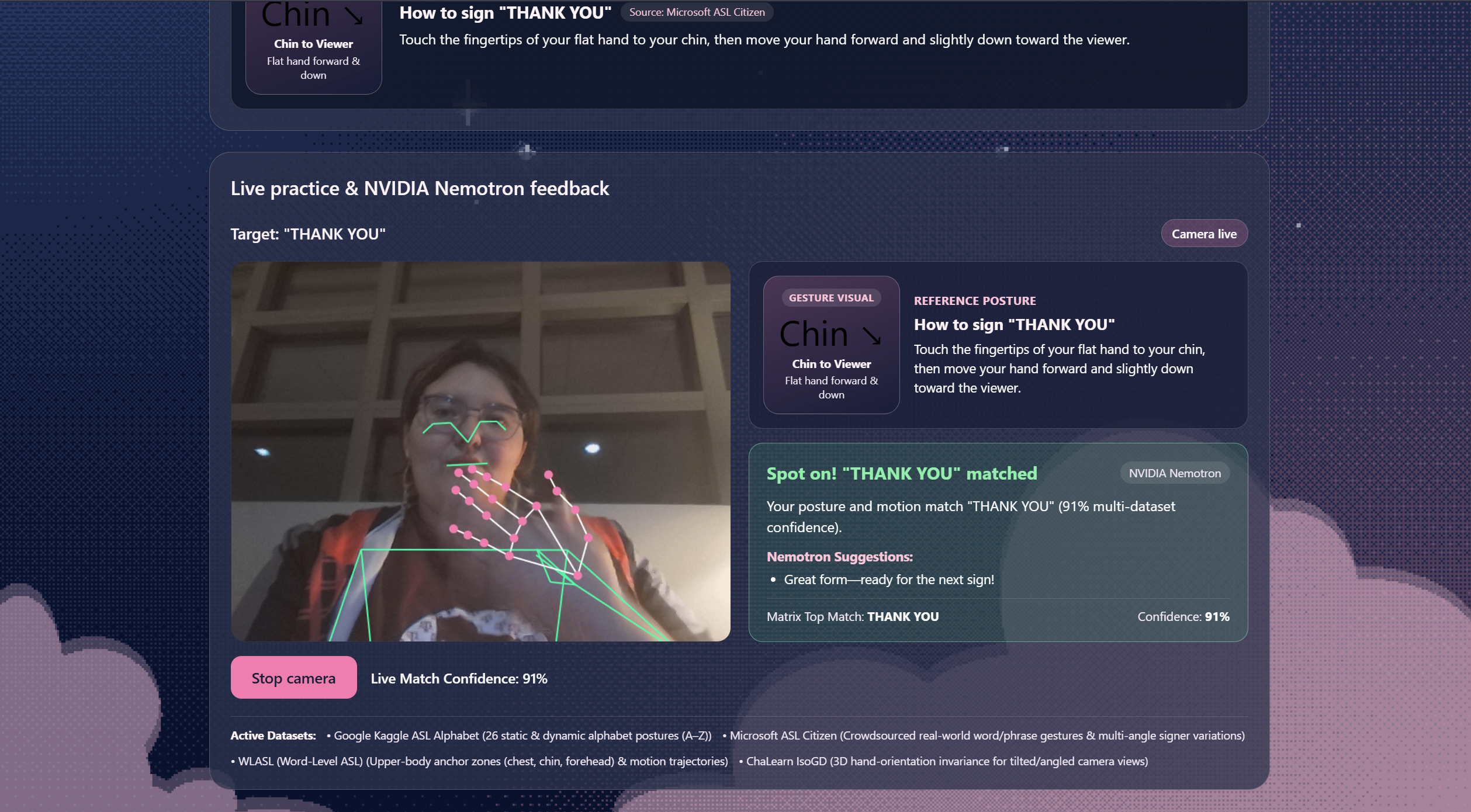
Translator mode where users can learn their chosen phrases.
Inspiration
Our goal for this hackathon was to solve a problem using computer vision. We began to think about skills that are inaccessible to the average person because they’re hard to learn through a book. For example, American Sign Language requires not only memorization of various hand-signs, but also precise movement and expression to properly communicate. Someone learning a new speaking language will naturally pick up on pitfalls in pronunciation and miscommunications because they are already familiar with interpreting verbal communication. However, the same person may not be able to notice inaccuracies in hand signs, even while looking in a mirror. We realized that a tool that could quickly give you feedback on signs would be incredibly helpful to a person who cannot access an in-person mentor.
What it does
Signly’s lessons guide a beginner ASL learner through the fundamentals of sign language while providing instant actionable feedback to nip mistakes in the bud. This increases a beginner’s skill and confidence so they can go into the world and start signing! The translator page provides a sort of online dictionary for signs. If a user finds themselves struggling with a specific sign, they can go practice it on the translator page.
How we built it
The frontend was first designed through Figma. We wanted the website to feel innovative and inviting, so we opted for a soft, gradient color scheme with sharp, bold font. The background was drawn with Pixilart and graphics were sourced from Icons8 or drawn in IbisPaintX. The design was then converted into JavaScript, HTML, and CSS and debugged with Claude AI.
For the backend, the first thing we did was use ChatGPT Codex to create and train a model to be able to classify the letters. We started with 4 letters, then 24, and then we added J and Z because the signs for those letters are not static. We then used the model and tested it in order to get an overall accuracy of 96.86%. Lastly, we then integrated and enhanced the backend with the frontend using Nemotron.
Challenges we ran into
As beginners to sign language ourselves, we found that we had to learn a lot of sign language along the way - thankfully, we had Signly to help us!
For hand sign recognition, starting with the right dataset is essential to getting accurate results. In our first test, we found that the model was having some trouble distinguishing signs that are pretty distinct from a human perspective.
Accomplishments that we're proud of
We’re most proud of our improvements in sign recognition accuracy. Through Nemotron’s reasoning, we are able to combine the analysis of 4 different ASL datasets in real time. Additionally, we found Nemotron’s suggestions for improvement in hand posture quite helpful in our own testing.
What we learned
Through this project, we have learned about some of the difficulties that come with interpreting hand signs. Traditionally, hand pose is interpreted by locating the joints of the fingers, but because the joints of a finger are so close together, interpretation becomes difficult in poor lighting or when the fingers overlap which is common in sign language. Our solution is to try to introduce different angles so the pose can be interpreted in a more three-dimensional space.
What's next for Signly
While we currently only have recognition for the alphabet and a few common words, our program is built for smooth implementation of new signs, which would make our website useful for more than just beginners. We also hope to build out the lessons in the future.
Built With
- css3
- figma
- gemini
- google-kaggle-asl-dataset
- html5
- javascript
- mediapipe
- nvidia-nemotron
