-
-
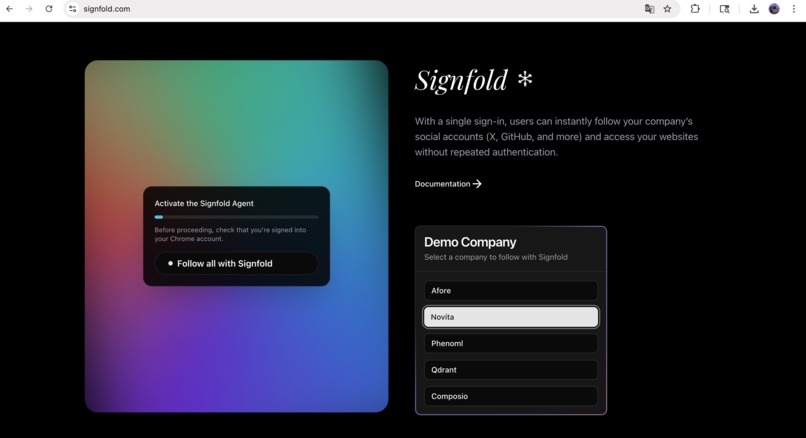
Main page (button you can integrate into your company website).
-
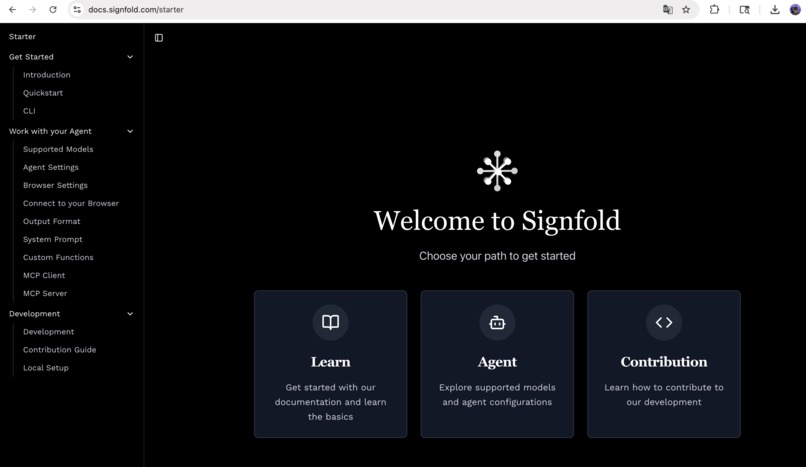
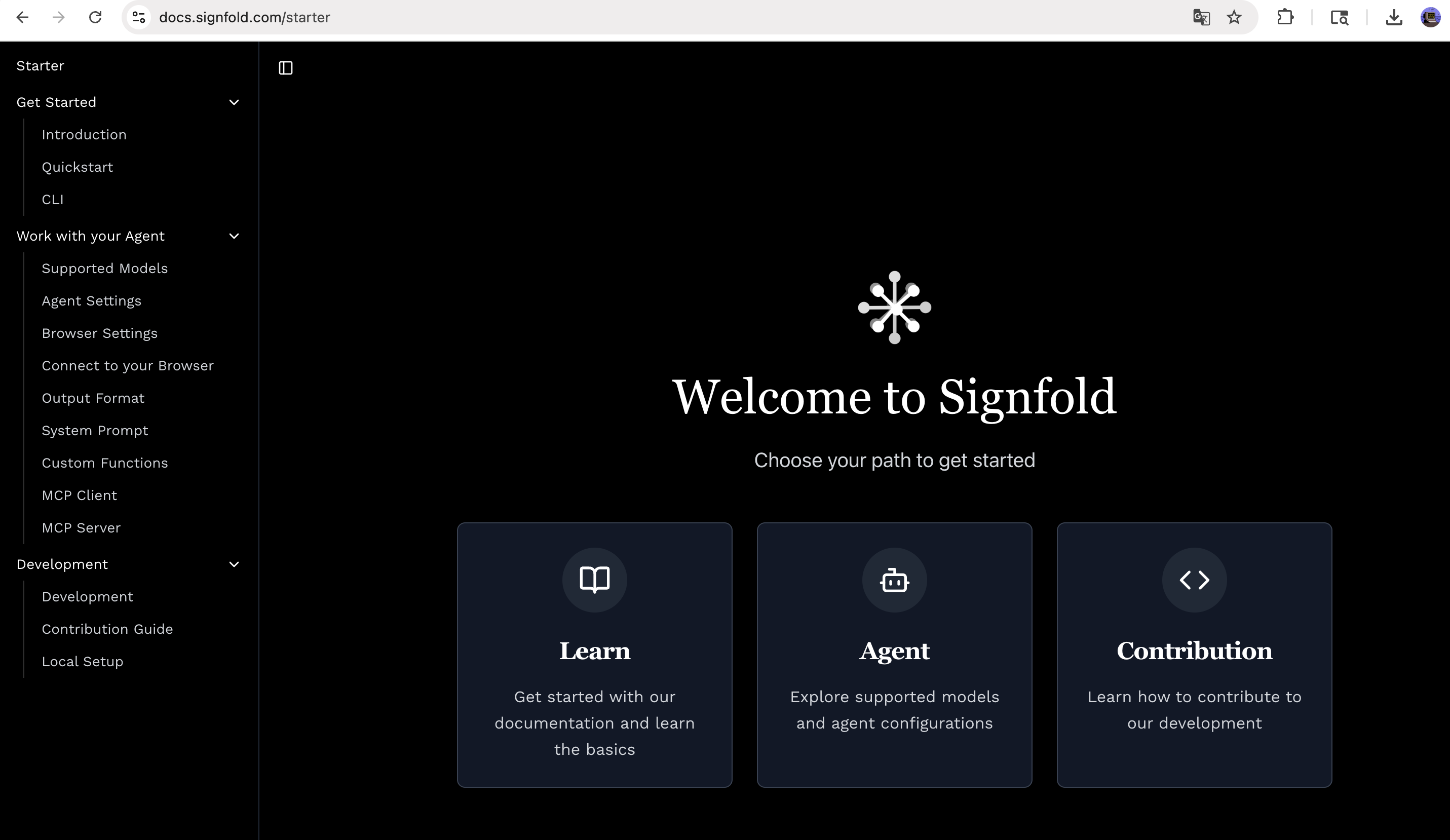
Documentation Library
Inspiration
Signfold was inspired by the frustration of manually following multiple social media accounts and websites for companies. We noticed that users often need to authenticate repeatedly across different platforms just to follow a company's social presence. This creates friction and reduces engagement. We wanted to create a seamless, one-click solution that would automate the entire process of following companies across all their social platforms.
What it does
Signfold is a browser automation platform that allows users to follow companies across multiple social media platforms with a single click. When a user clicks "Follow all with Signfold," the system automatically:
- Navigates to LinkedIn company pages and clicks the follow button
- Subscribes to YouTube channels
- Joins Discord servers via invite links
- Handles authentication seamlessly using the user's existing browser session
- Provides real-time status updates during the automation process
The platform features a modern, elegant UI with a rotating gradient design and integrates with a local Python backend that uses browser automation to execute these tasks.
How we built it
Frontend:
- Next.js 15 with TypeScript for the web application
- Tailwind CSS for styling with custom gradient animations
- React components with interactive hover effects
- Modern UI components using Radix UI primitives
Backend:
- Express.js server running backend
- Python automation scripts using the
browser-uselibrary - Chrome browser automation with Playwright
- OpenAI GPT-5 integration for intelligent task execution
Integration:
- Novita Model API for model integration
- RESTful API endpoints for communication between frontend and backend
- CORS configuration to allow cross-origin requests
- Real-time status updates and error handling
- Virtual environment management for Python dependencies
Challenges we ran into
Browser Automation Complexity: The biggest challenge was getting the browser automation to work reliably across different platforms. LinkedIn, YouTube, and Discord all have different security measures and dynamic content loading that required careful handling.
Cross-Origin Resource Sharing (CORS): Setting up proper CORS configuration between the deployed frontend and local backend was tricky, especially ensuring that the production frontend could communicate with the local automation server.
Python Environment Management: Managing the virtual environment and ensuring all dependencies (like Playwright and browser-use) were properly installed and compatible with the system's Python version.
Error Handling: Implementing robust error handling for network timeouts, authentication failures, and browser session management required extensive testing and iteration.
Accomplishments that we're proud of
Seamless Integration: Successfully created a system where users can trigger complex browser automation with a single button click, completely abstracting away the technical complexity.
Modern UI/UX: Built a beautiful, responsive interface with smooth animations and intuitive user experience that makes automation feel effortless.
Reliable Automation: Developed a robust automation system that can handle multiple social platforms, authentication states, and error conditions gracefully.
Local Execution: Created a hybrid architecture where the frontend can be deployed globally while keeping the automation backend local, ensuring security and performance.
Real-time Feedback: Implemented comprehensive status updates and error reporting so users always know what's happening during the automation process.
What we learned
Browser Automation Best Practices: Gained deep understanding of how to build reliable browser automation systems, including handling dynamic content, authentication flows, and error recovery.
Hybrid Architecture Design: Learned how to design systems that combine deployed frontends with local backends, balancing security, performance, and user experience.
Modern Web Development: Enhanced skills in Next.js 15, TypeScript, and modern React patterns, including proper state management and error handling.
API Design: Developed expertise in designing RESTful APIs that can handle long-running processes and provide real-time feedback.
Security Considerations: Learned about CORS, authentication flows, and how to safely execute local processes from web applications.
What's next for Signfold
Platform Expansion: Add support for more social media platforms like Twitter/X, Instagram, TikTok, and GitHub to provide comprehensive social following capabilities.
User Authentication: Implement Google OAuth integration to allow users to authenticate and save their preferences across sessions.
Analytics Dashboard: Create a dashboard showing which companies users have followed and provide insights int
Built With
- next.js
- novita
- python
- radixui
- react
- restful
- tailwind
- typescript


Log in or sign up for Devpost to join the conversation.