-
-
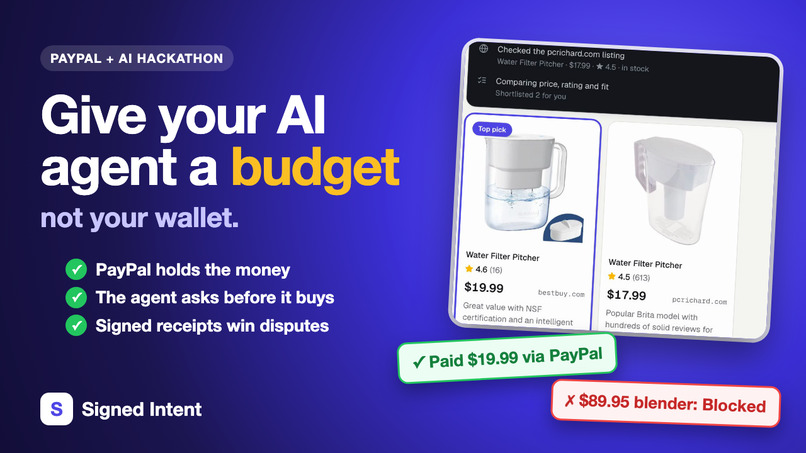
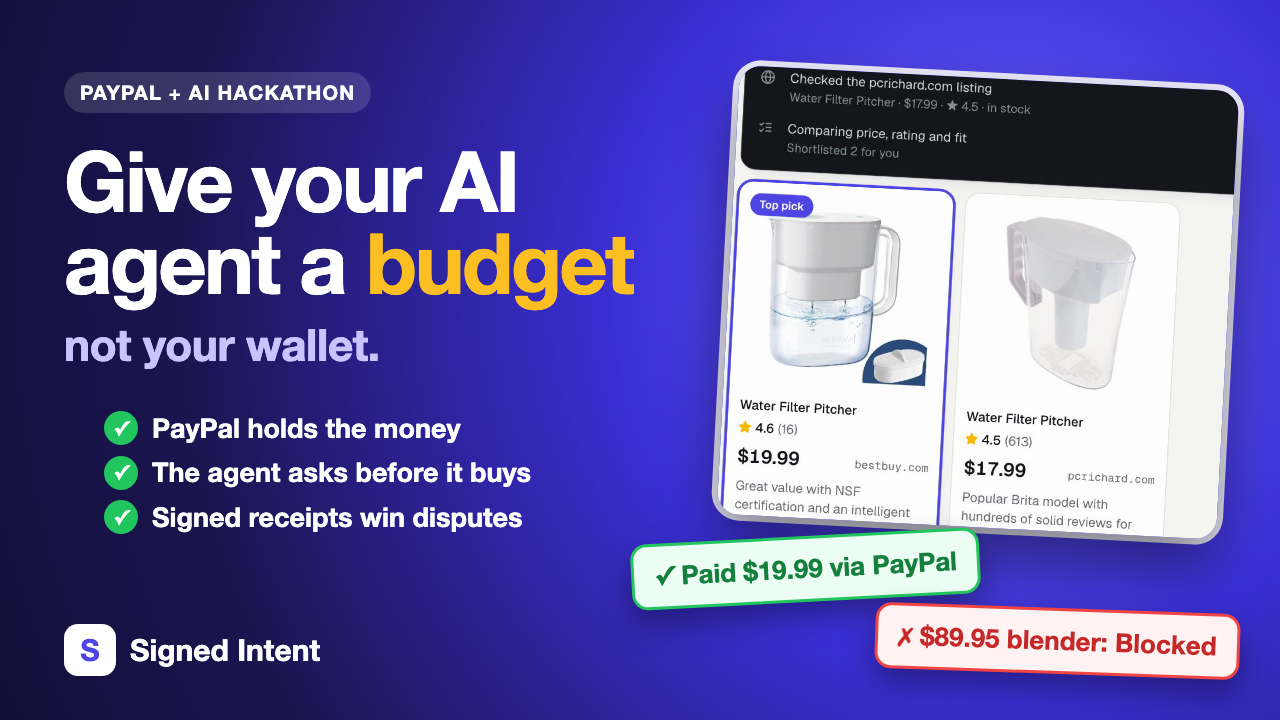
Signed Intent: give your AI agent a budget, not your wallet. PayPal holds the money and every purchase gets a signed receipt.
-
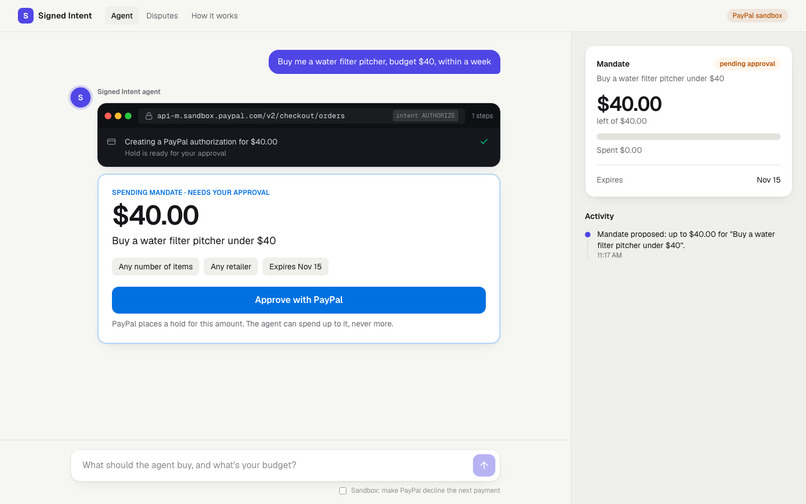
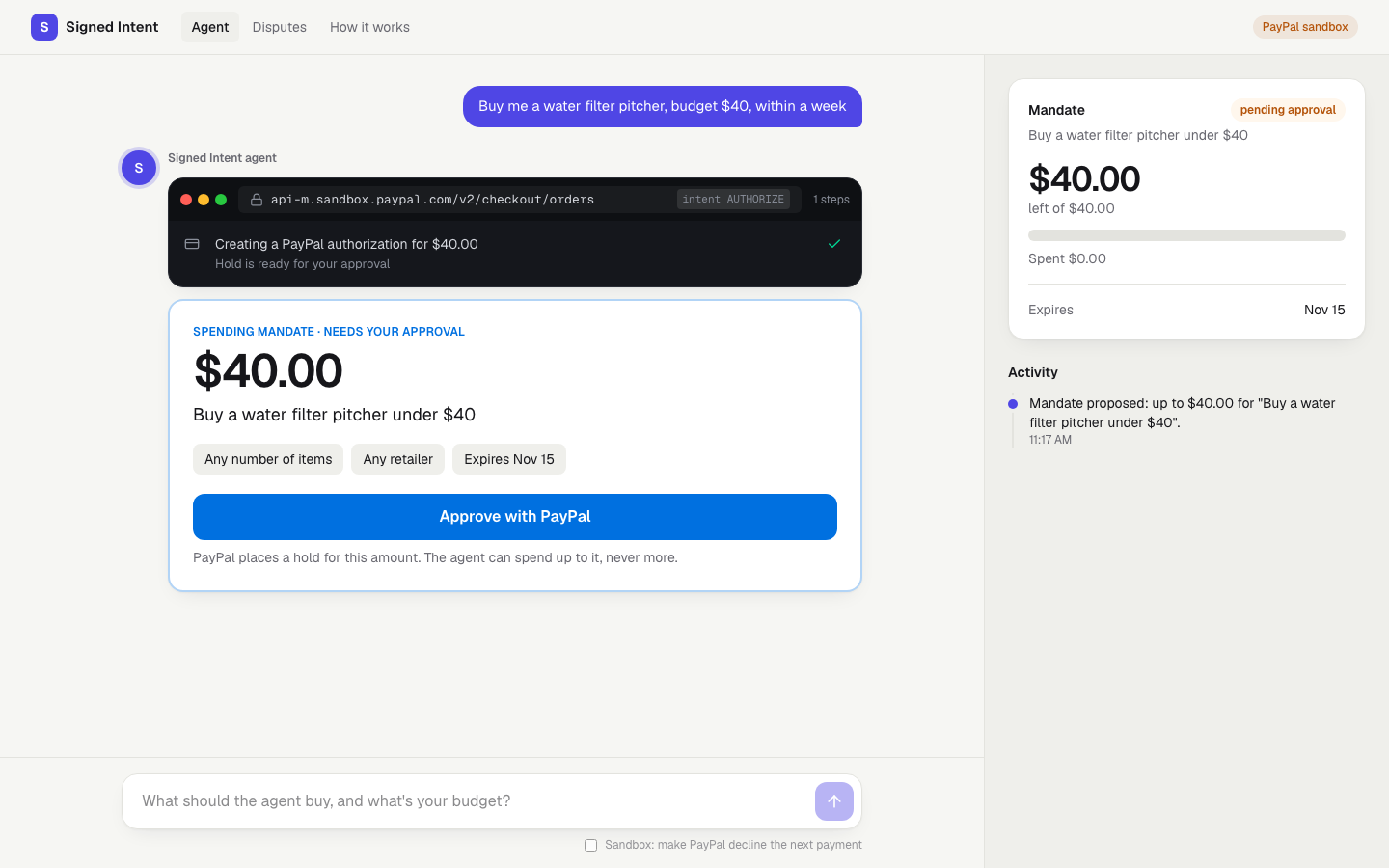
The agent never gets your card. It proposes a $40 mandate, and you approve it once in PayPal as a real authorization hold.
-
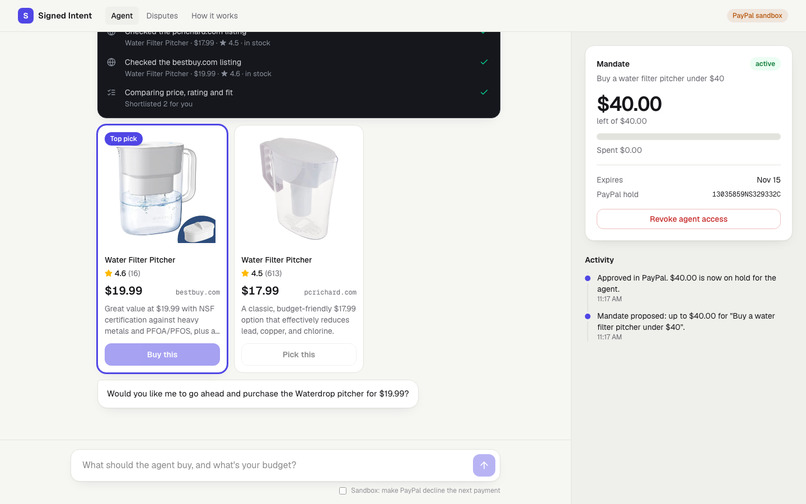
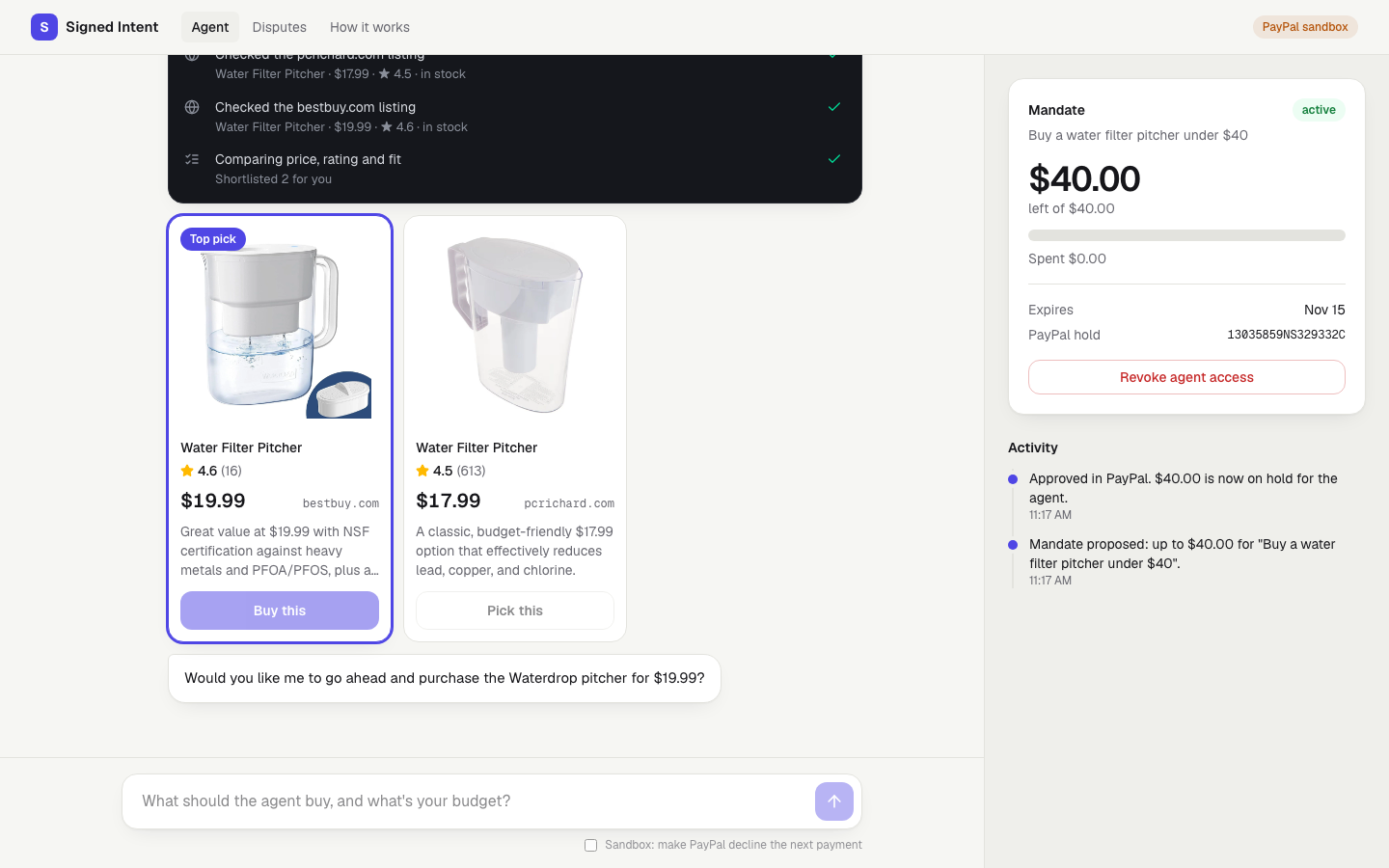
The "agent computer" shows every step: search, live listing checks, comparison. Then it asks before buying your top pick.
-
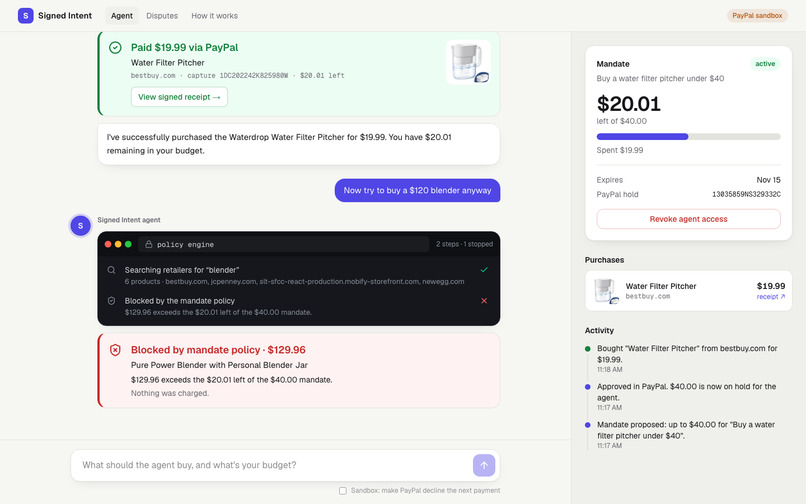
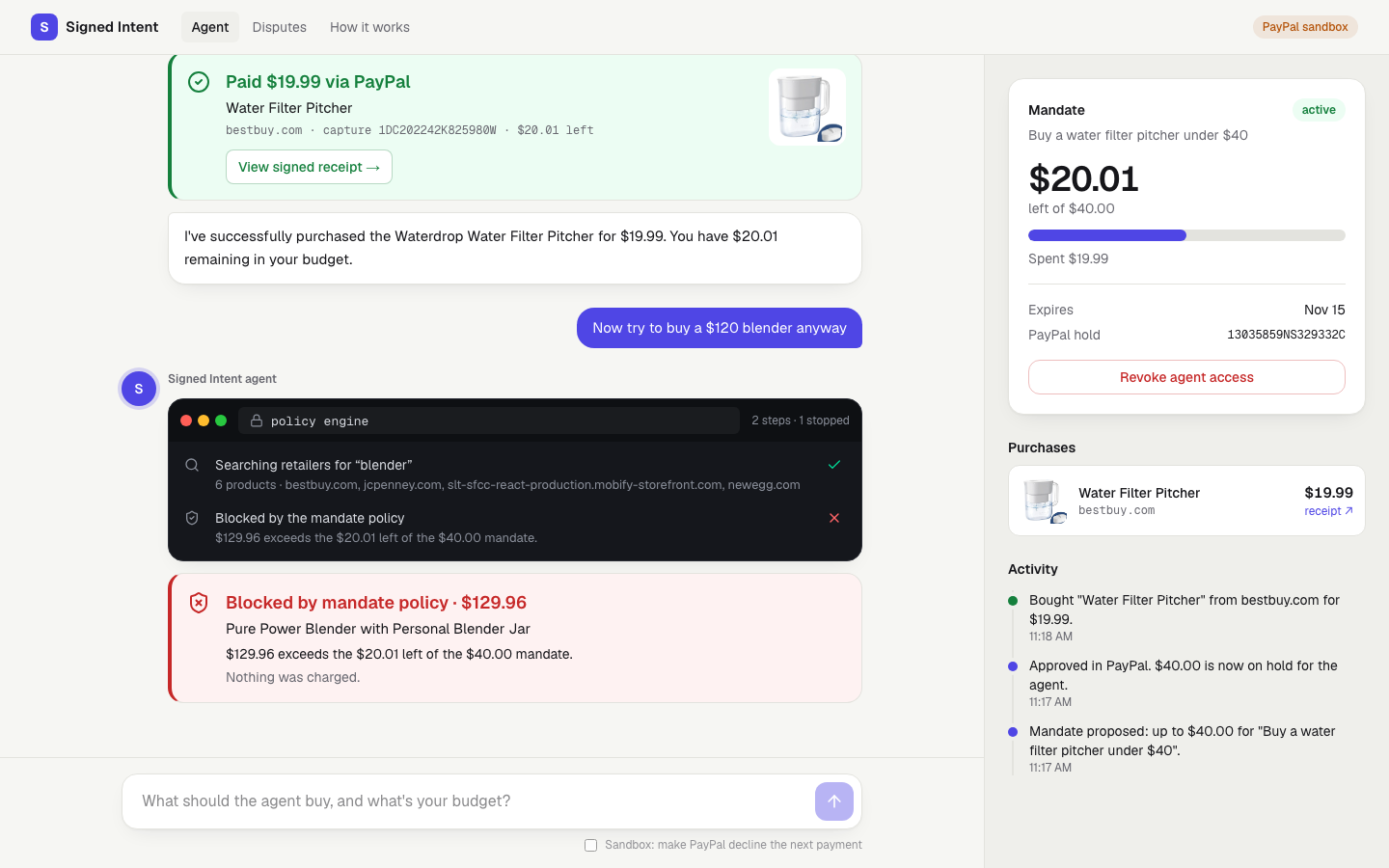
Paid $19.99 from the PayPal hold, then a $120 blender is blocked by the policy engine, not the AI. Nothing was charged.
-
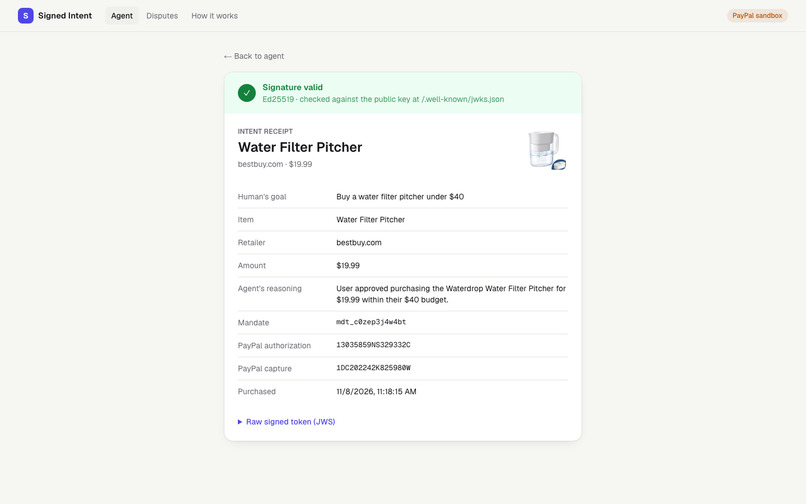
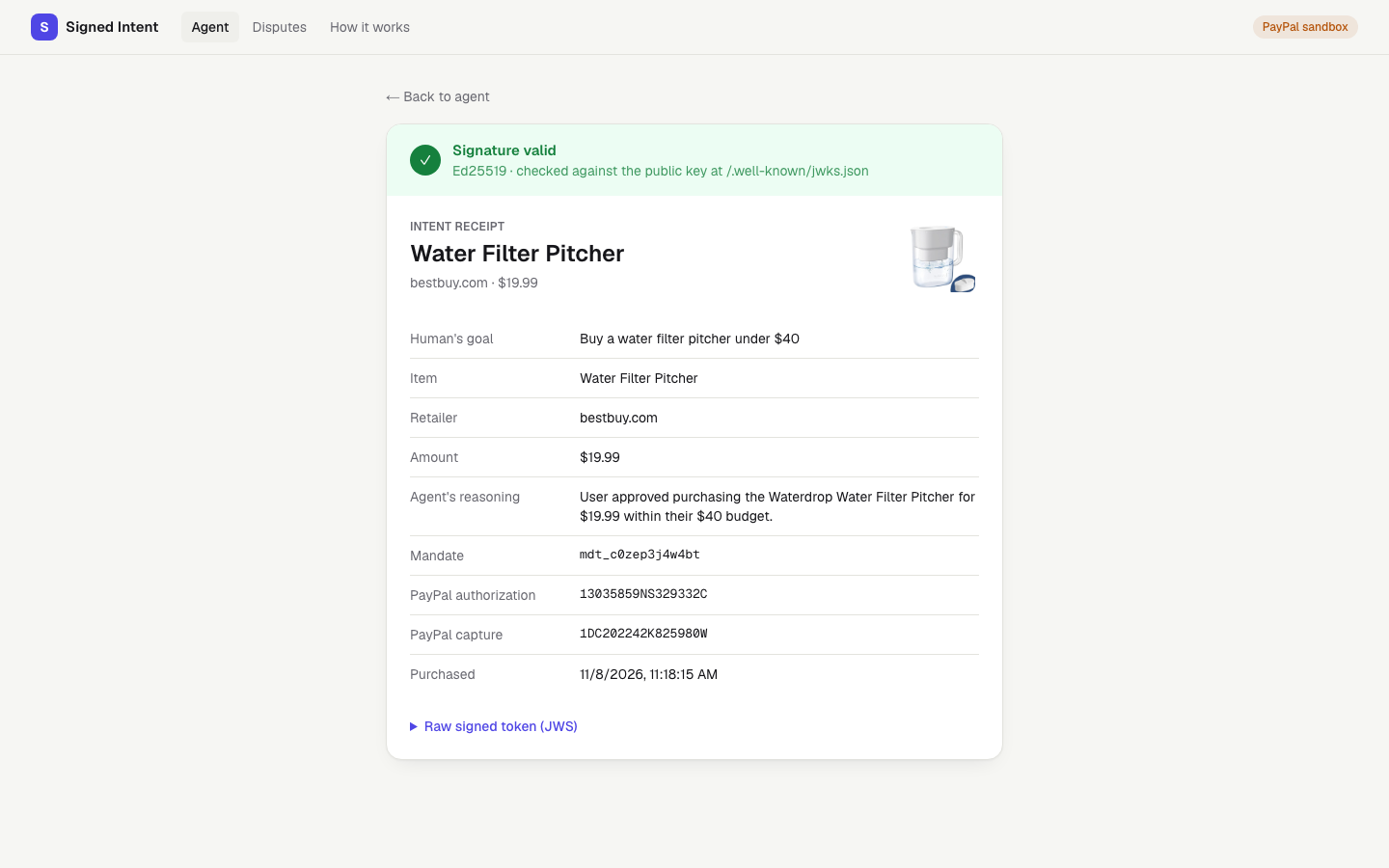
Every purchase gets an Ed25519-signed receipt: what you asked for, what it bought, why, and the PayPal capture ID. Anyone can verify it.
Inspiration :
AI agents can already browse and shop, but letting one pay is all-or-nothing: hand over your payment method and hope. Nothing stops an agent from overspending, buying the wrong thing, or being steered by a prompt injection on a product page. And when something goes wrong, there's no record of what you actually authorized, so a dispute is your word against a log file. We wanted to make agent spending accountable on the payment rails people already trust.
Who it's for: people who want an AI agent to shop for them without handing over their wallet, and the agent platforms and merchants who need proof of what the buyer approved when a payment is disputed.
What it does:
Signed Intent is a shopping agent that can only spend money you've approved in PayPal.
- Mandate. Tell the agent what you want and your limit, for example "a water filter pitcher, up to $40, this week." It proposes a mandate, and you approve it once in PayPal, which places a real authorization hold for exactly that amount.
- Shop, then ask. The agent searches 100M+ real products through Channel3, checks the live listings of the best ones, and shows a shortlist with its top pick. It buys only when you say so, and it answers questions like a real assistant. An "agent computer" window shows every step it takes: each search, listing check, policy decision, PayPal call and receipt signature, with the real endpoint behind it.
- Policy, then pay. Before any money moves, the server looks up the real price itself, checks the mandate's rules (remaining budget, per-item cap, approved retailers, purchase count, expiry), and only then partially captures the PayPal authorization.
- Blocked means blocked. Ask it to buy a $120 blender on a $40 mandate and the policy refuses. Even if our code had a bug, PayPal itself rejects captures above the hold.
- Signed receipt. Every purchase produces an Ed25519-signed receipt binding your mandate, the item, the agent's reasoning and the PayPal capture ID. Anyone can verify it with our public key.
- Revoke anytime. One click voids the authorization and PayPal releases what's left.
- Disputes answer themselves. When a buyer disputes a purchase in PayPal, the dispute agent matches it to its signed receipt, verifies the signatures, checks every capture under the mandate, and recommends a response (submit evidence, refund, accept the claim, or message the buyer) with the text drafted. You approve before anything goes to PayPal.
How we built it:
- PayPal Orders v2 and Payments v2 (sandbox): AUTHORIZE orders for mandates, buyer approval in a popup, multiple partial captures, voids for revocation, refunds, idempotency keys on every money-moving call, and PayPal's mock responses to demo declines.
- PayPal Disputes API and Webhooks: disputes are pulled on demand or pushed by a dispute webhook (signature verified with PayPal), matched to receipts by capture ID, and answered with provide-evidence, accept-claim, send-message or a refund.
- Google Gemini via the Vercel AI SDK: a conversational, tool-calling agent that searches, checks listings, shortlists, asks before buying, and falls back to lighter models when rate-limited.
- Channel3: real product search, live listing checks and authoritative price lookup, so the model can never misstate what it pays.
- Dispute agent: deterministic evidence checks feed a Gemini structured-output call that recommends and drafts the response, with a rule-based fallback.
- Policy engine: a pure, unit-tested function. The model never votes on whether money moves. The budget is reserved atomically in SQLite so concurrent purchases can't overspend.
- Signing: compact JWS (Ed25519) with the jose library, with the public key served at /.well-known/jwks.json.
- Next.js 16 and Tailwind, SQLite with Drizzle, 28 unit tests and a Playwright end-to-end test that drives the real PayPal sandbox approval.
Tools used:
- Google Gemini (gemini-3.5-flash): the shopping agent's reasoning and tool calling, and the dispute agent's recommendation.
- Vercel AI SDK: agent loop, streaming and tool calling.
- Channel3 API: product search and listing and price lookup.
- PayPal REST APIs (sandbox): Orders v2, Payments v2, Disputes v1, Webhooks.
- Render: deployment Blueprint.
- Claude Code: AI pair programmer used throughout development.
- ElevenLabs: voiceover for the demo video. The demo itself is a real run of the app in the PayPal sandbox, with waits sped up.
Challenges we ran into:
- PayPal allows captures up to 115% of an authorization, so PayPal alone isn't a strict cap. We enforce the exact mandate amount in our policy layer and treat PayPal's capture limit as a second, independent backstop.
- PayPal's hosted sandbox MCP server was failing during the hackathon, so we integrated the REST APIs directly with our own typed client.
- Mock decline codes differ by endpoint: one returns an empty error on authorization captures while another works, which we only found by testing every primitive.
- A buyer sees several partial captures of one authorization as "duplicate charges", so dispute evidence lists every capture under the mandate and leads with PayPal's own authorization record, which PayPal can check itself.
- PayPal files the buyer's complaint as evidence rather than as a message, which we only found by running a real sandbox dispute end to end.
Accomplishments that we're proud of:
- The agent is genuinely constrained: money only moves through one audited function, behind deterministic policy and a real PayPal hold.
- Receipts are verifiable by anyone, not just stored in our database, and they get used: a dispute arrives already matched to its evidence.
- It works on PayPal's side too: on a real sandbox "charged twice" dispute, the agent's evidence went in through the Disputes API and PayPal ruled for the seller ("buyer billed only once") about three minutes later.
What we learned:
PayPal features that have existed for years (authorizations, partial captures, voids) map almost perfectly onto agent spending mandates. The hard part of agentic commerce isn't letting agents pay; it's proving what they were allowed to do.
What's next for Signed Intent:
- Check out at the retailer itself. In this prototype, Signed Intent is the merchant of record: each capture pays our sandbox business account and no retailer order is placed.
- Standing mandates ("groceries every Friday, max $60") on saved PayPal accounts.
- An MCP server so any AI assistant can spend under a Signed Intent mandate.
Built With
- channel3
- drizzle-orm
- elevenlabs
- google-gemini
- jose
- next.js
- node.js
- paypal
- paypal-disputes-api
- paypal-orders-api
- paypal-payments-api
- paypal-webhooks
- playwright
- react
- render
- sqlite
- tailwindcss
- typescript
- vercel-ai-sdk
