Inspiration
My journey to create SignBridge began with a fundamental belief: communication is a basic human right. Yet, I consistently witnessed the profound barriers faced by millions in the deaf and hard-of-hearing community, particularly in the increasingly digital world. From virtual meetings to online education and essential public services, the disconnect was palpable. As a passionate developer and advocate for inclusive technology, this disparity didn't just bother me—it ignited a drive to build a tangible solution that could truly make a difference. The vision was clear: to create a bridge that would connect these two worlds, making digital conversations genuinely accessible.
What it does
I envisioned an AI-powered system that could translate American Sign Language (ASL) into spoken language and vice versa, in real time. What started as a local prototype quickly evolved into a comprehensive solution.
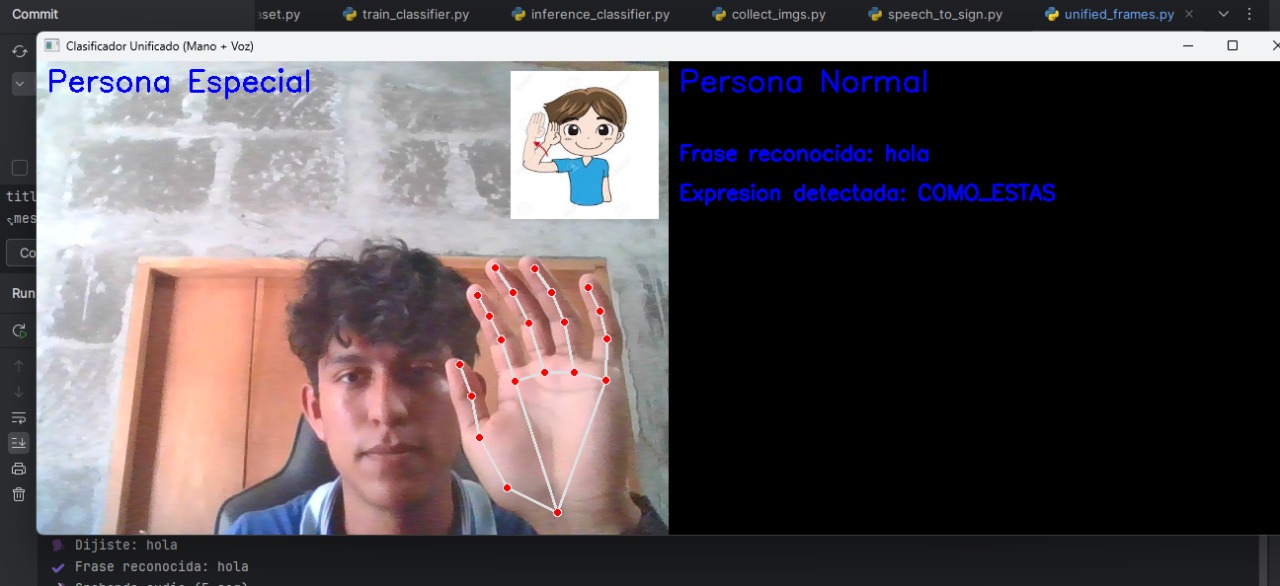
The core of SignBridge relies on a dual-frame video interface:
Frame 1 (Special User): This side focuses on real-time ASL detection. Using the power of OpenCV and MediaPipe, the system meticulously tracks hand movements and recognizes gestures. It then interprets these signs (whether individual letters, numbers, or full phrases) and displays the translated message in the other user's frame.
Frame 2 (Normal User): Here, speech recognition is employed to convert spoken language into text. This text is then translated into a corresponding ASL image or animation, providing a visual interpretation for the deaf/hard-of-hearing user.
All of this is underpinned by a robust deep learning model, meticulously trained on a public Kaggle ASL dataset. This training ensures accurate recognition of the full ASL alphabet, common numbers, and essential phrases, forming the backbone of our translation capabilities. We've also developed a backend REST API to ensure cross-platform compatibility, currently building both web and mobile applications, with future plans for direct integration into major communication tools like Zoom, Google Meet, and Microsoft Teams.
How we built it
This project has been a profound learning experience. I delved deep into the nuances of real-time computer vision and deep learning for gesture recognition, pushing the boundaries of what I thought was possible. Understanding the intricacies of ASL, not just as a set of signs but as a rich, expressive language, was crucial. I learned the importance of user-centric design, realizing that technology must truly meet the needs of its users to be effective. Iterative development, constantly refining the models and interface based on testing and feedback, became a cornerstone of our progress.
Challenges we ran into
Building SignBridge hasn't been without its hurdles. One of the primary challenges was achieving consistent and accurate real-time hand tracking and gesture recognition across diverse lighting conditions and user variations. Training the deep learning model to a high degree of accuracy, especially for the subtle differences between certain ASL signs, required significant effort and optimization of our datasets. Integrating these complex AI components into a seamless, low-latency dual-frame interface also presented technical difficulties, demanding careful synchronization between video processing, speech recognition, and translation modules.
Accomplishments that we're proud of
We're incredibly proud of how far SignBridge has come. A major highlight was presenting SignBridge at our university's annual innovation fair. The overwhelming positive feedback and enthusiasm from attendees, including students, faculty, and even some members of the deaf community, demonstrated the clear need and potential impact of our solution. This presentation was a resounding success, validating our efforts and fueling our determination. Seeing direct user interaction with the prototype and witnessing the "aha!" moments was truly rewarding.
Beyond the fair, we're proud of achieving:
Real-time, bidirectional translation between ASL and spoken English.
The development of a scalable backend REST API for future platform integrations.
Successful implementation of MediaPipe + OpenCV for robust hand sign detection.
Training a deep learning model capable of recognizing the full ASL alphabet, numbers, and basic phrases.
What we learned
This project has been a profound learning experience. I delved deep into the nuances of real-time computer vision and deep learning for gesture recognition, pushing the boundaries of what I thought was possible. Understanding the intricacies of ASL, not just as a set of signs but as a rich, expressive language, was crucial. I learned the immense importance of user-centric design, realizing that technology must truly meet the needs of its users to be effective. Iterative development, constantly refining the models and interface based on testing and feedback, became a cornerstone of our progress. The success at the university fair also taught us the power of direct engagement and showcasing tangible solutions to a broader audience.
What's next for SignBridge
Our vision for SignBridge extends far beyond the current prototype. We are actively working on:
Developing beta versions of our web and mobile applications for broader testing and feedback.
Exploring deeper integration with major communication platforms like Zoom, Google Meet, and Microsoft Teams.
Expanding our deep learning model's vocabulary to include more complex ASL phrases and regional variations.
Investigating features like gesture training and multilingual support to further enhance accessibility.
Seeking collaborations and partnerships to scale our impact and bring SignBridge to as many users as possible.

Log in or sign up for Devpost to join the conversation.