-
-
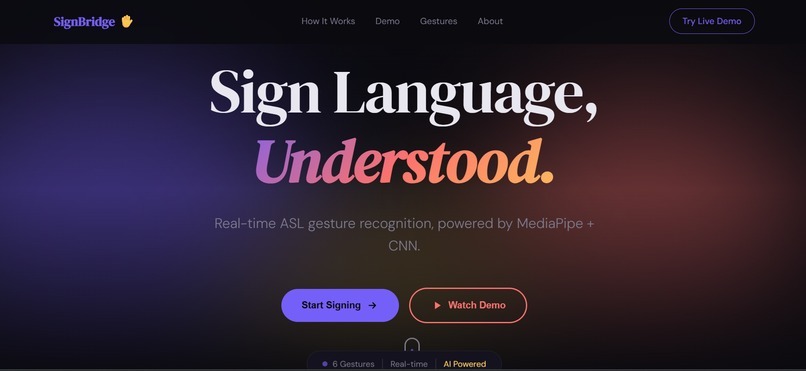
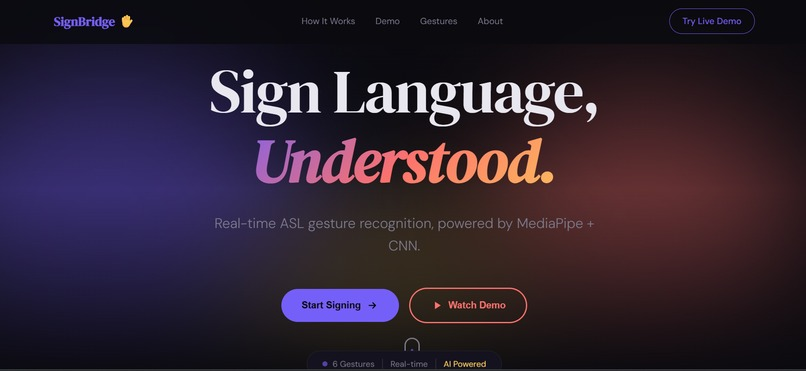
front page
-
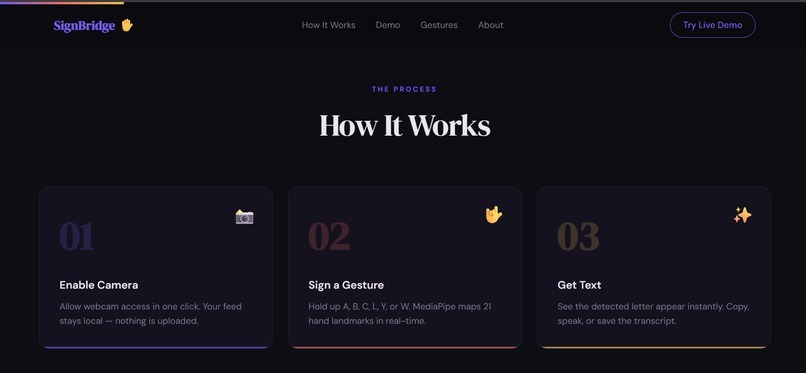
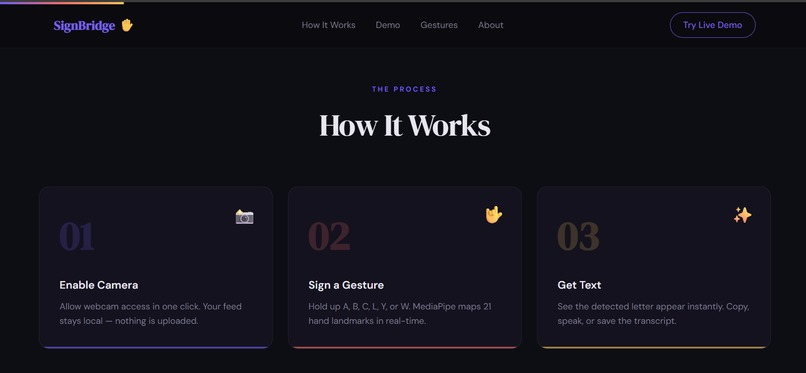
how it works
-
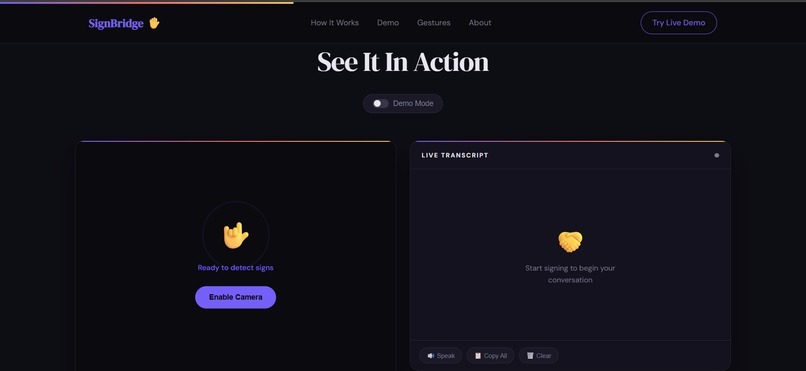
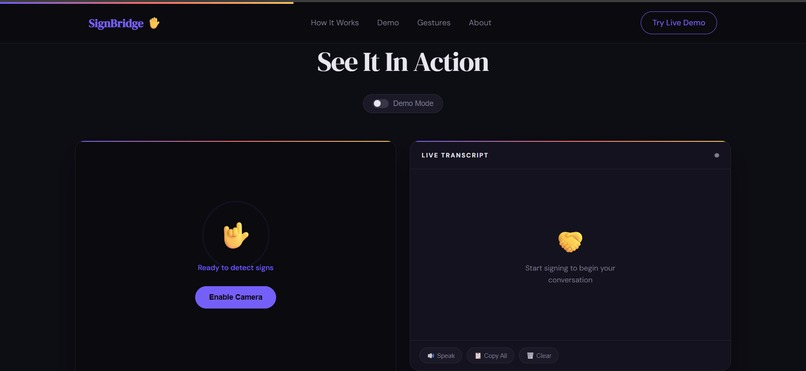
see it in action
-
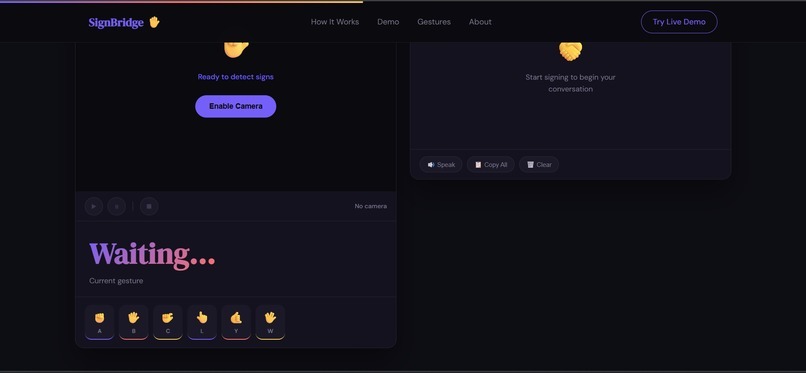
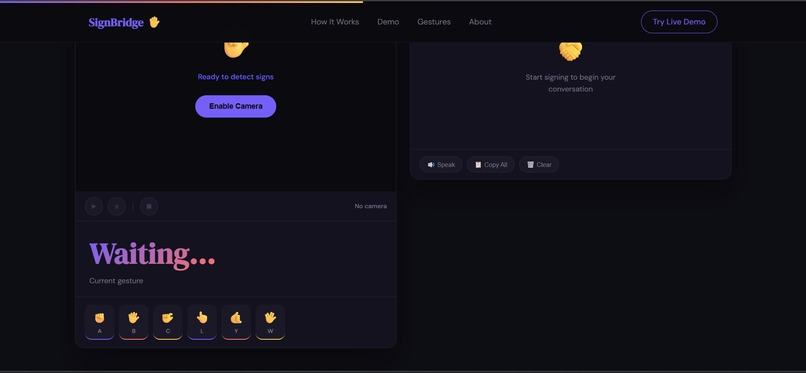
continuation
-
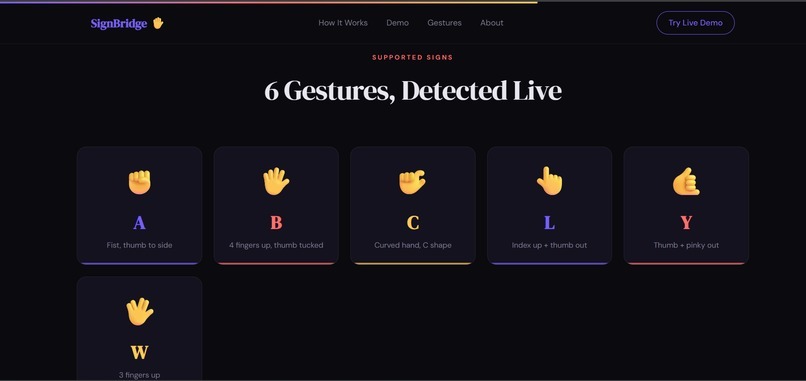
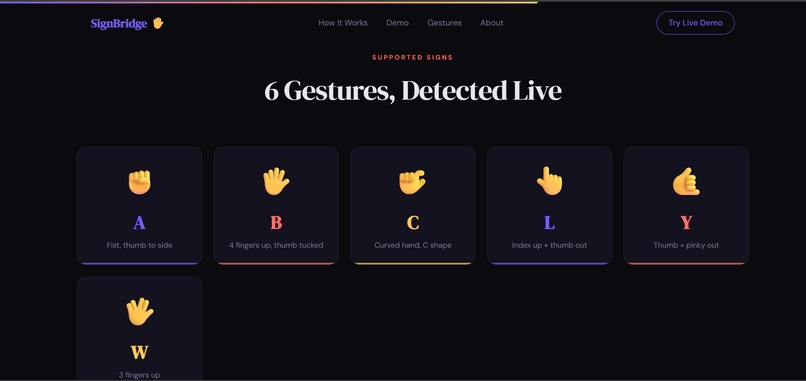
6 gestures
-
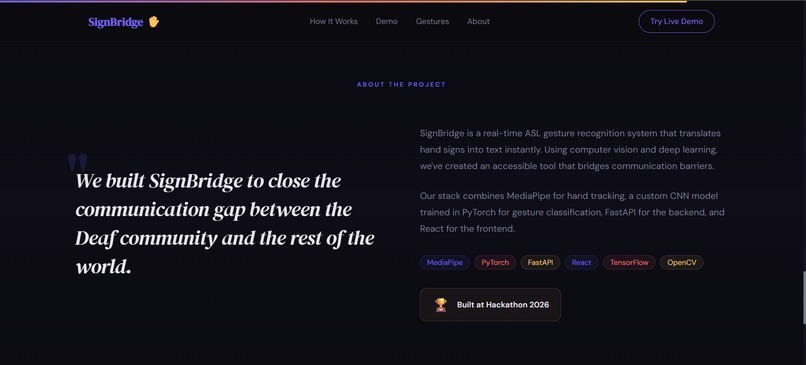
about the project
-
end of page and footer
Inspiration
Over 70 million people worldwide use sign language as their primary form of communication, yet most hearing people can't understand a single sign. This creates an invisible wall in everyday interactions — at hospitals, schools, and stores. We built SignBridge to start tearing that wall down.
What It Does
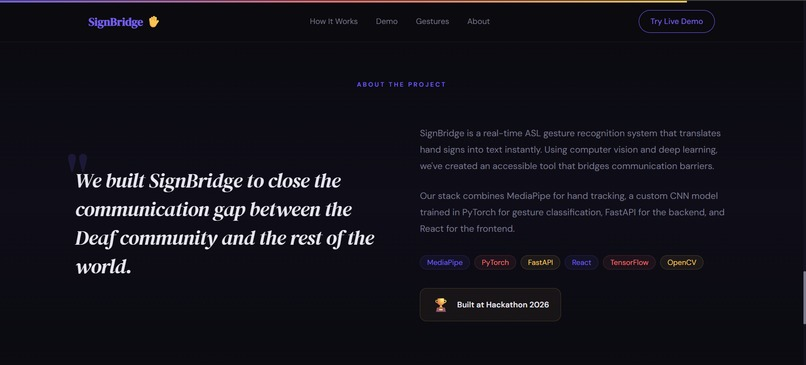
SignBridge is a real-time ASL gesture recognition web app. Open it in your browser, enable your webcam, and start signing. The app instantly translates your hand gestures into text displayed as a live chat transcript. It currently supports 6 ASL letters: A, B, C, L, W, and Y, with text-to-speech output so hearing people can also hear what's being signed.
How We Built It
- Frontend: React + Framer Motion for animations, all in a single HTML file
- Backend: FastAPI (Python) serving a REST
/predictendpoint - AI Pipeline: Every second, the browser captures a webcam frame and POSTs it to the backend. MediaPipe Hand Landmarker detects 21 precise hand landmarks, which are then classified using finger position rules
- CNN Model: A custom PyTorch CNN trained on the Sign Language MNIST dataset (27,455 training images) achieving about 90% test accuracy
Challenges We Faced
- Camera conflict: The browser and Python can't share the webcam simultaneously. We solved this by having the frontend capture frames and POST them to the backend as images — Python never touches the camera directly.
- Real-world accuracy: Models trained on clean dataset images don't generalize to messy webcam footage. MediaPipe's landmark-based approach solved this by working regardless of lighting or background.
- Python 3.14 compatibility: Several libraries had silent failures requiring significant debugging.
What We Learned
- How to build a full ML pipeline from dataset → training → deployed API
- The gap between academic model accuracy and real-world performance
- How MediaPipe hand landmark detection works under the hood
- How to architect a real-time video processing pipeline
What's Next
- Full ASL alphabet support
- Word and sentence-level prediction using LLMs
- Mobile support
- Two-way communication (text-to-sign animation) ```
3. Built With:
Python, JavaScript, HTML, CSS, PyTorch, FastAPI, MediaPipe,
React, Framer Motion, OpenCV, NumPy, Pandas, Uvicorn,
Sign Language MNIST Dataset


Log in or sign up for Devpost to join the conversation.