-
-
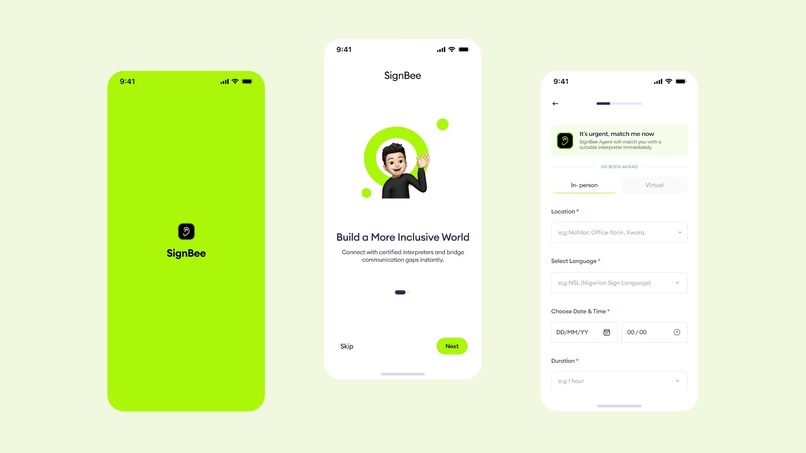
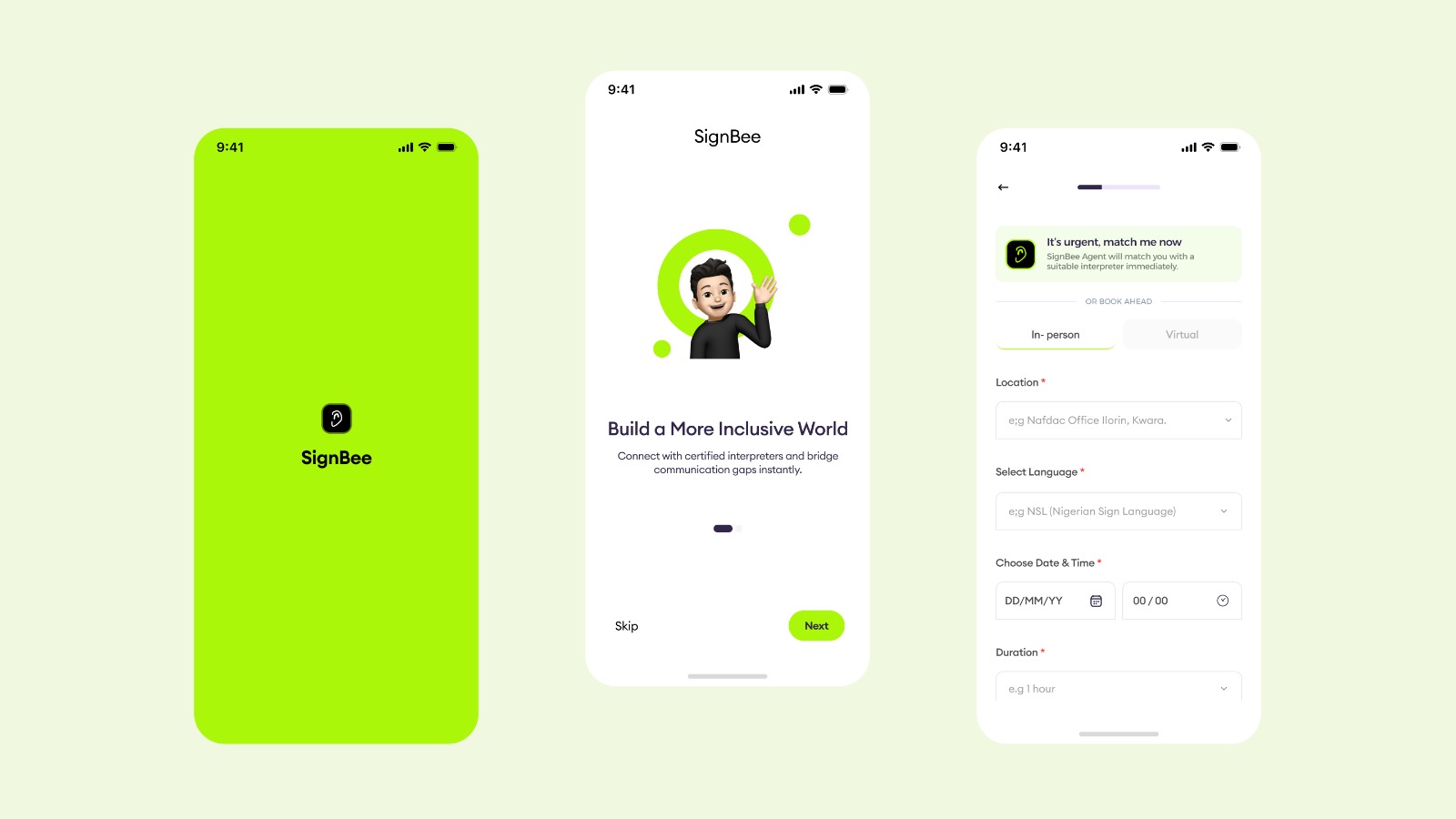
SignBee Agent flow
-
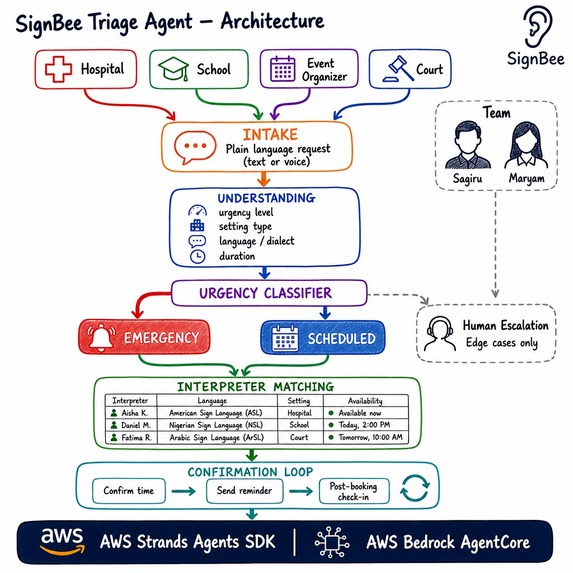
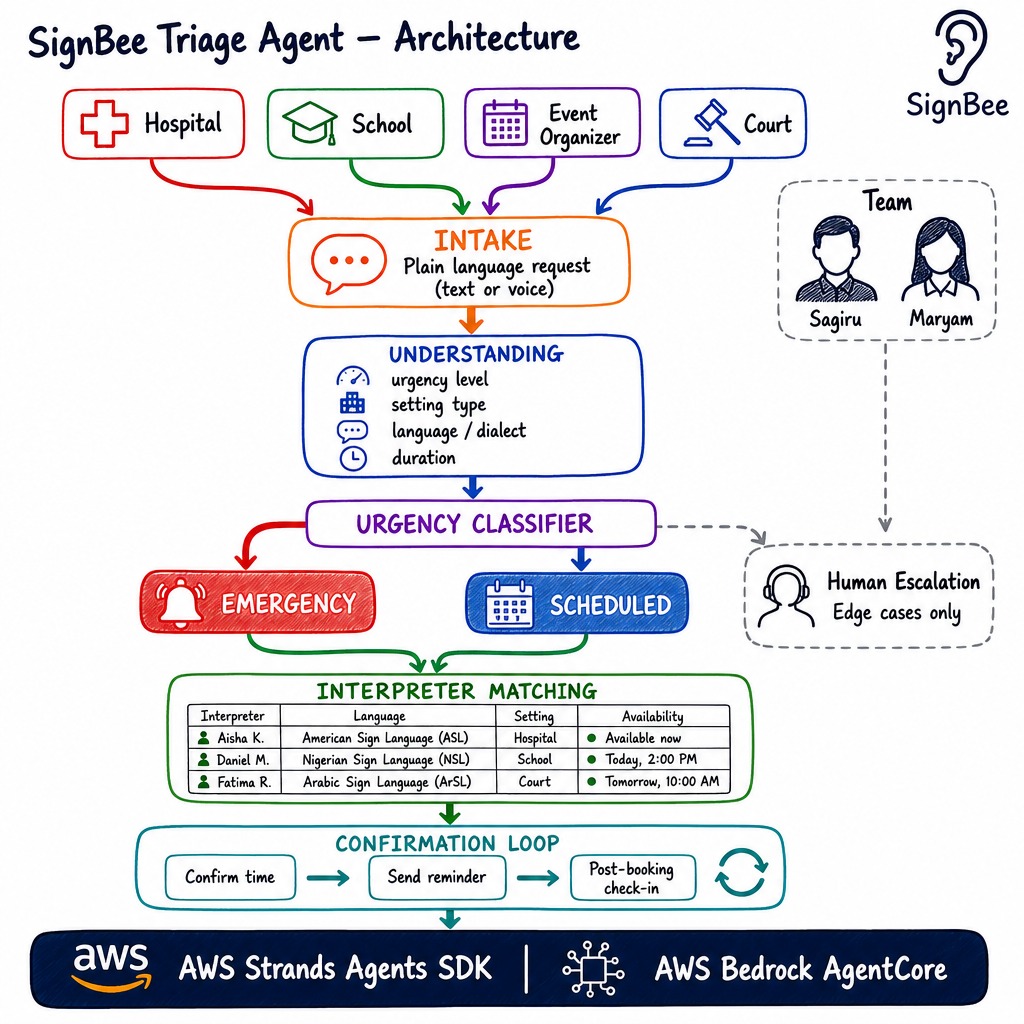
Architectural Diagram
Inspiration
Sign language interpreter access in Nigeria is inconsistent and slow to arrange. Institutions like hospitals, schools, courts, and event organizers often don't know what to ask for, how urgent their need is, or which interpreter is qualified for their context, and that triage work is entirely manual today. As the founder of SignBee, a platform designed to make interpreter booking accessible across Nigeria, I've seen this gap firsthand. This hackathon was the chance to build SignBee's first working piece of technology: an agent that handles the routine triage work quietly in the background, so Deaf individuals and the institutions serving them get matched with the right interpreter faster, especially when it's urgent.
What it does
SignBee's Triage Agent takes an interpreter request in plain language and extracts the key details: urgency, setting (medical, legal, educational, or event), language and dialect needs, and duration. It classifies urgency, distinguishing genuine emergencies from routine scheduled requests, and flags conflicting signals, for example, a requester saying a situation is urgent while describing a context that doesn't typically match that level of urgency, as a judgment call that goes to a human instead of being decided automatically. The agent matches the request against interpreter availability and proposes a shortlist, then handles routine confirmation and follow-up on its own. When it does escalate to a human, it shows its confidence score and reasoning on screen, so the decision is transparent rather than a black box.
How we built it
We built the agent using AWS's Strands Agents SDK for the core reasoning and decision loop, with Amazon Bedrock powering the language understanding and classification layer. We started narrow: getting one full workflow, intake through urgency classification, working end-to-end before adding anything else. Once that loop was solid, we layered in the matching logic against a mock interpreter dataset, then the confirmation and follow-up flow. We deliberately built the escalation logic as explicit, visible rules rather than a hidden model decision, so both our team and the judges could see exactly why the agent chose to act or hand off to a human.
Challenges we ran into
Defining "urgent" turned out to be harder than expected. Requesters don't always describe urgency consistently, so we had to design for conflicting signals, where the stated urgency doesn't match the described context, as a first-class case rather than an edge case. Balancing confidence thresholds was another challenge: too cautious, and the agent escalates everything, defeating the purpose; too confident, and it risks making judgment calls it shouldn't. Working within a compressed six-week window as a first-time build for SignBee also meant constantly choosing depth over breadth, keeping the demo scope tight so the core loop actually worked cleanly end-to-end.
Accomplishments that we're proud of
We're proud that this is SignBee's actual first working prototype, not a mockup, but real functioning technology behind a problem we've been designing for. We're especially proud of the escalation logic: building an agent that doesn't just pattern-match keywords, but reasons about mismatches between what's said and what's described, and shows that reasoning transparently rather than asking anyone to take it on faith.
What we learned
We learned how much of good agent design is really about knowing when not to act autonomously. The most valuable part of this build wasn't the automation itself, it was defining, explicitly and visibly, where human judgment still has to lead. We also learned a lot about scoping a first build realistically: starting with one working end-to-end workflow before expanding gave us something real to iterate on, rather than several half-finished pieces.
What's next for SignBee
This hackathon build becomes the technical foundation SignBee continues to build on. Next steps include expanding beyond the mock interpreter dataset to real interpreter profiles, refining the escalation logic against real-world triage cases, and integrating this agent into SignBee's full booking platform as we move toward pilot programs with institutions across Nigeria.

Log in or sign up for Devpost to join the conversation.