-
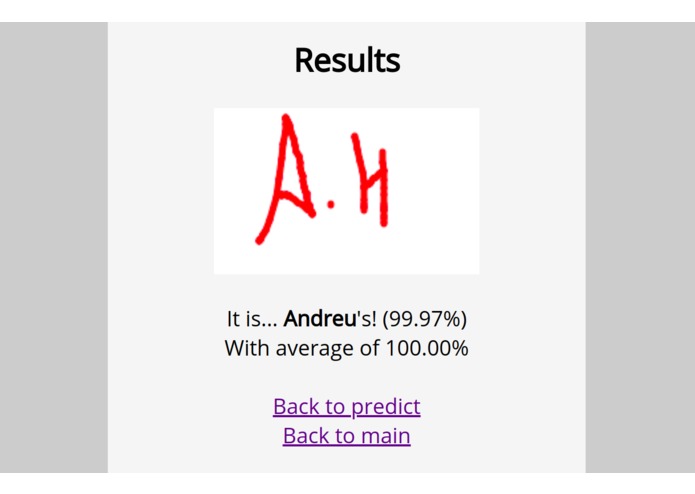
Outstanding accuracy identifying one of our team members' signature

Inspiration
We were wondering why, in the age of technology, signatures aren't easily verified electronically. The alternatives to them, such as digital signatures, aren't going to replace traditional signatures any time soon, so we decided to embrace the old-fashioned way by providing this tool.
What it does
Given a signature, it identifies its author from a group of people who provided sample signatures.
How we built it
We developed a website which acts as an interface for the users, and communicates with a neural network through a Flask API.
Challenges we ran into
- What features do we extract from the user's signature to best represent the person behind it?
- How do we model the way the user draws their signature?
- How do we connect all the pieces together to make for a good user experience?
Accomplishments that we're proud of
- Data extraction technique
- Time series + 2D convolution model
- Early good results on validation data show potential for our method
What we learned
- How to work with a team in a challenging, time-constrained environment
- Combining front-end and back-end, with several programming languages
- How to work with local and remote servers
What's next for SignatureVerify
- Obtaining a lot more data
- Refining the model
- Explore potential markets for its applications


Log in or sign up for Devpost to join the conversation.