Inspiration
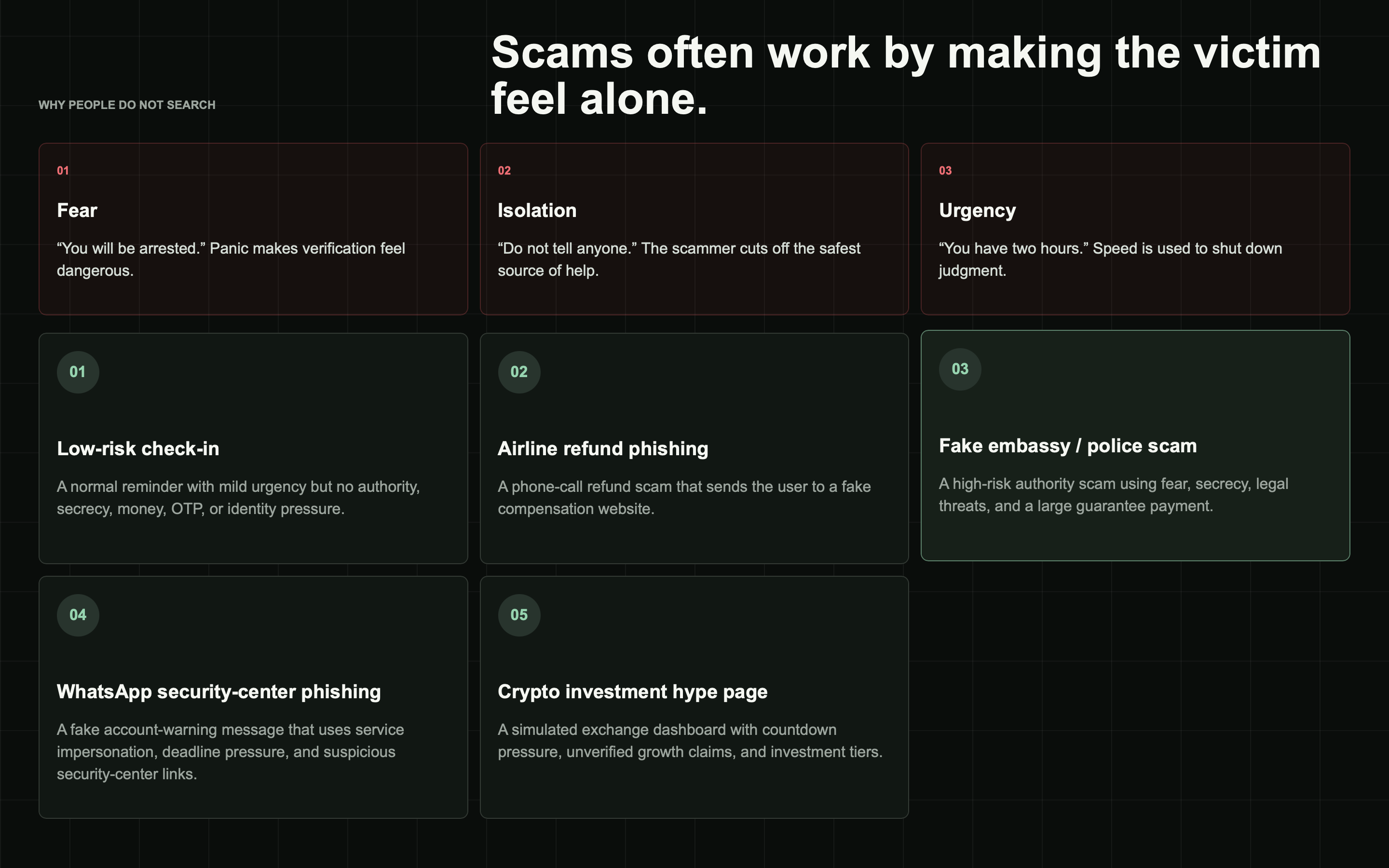
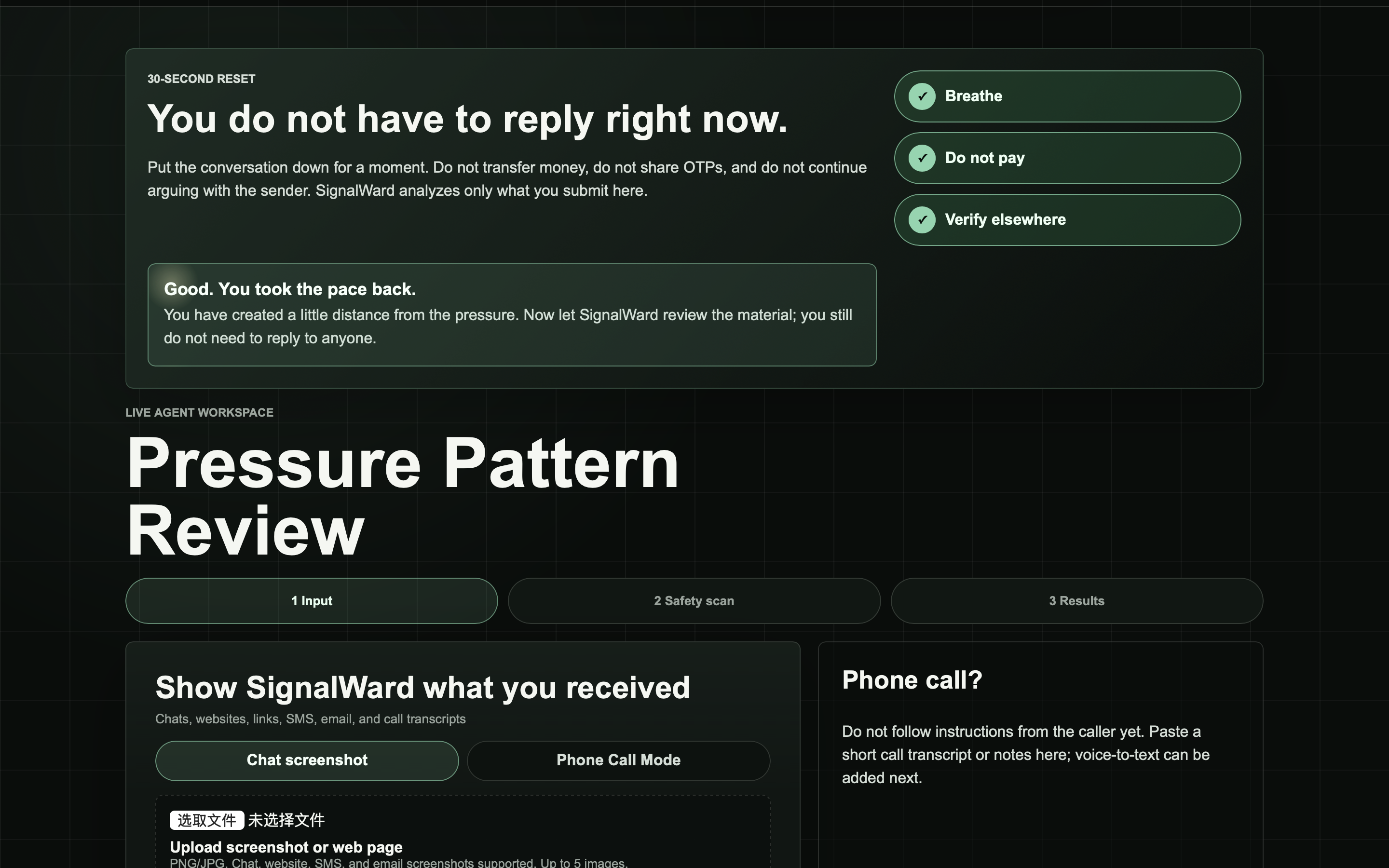
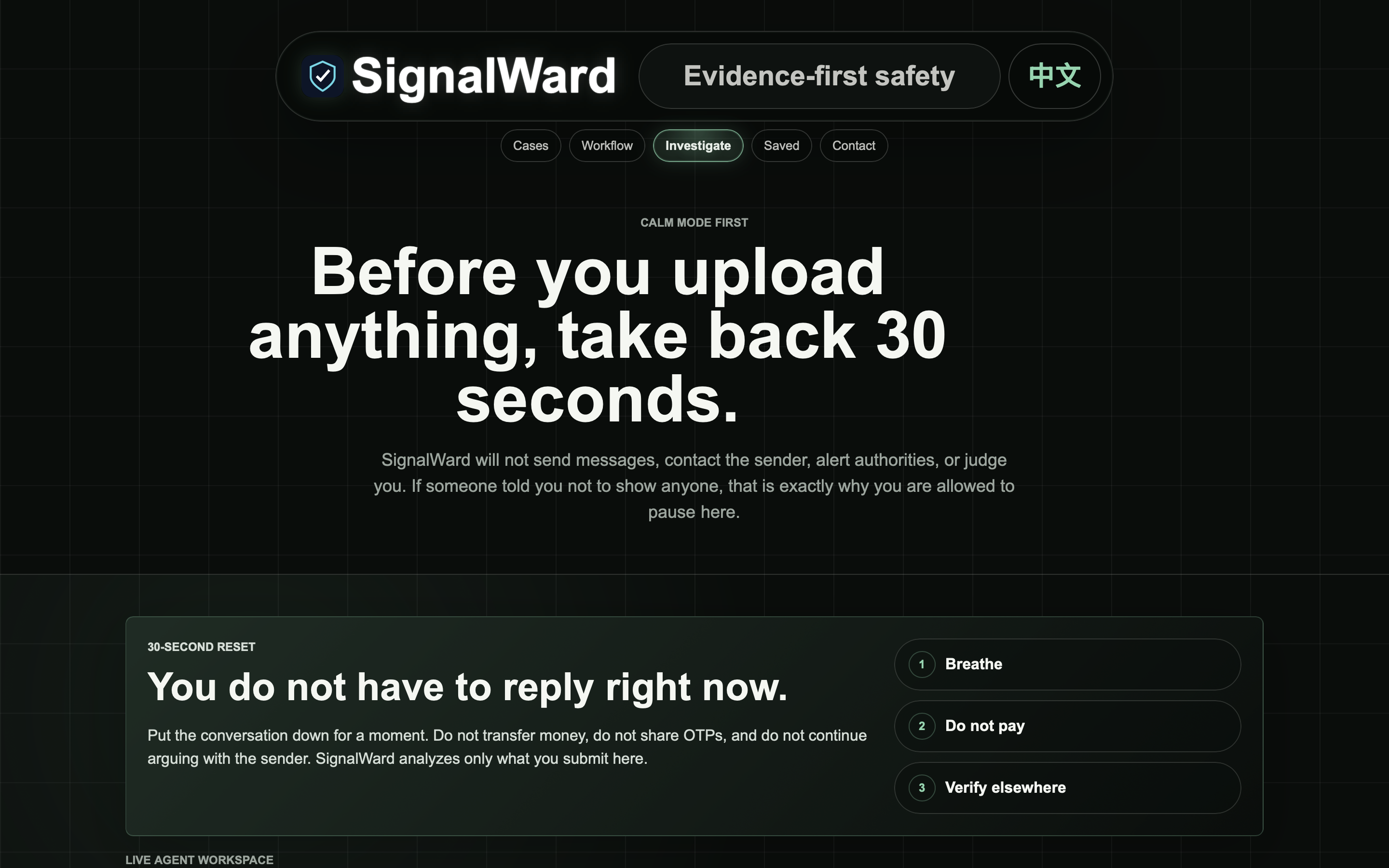
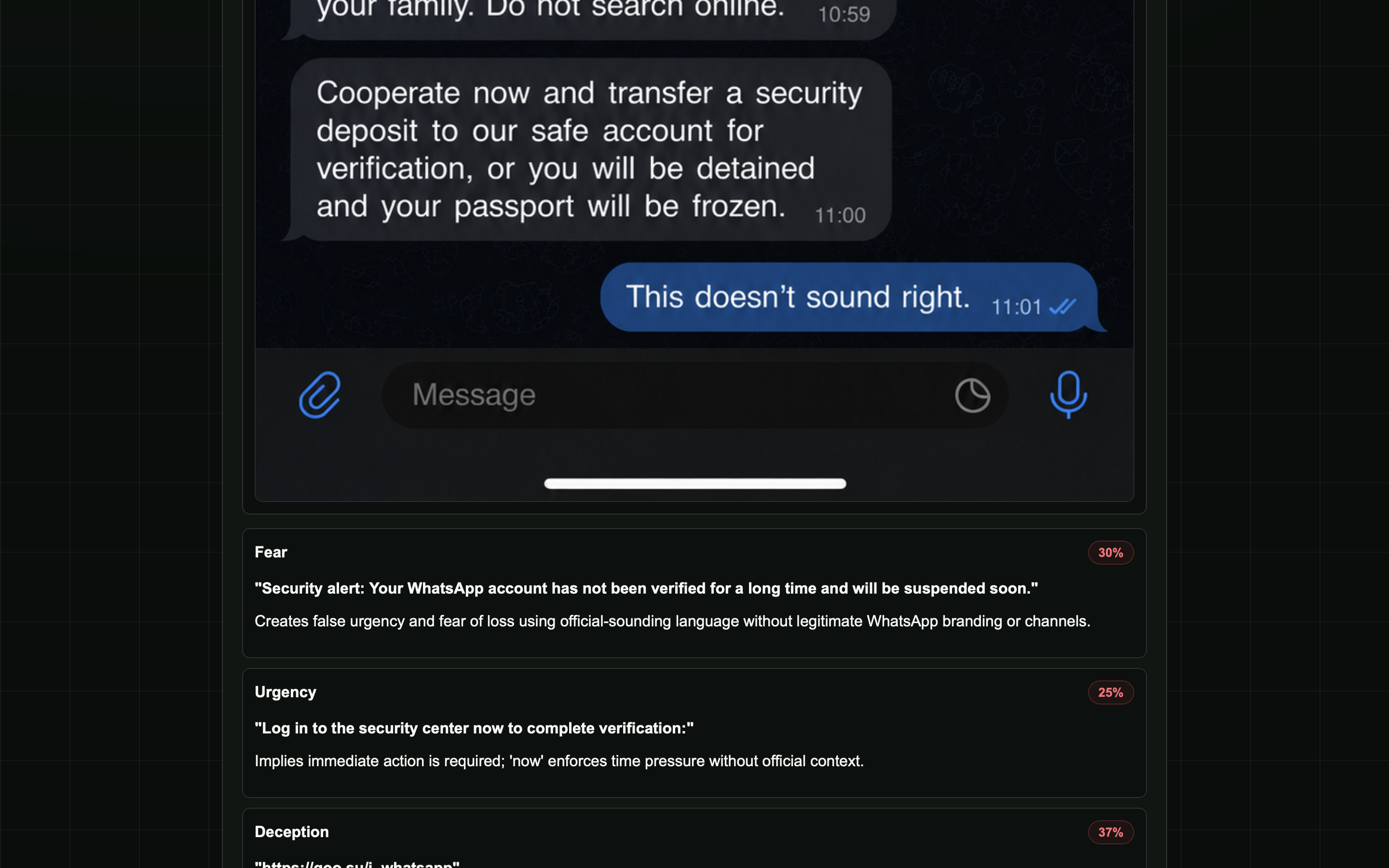
Scams rarely begin with an obvious request for money. They begin by controlling how a person thinks:
“Do not tell anyone.”
“You have two hours.”
“You will be arrested.”
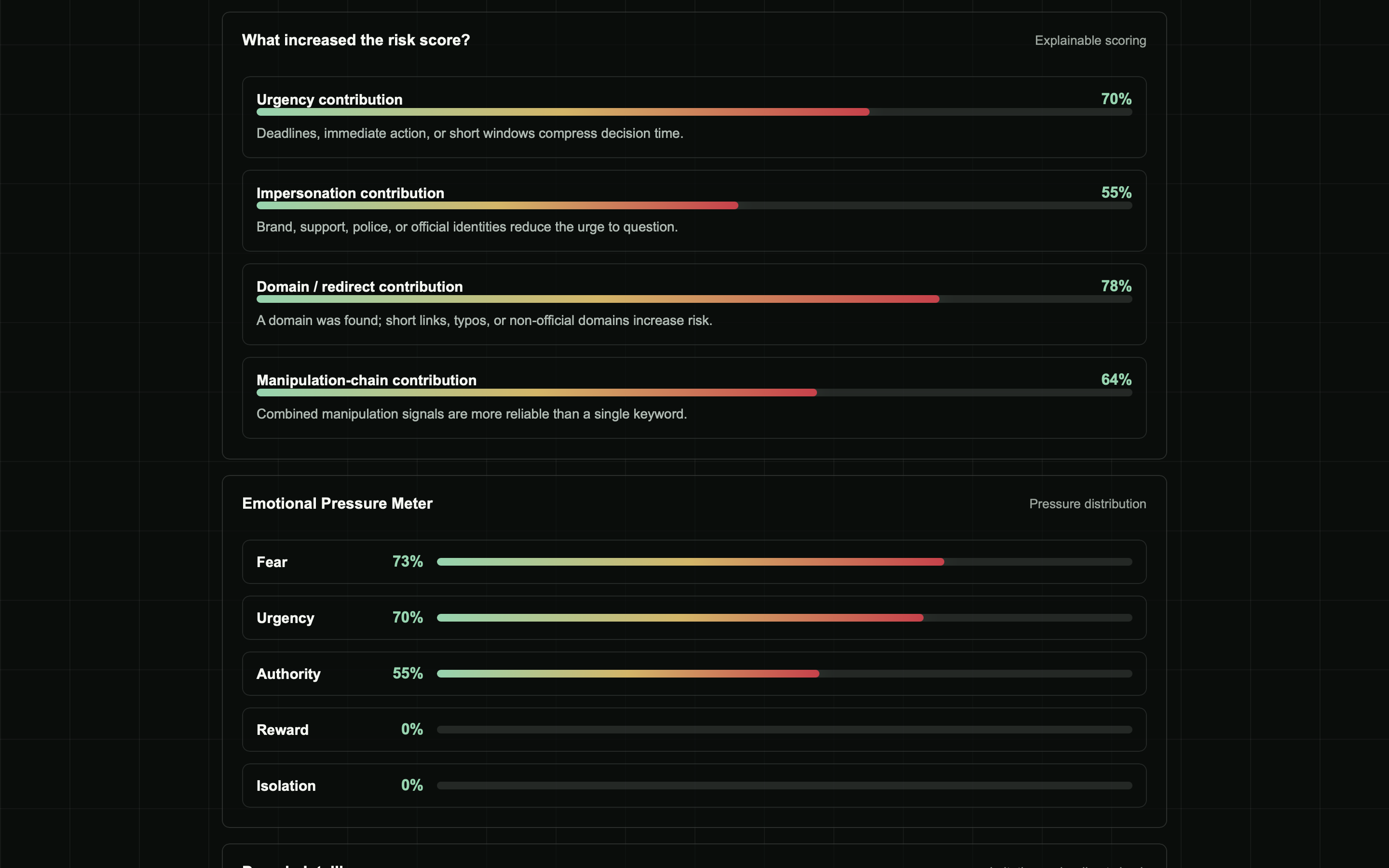
Fear, urgency, authority, and isolation make independent verification feel dangerous.
Most scam detectors return a single label or confidence score. But a confident AI answer can create a second problem: users may trust the model without understanding what was actually verified.
We built SignalWard around a different principle:
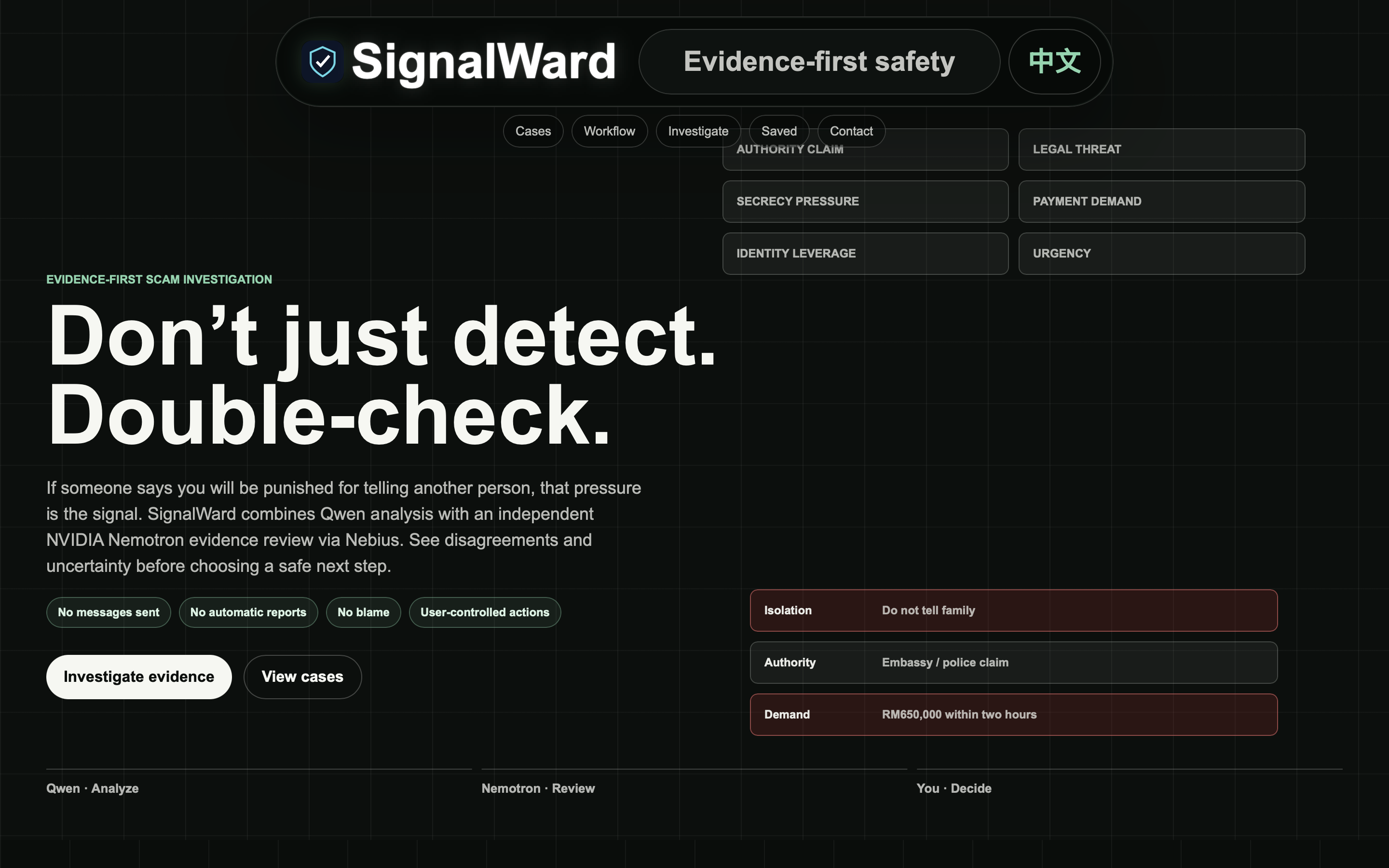
Don’t just detect. Double-check.
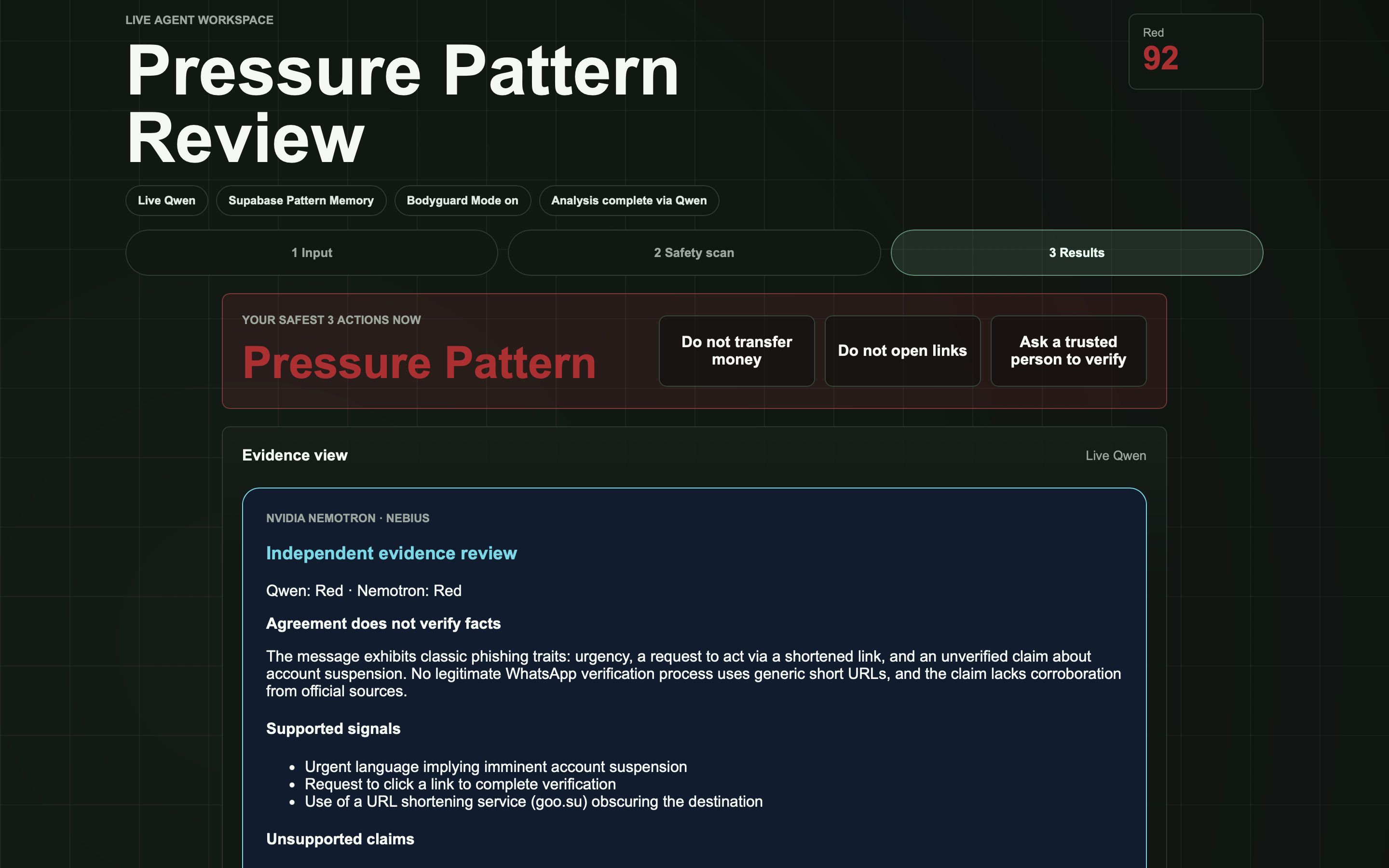
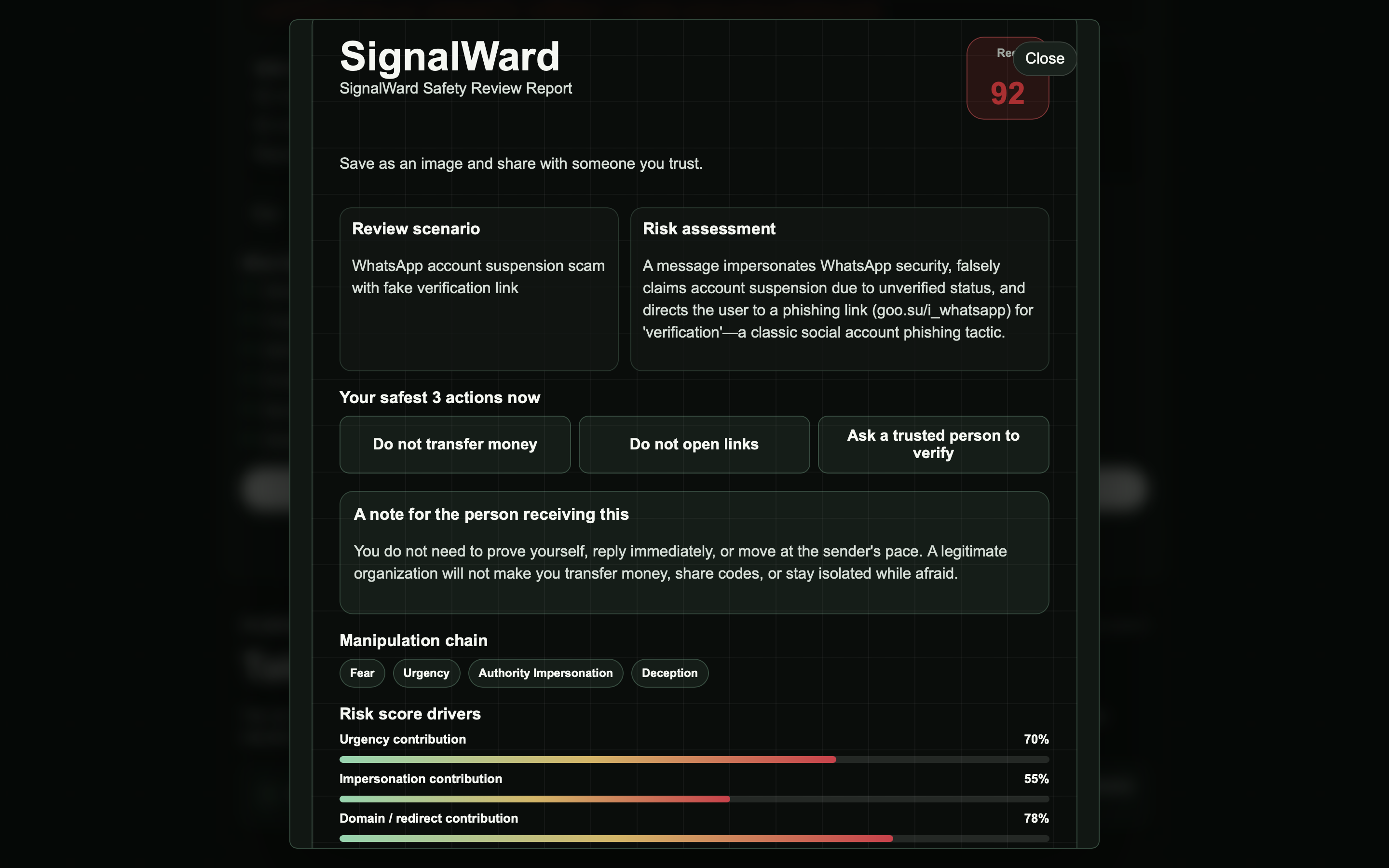
SignalWard helps people pause, inspect the evidence, see where two AI models agree or disagree, and choose a safer next step—without automatically contacting, accusing, or reporting anyone.
What it does
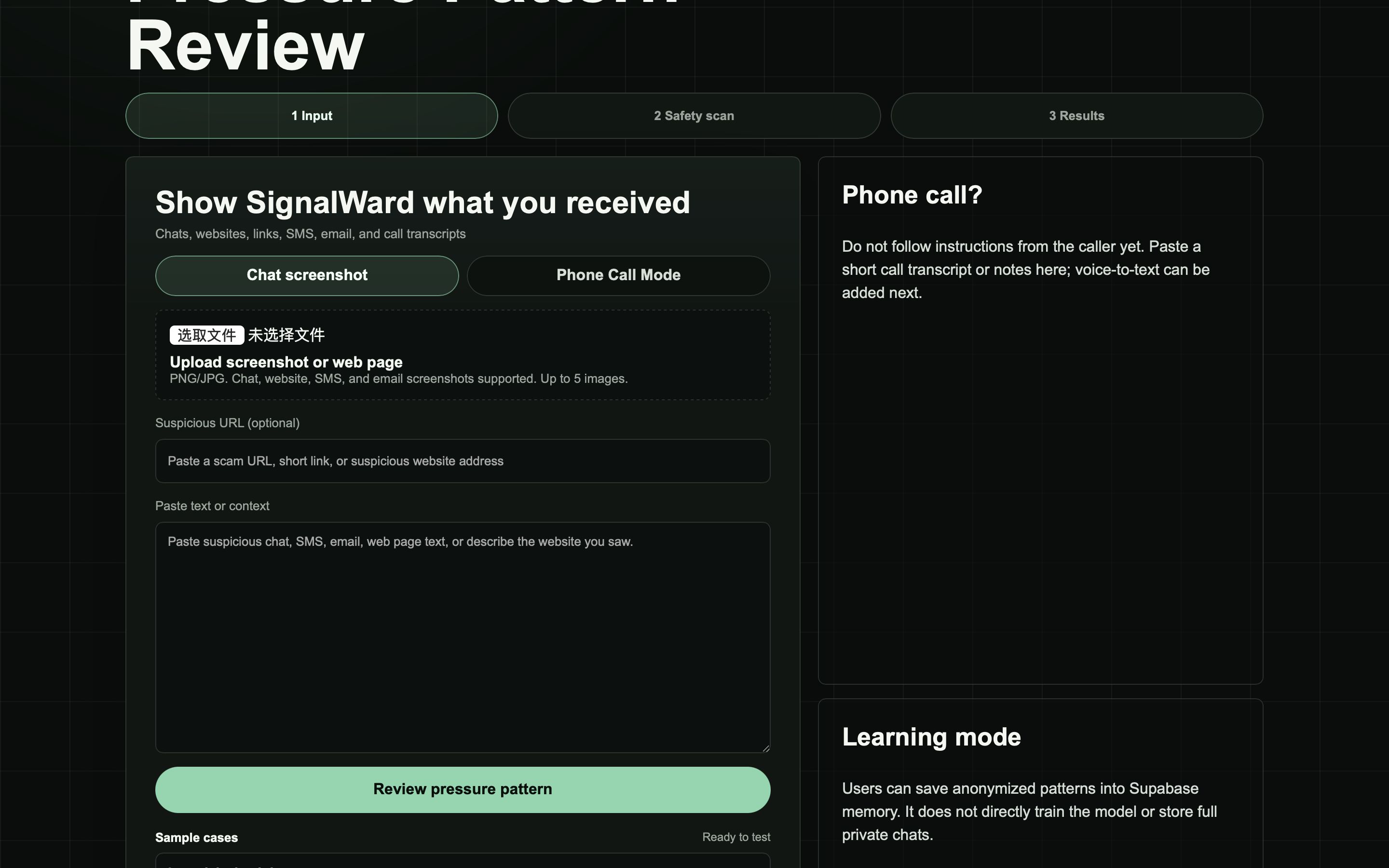
SignalWard accepts:
- Suspicious messages
- Call transcripts
- URLs provided as text
- Screenshots of conversations, websites, account warnings, or payment requests
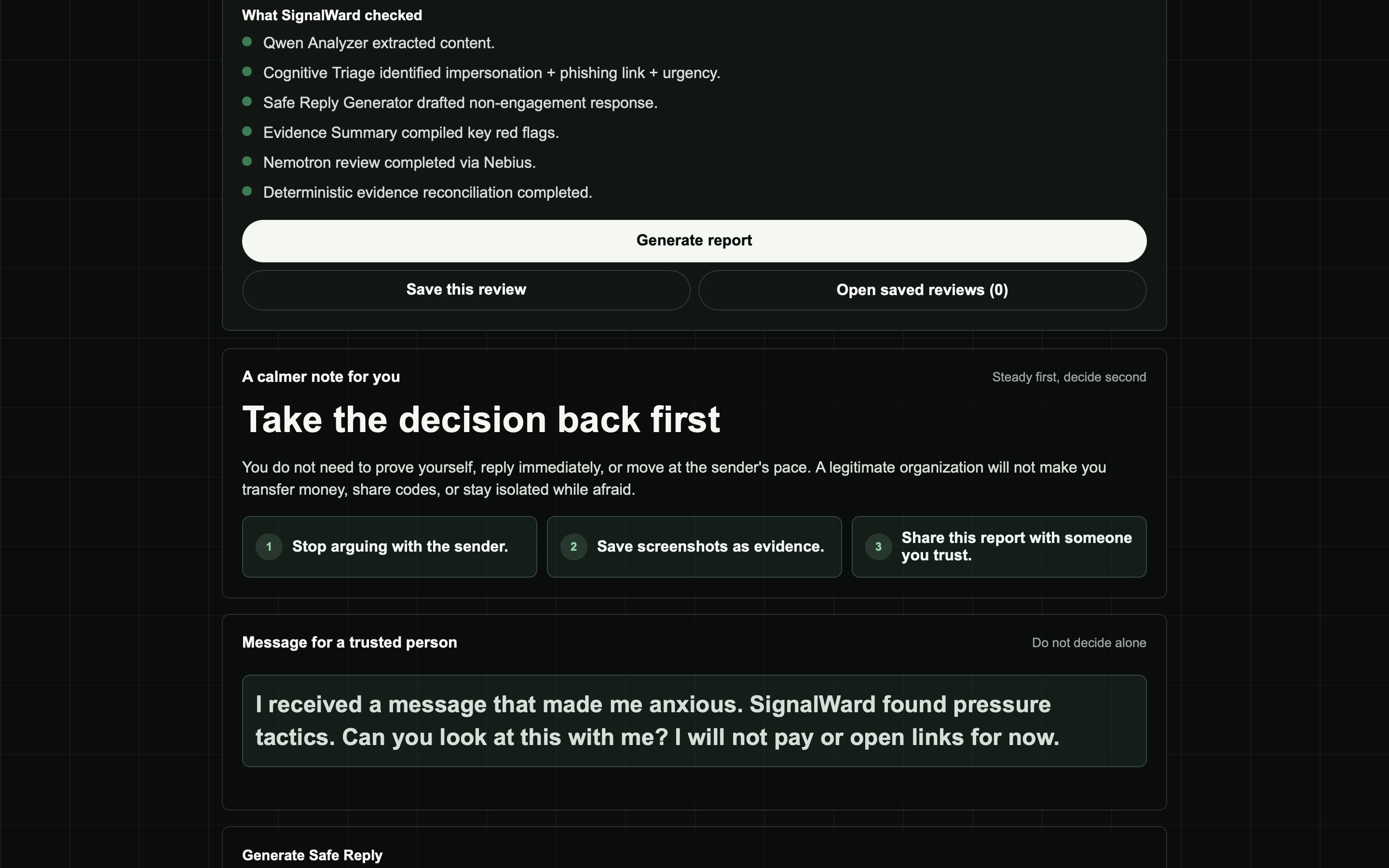
The evidence passes through a deliberately separated review pipeline:
- Qwen
qwen3-vl-plusperforms the primary multimodal analysis. It extracts visible text, identifies manipulation signals, creates an evidence timeline, and proposes a calibrated risk level. - NVIDIA Nemotron-3 Super 120B A12B, served through Nebius Token Factory, independently reviews the original text and extracted evidence.
- Nemotron does not receive Qwen’s final risk label or numerical score. This reduces anchoring and makes disagreement meaningful.
- A deterministic TypeScript coordinator compares both judgments and displays agreement, disagreement, missing information, and unsupported claims.
- When the models disagree, SignalWard retains the higher caution level instead of silently averaging the result down.
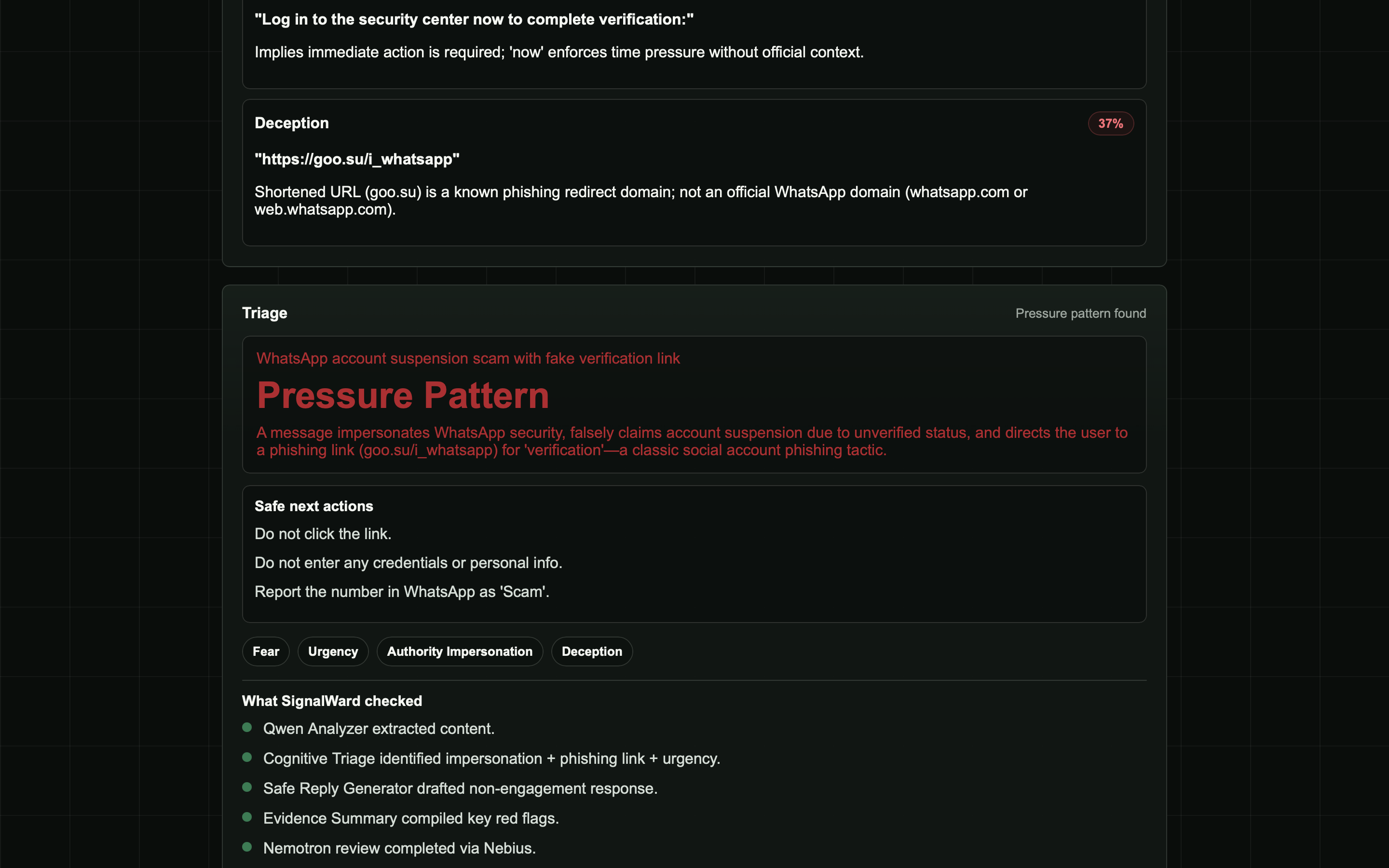
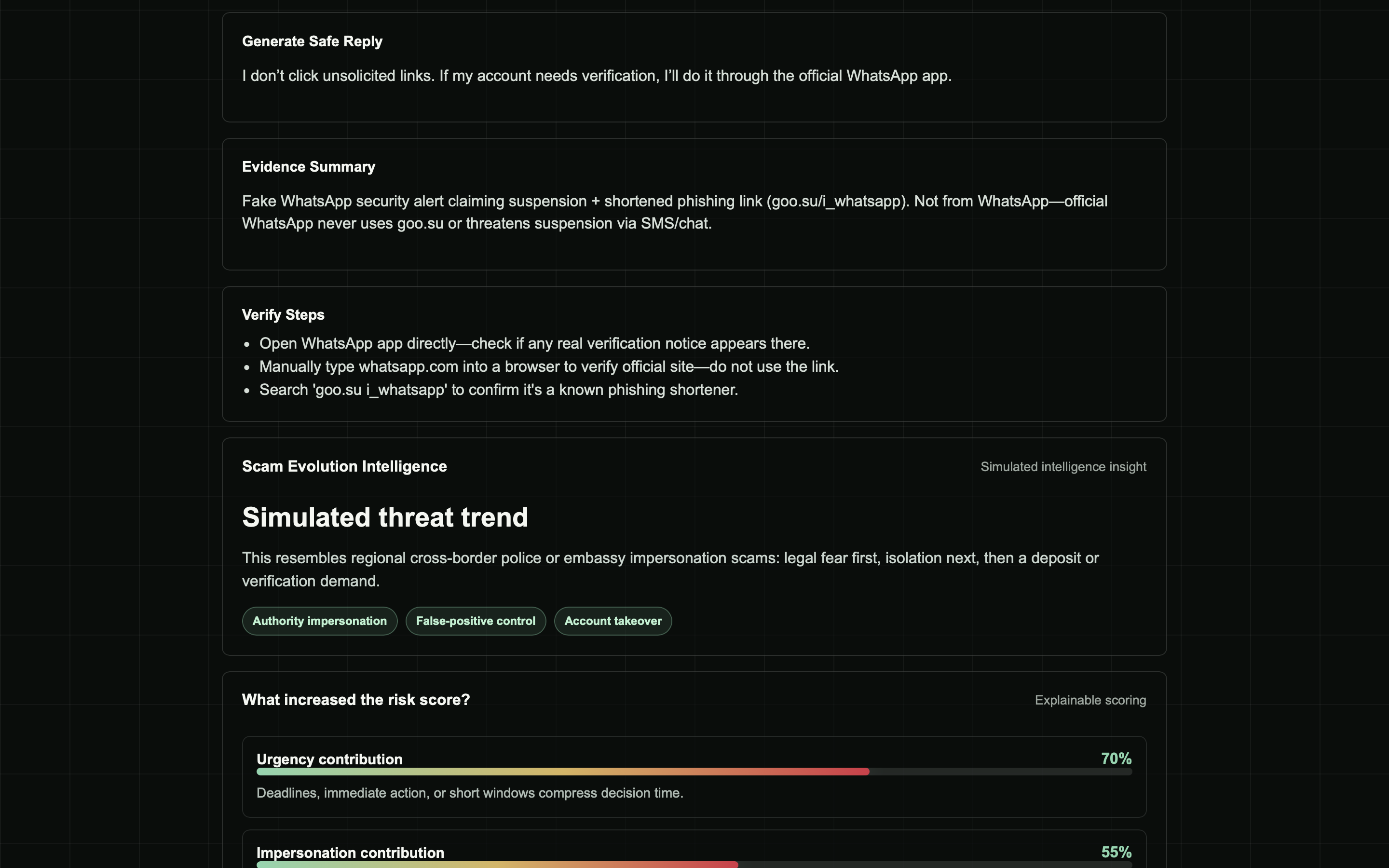
- The user receives concrete verification steps, a safe reply, an evidence summary, and fully user-controlled actions.
SignalWard never opens suspicious URLs, sends messages, files reports, or claims that an identity or allegation has been verified.
Why two models?
SignalWard is not a simple voting ensemble.
Each model has a distinct responsibility:
- Qwen is the primary multimodal evidence extractor.
- Nemotron is a skeptical reviewer that searches for unsupported claims, missing context, alternative explanations, and possible false positives.
- Application code, rather than another model, performs final reconciliation.
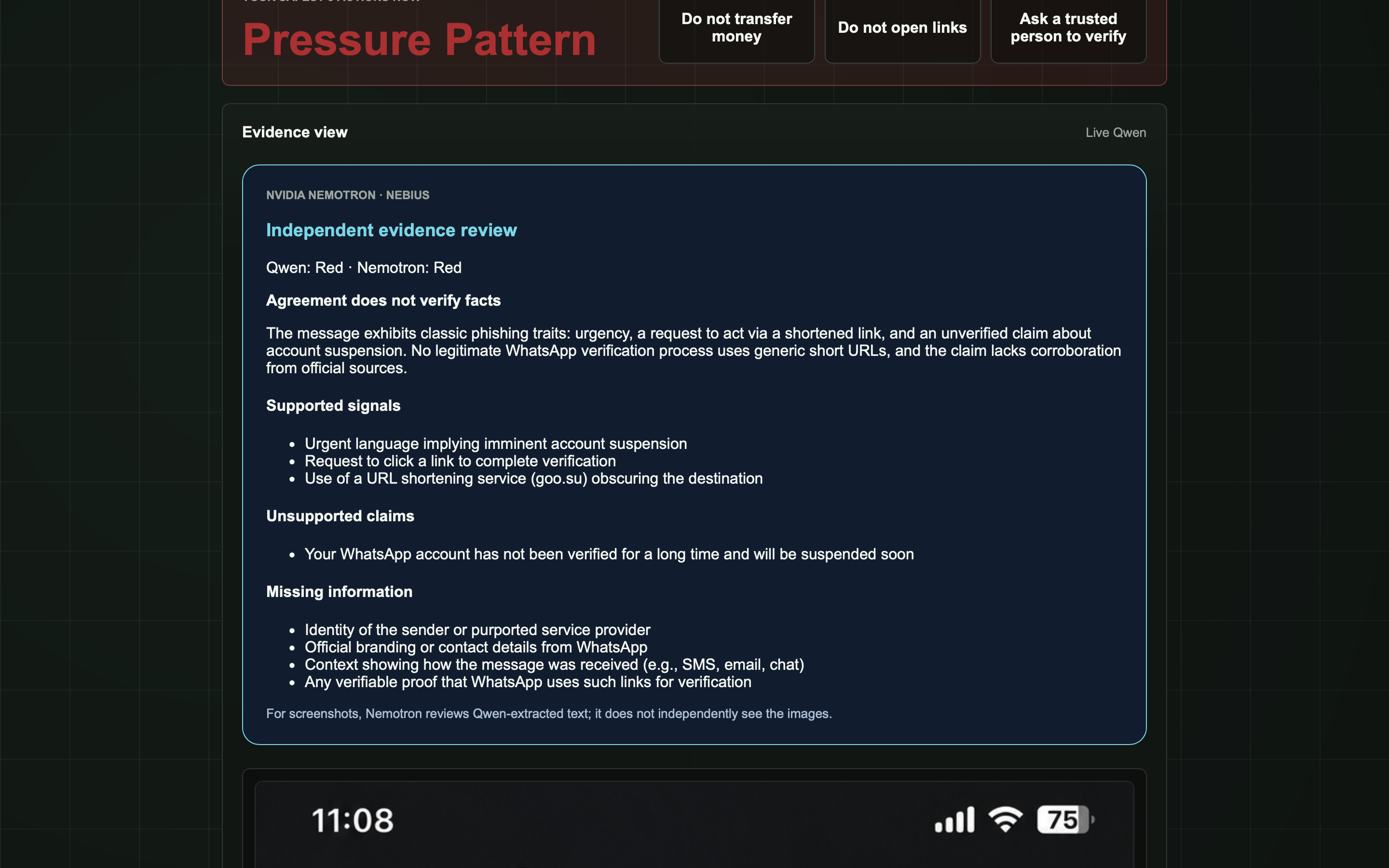
The independent-review panel clearly separates:
- Supported signals
- Unsupported claims
- Missing information
- Recommended verification steps
- Model agreement or disagreement
- Reviewer failure or unavailability
Two models agreeing is still not proof. SignalWard communicates agreement as supporting evidence—not as verification of identity, authenticity, or facts.
For screenshots, Nemotron reviews text and evidence extracted by Qwen. It does not independently see the original image. SignalWard explicitly discloses this shared dependency instead of presenting the result as independent visual verification.
How we built it
SignalWard is built with:
- Next.js 15
- React 19
- TypeScript
- Qwen
qwen3-vl-plus - NVIDIA Nemotron-3 Super 120B A12B
- Nebius Token Factory
- Supabase Postgres
- Vercel
Nebius Token Factory provides the OpenAI-compatible inference endpoint used to run Nemotron as the independent reviewer. This allowed us to integrate a production-scale NVIDIA model without provisioning or maintaining dedicated GPU infrastructure.
The server sends Nemotron only the evidence required for review—not Qwen’s conclusion. Nemotron is instructed to:
- Treat submitted content as untrusted data
- Avoid assuming that identities or claims are genuine
- Identify possible false positives
- Separate supported signals from unsupported claims
- Identify missing information
- Recommend independent verification steps
- Return a strict structured response
All model outputs are validated before reaching the interface. Invalid risk levels, malformed arrays, non-finite scores, and incomplete review objects are rejected.
If Nemotron is unavailable, SignalWard does not insert a fake or cached review. The interface explicitly reports:
Independent review unavailable; primary analysis only.
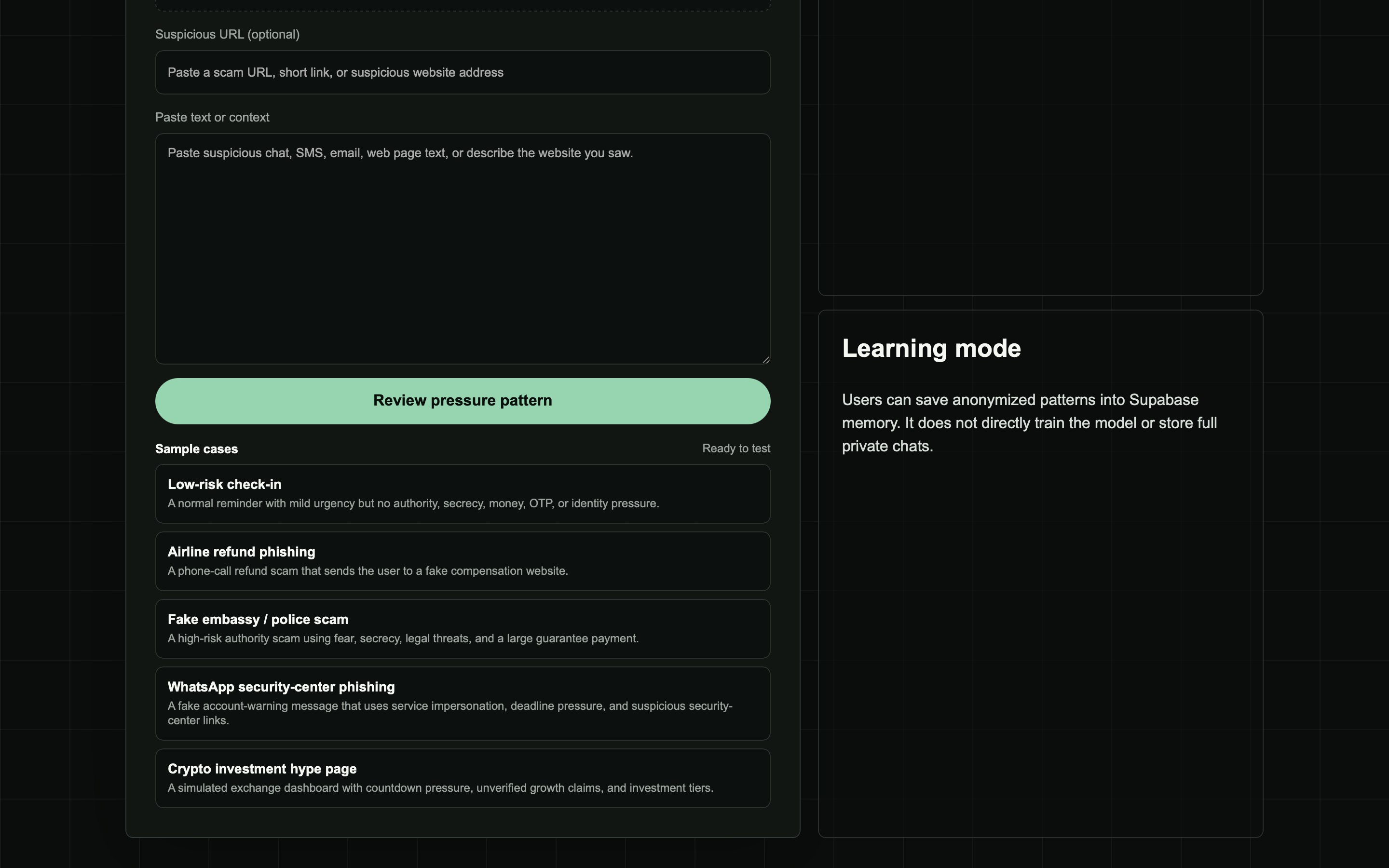
An optional Supabase Pattern Memory stores anonymized scam patterns only after user confirmation. It does not store original screenshots, complete conversations, names, account numbers, or contact information.
What is new
SignalWard evolves from our earlier open-source project, LUCID, which was previously submitted to the Google Cloud Rapid Agent Hackathon. We preserve that provenance and the original MIT license.
For the Nebius x NVIDIA Global AI Hackathon, we substantially rebuilt the AI pipeline around Nebius and NVIDIA Nemotron.
New work includes:
- NVIDIA Nemotron integration through Nebius Token Factory
- Blinded independent-review prompts
- Removal of the primary risk score and verdict from reviewer input
- Deterministic higher-caution reconciliation
- Explicit agreement, disagreement, and reviewer-unavailable states
- Strict model-output schema validation
- A dedicated independent-review interface
- Qwen multimodal analysis replacing the earlier Gemini pipeline
- Supabase Postgres Pattern Memory replacing MongoDB
- New SignalWard branding and bilingual workflow
- Reproducible reconciliation and reviewer-blinding tests
- Production deployment with server-side secrets
Challenges we faced
Making the second model meaningfully independent
If Nemotron received Qwen’s final score, it could anchor on the first model’s conclusion. We redesigned the reviewer payload so Nemotron receives the original text and extracted evidence—but not the primary verdict.
Handling screenshots honestly
Qwen can inspect screenshots, while the configured Nemotron endpoint reviews text. Nemotron’s screenshot review therefore depends on evidence extracted by Qwen. We disclose this limitation in both the interface and documentation.
Avoiding false confidence
Two models can agree and still be wrong. We designed SignalWard around evidence and verification steps rather than presenting agreement as proof.
Handling failures safely
A safety product should not silently replace a failed model call with a polished static answer. SignalWard exposes partial failure and clearly distinguishes sample reports from live analysis.
Producing reliable structured output
Model-generated JSON can be incomplete or inconsistent. We added runtime validation, risk-score calibration, bounded inputs, and deterministic reconciliation so malformed output cannot silently become a user-facing safety judgment.
Accomplishments that we are proud of
- Built a real dual-provider, dual-model review pipeline
- Prevented Nemotron from seeing the primary risk verdict
- Made model disagreement visible and actionable
- Added deterministic reconciliation across all 16 combinations of four risk levels
- Ensured high-risk disagreement cannot silently lower the safety recommendation
- Added schema-rejection and risk-score calibration tests
- Kept all provider credentials server-side
- Prevented the application from fetching suspicious URLs
- Designed safe degradation when a provider is unavailable
- Shipped a working public application and open-source repository
Our automated checks cover reconciliation combinations, malformed-output rejection, reviewer blinding, score calibration, and screenshot-dependency disclosure.
These tests validate system behavior—not model accuracy—so we do not present them as an accuracy benchmark.
What we learned
The most important lesson was that an AI safety product should communicate uncertainty rather than hide it.
A second model is valuable not because it automatically makes the first model correct, but because it can challenge unsupported claims, reveal missing evidence, and generate better verification steps.
We also learned that independent review is an architectural property—not simply a second API call.
Risk handling, provider failures, validation, and final reconciliation should not depend entirely on another probabilistic model.
Finally, the most useful recommendation is often not:
“This is definitely a scam.”
It is something concrete and reversible:
- Contact the organization through an independently sourced number
- Do not use the link or phone number in the suspicious message
- Ask a trusted person to review the evidence
- Pause before making a payment or sharing an OTP
- Verify urgent claims through a separate communication channel
What’s next
Next, we plan to:
- Run and document a larger live evaluation across ordinary, explicit-scam, and ambiguous cases
- Record false positives, missed warnings, unsupported claims, and model disagreements
- Improve multilingual coverage for Southeast Asian scam patterns
- Add privacy-preserving export for trusted-person review
- Explore direct multimodal review by an NVIDIA model
- Add latency and model-version observability
- Calibrate recommendations through user research
- Expand Pattern Memory using reviewed, anonymized scam evidence
SignalWard is not intended to replace law enforcement, banks, platforms, or human judgment.
It is designed to create one crucial moment of distance between manipulation and action.
Try SignalWard
- Live demo: https://signalward-ai.vercel.app
- Source code: https://github.com/Kokaro233/signalward-ai
Built With
- ai
- artificial
- cybersecurity
- detection
- factory
- fraud
- generative
- intelligence
- multimodal
- nebius
- nemotron
- next.js
- nvidia
- openai-compatible
- postgresql
- prevention
- qwen
- react
- safety
- scam
- supabase
- token
- typescript
- vercel

Log in or sign up for Devpost to join the conversation.