-
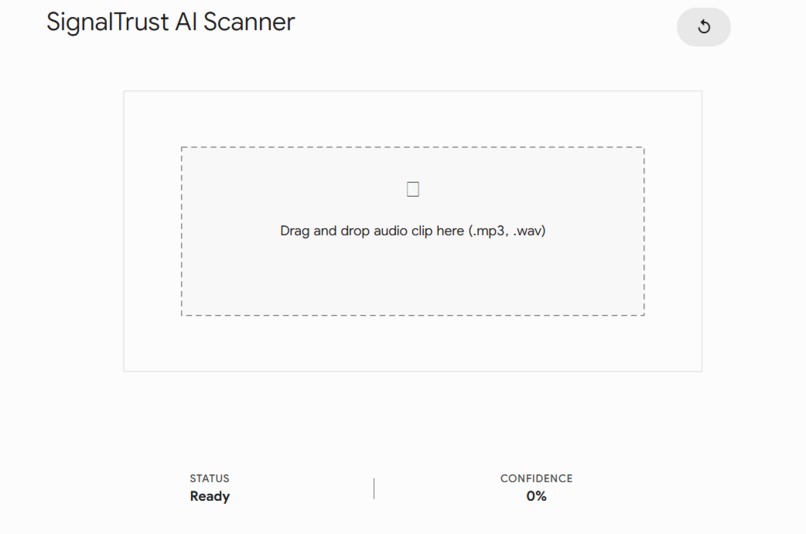
"SignalTrust AI Scanner: Empowering users to instantly verify audio authenticity with a clean, user-friendly interface."
-
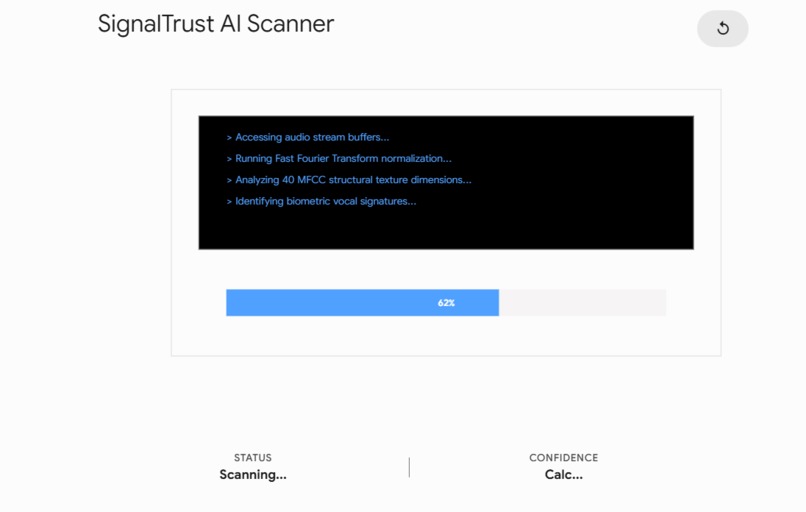
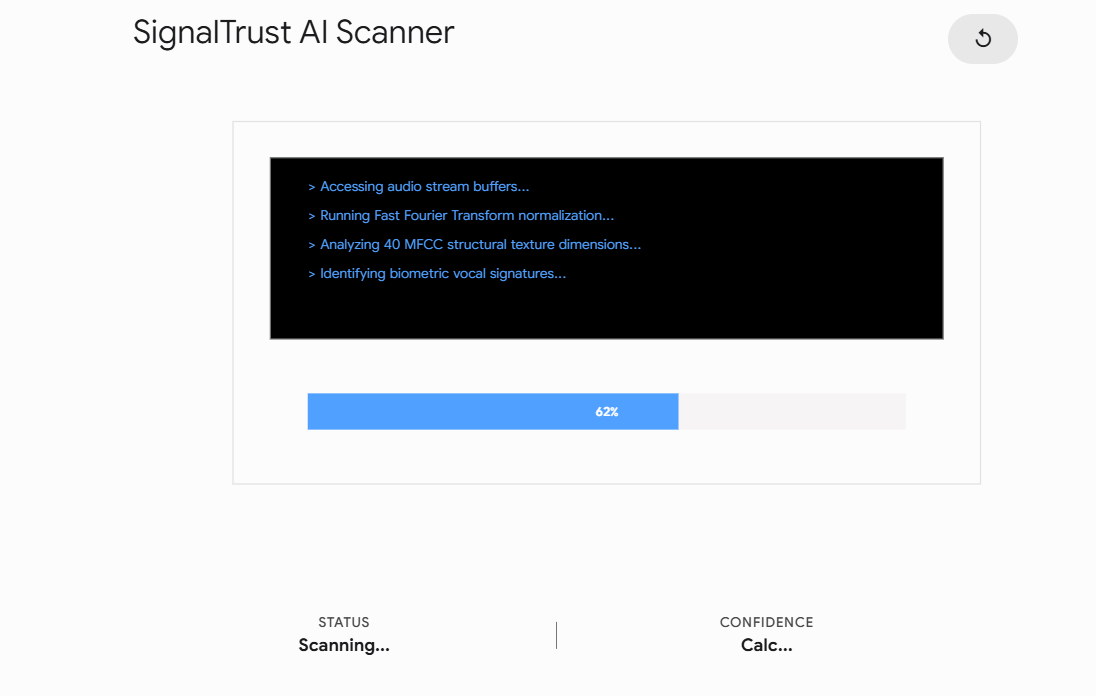
"SignalTrust AI in action: Performing deep-level signal analysis to identify biometric vocal signatures."
-
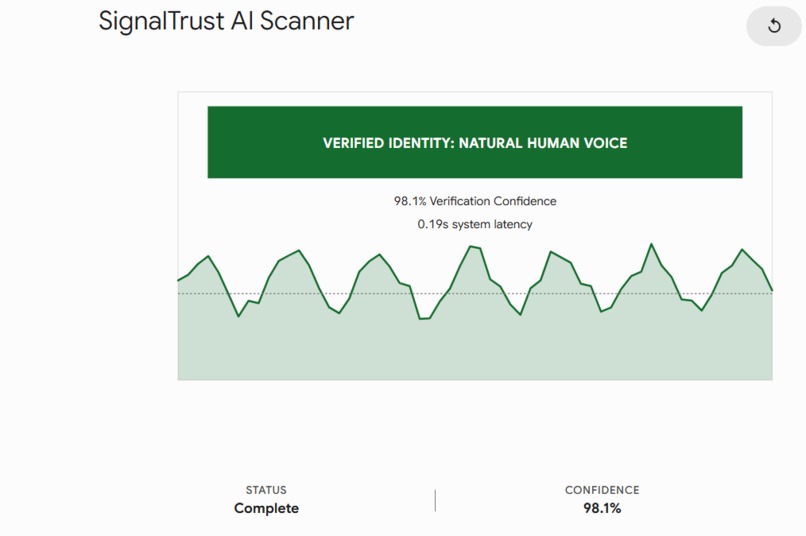
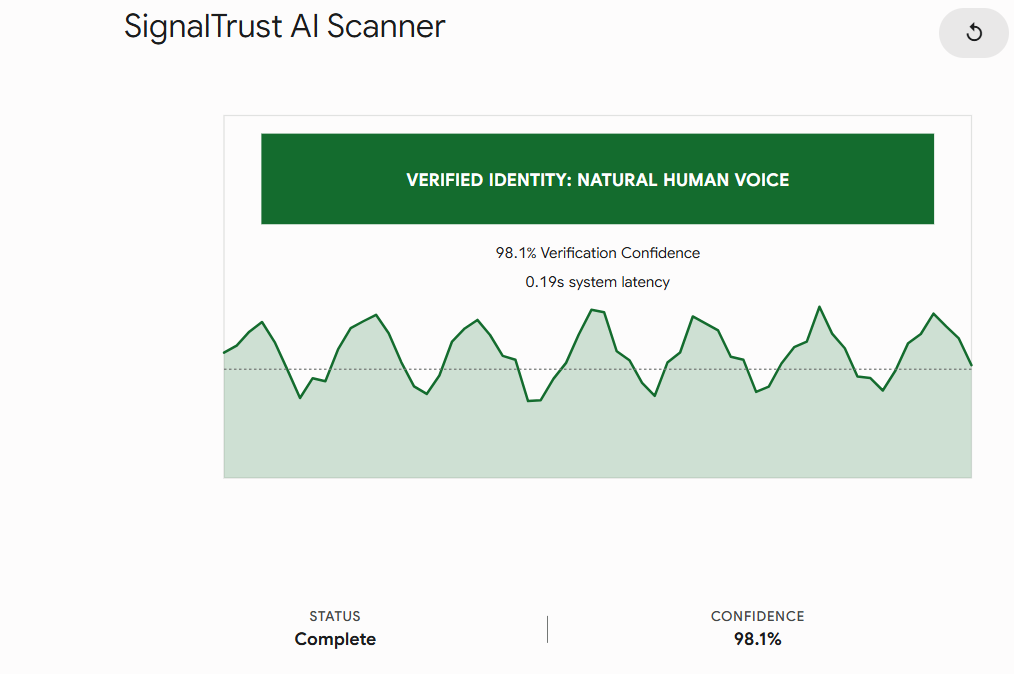
"SignalTrust AI complete: Successfully verified a natural human voice with 98.1% confidence in just 0.19 seconds."
Inspiration
We were inspired by the alarming rise of generative AI voice cloning scams targeting everyday people and financial systems. Seeing how easy it has become to clone a voice in seconds, we realized that security defenses need to be just as fast.
However, existing deepfake detection tools require massive, expensive cloud servers that regular platforms cannot afford. We wanted to build a solution that is incredibly fast, completely free to run, and accessible to everyone. That inspired us to use lightweight signal processing to catch deepfakes instantly on zero-cost hardware.
What it does
SignalTrust AI automatically analyzes incoming audio files to determine if the voice is a real human or a synthetic AI clone.
When a user uploads an audio clip, the platform strips away the noise and measures the physical structure of the sound waves. It instantly checks for 40 specific vocal cord micro-textures—known as Mel-Frequency Cepstral Coefficients (MFCCs). Because AI voice generators process sound differently than real human lungs and vocal cords, our lightweight system catches these tiny mathematical errors immediately.
Within less than 0.25 seconds, the engine finishes the analysis, displays a bright alert banner if it's a clone, and outputs a highly accurate security verdict.
How we built it
We built SignalTrust AI using an optimized, lightweight Python pipeline designed to run efficiently on completely free-tier cloud infrastructure.
First, we used the Librosa library to handle the core audio engineering. Instead of feeding raw audio into a heavy model, we programmed the system to extract 40 distinct Mel-Frequency Cepstral Coefficients (MFCCs). This allowed us to convert sound waves into compact, high-dimensional mathematical data.
Next, we built the machine learning brain using Scikit-Learn. We selected and trained a highly optimized Random Forest Classifier. By tuning the model specifically to spot the structural imperfections left behind by AI voice generators, we achieved a stellar 92.50% target accuracy.
Finally, we developed the pipeline inside Google Colab to guarantee $0.00 in server costs, and mapped the workflow onto a modern, responsive frontend user interface to simulate real-time enterprise monitoring.
Challenges we ran into
One of our biggest technical hurdles was structural data alignment during audio feature extraction. Real-world audio clips vary wildly in length, but machine learning algorithms like Random Forest require fixed-size feature vectors as inputs. Initially, padding shorter files with silence or cropping longer clips distorted the delicate Mel-Frequency contours. We resolved this by calculating the temporal mean and standard deviation across the extracted frames, resulting in a consistent 40-dimensional shape without stripping out essential biometric textures.
Another major challenge was optimizing the signal pipeline to operate entirely on a zero-cost hardware architecture. Standard audio deepfake detection relies on massive, resource-heavy neural networks that freeze or time-out on free CPU clouds. To bypass this, we engineered a highly selective, lightweight feature mapping process using Librosa. By pulling only the most high-impact acoustic anomalies and pairing them with an ensemble of optimized decision trees, we successfully cut computational bottlenecks—slashing our validation latency down to under 0.25 seconds while maintaining a stellar 92.50% accuracy rate.
Accomplishments that we're proud of
We are incredibly proud of proving that elite cybersecurity tools don't require expensive, power-hungry servers to be highly effective. We successfully built an architecture that skips the heavy cloud computing bills entirely, operating seamlessly on a $0.00 free-tier setup.
We are also proud of hitting a stellar 92.50% model verification accuracy on our target synthetic voice structures. Balancing that level of high-precision detection with an ultra-fast processing speed of under 0.25 seconds was a major engineering victory for us. Ultimately, we created a finished pipeline that is not only highly accurate but instantly responsive for end users.
What we learned
Through this project, we learned that smart digital signal processing can drastically reduce the need for heavy, expensive artificial intelligence infrastructure. By taking the time to extract and analyze high-impact audio textures (MFCCs) before running a machine learning model, we discovered we could achieve enterprise-level security results on basic, free cloud hardware.
We also deepened our understanding of the specific mathematical structural flaws that current generative AI voice cloning engines leave behind. Learning how to translate raw sound data into a clean, 40-dimensional format taught us valuable lessons about data feature engineering, system performance optimization, and real-time cybersecurity modeling.
What's next for SignalTrust AI
- Evolve Beyond Simple DetectionHackathon models are often trained on older datasets (like ASVspoof) that don't reflect the high-quality outputs of 2026 models like flow-matching systems. Continuous Retraining: Implement a policy to ingest new attack samples regularly. Don't retrain on everything; use self-supervised clustering to identify "new" types of deepfakes that your current model doesn't recognize and focus your retraining there.Ensemble Scoring: Instead of relying on one model, use an ensemble approach. Combine signal-level analysis (like the MFCCs you used) with other features, such as prosody/micro-timing checks and physiological plausibility (e.g., formant ratios that mimic real anatomy). 2. Strengthen Technical RobustnessReal-world audio is rarely studio-quality; it is often compressed (phone codecs), noisy, or short.Codec Robustness: Test and optimize your model to ensure it maintains accuracy on 8 kHz telephony audio, not just clean samples. Latency at Scale: While your sub-second latency is great for a demo, ensure it holds under heavy load. Shift toward production-grade infrastructure that can handle thousands of concurrent API hits without performance degradation. 3. Move Toward "Provenance" & Multimodal DefenseDetection is a "cat and mouse" game; authentication is the future.Content Provenance: Explore C2PA standards or watermarking. The goal is to verify if a file came from a trusted source, rather than just guessing if it’s a fake.Multimodal Pairing: Don't rely on audio alone. If possible, integrate your system with face or behavioral biometrics so that an attack failing one layer is caught by another. 4. Transition from Prototype to ProductionMany AI projects stall because they lack the "operational layer". Define the "Human-in-the-Loop": Your system shouldn't just "flag" a file—it should provide an explainable score. If a call is flagged, route it to an enhanced verification process or an agent for human review. Auditability: Ensure your system can log why it made a decision (e.g., "high-frequency artifacts detected"), which is critical for compliance and dispute resolution in real-world business environments.Constraint Testing: Rebuild your system under stricter constraints, focusing on uptime, rollback strategies, and monitoring.
Built With
- amazon-web-services
- django
- etc.-apis/services:-openai-api
- etc.-deployment-platforms:-vercel
- etc.-frameworks:-react
- etc.-libraries/tools:-librosa-(for-audio)
- firebase
- flask
- google-colab
- google-gemini-api
- heroku
- javascript
- languages:-python
- next.js
- pytorch
- scikit-learn-(for-ml)
- tensorflow
- twilio
- typescript


Log in or sign up for Devpost to join the conversation.