Inspiration
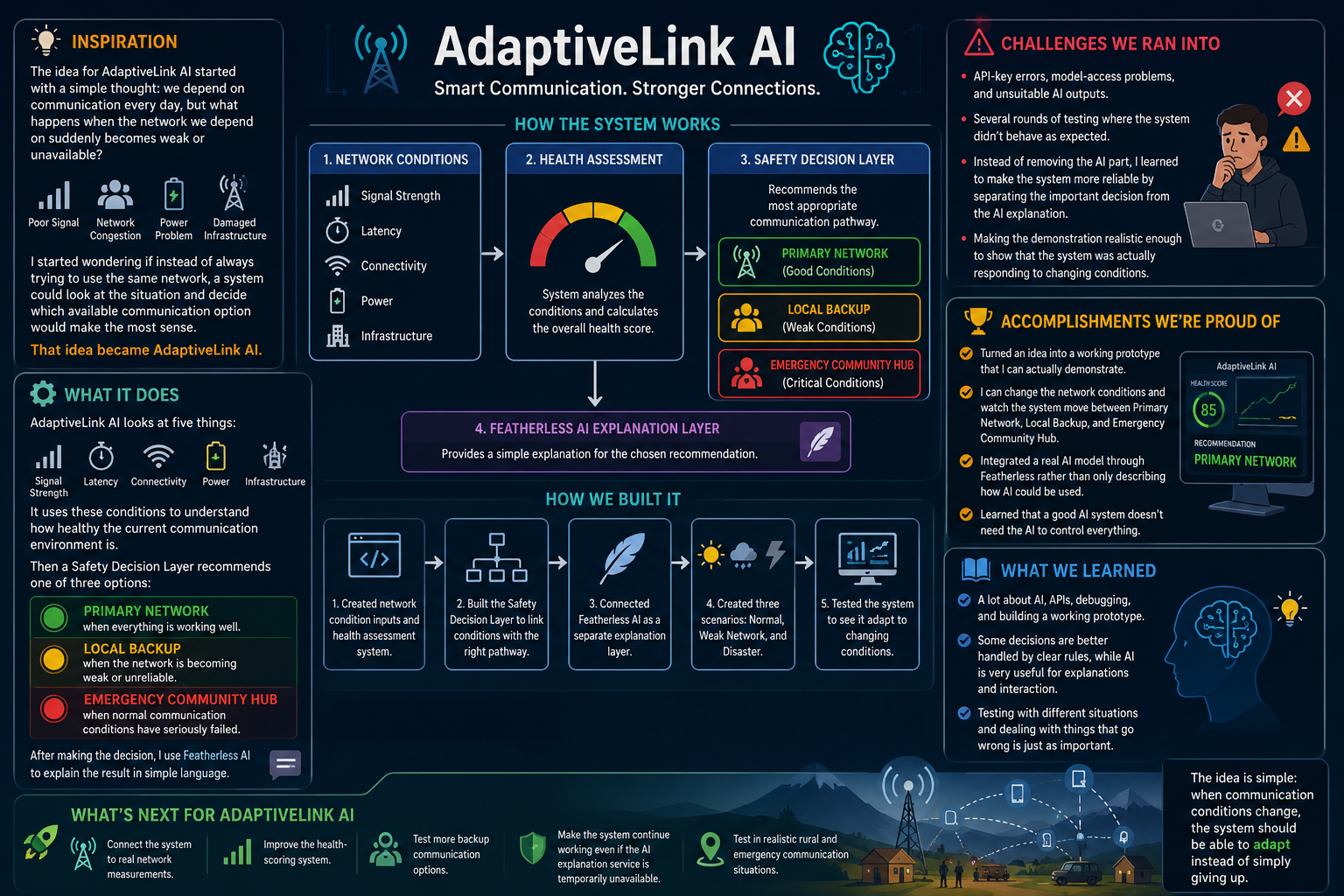
The idea started with a simple question: what happens when people need their phones most, but the network becomes unreliable? A conversation with my college lecturer about how much we depend on communication towers made me think about disasters, where towers can become overloaded, damaged, or lose power. That sparked the idea of using AI to help people choose the best communication option that is still available.
What it does
SignalShield AI monitors important network conditions such as signal strength, connectivity, latency, infrastructure availability, and power. It uses these conditions to recommend the most reliable communication path available at that moment. Depending on the situation, it can recommend staying on the main network, using a local backup, or relying on an emergency community communication hub. The goal is to help people make faster and smarter communication decisions when normal networks become unreliable.
How we built it
We designed SignalShield AI as an intelligent decision layer rather than as a replacement for existing towers or networks. We identified the communication conditions that can change during an emergency and built a system that evaluates those conditions and compares the available options. The prototype focuses on turning changing network information into a clear recommendation that a user or emergency coordinator can understand and act on.
Challenges we ran into
The hardest part was making the idea realistic. It was easy to imagine a system that simply says a network has failed, but we wanted it to do something more useful. We had to decide which network conditions matter most, how to compare different options, and how to make recommendations without assuming that unavailable technologies or infrastructure exist. Keeping the idea ambitious while staying technically realistic was one of our biggest challenges.
Accomplishments that we're proud of
We are proud of turning an idea that started as a simple question about communication towers into a practical AI-based concept for emergency resilience. We developed a clear decision-making approach that focuses on adapting to changing conditions instead of depending on one fixed communication path. Most importantly, the project is designed around a real problem that can affect people when communication is needed most.
What we learned
We learned that solving a real-world problem is not always about building the biggest or most complicated technology. A useful system has to understand the situation, work with what is already available, and make decisions that people can actually use. We also learned how important it is to clearly define what our AI can do, what it cannot do, and how it could eventually be tested in real environments.
What's next for SignalShield AI
Our next step is to develop a working prototype that can use real or simulated network data and test its recommendations under different emergency scenarios. We want to explore how SignalShield AI could work with existing communication infrastructure and local emergency systems. In the longer term, we hope to test it in rural and disaster-prone communities and improve the system based on real-world feedback.
Built With
- artificialintelligence
- machine-learning
- numpy
- pandas
- python
- scikit-learn


Log in or sign up for Devpost to join the conversation.