-
-
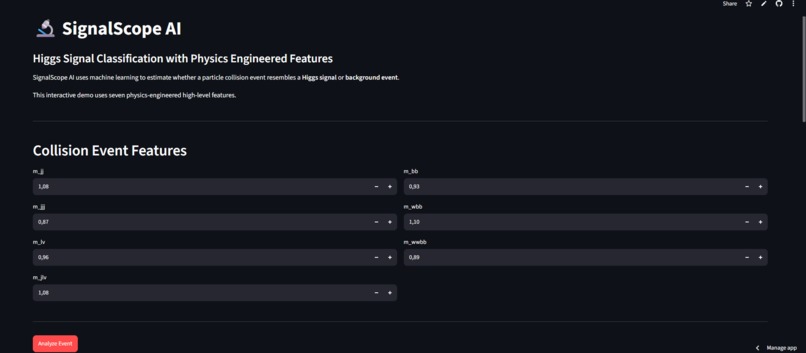
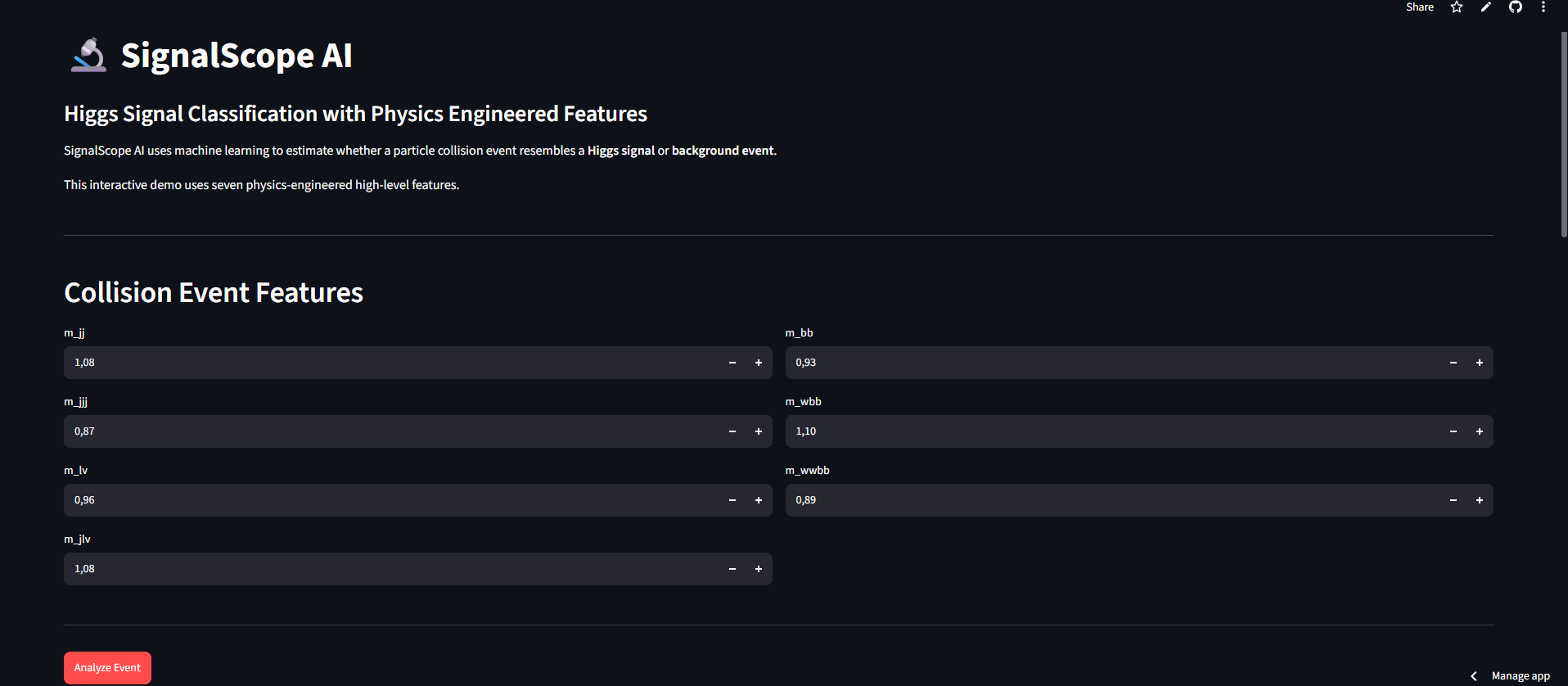
SignalScope AI interactive interface for Higgs signal classification using seven physics-engineered high-level features.
-
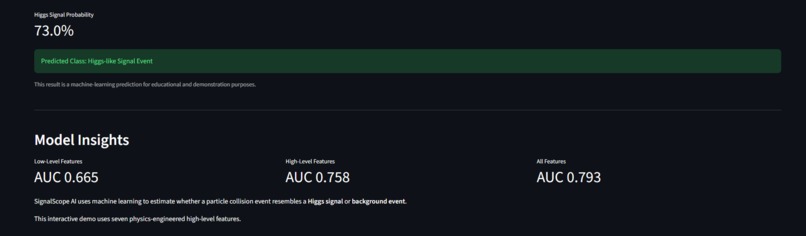
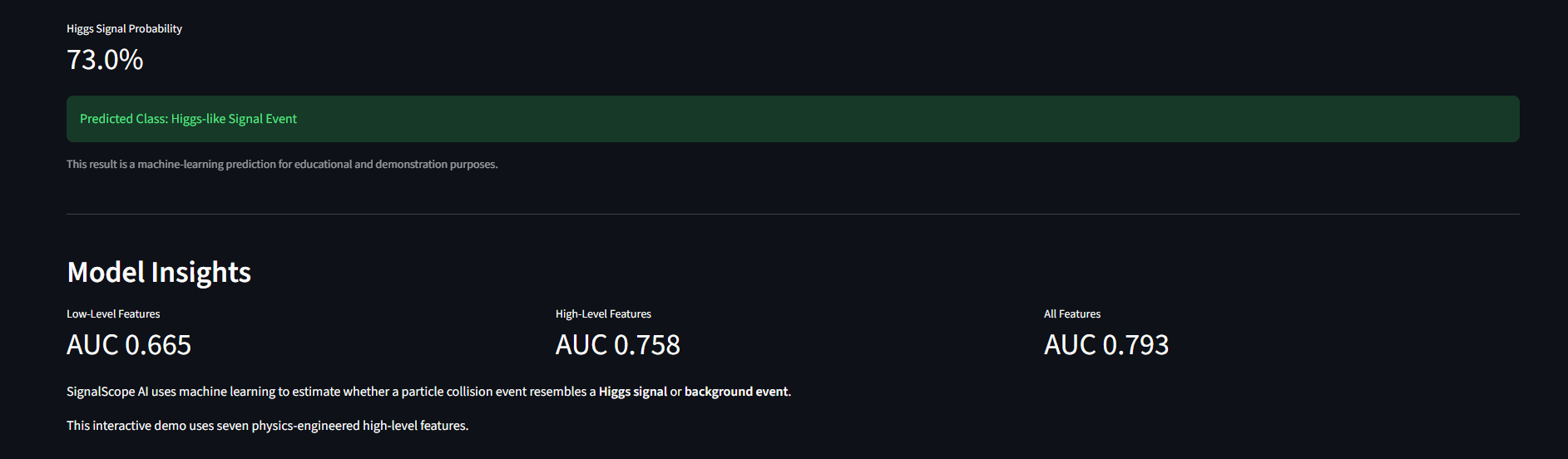
Example prediction output with Higgs signal probability and ROC-AUC comparison across low-level, high-level, and combined feature sets.
-
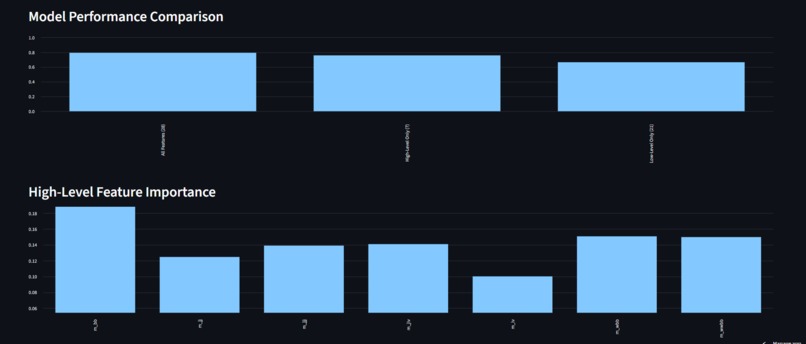
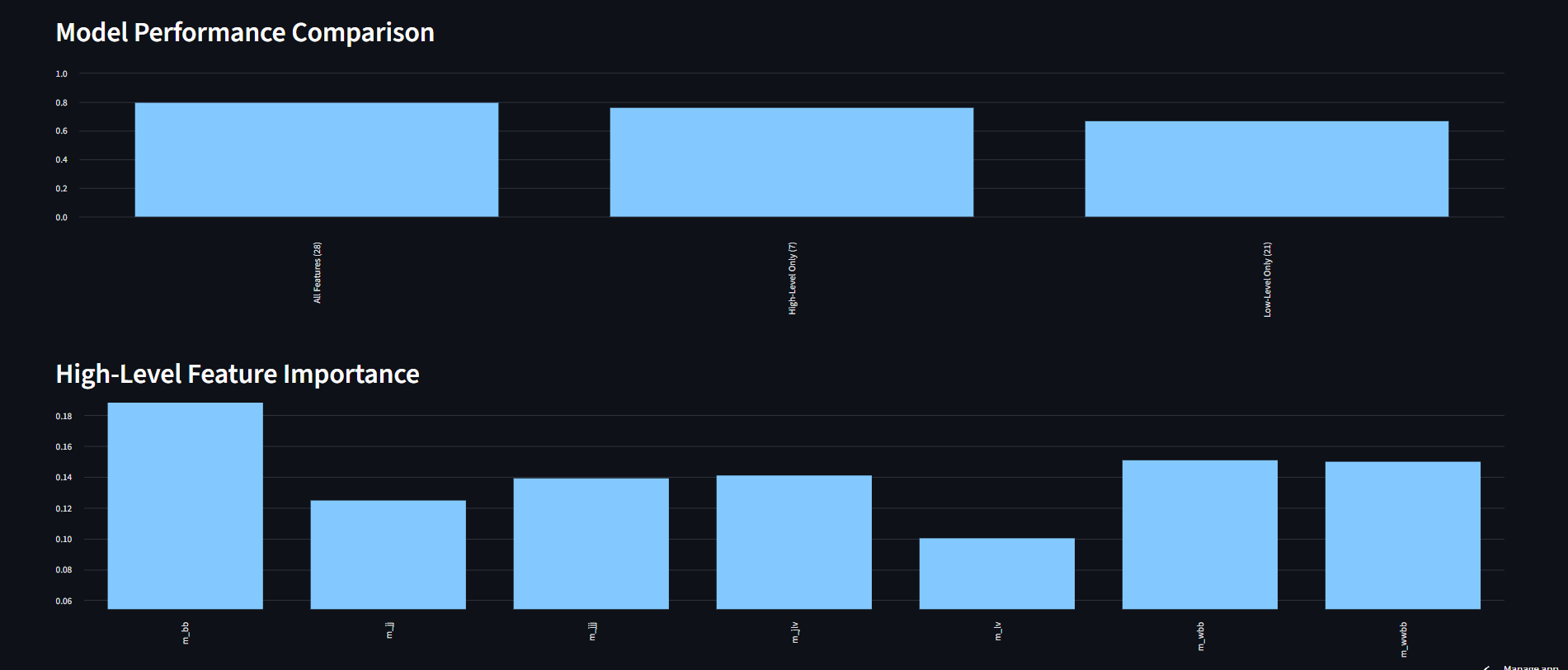
Model performance comparison and high-level feature importance analysis showing the contribution of physics-engineered variables.
Inspiration
Particle physics experiments generate enormous amounts of complex data, and distinguishing meaningful signal events from background is a challenging classification problem.
We wanted to explore how machine learning can support this task while still preserving a connection to the underlying physics.
SignalScope AI was inspired by a simple question:
How much do physics-engineered features contribute to Higgs signal classification?
Rather than treating the HIGGS dataset as a generic machine-learning dataset, we focused on comparing low-level detector information with high-level variables designed using physics knowledge.
What it does
SignalScope AI is an explainable machine-learning prototype for classifying simulated Higgs signal and background events.
The project compares three different feature groups:
- 21 low-level kinematic features
- 7 physics-engineered high-level features
- all 28 features combined
Using Random Forest, we obtained the following ROC-AUC scores:
- 0.665 with low-level features
- 0.758 with only seven high-level features
- 0.793 with all features combined
The interactive Streamlit application allows users to enter seven high-level physics variables, receive a Higgs signal probability, view the predicted class, and explore model performance and feature importance.
How we built it
We used a 10,000-event subset of the HIGGS dataset from the UCI Machine Learning Repository.
We first trained Logistic Regression as a baseline model and then used Random Forest to capture nonlinear relationships in the data.
To study the contribution of physics-engineered variables, we compared three feature configurations while keeping the train/test setup consistent:
- Low-Level Only — 21 features
- High-Level Only — 7 features
- All Features — 28 features
The interactive demo uses the seven high-level features:
m_jj, m_jjj, m_lv, m_jlv, m_bb, m_wbb, and m_wwbb.
The trained model was saved using Joblib and integrated into a Streamlit application. The final application was deployed using Streamlit Community Cloud.
Tech Stack
- Python
- pandas
- scikit-learn
- matplotlib
- Joblib
- Streamlit
- Google Colab
- Git
- GitHub
Challenges we ran into
One of the main challenges was turning a machine-learning notebook into a project that communicated a scientific question rather than simply reporting classification accuracy.
We also had to clearly separate the role of low-level detector features from high-level physics-engineered variables and design experiments that made this comparison meaningful.
During deployment, we encountered Python and scikit-learn compatibility issues when loading the trained model. We solved this by creating a compatible Python environment and testing the full application both locally and in the deployed version.
Another important challenge was communicating the difference between the best-performing 28-feature experimental model and the simpler 7-feature model used in the interactive demo.
Accomplishments that we're proud of
We are especially proud that the seven physics-engineered features alone achieved a ROC-AUC of 0.758, outperforming the 21 low-level features despite using a much smaller feature representation.
The combined 28-feature model reached a ROC-AUC of 0.793, suggesting that low-level and high-level variables contain complementary information.
We also transformed the project from a notebook-based machine-learning experiment into a fully deployed interactive application with model insights, feature importance, and performance comparisons.
What we learned
SignalScope AI showed us that domain knowledge can have a significant impact on machine-learning performance.
The physics-engineered high-level variables contained substantial discriminative information, and features such as m_bb became especially influential in the trained model.
We also gained experience across the complete machine-learning workflow:
- data preparation
- baseline modeling
- feature-group comparison
- model evaluation
- feature importance analysis
- model serialization
- Streamlit development
- deployment
- Git and GitHub
- technical documentation
Most importantly, we learned that machine learning becomes more meaningful in scientific applications when model performance is connected back to domain-specific reasoning.
What's next for SignalScope AI
Future versions of SignalScope AI could include:
- training on a larger portion of the HIGGS dataset
- comparing additional machine-learning and deep-learning models
- adding SHAP-based explainability
- investigating classification thresholds
- expanding the physics-oriented visualizations
- comparing learned representations with physics-engineered features
- exploring more realistic particle-physics analysis workflows
Our long-term goal is to continue exploring how machine learning and physics knowledge can complement each other in scientific data analysis.
Built With
- github
- joblib
- matplotlib
- numpy
- pandas
- python
- scikit-learn
- streamlit