Inspiration
AI has made it incredibly easy to ship software.
A founder, PM, designer, or solo builder can now create a landing page, a feature, or even a full product in hours. But there is a dangerous gap:
Shipping faster does not mean learning faster.
Most AI-built products are launched with beautiful interfaces, polished copy, and zero behavioral evidence. Builders ask AI if the product is clear, but AI is not a real user. It does not hesitate, miss the CTA, get confused by unclear value, or abandon the flow.
That inspired SignalRoom.
SignalRoom is built around a simple thesis:
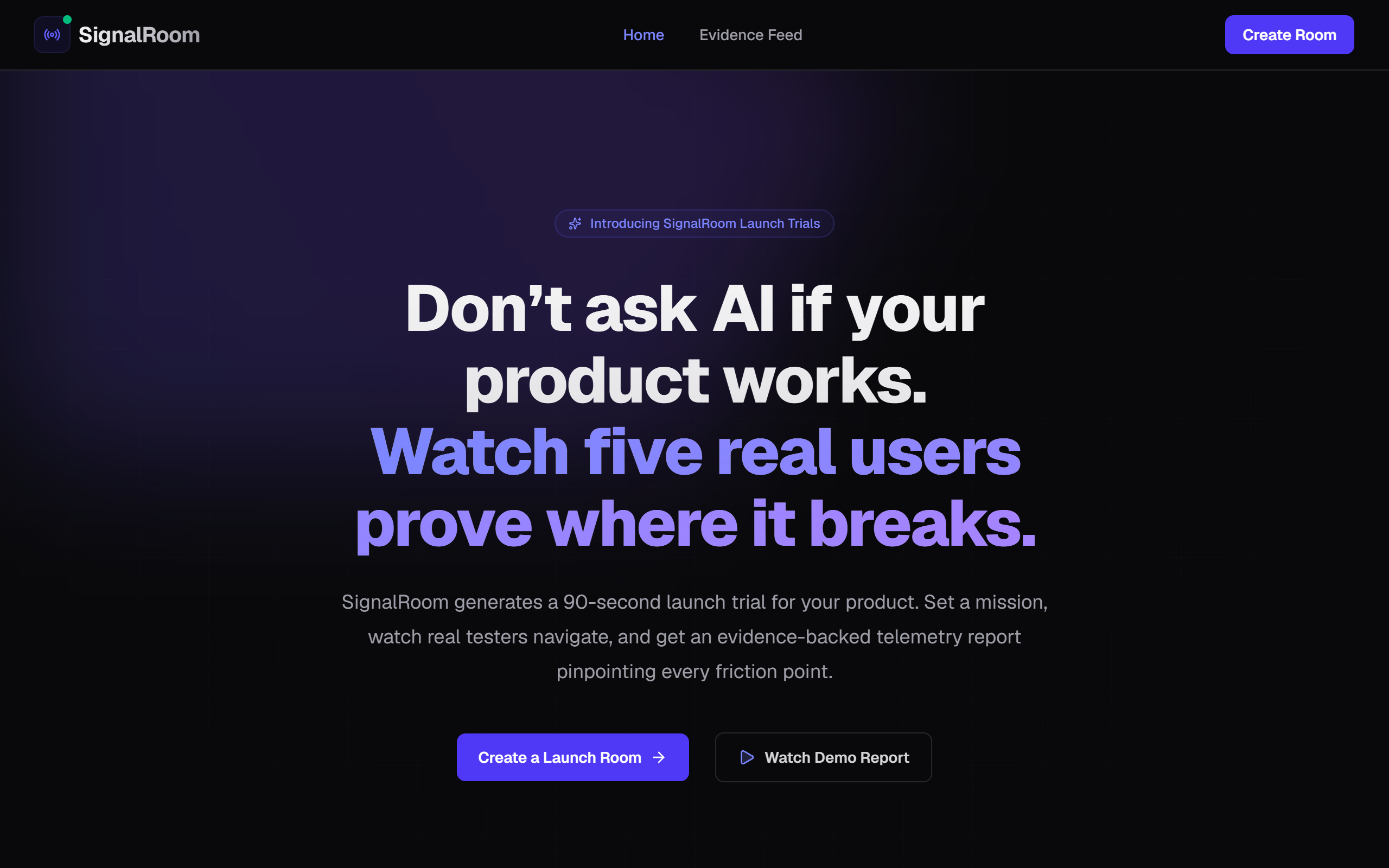
Don’t ask AI if your product works. Watch real users prove where it works — and where it breaks.
What it does
SignalRoom is a real launch trial system for product builders.
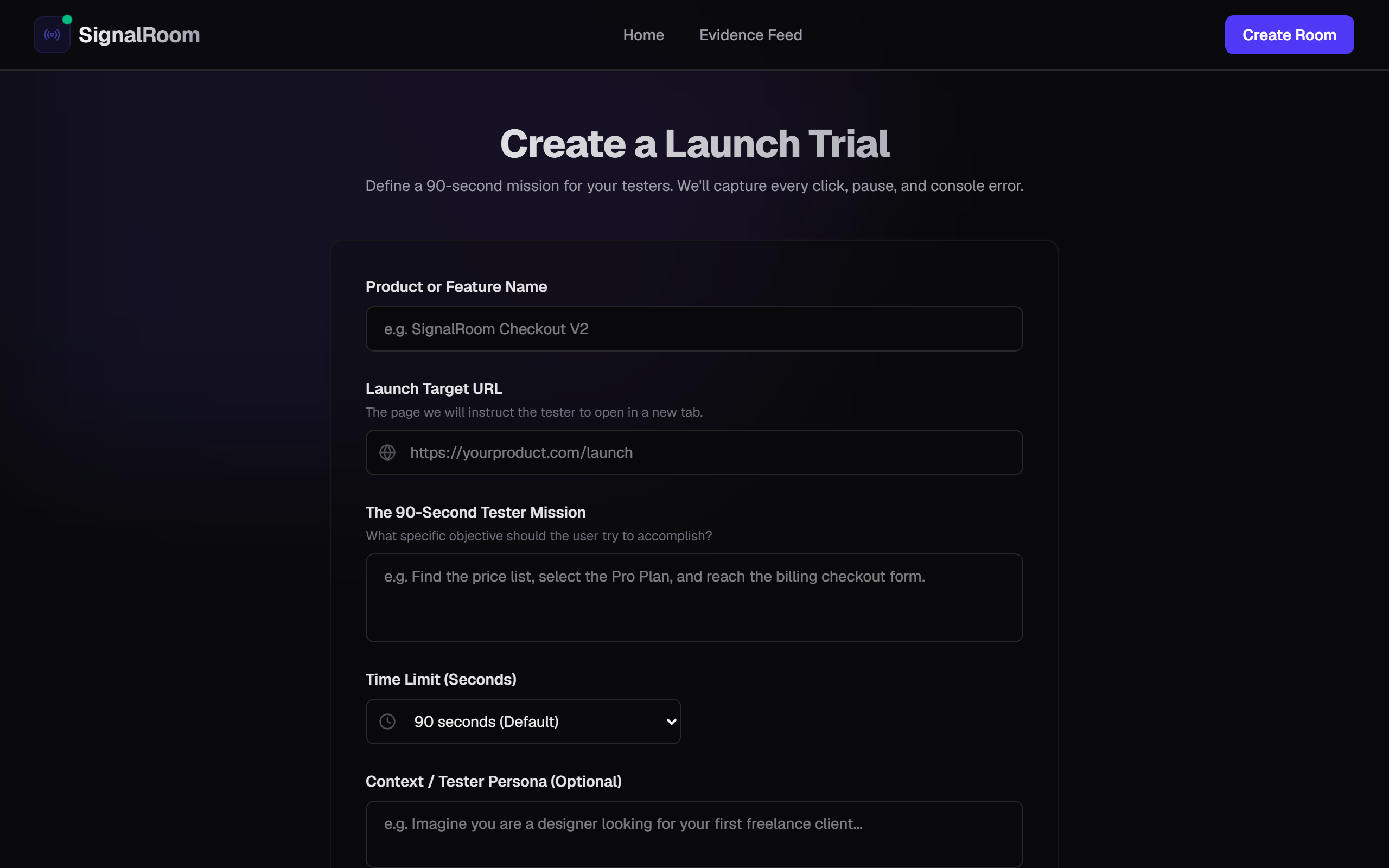
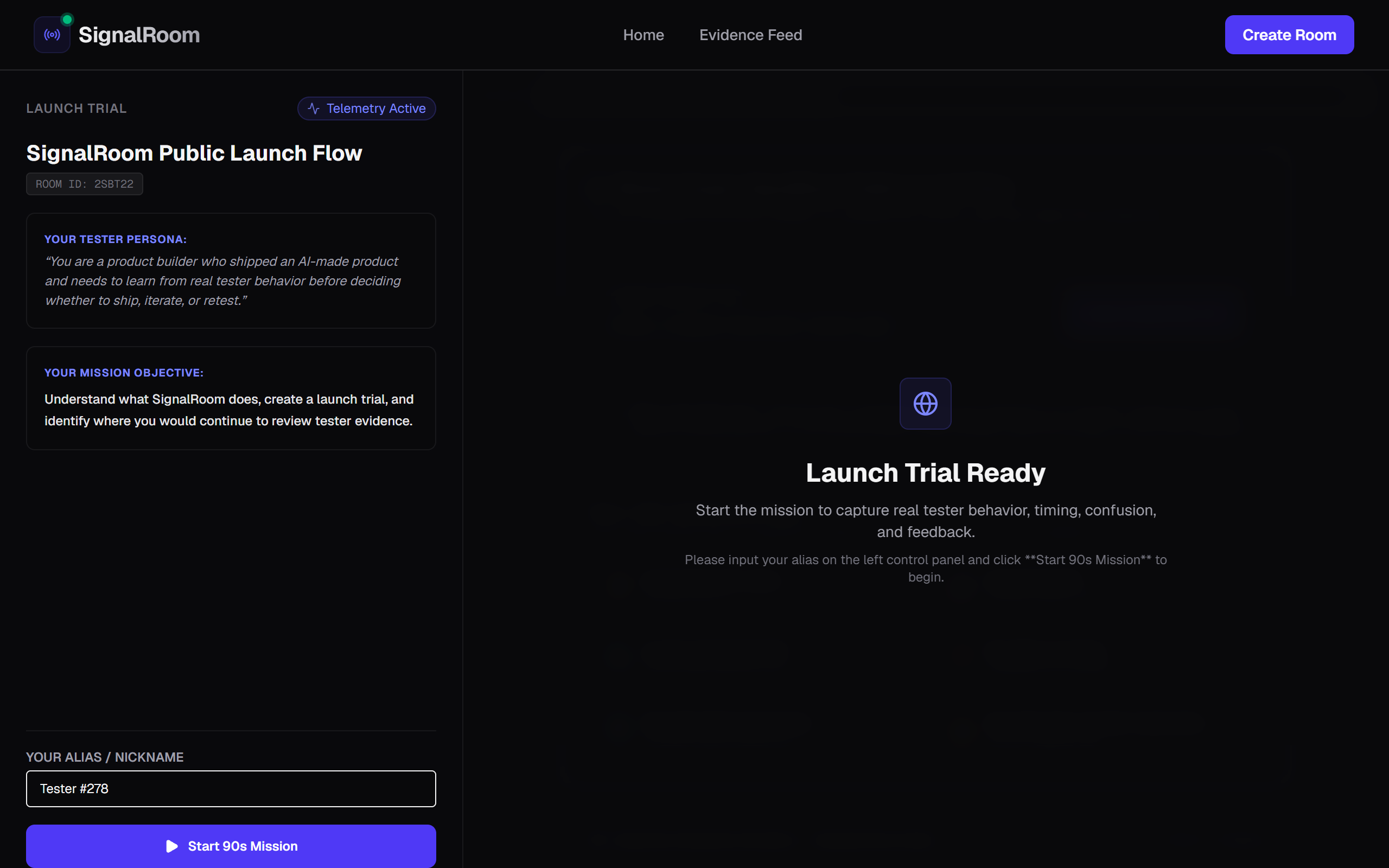
It lets a builder create a public testing room for any product URL, define a target user, and give testers a focused 90-second mission.
A tester opens the link, completes the mission, and every meaningful action becomes product evidence.
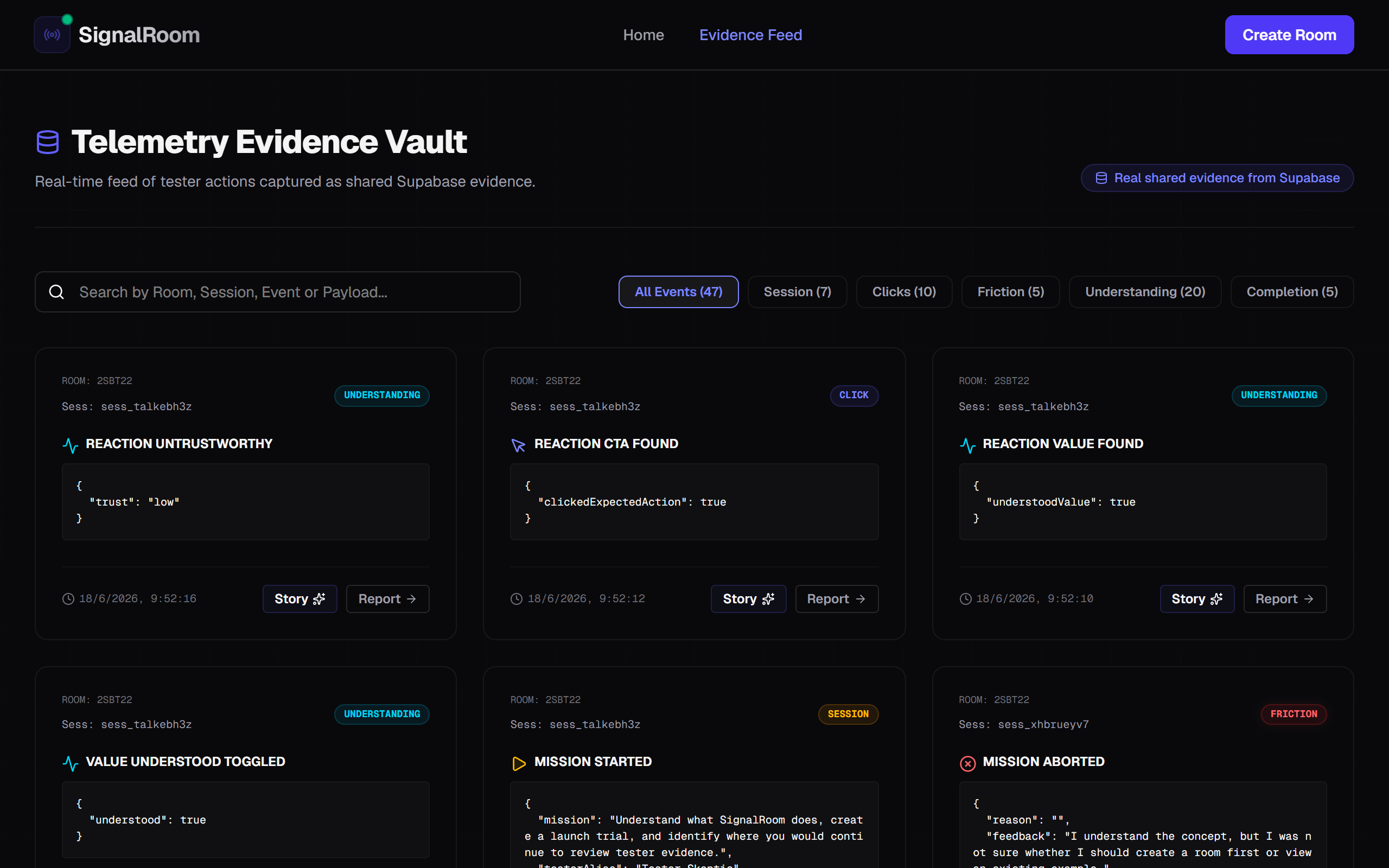
SignalRoom captures:
- ✅ Mission starts and completions
- ✅ Tester reactions
- ✅ CTA discovery
- ✅ Confusion signals
- ✅ Trust signals
- ✅ Feedback notes
- ✅ Session timelines
- ✅ Evidence confidence
- ✅ Product decision signals
Then SignalRoom turns that evidence into:
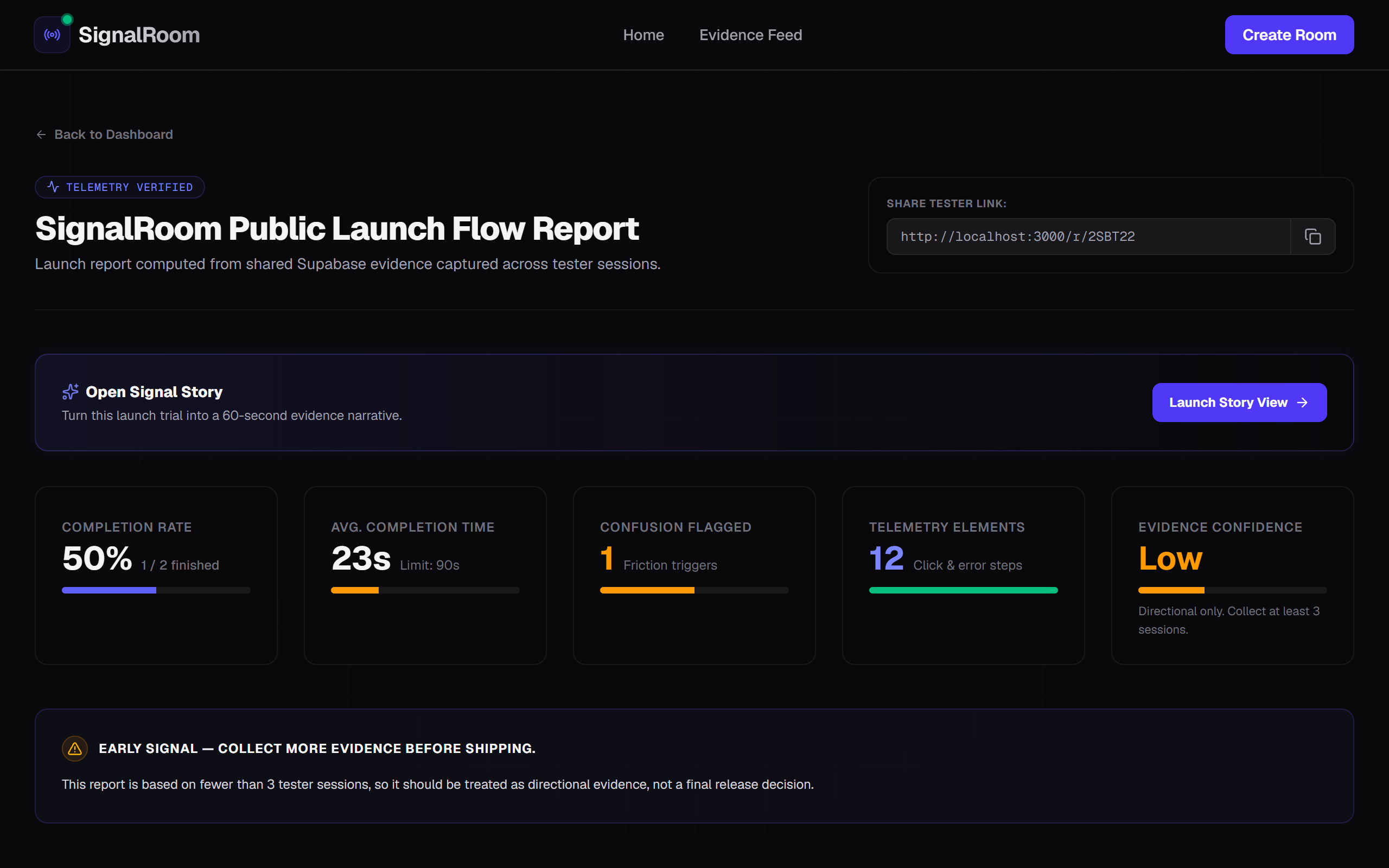
📊 Evidence-backed Reports
A product report calculated from real sessions and real events, not invented AI scores.
🔁 Privacy-safe Session Replay
No screen recording. No video capture. SignalRoom reconstructs the tester journey from event telemetry only.
🔥 Friction Autopsy
Behavioral patterns become actionable product insights such as CTA friction, offer clarity risk, trust signal risk, or strong launch signal.
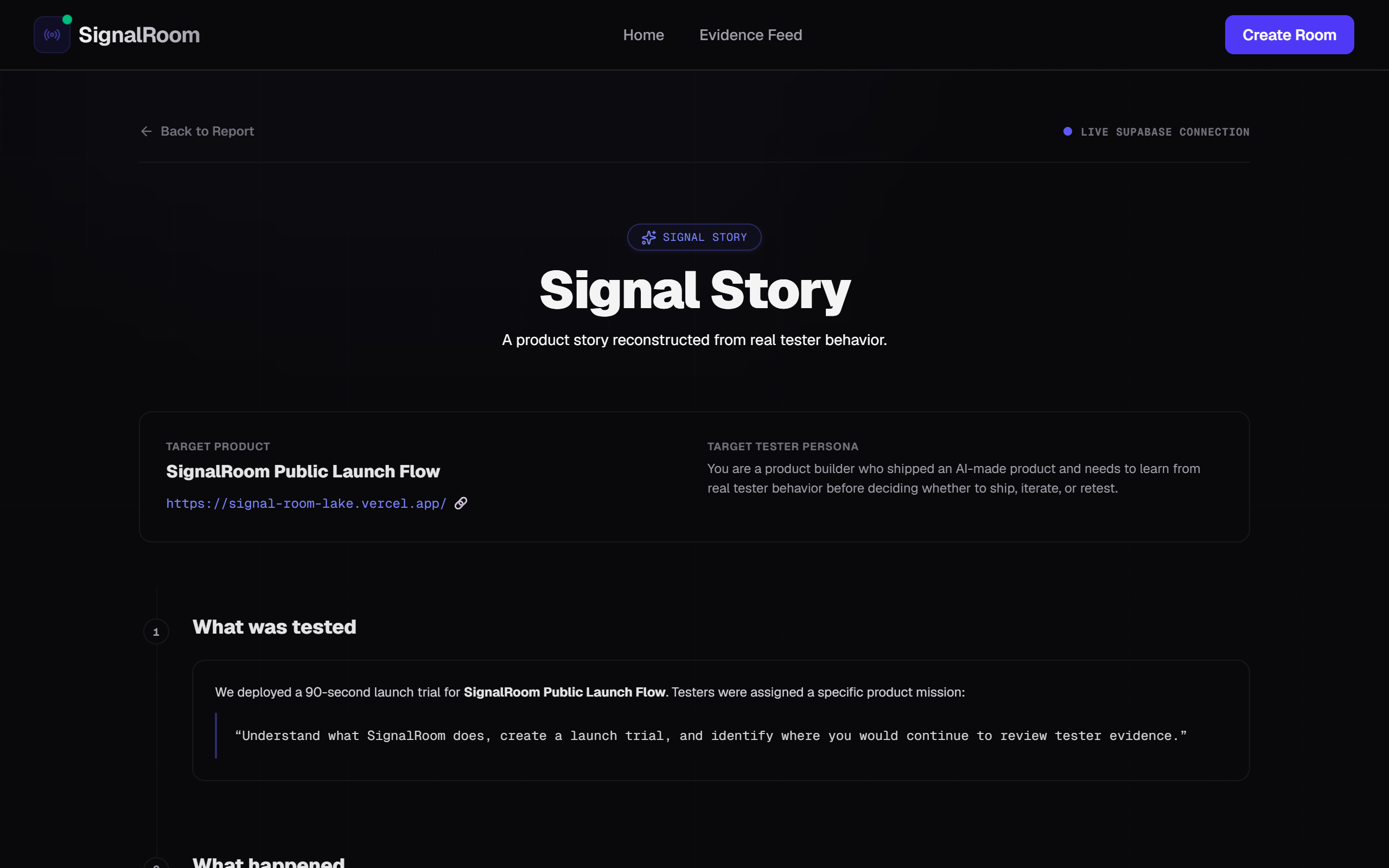
🎬 Signal Story
A narrative view that explains what was tested, what happened, the break moment, what SignalRoom can verify, and what it cannot claim.
🧭 Novus-powered Product Intelligence
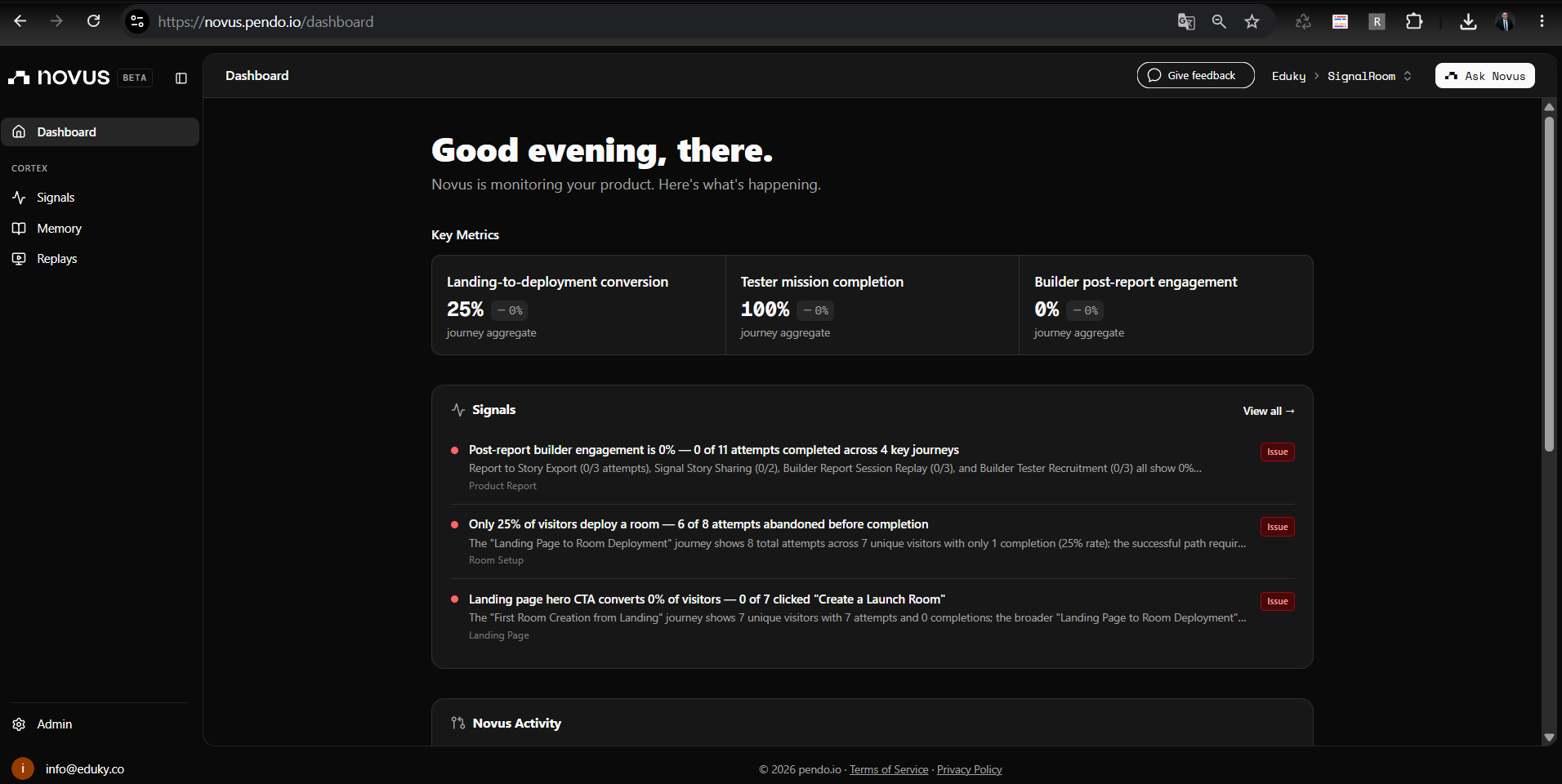
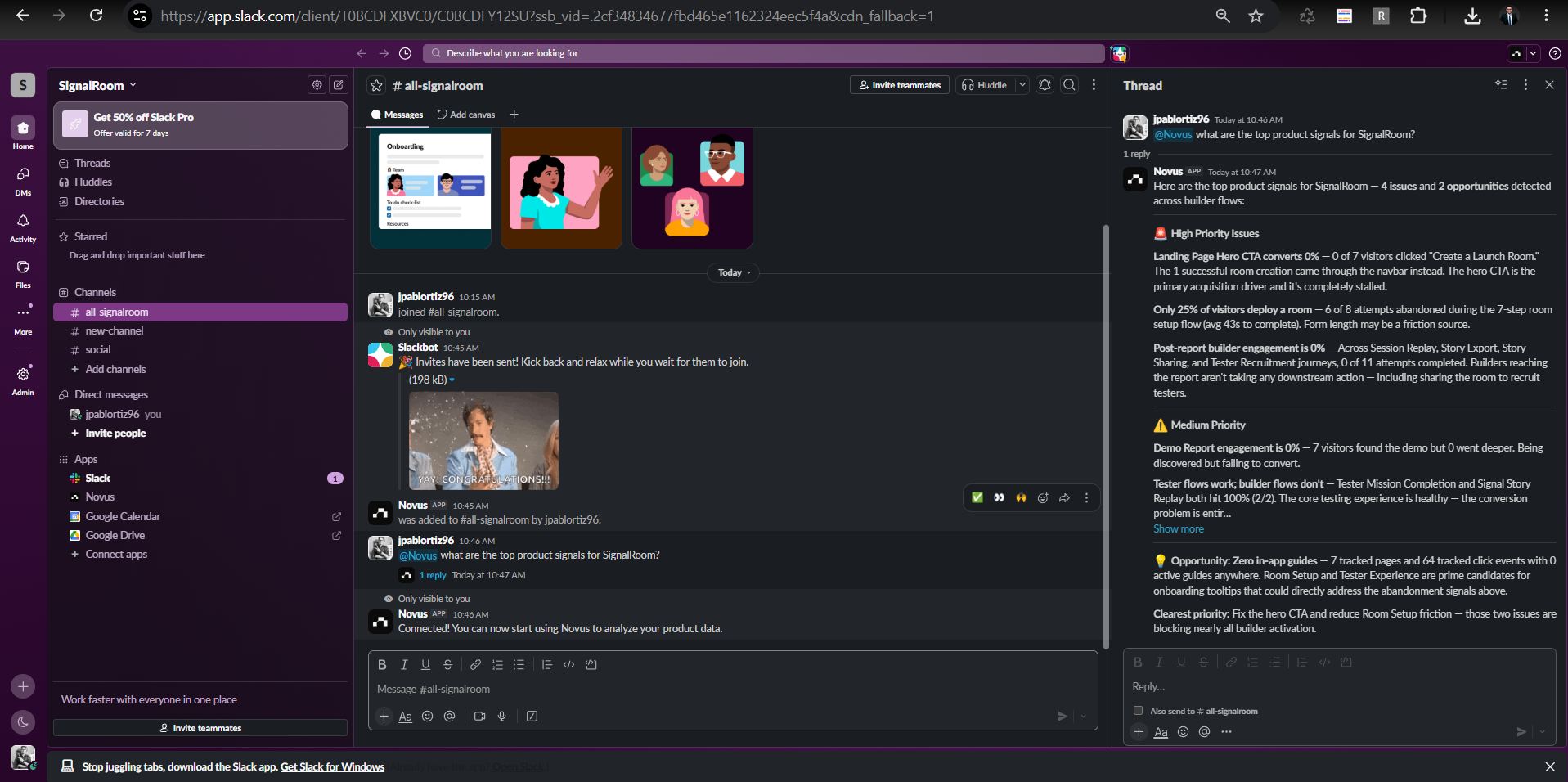
Novus monitors SignalRoom as a real product, detects product areas and user journeys, surfaces actionable signals, and routes insights into Slack so the team can act where product work already happens.
How we built it
SignalRoom is a full-stack web product built with a production-oriented stack:
- Next.js App Router for the frontend and routing
- TypeScript for safer product logic
- Tailwind CSS for the premium UI system
- Supabase Postgres for shared rooms, sessions, and events
- Vercel for deployment
- Novus / Pendo for product intelligence and behavioral analytics
- Slack integration for product signals in team workflow
The system is built around four core entities:
| Entity | Purpose |
|---|---|
rooms |
Stores the product URL, mission, target persona, and trial configuration |
sessions |
Stores each tester attempt and outcome |
events |
Stores telemetry actions such as mission started, CTA found, confusion reported, and mission completed |
reports |
Supports calculated evidence summaries and product decision outputs |
The architecture is intentionally evidence-first:
- Builder creates a launch room.
- Tester completes a focused mission.
- Events are stored in Supabase.
- SignalRoom reconstructs what happened.
- Reports and Signal Story turn behavior into product insight.
- Novus monitors the product itself and surfaces higher-level product signals.
- Slack brings those signals into the team workflow.
Novus is not installed as a checkbox. It is a strategic layer in SignalRoom’s own product loop.
During testing, Novus surfaced real signals such as landing CTA friction, room setup drop-off, post-report engagement gaps, and strong tester mission completion. Those insights were then routed into Slack through the Novus integration.
That means SignalRoom is not only helping builders learn from users.
SignalRoom is also learning from its own usage.
Challenges we ran into
The biggest challenge was keeping the product honest.
It would have been easy to build a generic AI dashboard with a fake product score, but that would not be credible. SignalRoom needed to prove value through real sessions, real events, and real evidence.
Key challenges included:
- Designing a tester flow that works without login
- Capturing meaningful behavior without recording video
- Avoiding fake validation or unsupported claims
- Handling public product URLs that cannot be embedded because of browser security restrictions
- Making Supabase persistence work across real devices
- Preventing temporary loading states from showing false “not found” errors
- Integrating Novus without treating it as a superficial requirement
- Turning raw telemetry into a clear product narrative that a PM or founder can understand quickly
The product also had to stay narrow. Instead of adding auth, billing, teams, or complex dashboards, I focused on one core loop:
Create a room → test with real users → capture evidence → decide what to do next.
Accomplishments that we're proud of
I am proud that SignalRoom is not just a polished UI.
It is a real shipped product with:
- 🚀 A public production URL
- 🧪 Real launch rooms
- 🔗 Public tester links
- 🗄️ Shared Supabase persistence
- 📡 Real telemetry events
- 📊 Evidence-backed reports
- 🔁 Privacy-safe session replay
- 🔥 Friction Autopsy cards
- 🎬 Signal Story narratives
- 🧭 Novus product signals
- 💬 Slack workflow integration
- 📚 Technical documentation
- 🏗️ Architecture diagrams
- ✅ Deployment checklist
- ⚠️ Honest limitations
What makes this especially exciting is that Novus detected product signals from SignalRoom itself. It identified friction in the product journey and surfaced those insights in Slack.
That is the product loop I wanted to prove:
SignalRoom helps teams learn from behavior, and Novus helps SignalRoom learn from its own behavior.
What we learned
This project reinforced a core product lesson:
The best product insight usually comes after shipping, not before.
AI can accelerate building, but it cannot replace evidence from real users.
I learned that product analytics should not be treated as an afterthought. Instrumentation changes how a product is designed, evaluated, and improved.
I also learned the value of under-claiming and over-proving.
SignalRoom does not claim that a few tester sessions prove market demand. It provides directional behavioral evidence from early usage so teams can make better decisions faster.
The most important learning was this:
In the AI shipping era, the winners will not just be the people who build fastest. They will be the people who learn fastest.
What's next for SignalRoom
Next
- Team workspaces
- Better tester recruitment links
- Room-level collaboration
- More robust evidence exports
- Improved report sharing
- Cleaner stakeholder-ready summaries
Later
- Multi-room analytics
- Experiment comparison
- Friction trend detection
- Launch health scoring
- Richer Novus signal mapping
- Deeper Slack workflows for product teams
Future
- Product memory over time
- AI-assisted recommendation layer
- Benchmark library for launch trials
- Continuous product learning loops for AI-built products
- Stakeholder-ready evidence reports for founders, PMs, and product teams
Final thesis
SignalRoom helps builders stop guessing after they ship.
It turns early tester behavior into evidence, reports, replays, stories, and product signals.
Because in the AI shipping era, shipping is no longer the bottleneck.
Learning is.
Built With
- css
- eslint
- git
- github
- html
- javascript
- mermaid
- next.js
- novus-/-pendo
- react
- slack
- supabase-postgres
- tailwind-css
- typescript
- vercel

Log in or sign up for Devpost to join the conversation.