Inspiration
Every health check ever written asks the same question: is the service up?
That question is useless for AI. I kept running into a failure that no monitoring I had would catch — a model provider returns HTTP 200, the request is "successful" by every metric on the dashboard, and the body is unusable. A broken JSON contract. A confidence score below the threshold. A truncated answer. The agent downstream doesn't know, so it retries. And retries. And the first signal anyone gets is the bill at the end of the month.
The infrastructure we have was built for services that fail loudly. AI dependencies fail quietly, expensively, and semantically. So the question I wanted to answer was different:
Is this dependency healthy enough for this request, at this cost, with this level of risk?
What it does
SignalMesh is a distributed reliability and attention control plane for AI agents.
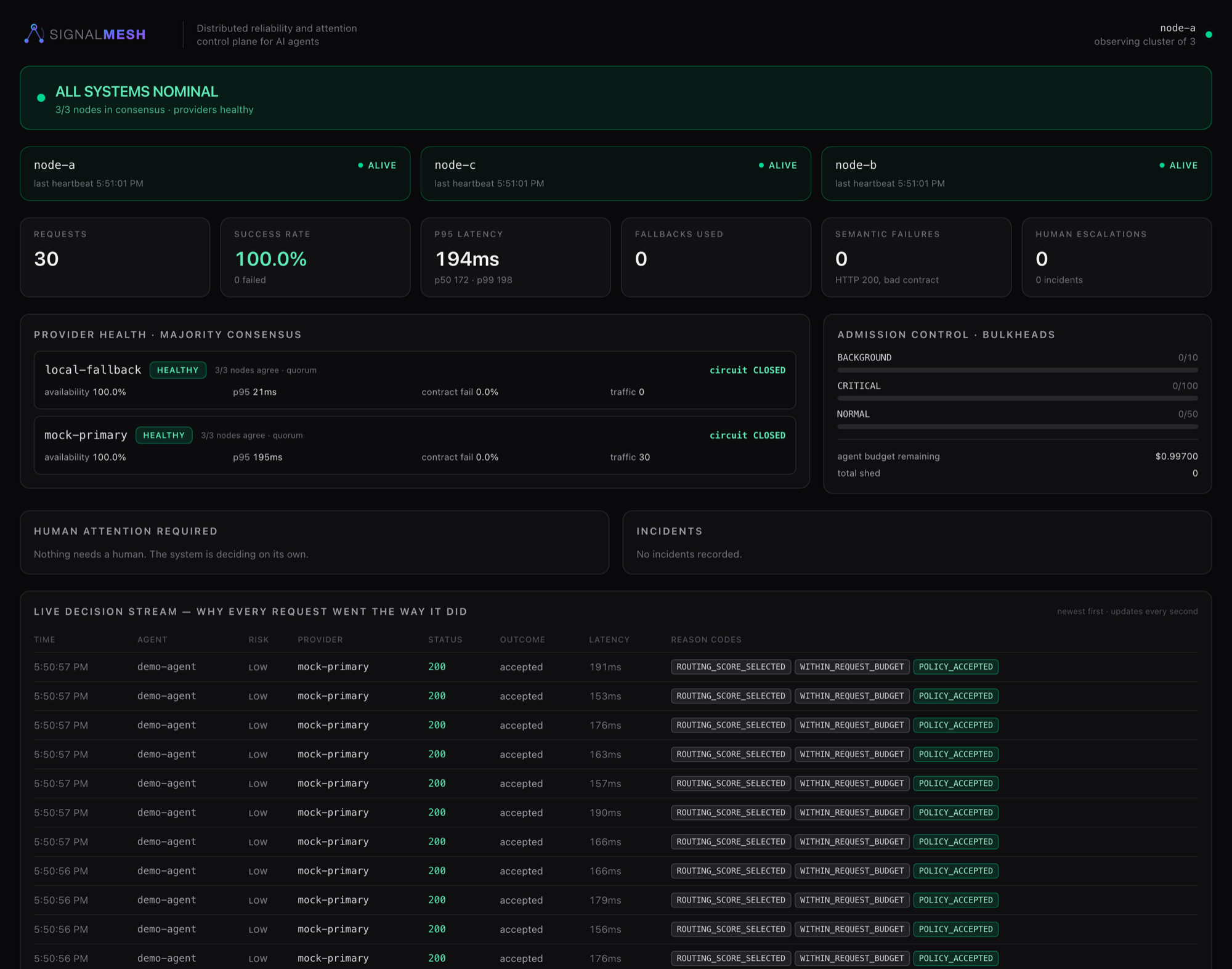
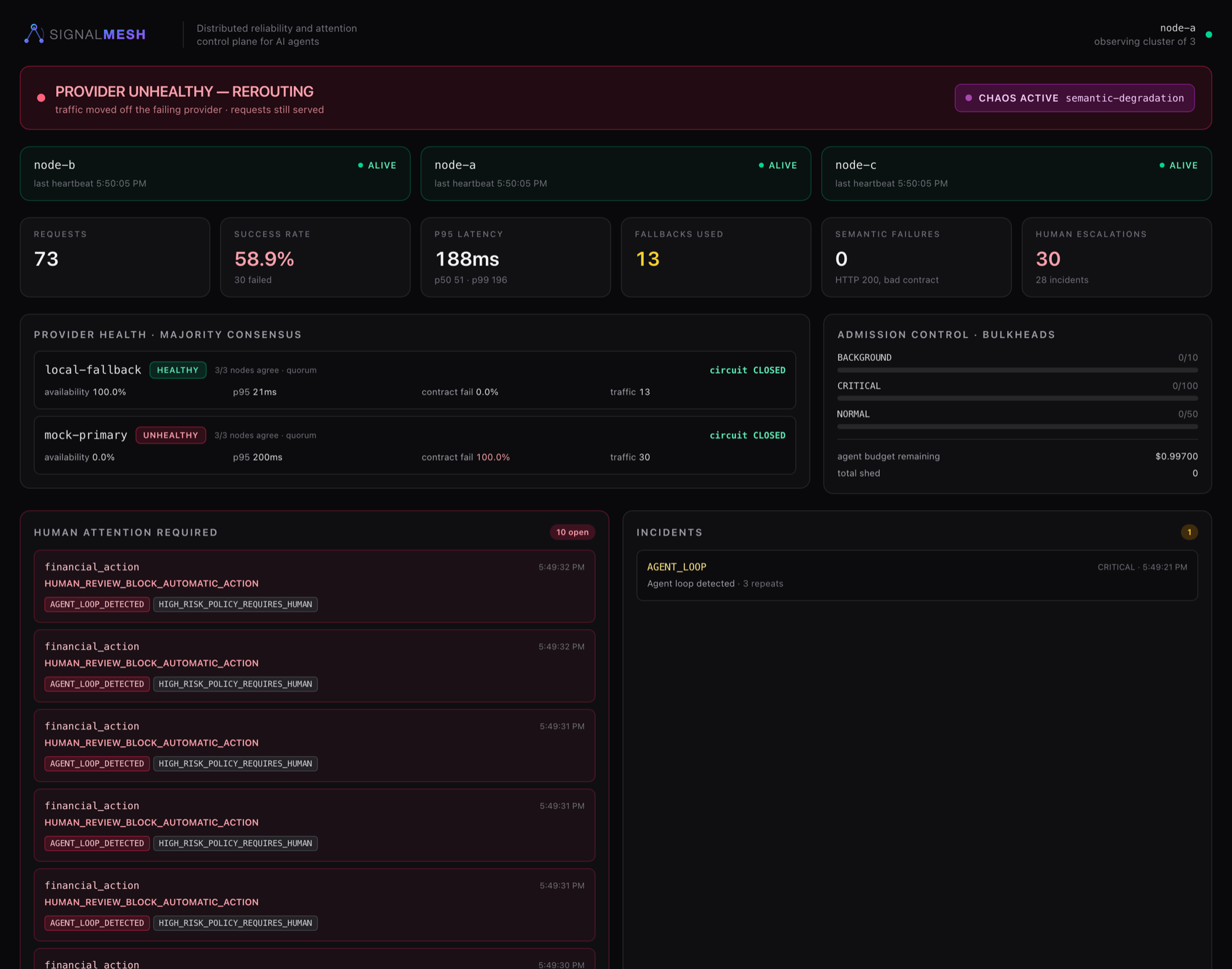
Three independent Go nodes gossip over NATS, reach majority consensus on every provider's health, and decide — deterministically, per request — whether to accept, retry, fall back, or escalate to a human. Every decision emits a machine-readable reason code, so nothing is a black box.
| Failure | What SignalMesh does |
|---|---|
| HTTP 200 with a broken contract | Semantic validation marks it a failure and reroutes |
| Total provider outage | Circuit opens, traffic moves to a zero-cost local path |
| A SignalMesh node dies | Heartbeat timeout ages it out of quorum, traffic continues |
| Agent stuck in a retry loop | Fingerprint detection trips the breaker, opens an incident, escalates |
| Traffic spike | Per-class bulkheads shed non-critical load, critical capacity untouched |
| Budget exhausted on a high-risk task | Refuses to guess — escalates to a human instead |
Every response carries its own explanation:
{
  "phase": "agent_loop",
  "reason_codes": [
    "AGENT_LOOP_DETECTED",
    "RUNAWAY_RETRY_STOPPED",
    "HUMAN_ATTENTION_REQUIRED"
  ],
  "escalation": {
    "recommended_action": "HUMAN_REVIEW_BLOCK_AUTOMATIC_ACTION"
  }
}
How routing actually decides
Routing is deterministic and auditable — no model in the control path. For a cluster of \( n \) nodes, a provider's health verdict requires a simple majority of observations from nodes that are still alive:
$$ \text{quorum}(n) = \left\lfloor \frac{n}{2} \right\rfloor + 1 $$
A dead node's observations are dropped the moment its heartbeat expires, so stale votes never prop up a failing provider. Each candidate provider \( p \) is then scored:
$$ S(p) = 40\,a_p \;+\; L_p \;+\; H_p \;-\; 0.4\,c_p \;+\; K_p \;-\; F_p $$
where \( a_p \in [0,1] \) is consensus availability, \( c_p \) is the contract-failure percentage, and the remaining terms are policy-driven:
$$ L_p = \begin{cases} +20 & \text{p95} \le \text{latency budget} \\ -20 & \text{otherwise} \end{cases} \qquad H_p = \begin{cases} 25 & \text{HEALTHY} \\ 5 & \text{DEGRADED} \\ 0 & \text{UNKNOWN} \end{cases} $$
\( K_p \) rewards staying inside budget (\( +10 \) for a zero-cost provider, \( +5 \) for one within the request budget), and \( F_p \) penalises fallbacks (\( 5 \), rising to \( 20 \) when the task is high-risk — a fallback is capacity, not a substitute for a trusted provider).
The health verdict itself is a threshold function over the probe window:
$$ \text{status} = \begin{cases} \text{UNHEALTHY} & a < 50\% \;\lor\; c > 20\% \\ \text{DEGRADED} & a < 95\% \;\lor\; c > 2\% \;\lor\; \text{p95} > 1500\,\text{ms} \\ \text{HEALTHY} & \text{otherwise} \end{cases} $$
Because it's arithmetic rather than inference, every routing decision can be replayed and explained after the fact — which is exactly what the reason codes do.
How I built it
Data plane (Go). Each request runs a fixed pipeline: admission control → loop detection → deterministic scored routing → circuit breaker → generation → semantic contract validation → quality and cost gates → escalation. Every stage can veto, and every veto has a name.
Control plane (NATS). Node heartbeats, provider-health observations, chaos commands, incidents, and escalations. Events carry IDs for idempotent delivery and timestamps plus versions, so out-of-order arrivals are ignored rather than corrupting state.
Chaos engine. Every failure mode is a single endpoint call that auto-restores. No manual process kills — which means anyone can reproduce the entire demo.
Dashboard (Next.js). Polls aggregated node state and renders cluster health, provider consensus, bulkhead saturation, and a live colour-coded reason-code stream.
Challenges I ran into
Consensus without pretending to have Raft. Three nodes independently observe a provider and disagree. The obvious answer was Raft — and it was a trap. I could not have implemented leader election and log replication correctly in a day, and shipping a subtly broken consensus layer while claiming safety would have been worse than not having one. I chose majority quorum and wrote the limitation into an ADR: under partition, each node falls back to local observations and makes no global claim. Honest and defensible beats impressive and unverifiable.
Making recovery visible. My first version detected failure in seconds but took almost a minute to show recovery, because health was averaged over a fixed-size probe buffer. Nobody watching a five-minute demo waits a minute. I bounded health to a rolling 15-second window, so the system returns to green about as fast as it went red.
Consensus that survives node loss — visibly. A dead node's last observations were still counting toward quorum. Correct behaviour was to drop them the moment the node is declared dead, which also made the demo honest: you watch \( \text{observations} : 3 \rightarrow 2 \) and quorum hold.
What I learned
This was my first serious Go codebase — I came at distributed systems from the AI side, not the other way around. I went down the stack because the failures I cared about could not be fixed at the application layer.
The bigger lesson was about honesty as an engineering practice. The strongest parts of this project are the places where I wrote down what it cannot do: ADR-006 states explicitly that this is not Raft, and the README says up front that the provider layer is a deterministic simulator. Documenting the boundary made the design better, because I stopped designing around a claim I couldn't support.
What is real, and what is simulated
Stated plainly, because it matters:
- Real: the 3-node cluster, NATS gossip, majority health consensus,
node-failure detection, deterministic routing, circuit breakers, admission
control, semantic validation, agent-loop detection, budget governance,
escalation, metrics, dashboard, and benchmarks.
go test -racepasses across the deterministic core. - Simulated: the provider upstream is a deterministic simulator. It models the failure modes faithfully — 200-with-broken-contract, latency inflation, hard 5xx — but is not a live OpenAI/Anthropic endpoint. The local fallback calls Ollama when configured, and otherwise returns a deterministic answer so the demo never depends on a GPU.
- In-memory: budgets, loop state, decision log, and incidents are node-local. Postgres and Redis are provisioned for the durable-audit and shared-state design but are not on the request path today.
Real provider connectors are one Provider interface implementation away. That was
deliberately out of scope: the reliability control plane is the project, not the
connectors.
Measured results
Real numbers from the included load generator against the live 3-node cluster —
raw JSON is committed in docs/benchmark-results/.
| Load | Result |
|---|---|
| 1000 requests @ 50 concurrent, baseline | 100% success, p95 200 ms |
| 100 requests during a total provider outage | 100% success, p95 56 ms, all on the zero-cost fallback |
p95 stays flat from 1 to 50 concurrent, which means the entire pipeline — admission, scoring, validation, breakers — adds no measurable tail latency.
What's next
Real provider connectors, Redis-backed shared budget and loop state, a Postgres audit log, task-specific response contracts, and Raft if formal safety under partition ever becomes a requirement rather than a nice-to-have.
SignalMesh doesn't just keep AI running. It decides when AI is healthy enough to keep running without you.
Built With
- chaos-engineering
- circuit-breaker
- consensus
- distributed-systems
- docker
- docker-compose
- go
- llm
- nats
- next.js
- node.js
- observability
- ollama
- prometheus
- react
- tailwindcss
- tanstack-query
- typescript

Log in or sign up for Devpost to join the conversation.