Inspiration
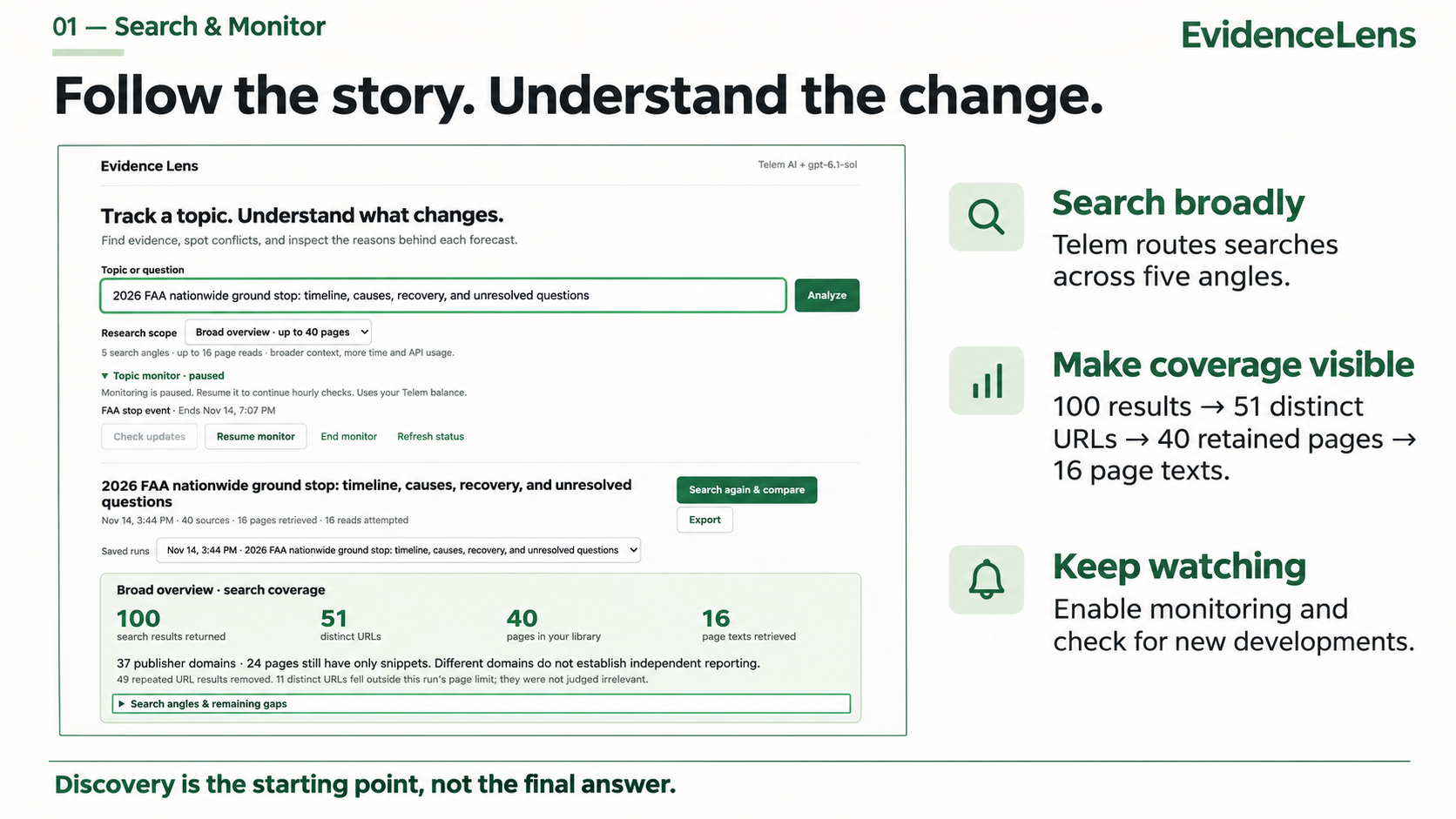
Our starting point was the Telem Monitor API. As we explored its output, we noticed that many updates repeated the same underlying reporting. A growing feed of related articles did not necessarily mean the event itself had changed.
But people monitor a topic because they want to understand what is actually happening, what has changed, and what those developments could mean for them—not simply receive more news links.
That led us to build EvidenceLens as an interpretation layer on top of Telem’s monitoring and retrieval capabilities. We wanted to connect repeated coverage, trace claims to evidence, surface unresolved disagreements, and explore possible downstream impacts.
What it does
EvidenceLens turns related news into an evidence-backed picture of an evolving event.
Built on Telem’s search, fetch, and monitoring APIs, it helps users answer three questions:
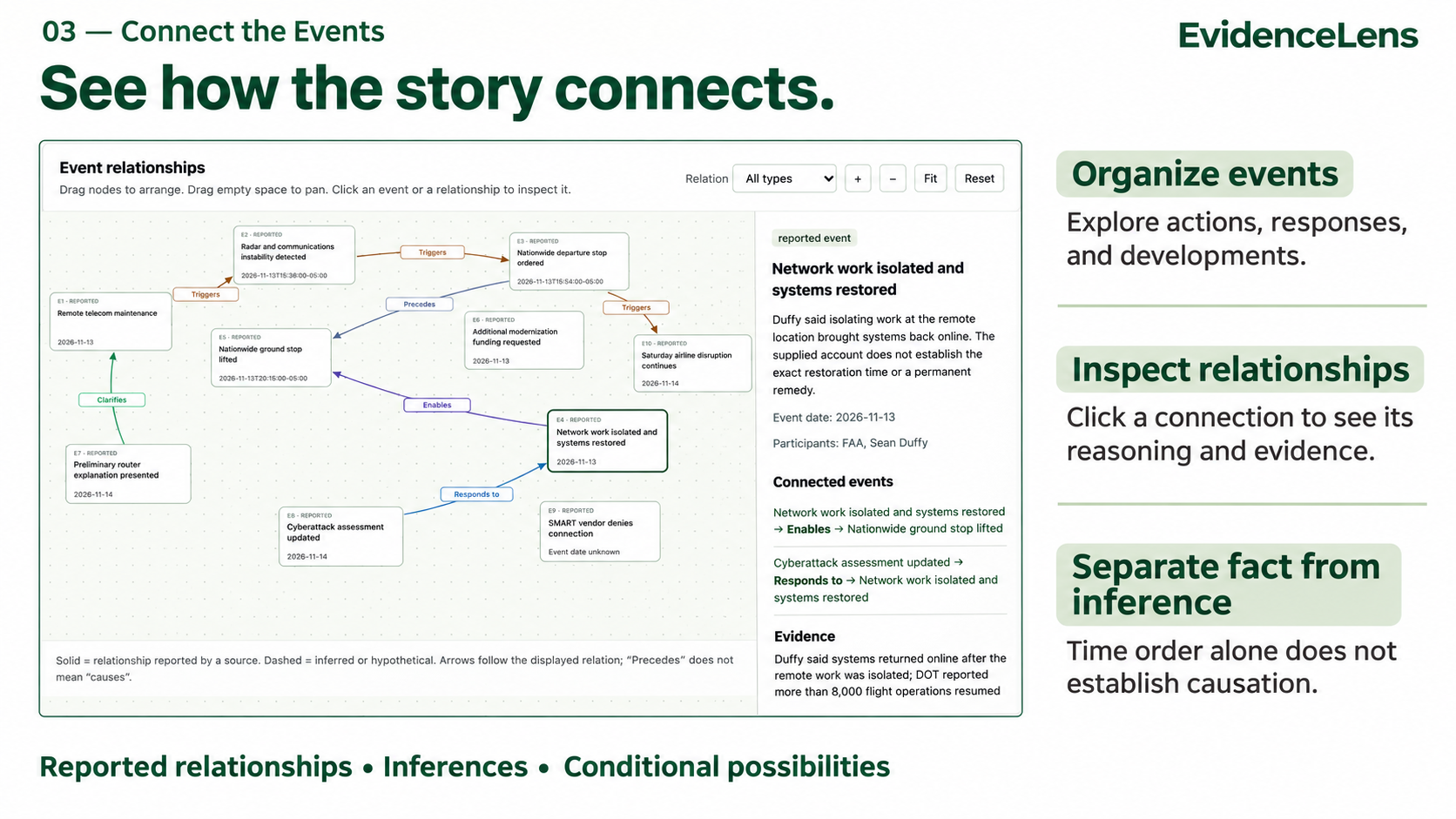
- What happened? Extract claims and events, with quotations and source links.
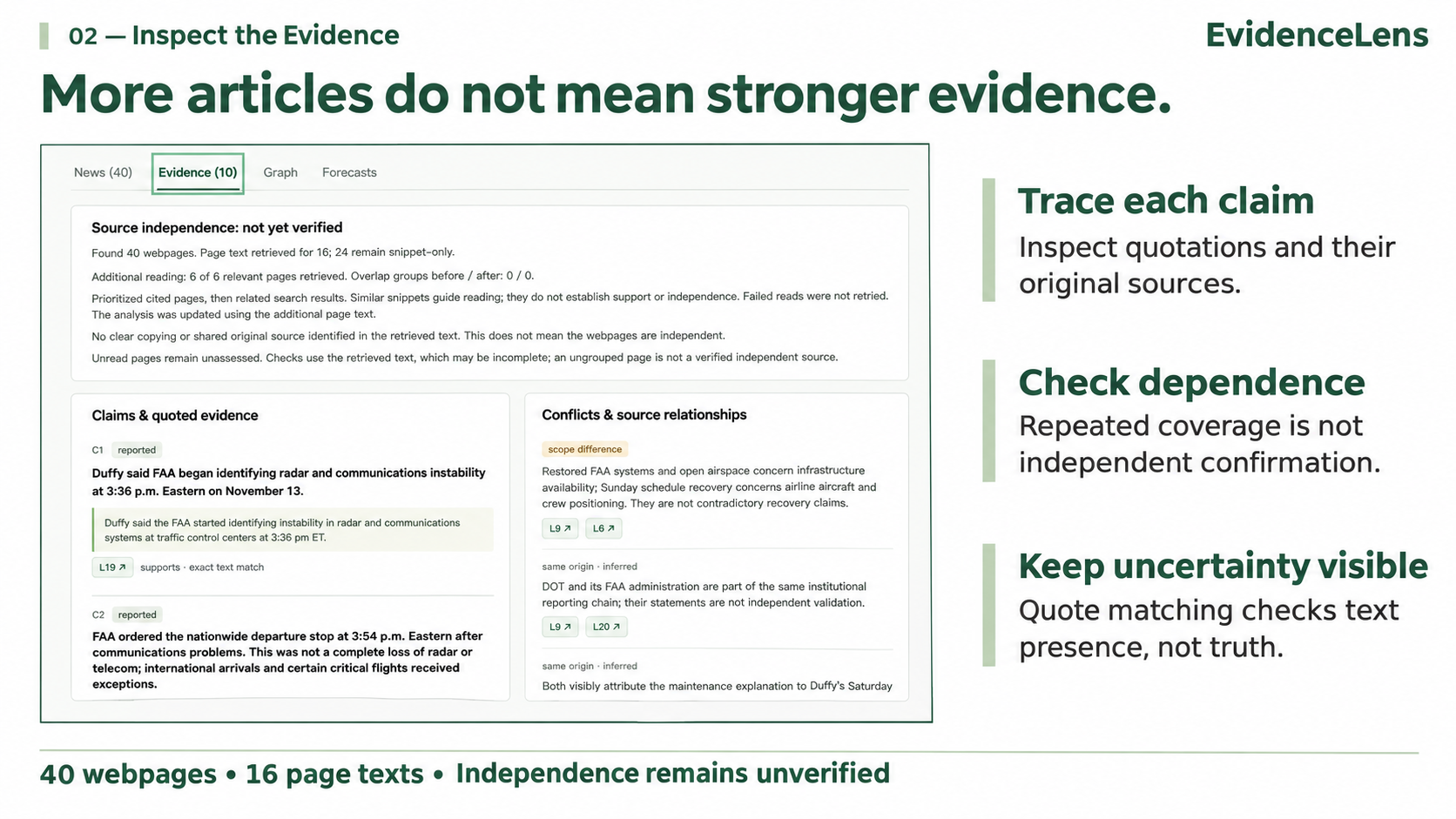
- How strong is the evidence? Identify repeated coverage, surface conflicting accounts, and keep unverified source independence explicit.
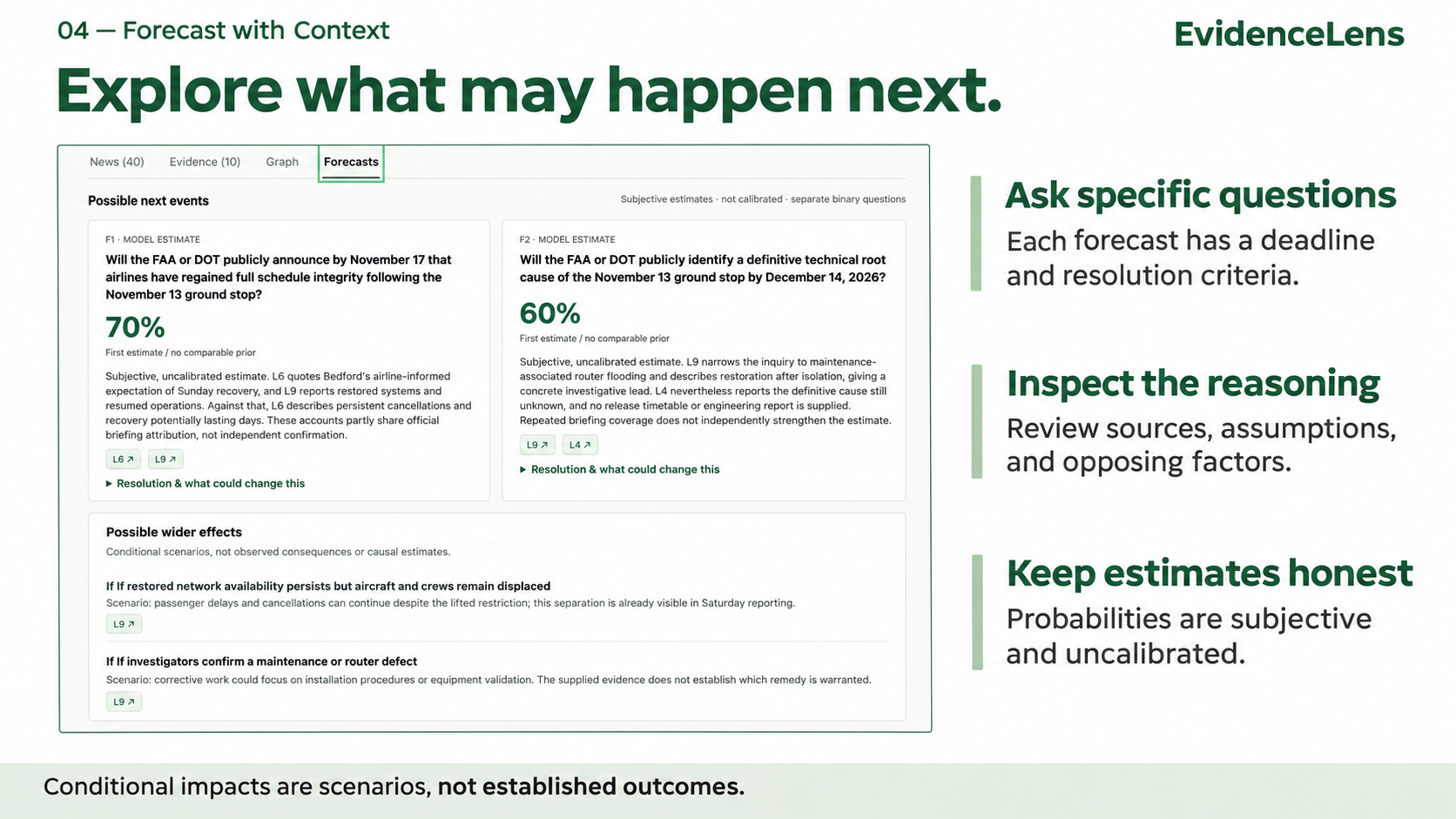
- What might happen next? Explore conditional impacts and time-bounded forecasts, with reasons and resolution criteria.
Users can inspect the evidence, check monitored developments, and compare saved research runs. Forecasts are subjective and uncalibrated; when the evidence does not justify a percentage, the app explains why no estimate is provided.
How we built it
Telem handles discovery; EvidenceLens adds interpretation and continuity.
We use Telem’s automatic routing to search across providers and fetch relevant pages. An initial analysis identifies claims, followed by a bounded reading pass that retrieves additional relevant pages and updates the analysis.
Our search strategy uses two complementary query tracks. The first looks for primary sources, official statements, and direct evidence. The second looks for corrections, contrary evidence, and alternative explanations that could challenge the emerging account.
Both tracks use Telem’s automatic routing without pinning a search provider. We merge the results, deduplicate URLs, and fetch selected pages for analysis. A follow-up reading pass prioritizes unread sources cited by claims, then related search results.
The goal is to test the emerging explanation, not manufacture a balanced debate. Conflicting reports are examined for differences in timing and scope, and missing evidence remains an explicit limitation.
The OpenAI Responses API returns structured claims, events, relationships, and forecasts. Server-side checks validate references and quotation matches, while source-grouping logic detects matching text and explicit shared attribution.
A React and TypeScript interface makes the results inspectable. Neo4j Aura stores sources, citations, event relationships, and research snapshots for later comparison.
Challenges we ran into
The central challenge was preventing repeated information from looking like stronger evidence.
Different URLs can reproduce the same report, while different accounts may describe different dates or scopes rather than contradict each other. We keep source dependence visible and avoid treating website count as independent confirmation.
We also had to balance reading depth against latency and cost. Our additional-reading pass prioritizes relevant unread pages instead of relying entirely on the first results.
Finally, uncertainty needed clear language. “No probability estimate” now explains missing evidence rather than presenting an unsupported number.
Accomplishments that we're proud of
We built a working research loop: retrieve → inspect → read further → update → preserve history.
The result connects claims to quotations, events to evidence, and forecasts to explicit assumptions. Users can investigate the reasoning behind an assessment instead of receiving only a generated summary.
We also added tests for duplicated reporting, fabricated quotations, failed retrievals, and stale analysis. Our small evaluation did not establish an accuracy advantage over a cited-summary baseline, and we kept that result visible.
What we learned
The value of monitoring is meaningful change, not notification volume.
Deduplicating URLs is only a first step. Users need to distinguish new evidence from another retelling, a preliminary explanation from an established finding, and a possible impact from an observed outcome.
We also learned that quotation matching is not factual verification. A real quotation can still be used in the wrong context. Making that boundary explicit became a core design principle.
What's next for EvidenceLens: Evidence & Impact Forecasting
Our next priority is a clearer “What changed?” view: new primary evidence, repeated coverage, revised conclusions, and unresolved questions.
To support it, we plan to:
- Expand coverage across sources, timelines, and affected parties.
- Check whether evidence supports each claim’s entity, date, scope, quantity, and negation.
- Use historical evidence and unresolved conflicts to guide targeted follow-up searches.
- Measure whether users understand developments faster and more accurately, and evaluate forecasts before claiming calibration.
Built With
- cloudflare
- neo4j
- openai
- react
- tailwind
- telem
- typescript
- vite
- workers
