-
-
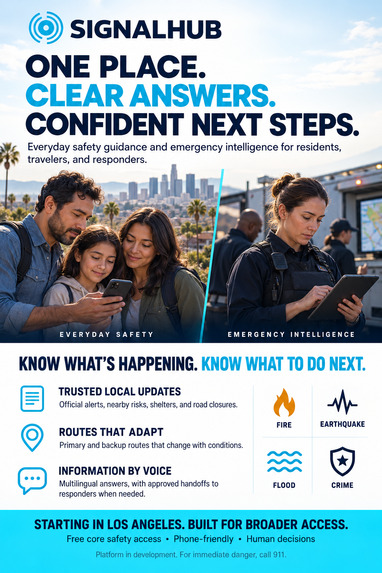
SignalHub Poster
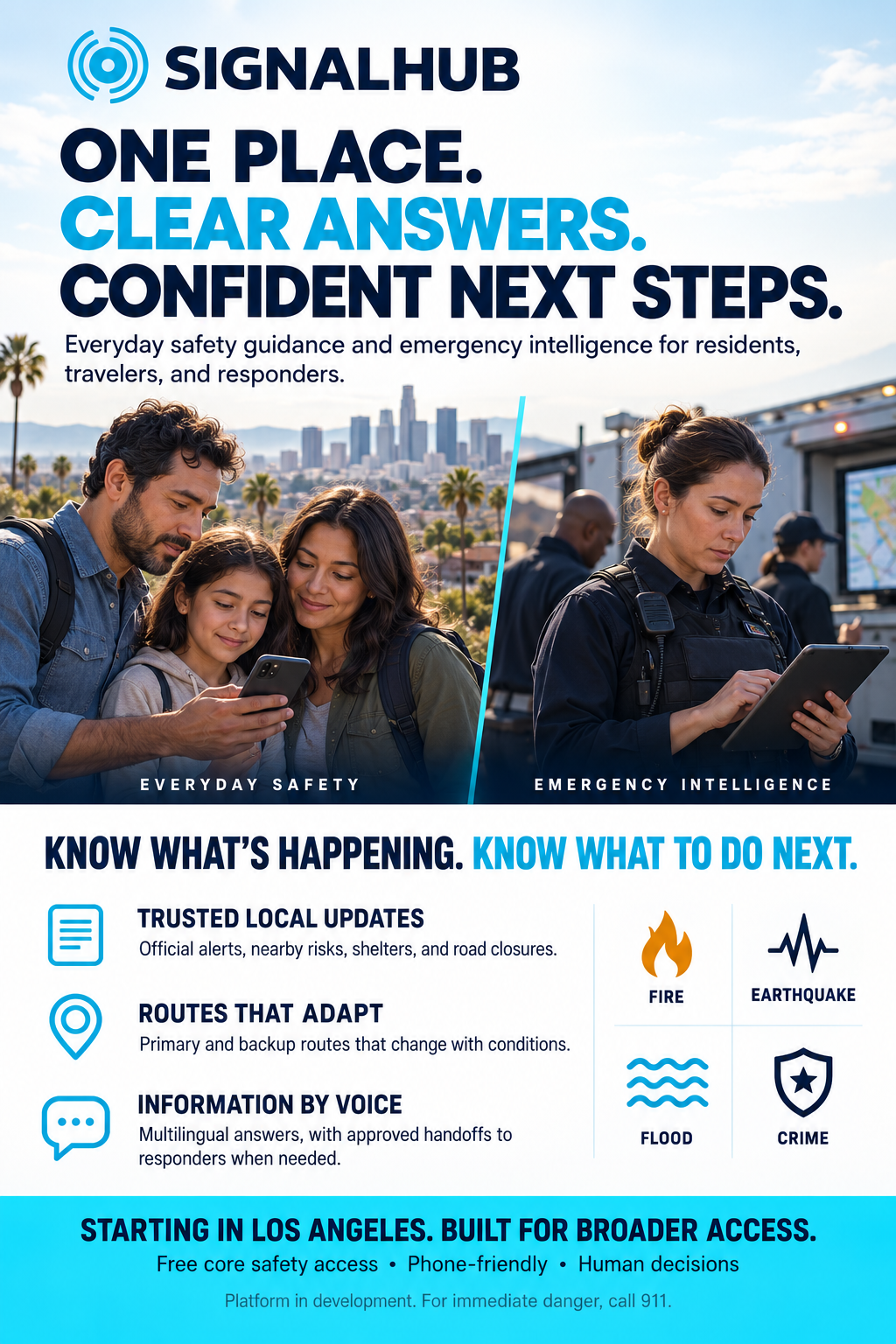
Inspiration
In Los Angeles, a wildfire, earthquake, flood, or nearby crime can leave people asking the same questions: What is happening? Is my neighborhood affected? Where should I go?
Answers are often scattered across websites, social media, maps, and phone calls. People may call emergency lines simply because they cannot find information elsewhere.
We envisioned SignalHub as one place for everyday safety guidance and emergency intelligence helping residents and travelers stay informed while giving responders a clearer picture of developing situations.
What it does
SignalHub is designed to bring official alerts, local conditions, incident information, shelters, road closures, and travel guidance into one accessible platform.
Its core capabilities include:
- Multilingual voice assistance: People can call for information and ask questions naturally.
- Dynamic routes: Primary and backup routes adapt to changing conditions, location, and mobility needs.
- Incident grouping: Related information is combined into one incident summary while preserving timestamps, source details, and supporting evidence.
- Cross-verification: Different sources are compared, with clear labels distinguishing unverified information from official updates.
- Duplicate-call reduction: Once an authorized source confirms an incident is being handled, SignalHub can show that status and direct people to updates.
- Human handoffs: If a caller describes an emergency, the proposed workflow connects them and relevant details to authorized responders through approved channels.
Core safety information would remain free. Optional paid profile upgrades could provide personalized travel deals, venue entry guidance, and booking support. Advertising and agency contracts form part of our proposed business model.
How we built it
Our approach combines Retell AI’s voice-agent technology with the SignalHub intelligence platform we are developing.
Retell AI provides the conversational phone interface. SignalHub’s planned role is to connect relevant information, group related incidents, assess source agreement, and prepare clear summaries for residents and human operators.
During the hackathon, we developed the product concept, visual interface designs, call workflows, and business model. We also mapped how the civilian experience connects with the responder experience, keeping critical emergency decisions under human control.
Challenges we ran into
One major challenge was defining SignalHub’s role clearly. People should use it for information and guidance, while emergency reporting and response remain with authorized services.
Another challenge was balancing speed with accuracy. Multiple sources can disagree, and many similar observations do not automatically confirm an event. Our design therefore emphasizes source labels, uncertainty, and human review.
We also had to consider changing routes, language barriers, limited connectivity, and people without smartphones—all while keeping the interface simple.
Accomplishments that we're proud of
We brought everyday safety information and emergency intelligence together in one coherent product vision.
We defined distinct roles for Retell AI and SignalHub, designed civilian and responder views, and incorporated dynamic routing, incident grouping, multilingual access, and confirmed response updates.
We also developed a proposed revenue model that keeps core safety access free and an expansion plan that includes underserved communities.
What we learned
We learned that useful emergency technology needs more than fast AI. It needs trustworthy sources, understandable information, accessible communication, and clear responsibility.
We also learned that reducing confusion can be valuable in itself. Answering routine questions and making existing incident updates easier to find could help reduce unnecessary calls.
Most importantly, AI should support human judgment, with people retaining control over emergency decisions.
What's next for SignalHub
Our next step is to build and test a focused Los Angeles pilot. We would seek collaboration with LAPD, fire departments, and emergency-management agencies to validate information access and approved handoff workflows.
We plan to measure information accuracy, successful handoffs, accessibility, and whether SignalHub reduces repeated information calls.
We also intend to pursue suitable federal funding opportunities, including exploring USDA NIFA SBIR for a rural-community pilot.
Following successful local testing, we would expand to other cities and countries by adapting languages, data sources, and responder connections. Future access options include proposed messaging integrations, moderated community forums, supported-device partnerships, and public SignalHub tablet kiosks for people without reliable phone access.## Inspiration
Built With
- nextjs

Log in or sign up for Devpost to join the conversation.