# Inspiration:
SignalForge was inspired by a common problem founders, agencies, and product marketers face: competitor research is usually messy, scattered, and hard to turn into a clear strategy.
Teams often collect notes from websites, pricing pages, customer reviews, social media, sales calls, and competitor products, but that information ends up spread across documents, screenshots, spreadsheets, and AI chat prompts.
I wanted to build something that felt more like a real strategy workspace, not just another chatbot. Instead of asking AI for a one-time answer, SignalForge helps users organize research into structured competitor profiles, evidence, positioning maps, and strategy decisions.
The goal was to make market positioning easier to understand, easier to collaborate on, and easier to present.
# What it does:
SignalForge is an AI-powered positioning workspace that helps users turn messy competitor research into clear market strategy.
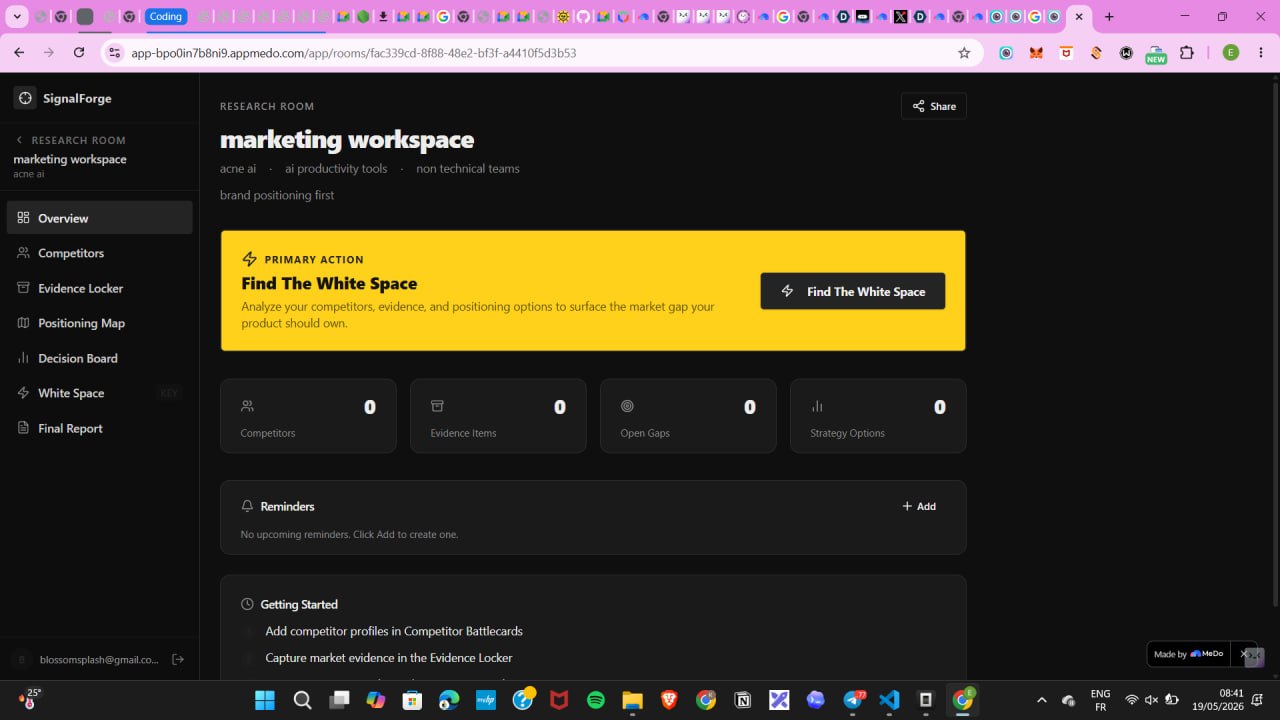
Users can create research rooms for a company, client, or product category. Inside each room, they can add competitor battlecards, store evidence, compare competitors, score positioning options, and generate a final strategy report.
The app includes:
-Research rooms for organizing each strategy project
-Competitor battlecards with structured positioning fields
-Evidence lockers for website copy, pricing notes, complaints, reviews, and sales objections
-Positioning maps to compare competitors side by side
-Strategy decision boards to score different positioning angles
White-space analysis to identify underserved market opportunities
-Client-ready final reports
-Team collaboration and shared workspace access
-Public read-only sharing links
-Notifications and invite flows
- A template library for common positioning strategies
-A navigation assistant to help first-time users understand the product
-PDF export for final reports
The main idea is simple: organize research, compare competitors, find gaps, choose a strategy, and generate a report.
# How i built it:
I built SignalForge as a web application focused on structured workflows rather than a chat-first experience. The product is organized around research rooms, which act as dedicated workspaces for each project.
I designed the app around the core flow a strategist would naturally follow:
-Create a research room -Add competitors -Add supporting evidence -Compare positioning patterns -Identify open market gaps -Score possible strategy directions -Generate a final report -Authentication was added so users can have their own private workspaces.
I also added collaboration features so a founder, employee, agency, or client can work together inside the same research room.
Users can invite registered collaborators as editors or viewers, and invited users can accept collaboration invites inside their own SignalForge account.
I also added public sharing, allowing a research room to be shared as a read-only link. This makes it useful for sending strategy work to clients, teammates, or judges without requiring them to log in.
The interface was built around cards, tables, structured forms, and reports, because we wanted SignalForge to feel like professional strategy software instead of a generic AI prompt box.
# Challenges i ran into:
One of the biggest challenges was designing the product so it did not feel like “just ChatGPT with a wrapper.” I had to think carefully about what makes the experience valuable as software. That led us to focus on structured competitor profiles, editable battlecards, evidence-backed insights, scoring tables, and living reports.
# Another challenge was collaboration:
I wanted users to be able to invite only registered users, assign roles like editor or viewer, and notify invited users inside the app.
Making sure permissions worked correctly was more complex than expected because the app needed to know who owned a room, who had editor access, who had viewer access, and who should be blocked from making changes.
I also ran into issues with saving and applying data in different parts of the app, such as research room creation, template application, and decision board options. These challenges helped us understand how important it is to connect the frontend experience properly to the database and permission rules.
# Another challenge was onboarding:
Since SignalForge has several sections, first-time users might not immediately know where to start. To solve that, we added a navigation assistant that welcomes users and explains what each feature does.
# Accomplishments that I am proud of:
I am proud that SignalForge evolved from a simple idea into a full product concept with a clear workflow and real use cases.
Some accomplishments we are especially proud of:
Turning a broad AI strategy idea into a structured SaaS product
Creating a research room model that keeps strategy work organized
Building editable competitor battlecards instead of relying on one-time AI responses
Adding an evidence locker so insights can be tied back to real research
Creating a positioning map and decision board to help users make better choices
Adding collaboration features so teams can work together Adding a public read-only sharing experience
-Adding a template library to help users start faster
-Adding a navigation assistant for first-time users
-Keeping the product focused on strategy outcomes, not just AI generation
-The biggest accomplishment is that SignalForge feels like a workspace with a repeatable process, not just a tool that gives a single answer.
# What i learned:
I learned that building an AI product is not only about generating text. The real value comes from helping users structure their thinking, organize their work, and make better decisions.
I also learned that strategy work needs evidence. If an AI tool makes a recommendation without showing where it came from, users may not trust it. That is why the evidence locker became such an important part of SignalForge.
Another major lesson was the importance of permissions and collaboration. Once multiple users can access the same workspace, the app needs clear rules for who can view, edit, invite, and share.
I also learned that onboarding matters. Even if an app has powerful features, users need guidance to understand how everything connects. The navigation assistant helps make the product easier to use for someone opening it for the first time.
# What's next for SignalForge:
Next, i want to make SignalForge’s AI analysis more powerful and more evidence-driven.
Future improvements include:
Stronger AI white-space analysis based on all battlecards and evidence
Automatic evidence extraction from pasted websites, reviews, and competitor pages
Better AI-generated positioning recommendations
More advanced client-ready report exports
Deeper collaboration features for agencies and teams
Commenting and approval workflows
More positioning templates for different industries
Version history for strategy changes
Better analytics around competitor patterns and market gaps
Long term, SignalForge can become the strategy workspace founders and agencies use to understand their market, explain their differentiation, and make stronger positioning decisions.
Built With
- css
- database-storage
- html5
- javascript
- react
- row-level-security
- supabase
- user-account-collaboration-permission
- vite


Log in or sign up for Devpost to join the conversation.