-
-
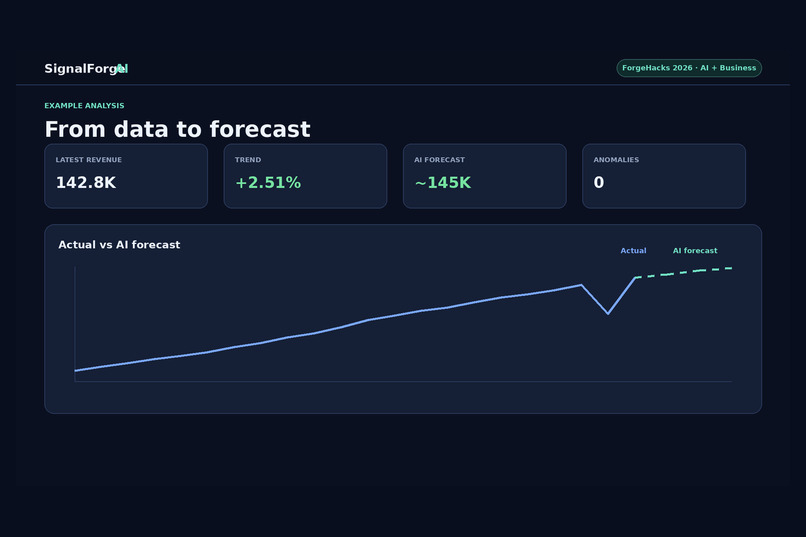
overview
-
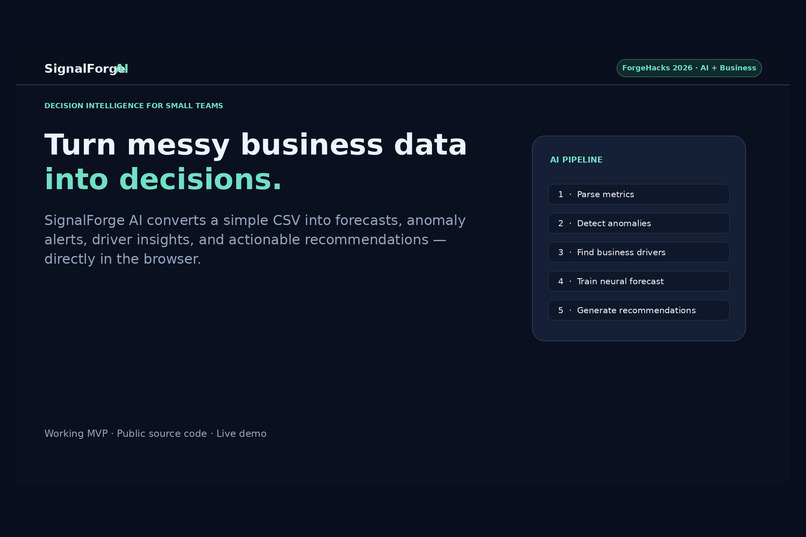
forecast resuits
-
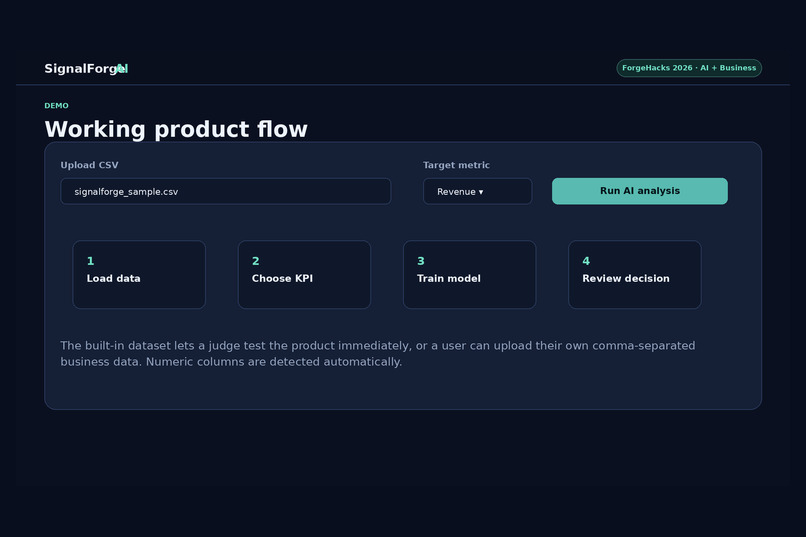
product flow
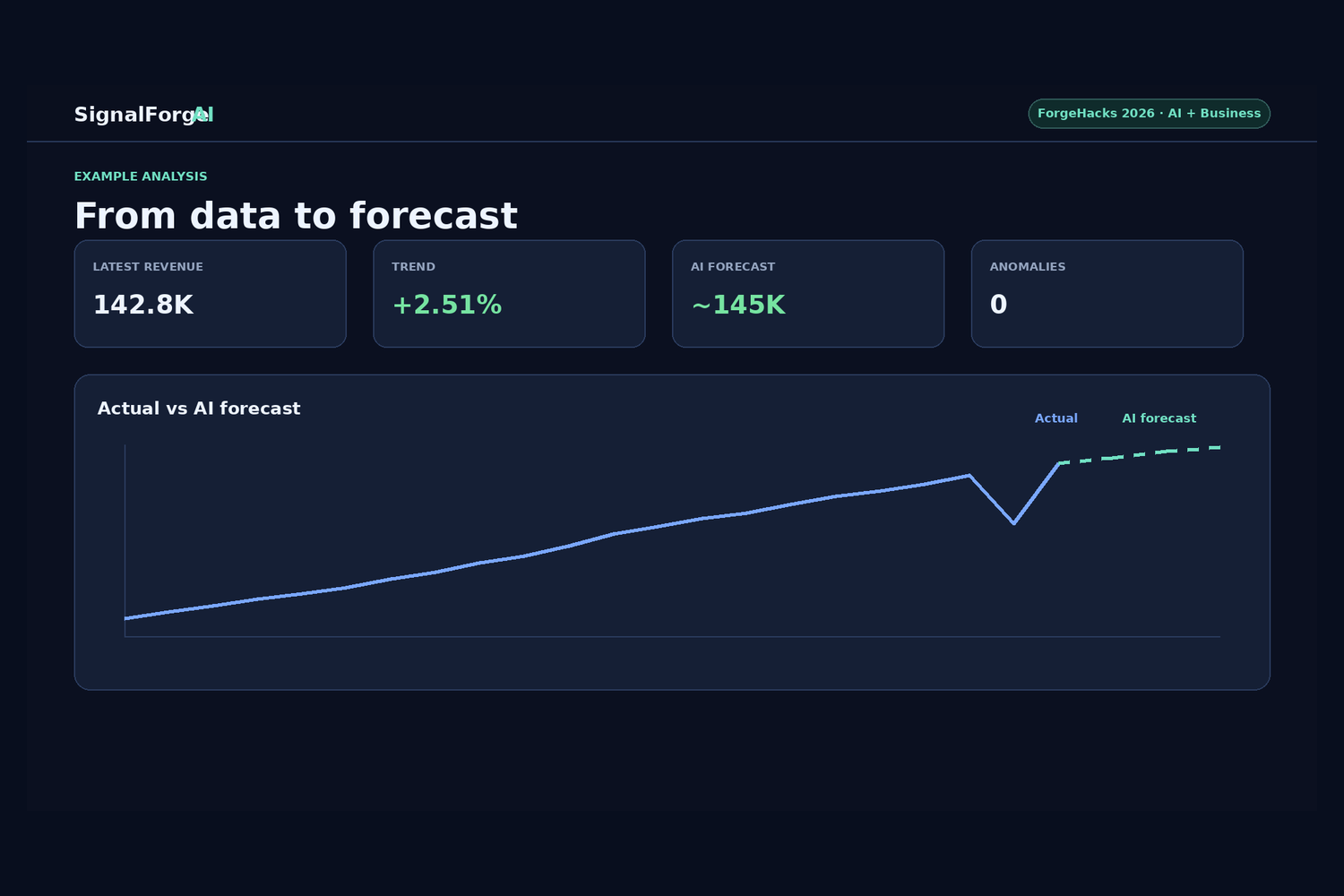
Inspiration
Small teams often have plenty of business data but no dedicated analyst or data science team. Revenue, leads, conversion, marketing spend, CAC, and churn may already exist in spreadsheets, yet turning those numbers into a clear decision still takes time and expertise.
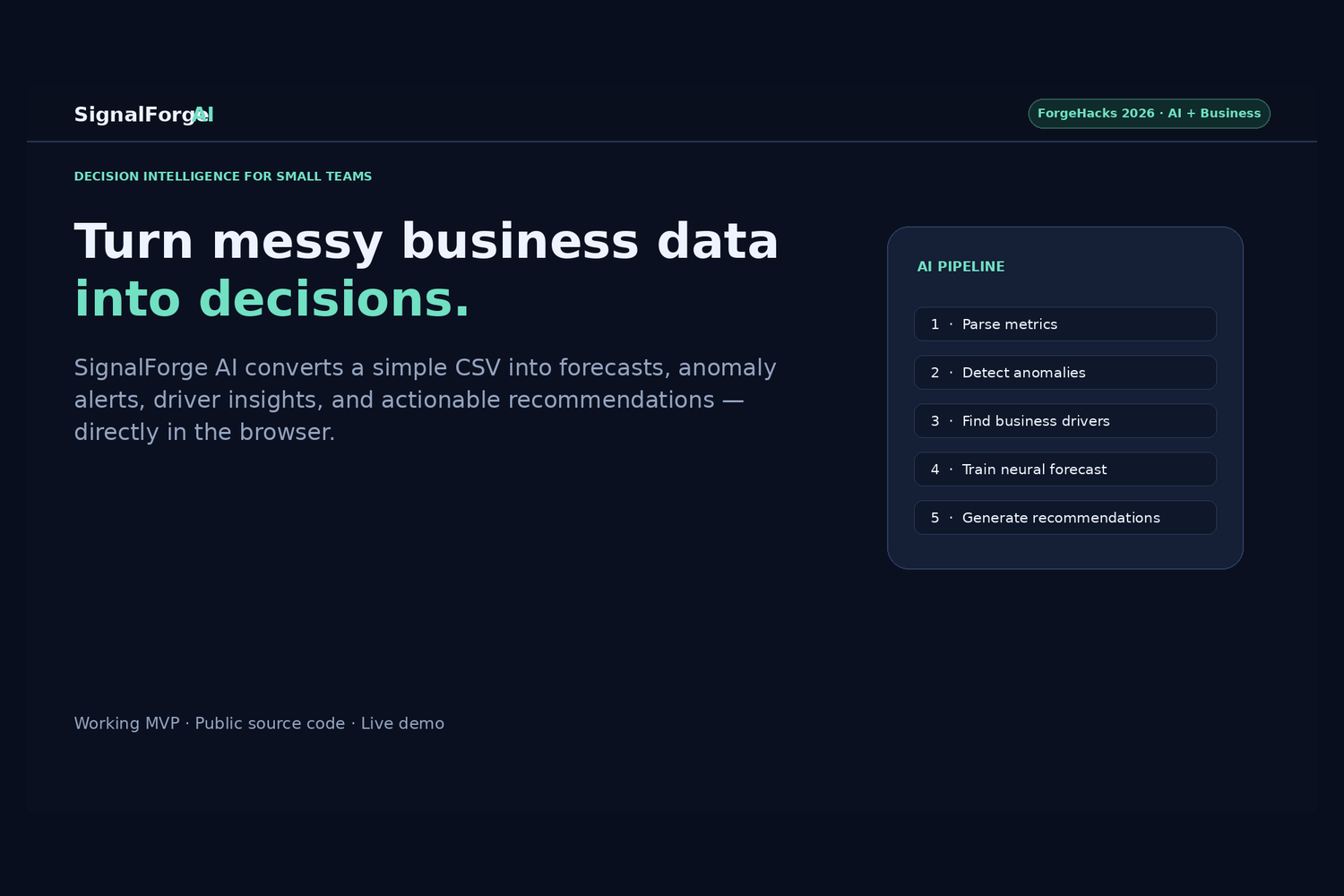
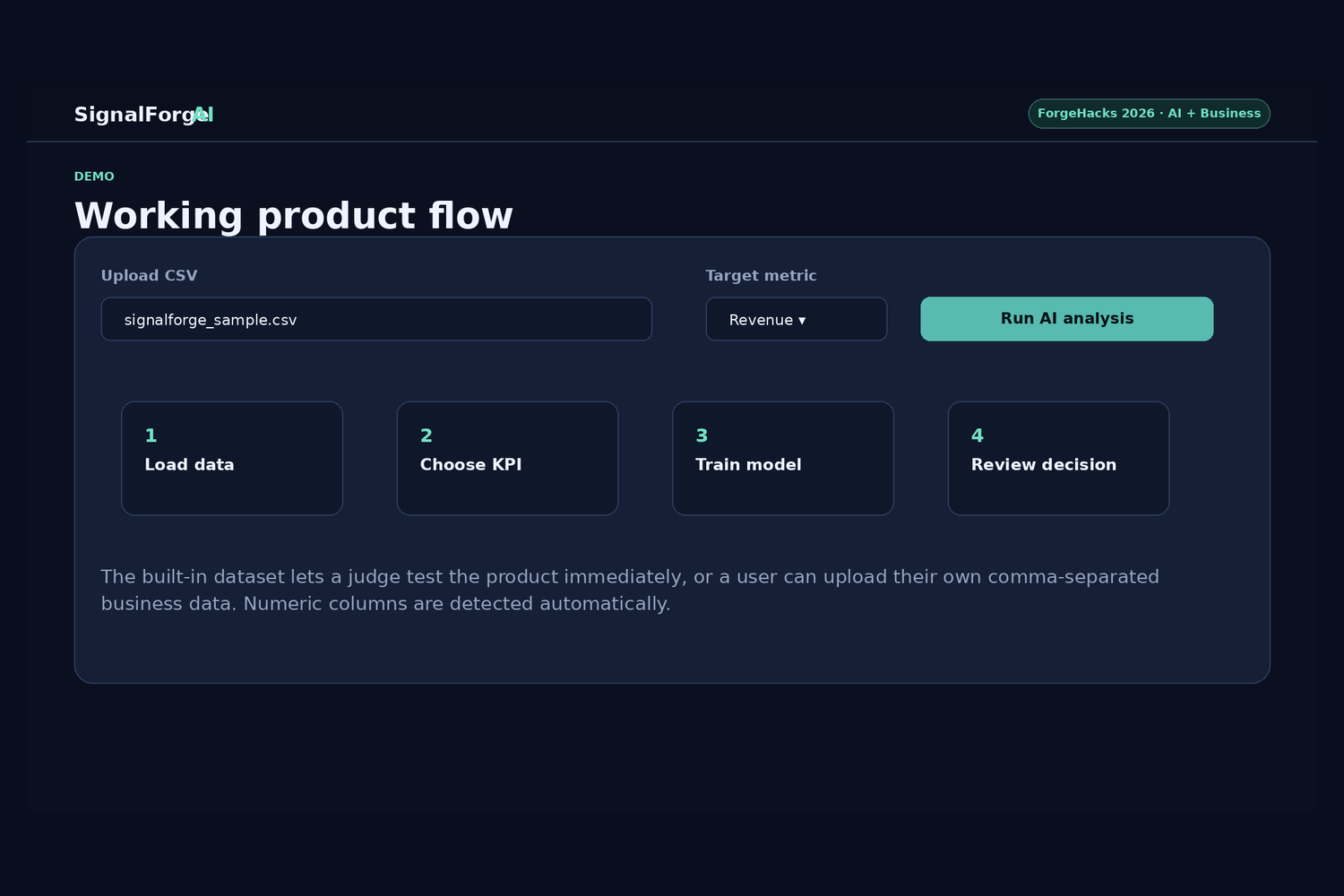
I built SignalForge AI during ForgeHacks 2026 to make business analytics more accessible: upload a dataset, choose the metric that matters, and receive a forecast, anomaly alerts, driver signals, and an actionable decision brief.
What it does
SignalForge AI turns a CSV dataset into decision intelligence.
A user can:
- upload a business CSV or use the built-in demo dataset;
- automatically detect numeric business metrics;
- choose a target KPI such as revenue, conversion, CAC, or churn;
- identify overall trends;
- detect unusual observations;
- discover metrics most strongly associated with the target KPI;
- train a neural forecasting model directly in the browser;
- predict the next business period;
- receive an executive summary and recommended actions.
The goal is to move from data → signal → prediction → decision in one workflow.
How AI is used
AI is a core part of the product.
SignalForge uses TensorFlow.js to train a lightweight neural time-series model on the uploaded business data directly inside the user's browser.
The prediction is combined with:
- anomaly detection;
- correlation-based driver analysis;
- trend analysis;
- a recommendation layer that converts these signals into business actions.
This means AI is not only used to help build the application — it is part of the functionality experienced by the user.
Privacy
Business data can be sensitive.
The current MVP processes uploaded CSV data locally in the browser. Raw datasets are not sent to an external AI API during the analysis.
How I built it
I built SignalForge AI as a lightweight browser application using HTML, CSS, JavaScript, TensorFlow.js, and Chart.js.
I intentionally kept the MVP simple enough to run without a backend while still including a real machine-learning workflow.
The neural model uses recent time-series observations to learn patterns and generate future predictions. The application then combines that prediction with statistical signals to create an executive decision brief.
Challenges
One of the biggest challenges was balancing useful AI with a fast and understandable user experience.
A more complex forecasting model could require significantly more data and computing resources. For the hackathon MVP, I designed a lightweight neural model that can train quickly in the browser.
Another challenge was avoiding misleading recommendations. Correlation does not prove causation, so SignalForge explicitly presents driver relationships as investigation signals rather than guaranteed explanations.
What I learned
Building SignalForge reinforced that useful business AI is not only about prediction accuracy.
For many users, the difficult part is understanding what a prediction means and what they should investigate or do next.
That is why SignalForge combines forecasting with anomaly detection, driver analysis, and recommendations instead of displaying only another analytics dashboard.
What's next
Next I would add:
- seasonality-aware forecasting;
- scenario simulation;
- automatic KPI interpretation;
- richer model explainability;
- saved company workspaces;
- comparison of multiple forecasting models;
- decision tracking so users can compare recommendations with actual outcomes.
The long-term vision is an AI decision analyst that makes advanced business intelligence accessible to founders and small teams without requiring a data science department.
What it does
How we built it
Challenges we ran into
Accomplishments that we're proud of
What we learned
What's next for SignalForge AI
Built With
- anomaly-detection
- chart-js
- data-analysis
- html5
- javascript
- machine-learning
- neural-networks
- tensorflow-js
- time-series-forecasting

Log in or sign up for Devpost to join the conversation.