-
-
signalflow ai
Inspiration
Procurement fraud costs enterprises over $4.7 trillion annually, yet most detection tools are black boxes — flagging anomalies without explanation, forcing operators to approve or reject blindly. We wanted to build something different: a system where AI assists but humans retain final control, with every decision fully explainable and auditable.
What it does
SignalFlow AI is a procurement fraud incident orchestration platform built on UiPath Maestro. It coordinates 4 coded AI agents through a BPMN workflow:
- Ingestion Agent — validates incoming procurement data structure
- Context Agent — checks vendor history from database
- Risk Agent — calculates risk score (0-100) with Gemini/Groq AI reasoning
- Reporting Agent — generates immutable audit trail
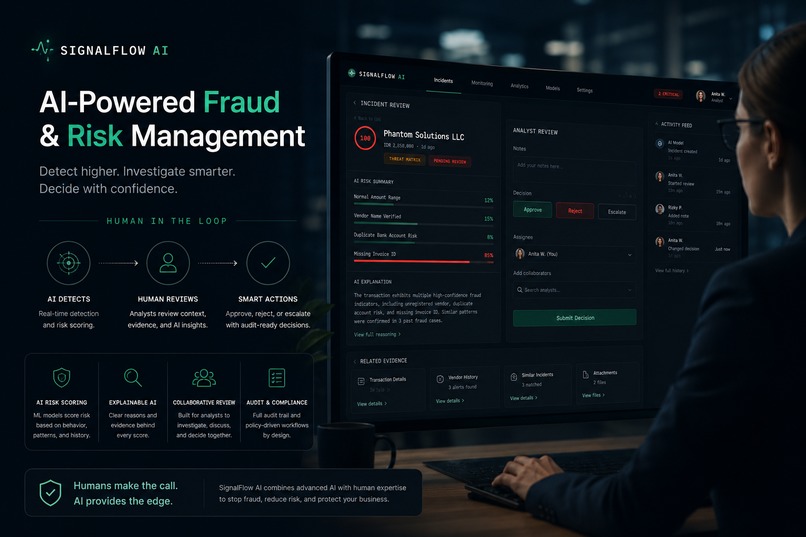
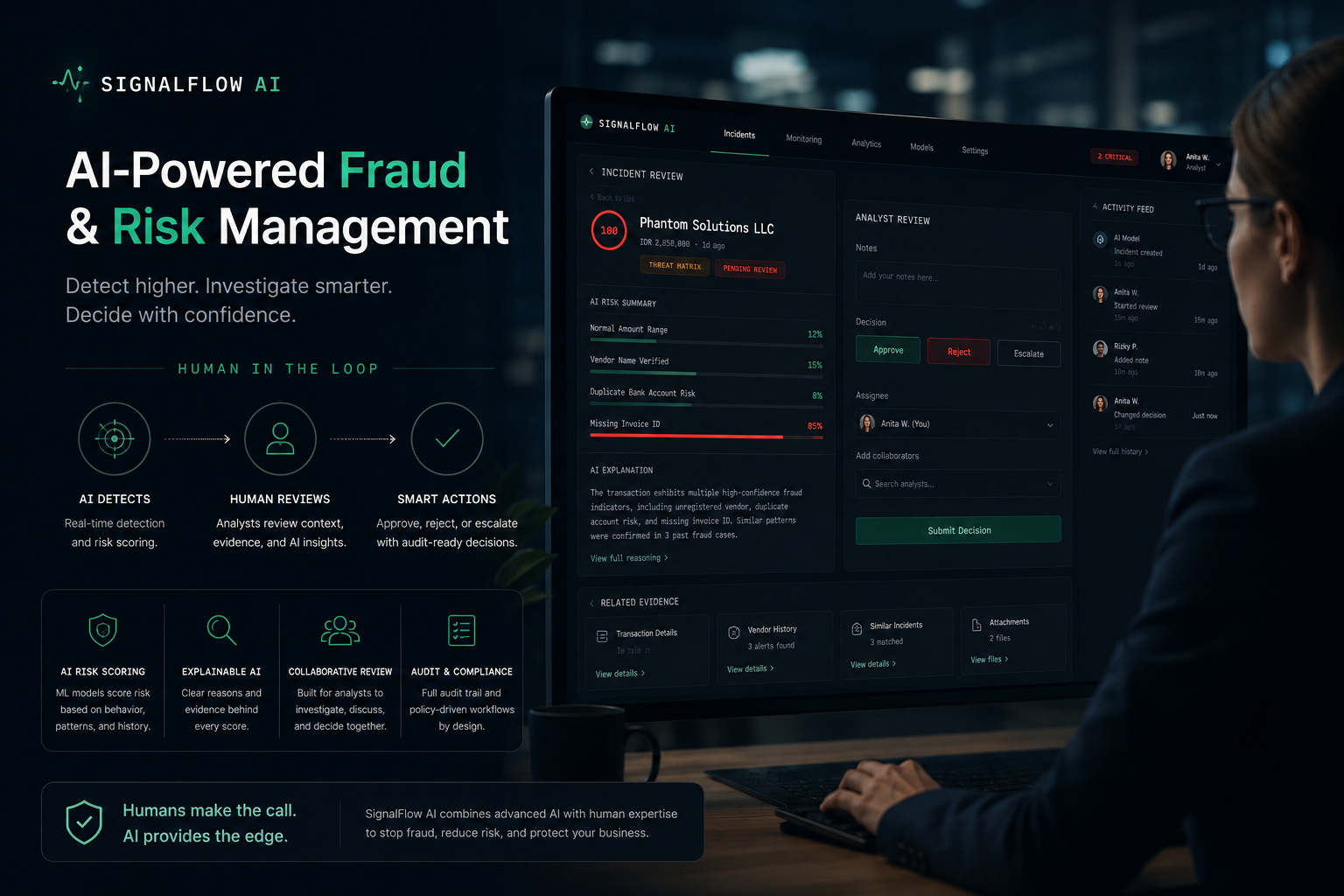
Every incident triggers a UiPath Maestro job. When risk score ≥ 80 (CRITICAL), the BPMN workflow pauses and surfaces full context to a human operator — who makes the final call via the Mission Control dashboard.
Key features:
- Threat Matrix — explainable AI with per-factor risk breakdown
- Human-in-the-Loop Override — operator approve/reject with full reasoning visible
- Immutable Audit Log — every action timestamped and compliance-ready
- Dual LLM Resilience — Gemini 2.5 Flash primary, Groq (LLaMA 3.1) fallback
- Bulk Action Safety Lock — prevents accidental approval of high-risk items
How we built it
The backend is a FastAPI Python service hosting 4 coded AI agents. Each agent is a modular Python class — making them independently testable and replaceable. The agents communicate through a shared data pipeline, with results persisted to Supabase PostgreSQL.
UiPath Maestro orchestrates the entire workflow via BPMN. Every /analyze API call triggers a Maestro job through the Orchestrator API, with the process state tracked in real-time. The BPMN gateway conditions route incidents to human review or auto-approval based on risk score.
The frontend is a Next.js + Tailwind + Framer Motion dashboard designed as a cinematic Mission Control — real-time incident feed, animated Threat Matrix, terminal-style audit log, and human override controls.
AI reasoning uses Google Gemini 2.5 Flash as primary LLM, with automatic fallback to Groq when Gemini is unavailable — ensuring the system remains operational even during API outages.
Challenges we ran into
- Dependency conflicts between
google-genai,gotrue, andpostgrestrequiring careful version management for production deployment - UiPath API authentication — understanding the correct OAuth2 client credentials flow for the staging environment took significant debugging
- BPMN condition expressions — Maestro requires specific condition expression syntax that differs from standard BPMN
- Real-time UI updates — balancing polling frequency with API rate limits while maintaining the "live" feel of the dashboard
Accomplishments that we're proud of
- Full end-to-end pipeline from data ingestion to UiPath Maestro job trigger in under 2 seconds
- Explainable AI implementation that makes risk decisions transparent to non-technical operators
- Production-grade resilience with dual LLM fallback and graceful exception handling
- A dashboard that genuinely feels like enterprise software, not a hackathon prototype
What we learned
- UiPath Maestro's BPMN orchestration is powerful for coordinating multi-agent workflows with human decision points
- Explainable AI is not just a nice-to-have — it's essential for enterprise adoption of AI in high-stakes decisions
- Dual LLM architecture significantly improves system reliability in production
What's next for SignalFlow AI
- Real-time BPMN visualization showing live process state in the dashboard
- PDF/invoice document parsing using UiPath Document Understanding
- Multi-tenant support for enterprise deployment
- Integration with ERP systems (SAP, Oracle) via UiPath API Workflows
Built With
- fastapi
- framer-motion
- gemini
- groq
- hugging-face
- next.js
- python
- supabase
- tailwind-css
- typescript
- uipath-maestro
- uipath-orchestrator
- vercel

Log in or sign up for Devpost to join the conversation.