SignalBridge
Inspiration
Running a large festival is a coordination problem as much as it is a safety problem.
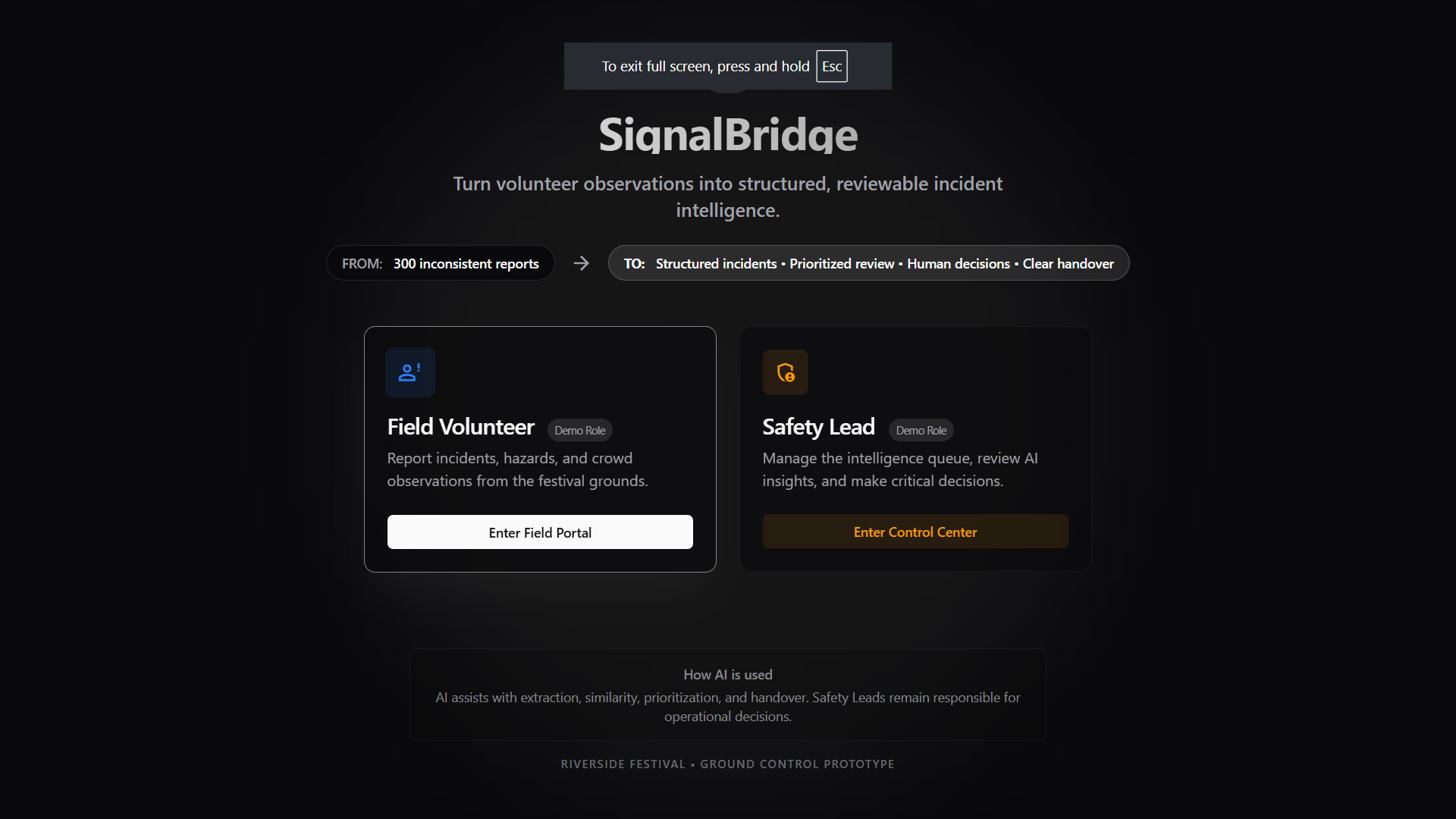
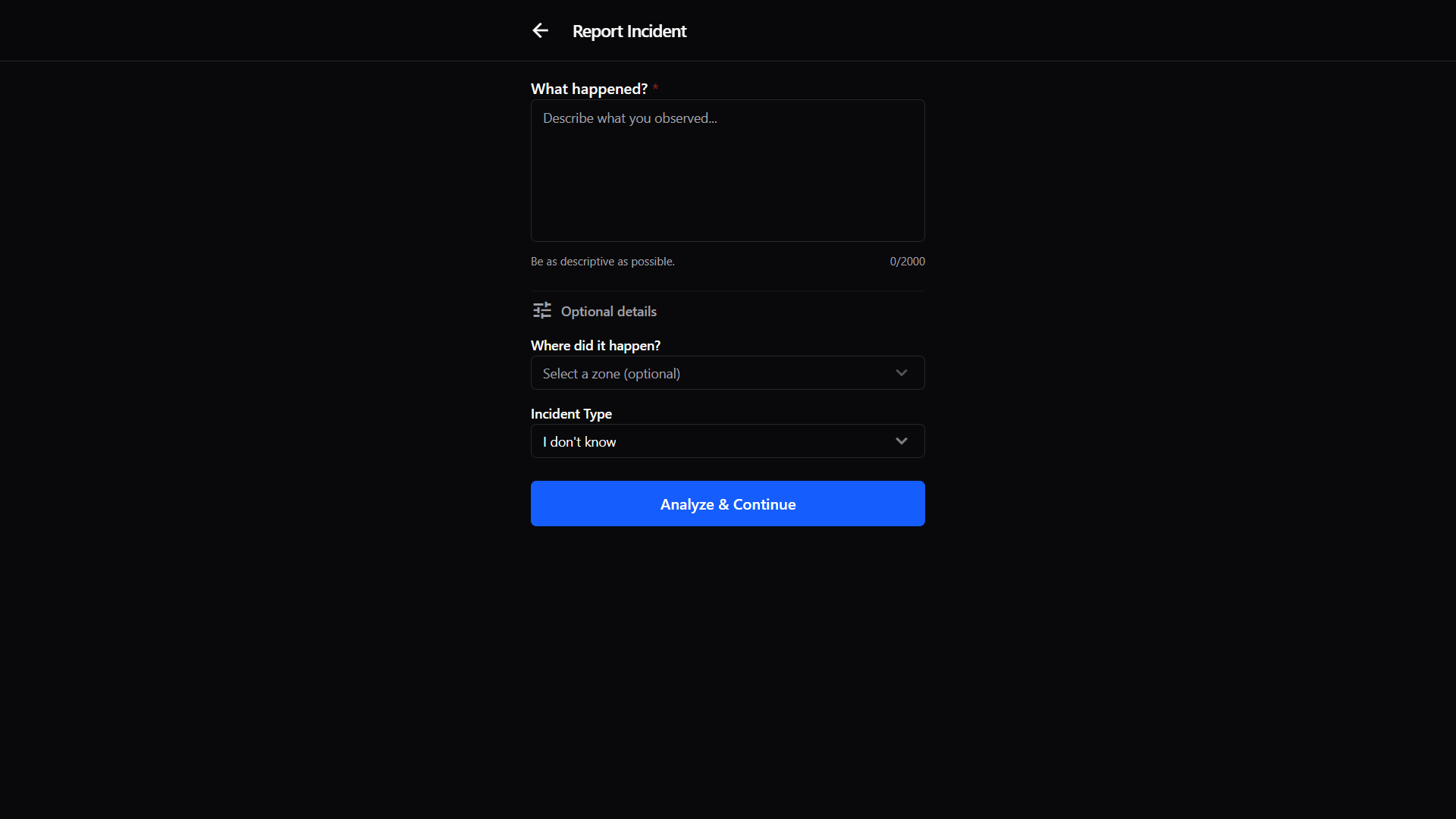
For the Ground Control scenario, we imagined a small team of 5 Fieldday Events staff coordinating 300 volunteers across a 3-day riverfront festival with up to 15,000 people per day. Volunteers may notice crowd congestion, a lost person, a blocked access route, a broken barrier, smoke, or another potential hazard — but their reports will naturally vary in wording, detail, urgency, and location.
The safety lead therefore faces a critical bottleneck:
How do you turn hundreds of inconsistent observations into reliable, actionable safety intelligence without removing humans from the decision loop?
That question inspired SignalBridge, an AI incident-intelligence layer designed to help a safety lead make sense of incoming volunteer reports quickly while keeping critical decisions under human control.
What SignalBridge Does
SignalBridge transforms an unstructured volunteer observation into a structured incident that can be reviewed by the safety team.
The workflow is:
Volunteer observation → AI extraction → location & signal analysis → priority suggestion → duplicate detection → human decision → responder recommendation → handover summary
The AI extracts information such as:
- Incident category
- Location and zone
- People or groups affected
- Observable urgency signals
- Missing information
- Confidence
- Evidence from the original report
It can also identify potentially related reports, explain why an incident may require attention, recommend an appropriate responder, and generate a grounded handover summary.
Most importantly, AI does not make the final safety decision.
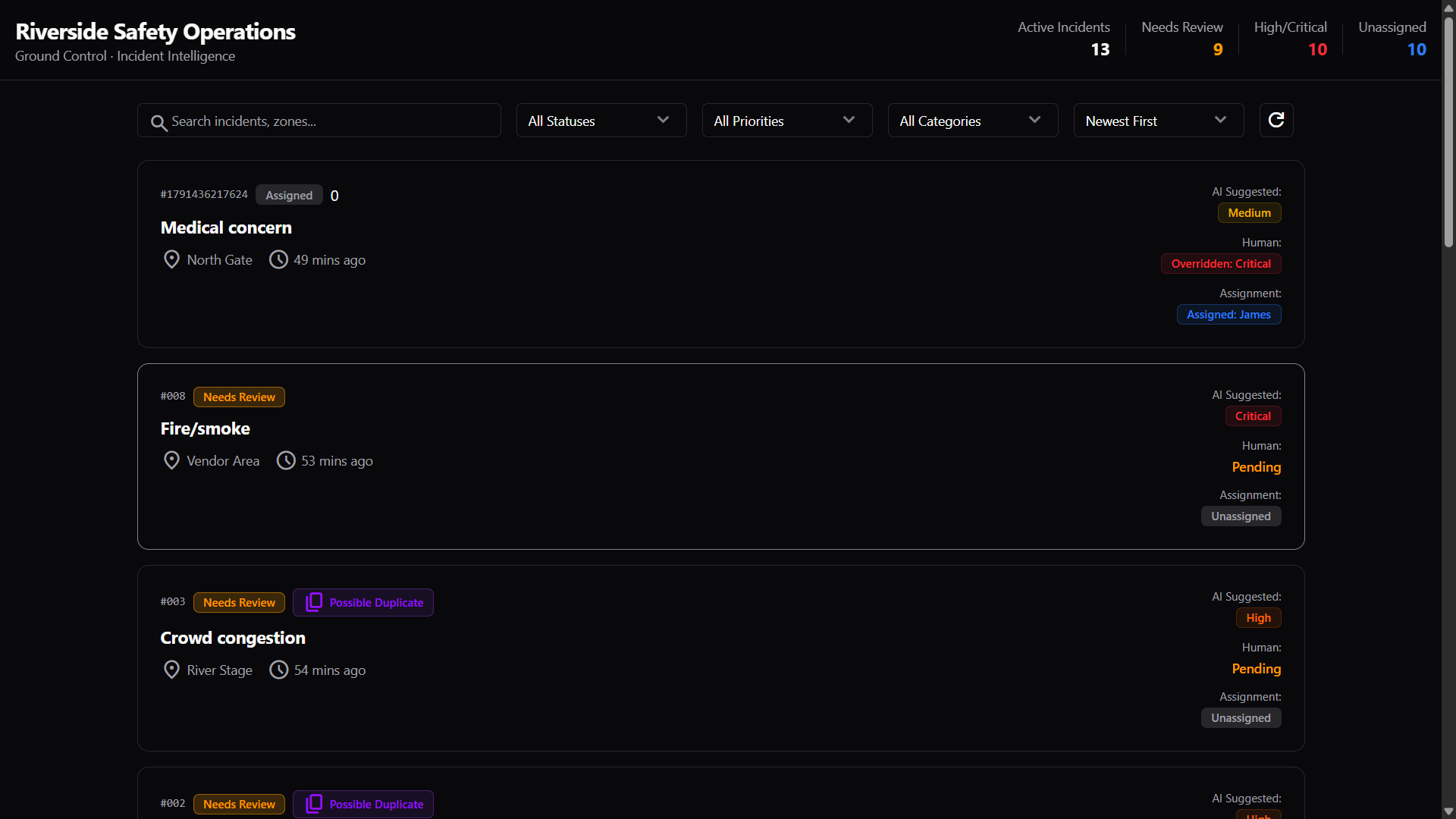
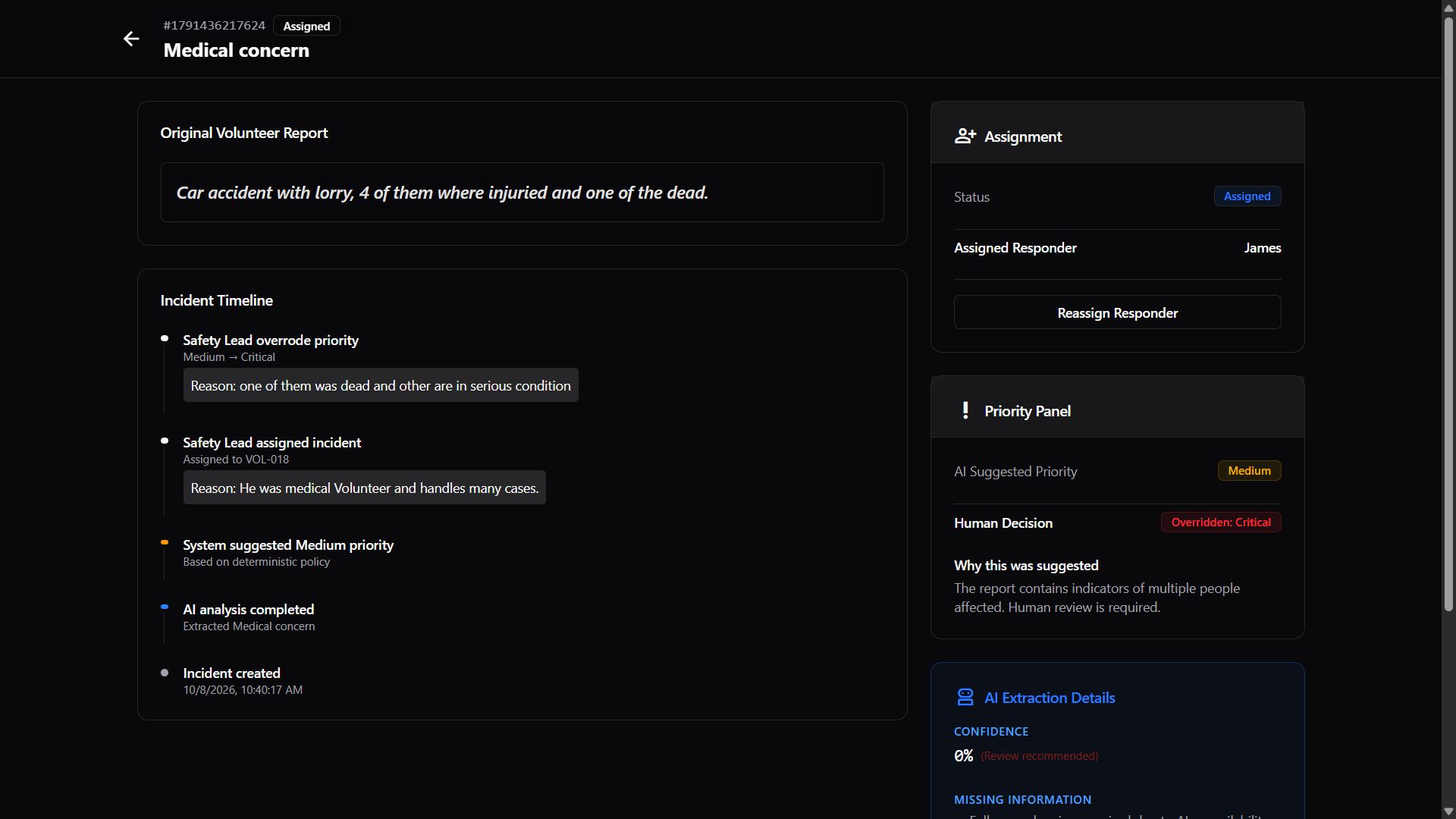
Critical actions remain explicitly controlled by the Safety Lead. The system distinguishes between AI-suggested and human-confirmed decisions, records decisions in an audit timeline, and allows the Safety Lead to override AI recommendations.
AI assists. Humans decide.
How We Built It
We built SignalBridge as a full-stack web application with separate volunteer and safety-lead experiences.
The frontend provides:
- Volunteer reporting
- AI interpretation review
- Safety incident queue
- Filtering and sorting
- Incident detail and timeline
- Priority decisions
- Duplicate review
- Responder assignment
- AI-assisted handover
The backend handles incident processing, deterministic safety policies, duplicate detection, assignment recommendations, audit logging, and AI integration.
For natural-language understanding, we use Groq-hosted LLM inference through a backend-only integration. AI outputs are constrained to structured formats so that the application can validate and use them reliably instead of treating free-form AI text as operational truth.
For safety-critical logic, we deliberately use deterministic rules alongside AI. For example, priority is not simply whatever the model says: observable risk signals are evaluated through a policy engine, while the AI provides supporting interpretation and explanation.
We also created a fictional festival dataset containing 11 incidents and 20 volunteer profiles so the complete workflow could be demonstrated realistically without using real personal or emergency data.
Challenges We Faced
One of the biggest challenges was deciding where AI should and should not be used.
It would have been easy to build a chatbot that simply summarizes reports. Instead, we wanted AI to perform meaningful work within a real operational workflow.
We therefore separated responsibilities:
AI handles language-heavy tasks
- Understanding messy volunteer reports
- Extracting structured information
- Identifying missing information
- Finding semantic similarities
- Explaining suggestions
- Generating grounded handover summaries
Deterministic logic handles operational safeguards
- Priority policy
- Duplicate thresholds
- Assignment heuristics
- Allowed incident categories
- Human approval requirements
Another challenge was designing for uncertainty. A volunteer may provide an incomplete report such as a vague reference to something happening near the river. SignalBridge does not pretend to know what happened. Instead, it highlights missing information and asks for clarification or human review.
We also had to ensure that AI failures would not break the workflow. The system includes validation, fallback behaviour, loading and error states, and human review paths so that an unavailable or uncertain AI service does not become a single point of failure.
What We Learned
Building SignalBridge taught us that applying AI to operational systems is not just about model capability.
The more important questions are:
- What should the AI decide?
- What should it only recommend?
- What must always require human approval?
- How can the user understand why the AI made a suggestion?
- What happens when the AI is uncertain or wrong?
We learned that good AI product design is about creating a reliable partnership between automation and human judgment.
For a safety workflow, the goal is not to replace the safety lead. The goal is to reduce the cognitive load of processing hundreds of reports so the safety lead can focus on decisions that genuinely require human judgment.
The Result
SignalBridge turns a fragmented stream of volunteer observations into a structured, reviewable operational picture.
A report that begins as:
"Lots of people getting stuck near the east gate, can't really move through."
can become a structured incident with a location, category, observable risk signals, missing information, AI confidence, priority suggestion, related reports, responder recommendation, and a clear human decision trail.
That is the core idea behind SignalBridge:
Turn messy signals into clear decisions — without taking humans out of control.

Log in or sign up for Devpost to join the conversation.