Inspiration
Emergency broadcasts are often accurate but hard to understand in a busy living room. SignalBridge turns a television broadcast into clear, accessible guidance for people who may miss small text, visual context, or fast spoken instructions.
What it does
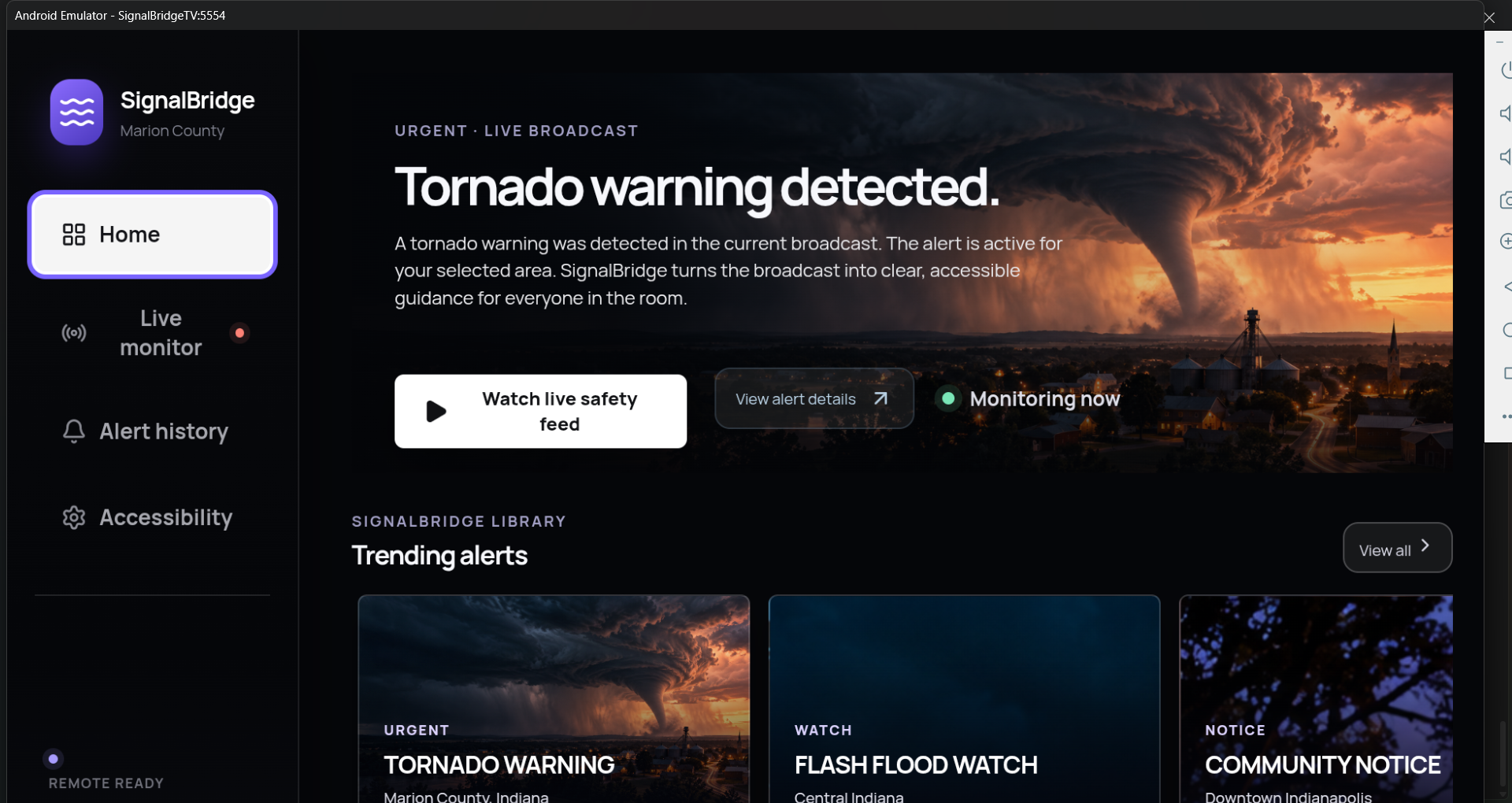
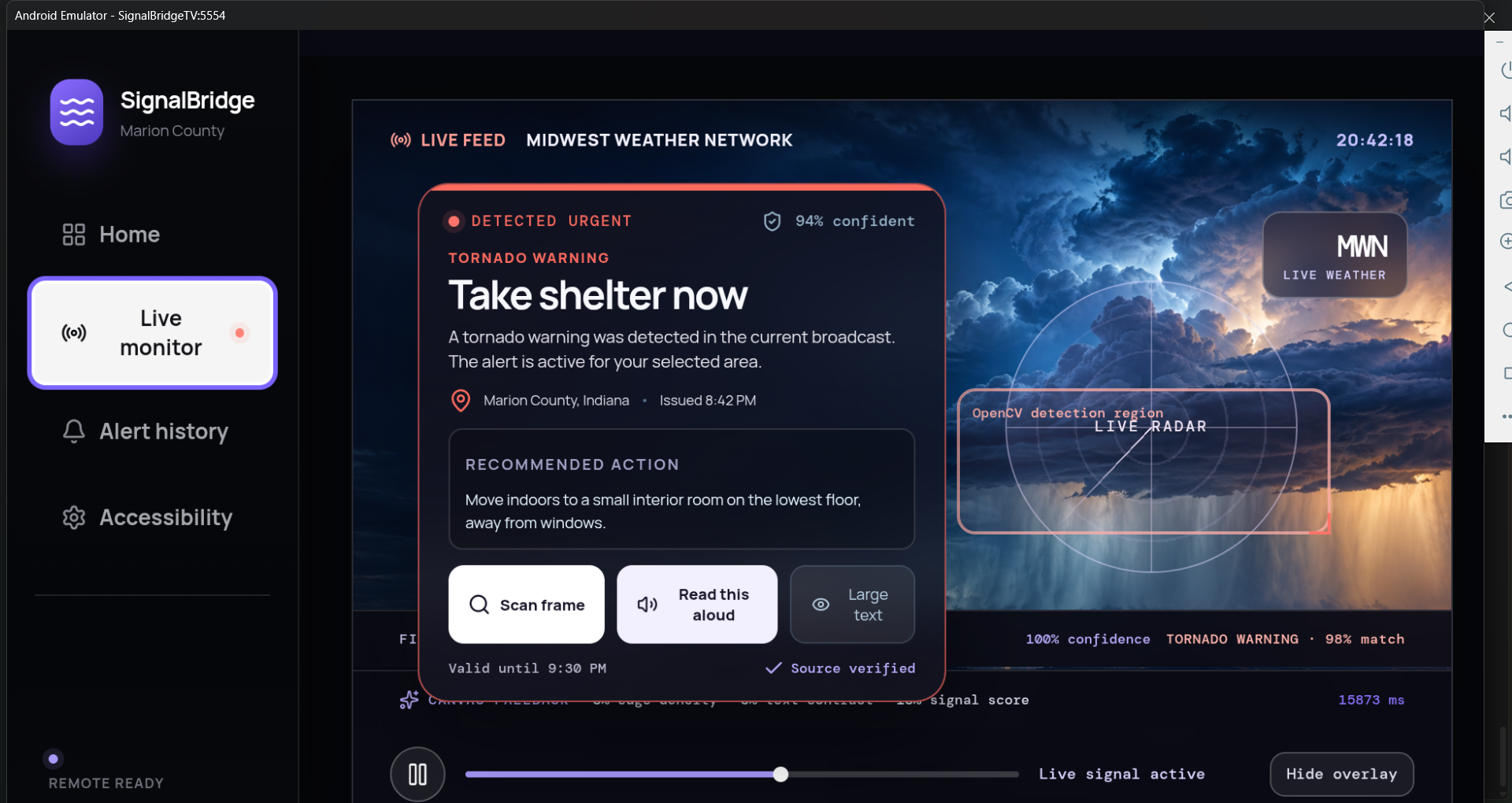
SignalBridge is a remote-first safety companion for Fire TV. It presents a high-contrast alert experience, explains what was detected, shows confidence and source verification, and gives a direct recommended action. The demo flow moves from Home to Alert Details to Live Monitor, runs an OpenCV-powered frame scan, reports a tornado warning with confidence and match score, and provides Accessibility controls, Read Aloud, Large Text, and Alert History.
How we built it
The project is a TypeScript and React web application built with Vite and designed around a 1920x1080 TV layout. OpenCV.js performs edge analysis on the demo frame, while OCR and alert-normalization adapters produce structured severity, category, confidence, and guidance metadata. The app runs in an Android TV API 36 emulator through a WebView harness and is packaged with a Fire TV HTML5 ZIP workflow. The interface uses large focus targets and deterministic D-pad navigation so the experience can be operated like a TV app.
Challenges we ran into
The biggest challenge was proving a TV interaction model on a Windows development machine without physical Fire TV hardware or the Kepler Virtual Device. We solved that by validating the app in the Android TV Emulator, testing 1920x1080 rendering and remote-style input, and keeping the detection pipeline honest with deterministic fixtures and a documented fallback for offline WebViews.
Accomplishments that we're proud of
We built a cohesive safety workflow instead of a single alert screen. A reviewer can follow the alert from detection to explanation to action, inspect the visual evidence, run a scan, and change how information is presented for accessibility. The repository includes automated tests, architecture notes, a Fire TV packaging path, and a reproducible emulator demo.
What we learned
TV UX requires a different rhythm from desktop UX. Focus state, readable hierarchy, predictable navigation, and short guidance matter as much as the computer vision result. We also learned to separate the detection contract from the current fixture source so a live classifier or broadcast integration can be added without redesigning the user experience.
What's next for SignalBridge
Next we would connect a live broadcast source and production classifier, add real alert feeds, and port the validated web shell to a native Fire TV or Vega implementation. We would also add remote-focus regression tests and measure alert comprehension with people who rely on large text, captions, or spoken guidance.
Built With
- accessibility
- android-tv-emulator
- computer-vision
- fire-tv
- opencv.js
- react
- tesseract.js
- typescript
- vite
