-
-
Logo
-
-
-
-
-
-
Signal Table
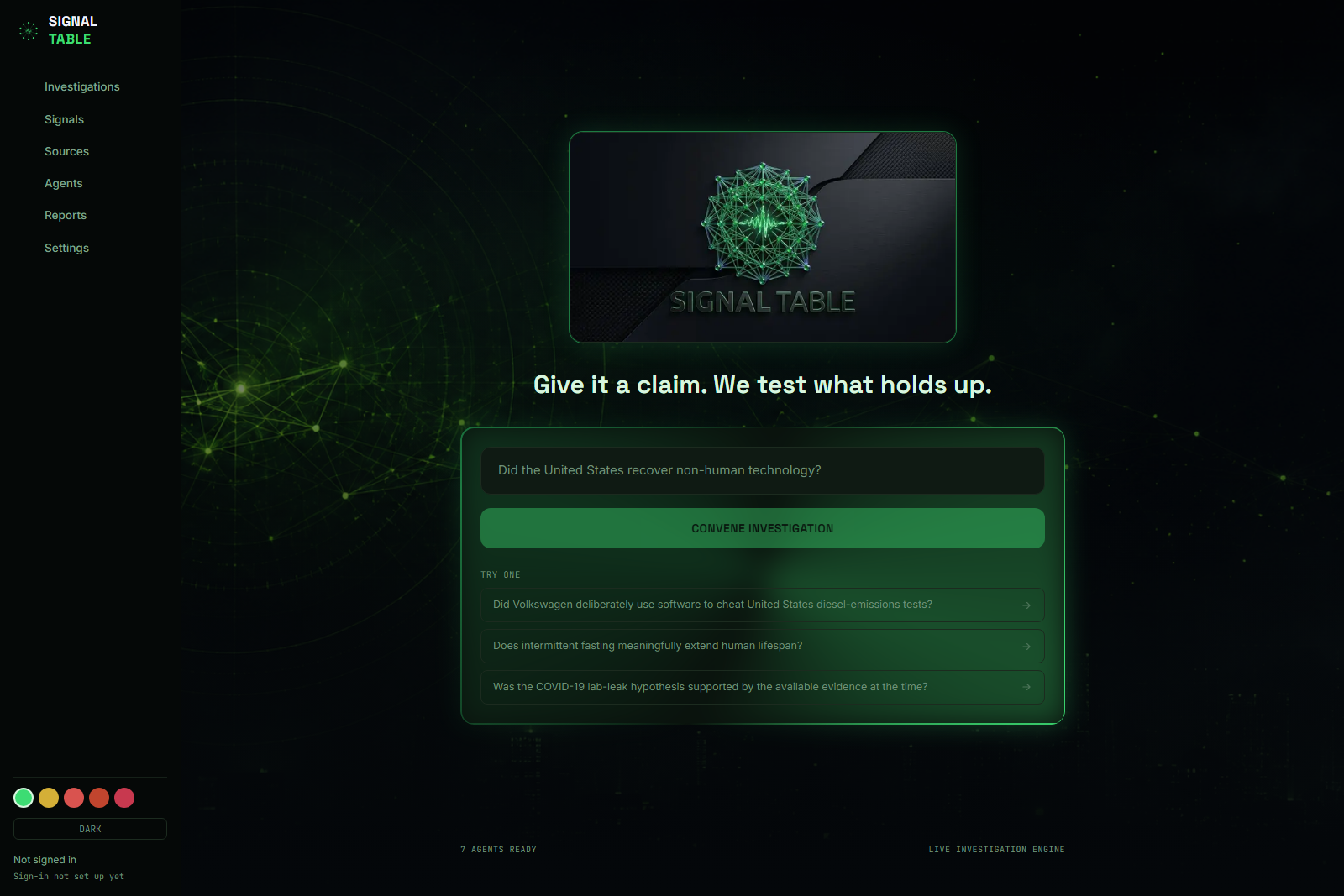
Signal Table is a collaborative research partner for contentious questions.
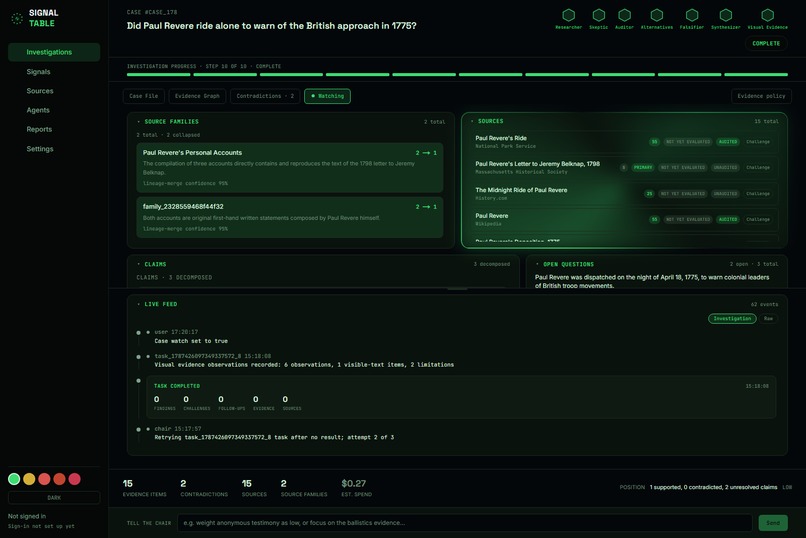
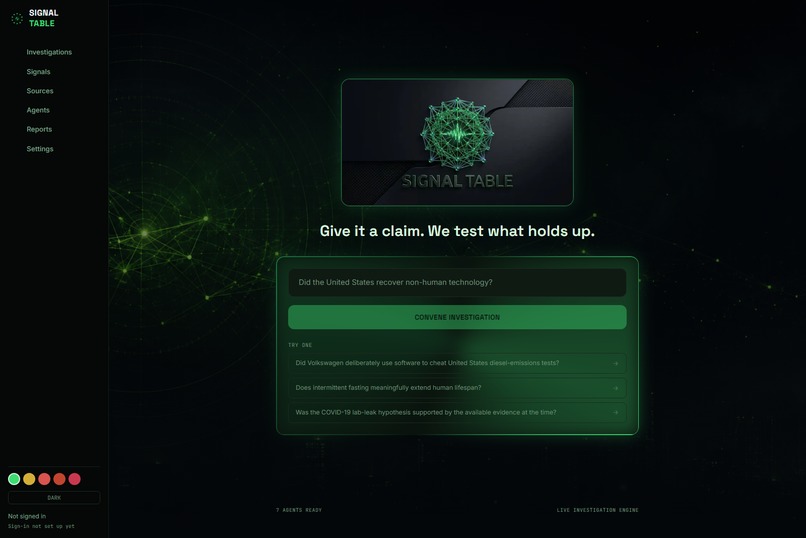
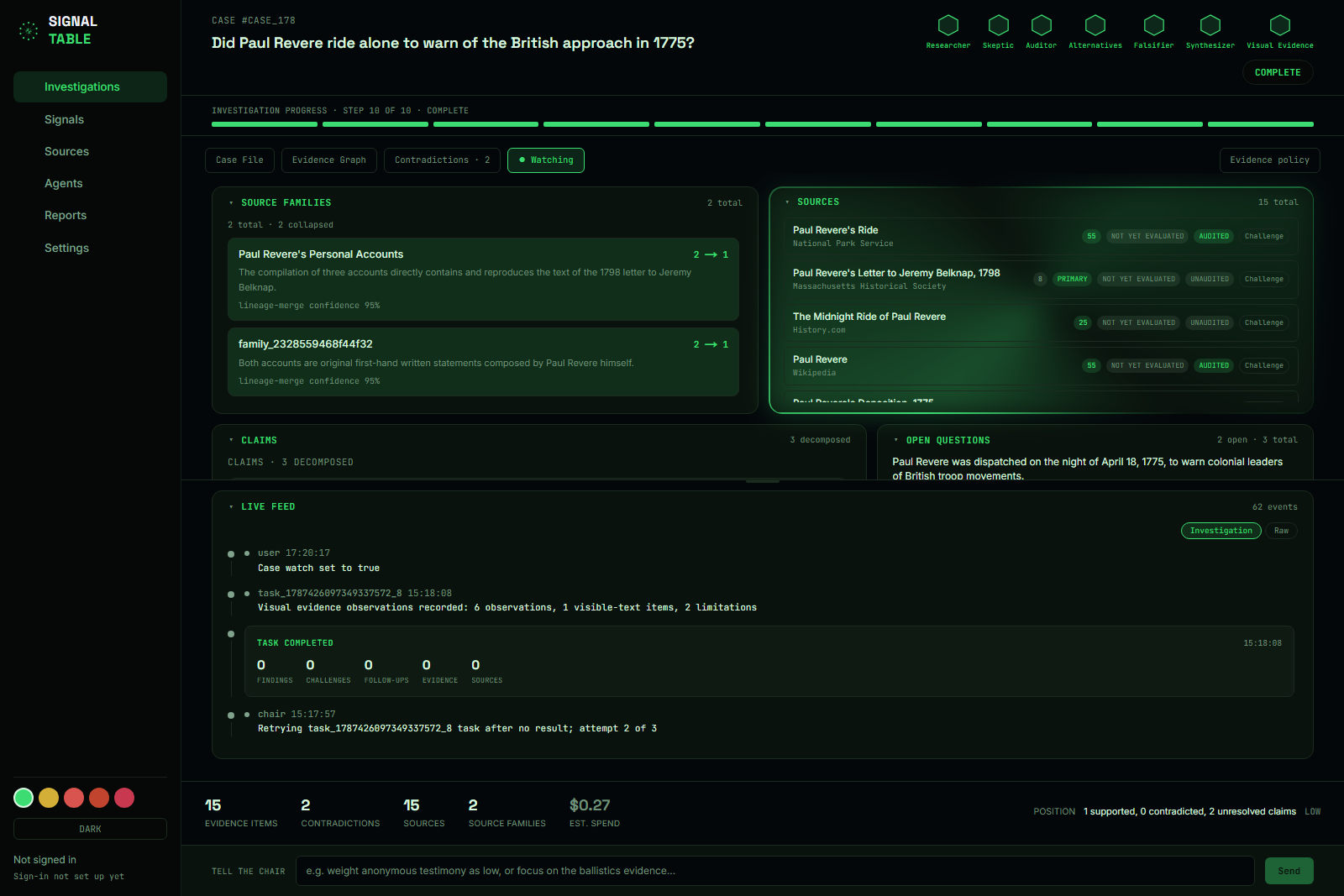
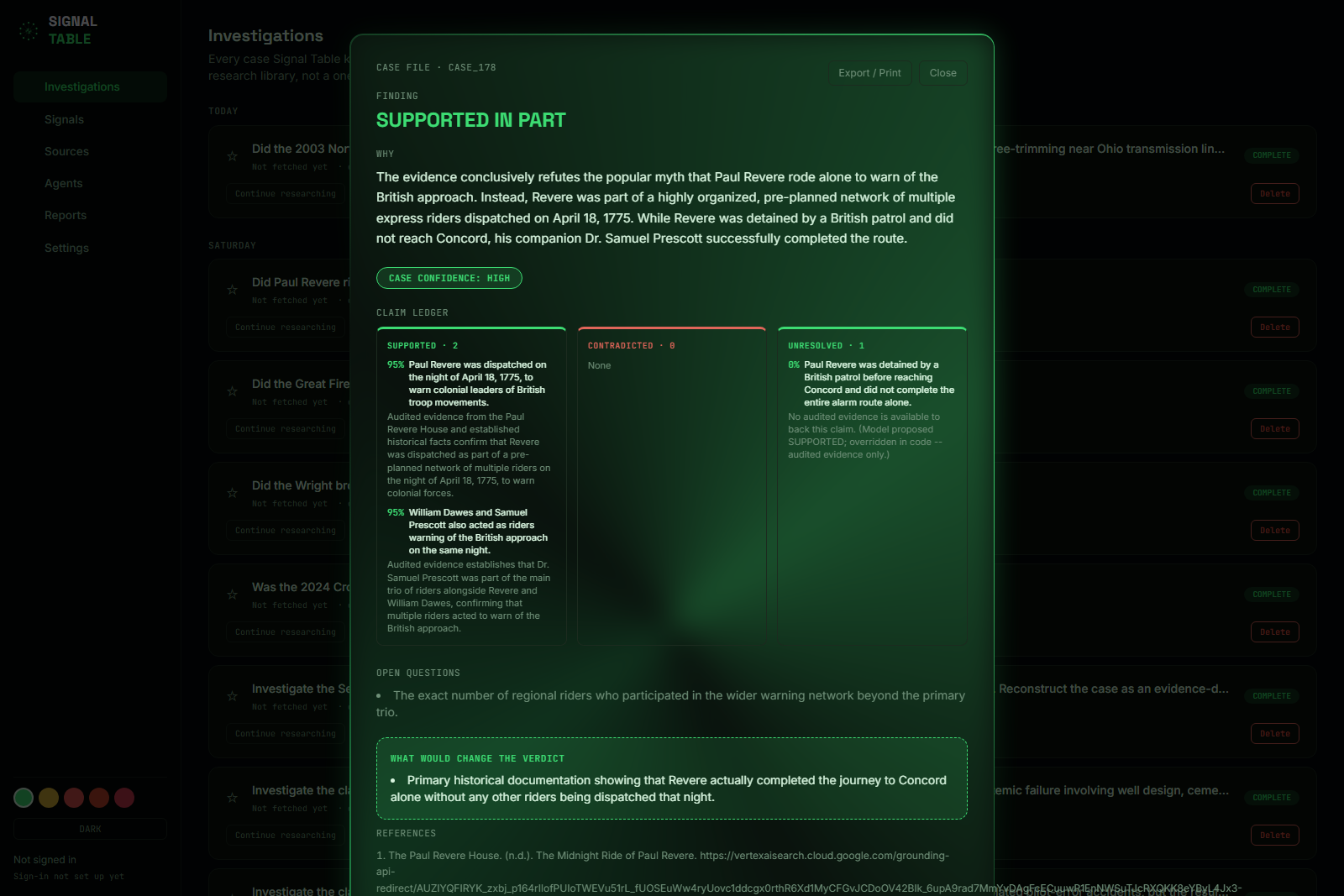
Instead of returning a single opaque answer, Signal Table helps the user convene and steer an evidence-driven investigation. The user provides a claim, question, or uncertainty. A Chair agent decomposes it into individually testable claims, then coordinates specialized agents that research, challenge, audit, falsify, and synthesize the available evidence.
How it works
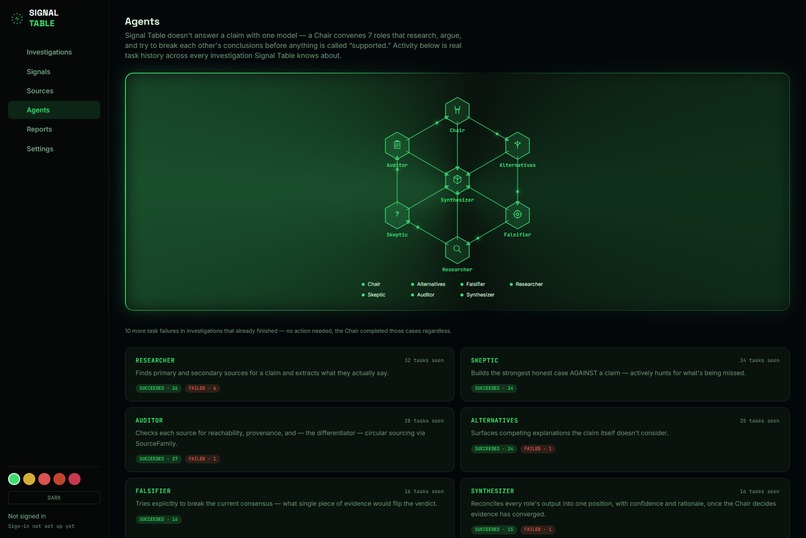
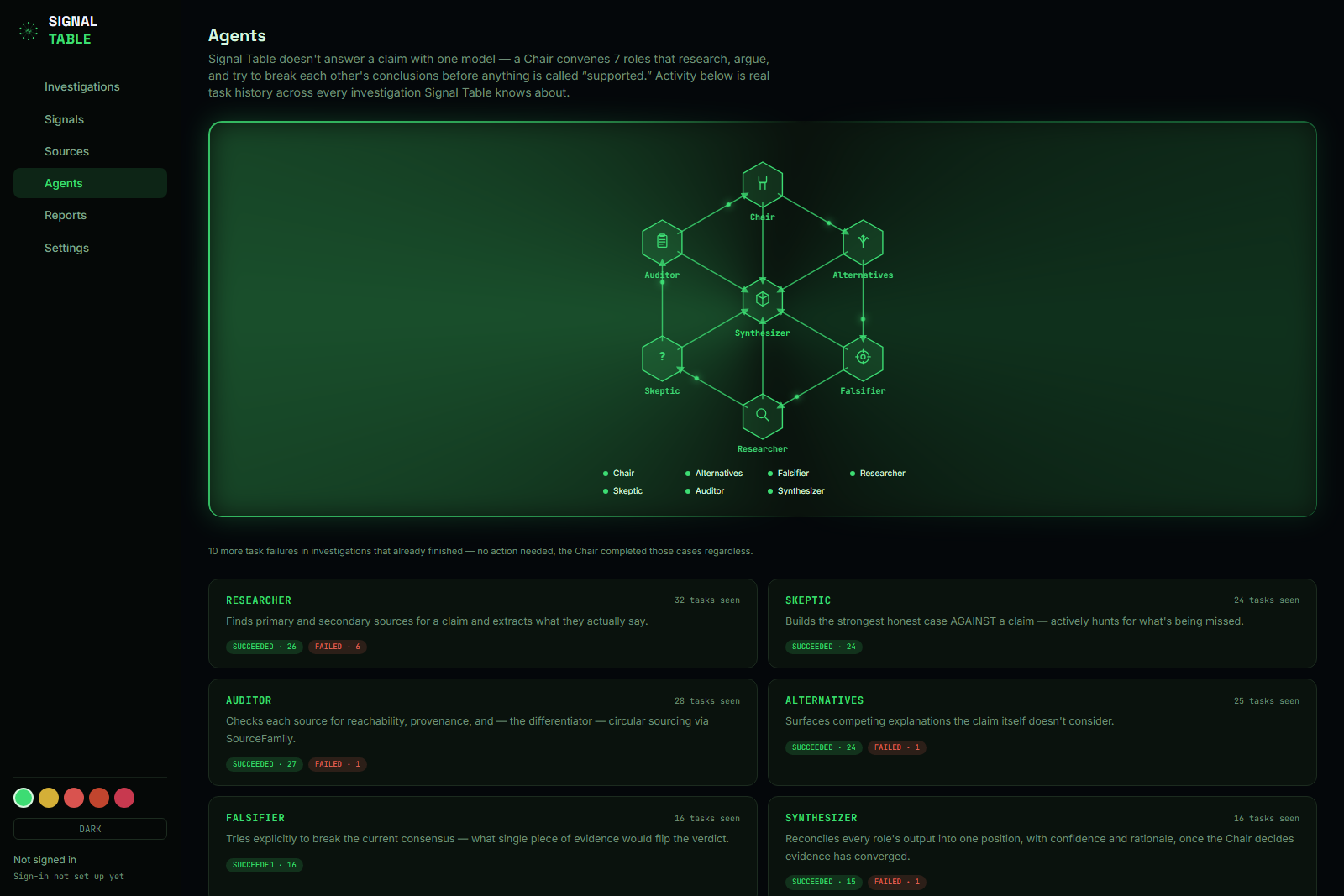
The Chair dynamically dispatches asynchronous work through Pub/Sub:
- Researcher gathers sources and evidence.
- Skeptic challenges the leading interpretation.
- Alternatives generates competing hypotheses.
- Auditor checks source quality, provenance, and shared lineage.
- Falsifier actively tests whether the current position could be wrong.
- Synthesizer produces the final cited case file.
- Visual Evidence Researcher inspects user-uploaded images or PDFs and records only directly observable details.
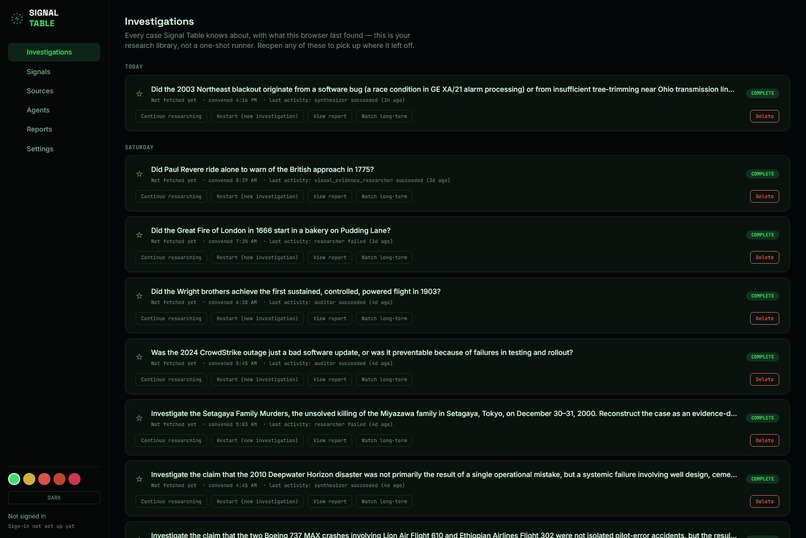
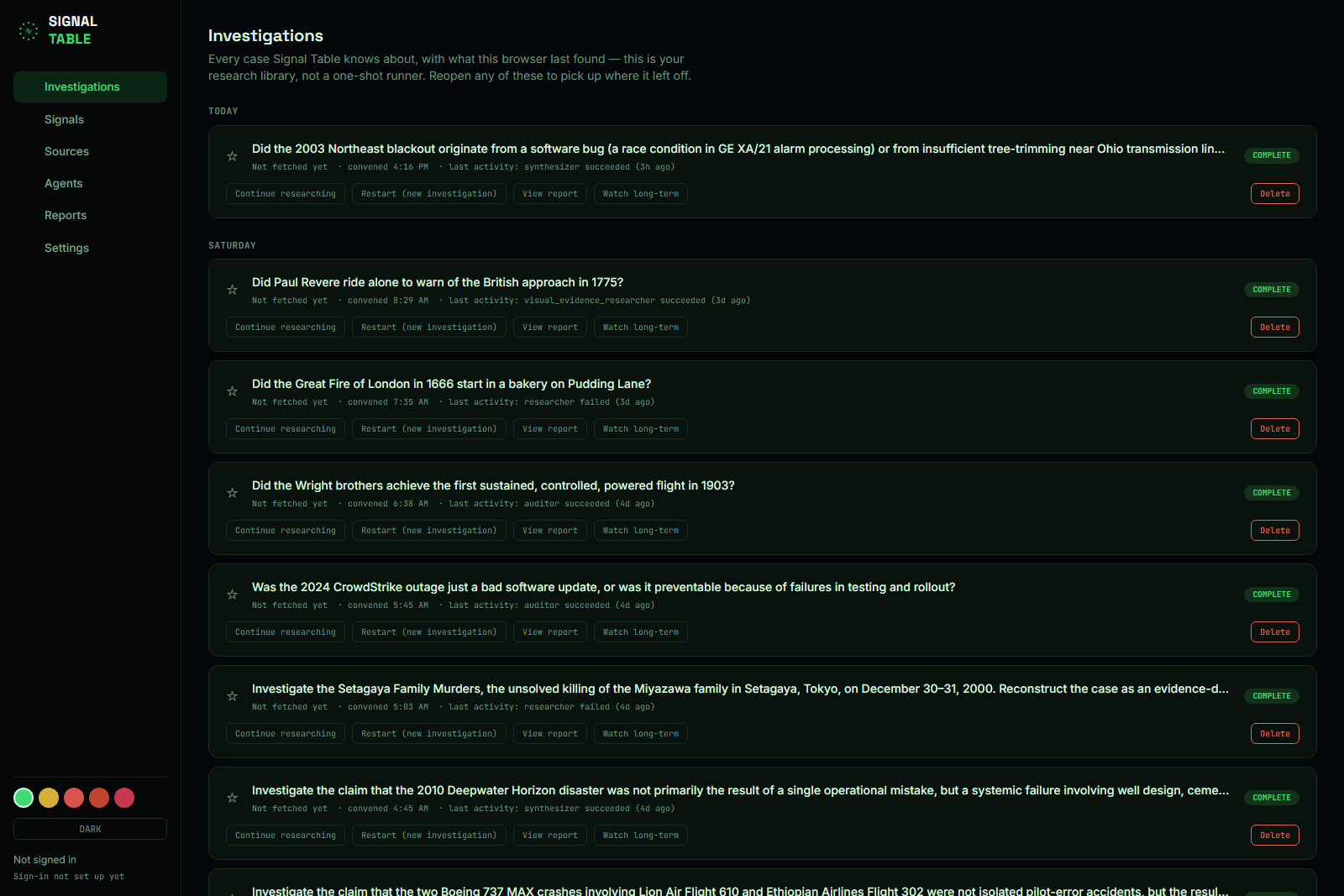
The user remains part of the investigation. They can clarify the question, ask the system to dig deeper, challenge a source, add a new question, suggest a source, or provide evidence-policy feedback. Those interactions become part of the durable research record and can trigger new investigation work.
What the user receives
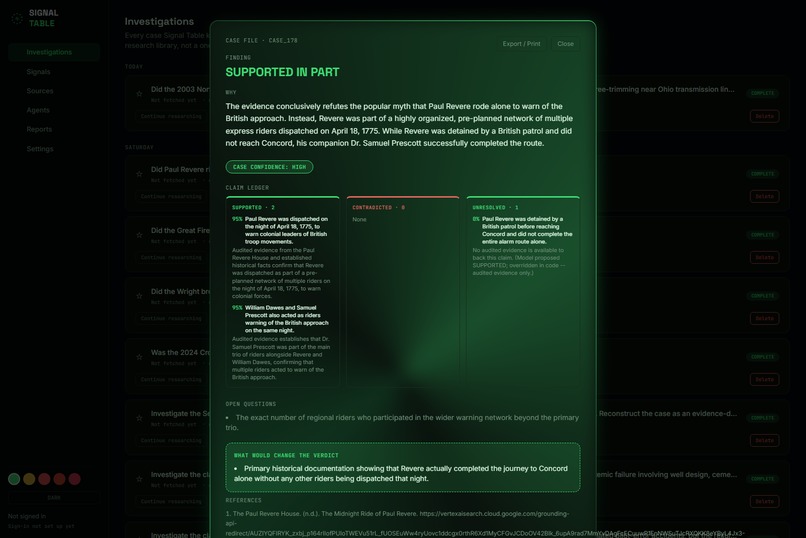
Each investigation becomes a structured Research Case File containing:
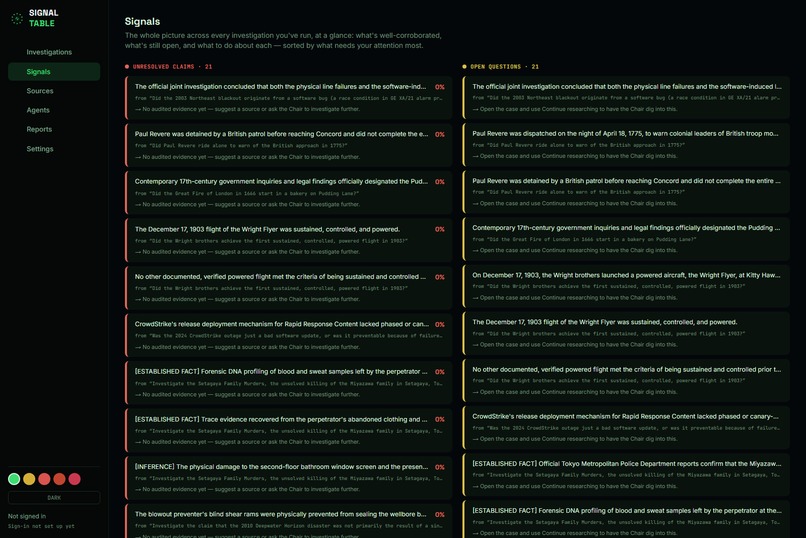
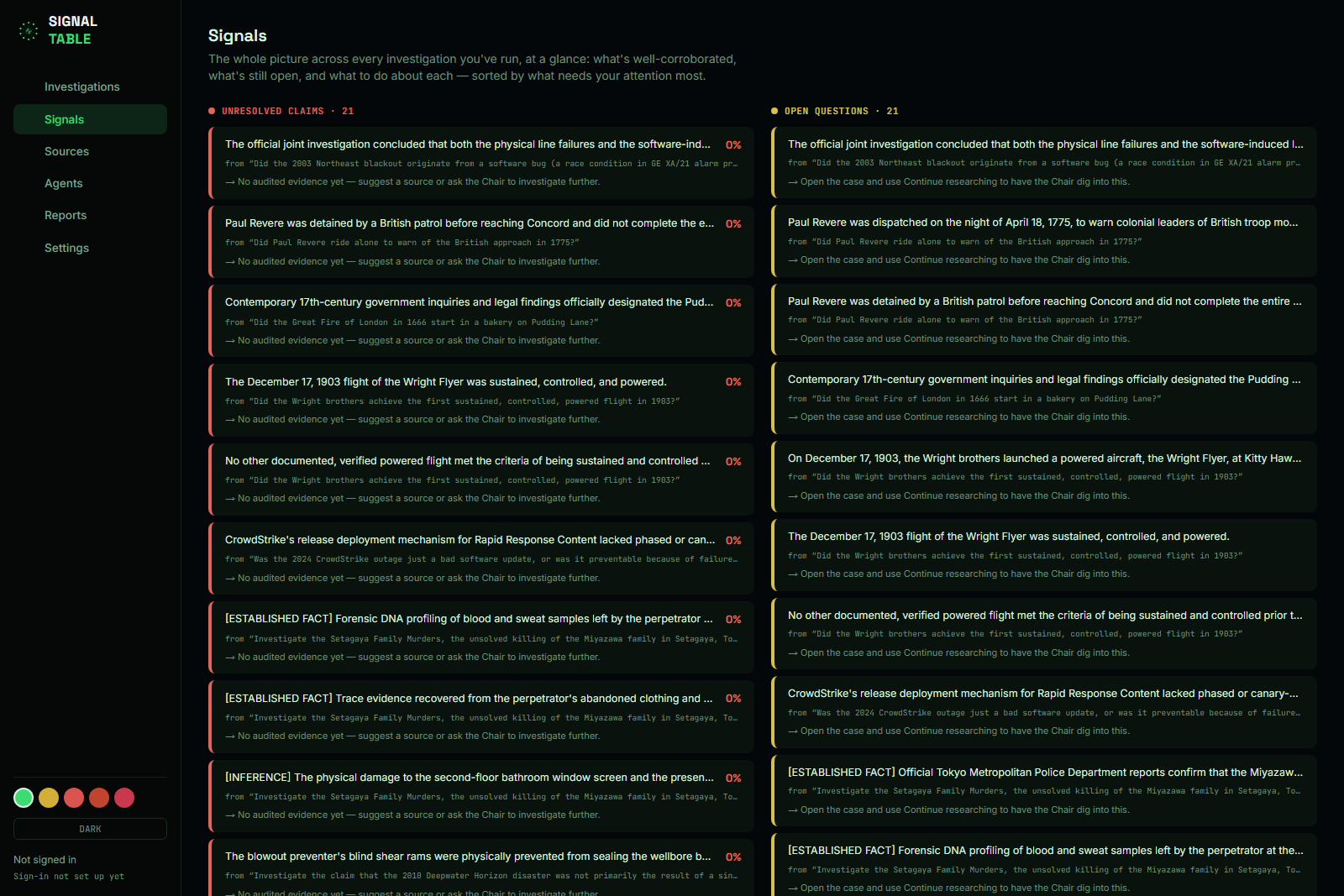
- supported, contradicted, and unresolved claims;
- confidence revisions and their reasons;
- source-family lineage to identify circular reporting;
- audited and unaudited evidence distinctions;
- contradictions and competing hypotheses;
- open questions and recommended follow-up work;
- an evidence graph;
- a final cited position with explicit limitations.
User-uploaded visual material is stored privately in Google Cloud Storage and processed through the same asynchronous task pipeline. Visual observations never become accepted evidence automatically.
Architecture
Firestore is the durable source of truth for cases, claims, sources, evidence, tasks, results, feedback, revisions, and event history. Pub/Sub carries bounded task and result messages between the Chair and worker processes. GKE Autopilot runs the API, Chair, and specialized worker Deployments using Workload Identity, restricted containers, default-deny networking, and digest-pinned images from Artifact Registry.
The most important architectural rule is:
Workers propose. Only the Chair commits.
Workers cannot directly write authoritative investigation state. Their outputs are proposed candidates that the Chair validates and reconciles through Firestore transactions. This keeps hallucinated or duplicated worker results from silently corrupting the case record.
The frontend is a Next.js/TypeScript application using the HTTP and SSE API. It shows the investigation progressing live while also allowing the user to reopen durable case history and review previous investigations.
Google technology
Signal Table uses:
- Gemini 3.5 Flash through Vertex AI;
- the official Google GenAI SDK for Go;
- GKE Autopilot;
- Firestore;
- Pub/Sub;
- Artifact Registry;
- Cloud Logging;
- Google Cloud Storage for private visual uploads;
- GKE Workload Identity for service authentication.
Signal Table is designed to help people think with a transparent investigation team rather than accept an unsupported one-shot answer.
Built With
- cloud-logging
- firestore
- gemini-3.5-flash
- gke-autopilot
- go
- google-genai-sdk
- next.js
- pub/sub
- typescript
- vertex-ai


Log in or sign up for Devpost to join the conversation.